VUG vs QQQ: Holdings, Performance, and Which ETF Is Best for 2026?
1. Quick Answer: VUG vs QQQ in 2026
For most beginners who want a low-cost, buy-and-hold growth ETF, VUG is usually the simpler core choice because it is cheaper, broader, and less tied to the Nasdaq-100 rulebook. For investors who specifically want a stronger Nasdaq-100 innovation tilt and can tolerate sharper ups and downs, QQQ can be the more aggressive growth choice. Neither ETF is automatically “best” for everyone. The better ETF depends on your goal, time horizon, risk tolerance, and what you already own.
In plain English: VUG is like buying a large basket of U.S. growth stocks. QQQ is like buying a more concentrated basket of the largest non-financial companies listed on Nasdaq, with a heavy tilt toward technology and innovation leaders.
| Best fit | VUG | QQQ |
|---|---|---|
| Beginner long-term investor | Often better as a simple growth tilt | Useful, but more concentrated and volatile |
| Lowest annual fee | 0.03% expense ratio | 0.18% expense ratio |
| Nasdaq-100 exposure | No; tracks the CRSP US Large Cap Growth Index | Yes; tracks the Nasdaq-100 Index |
| Number of holdings | About 159 holdings (holdings change over time) | 104 holdings as of July 10, 2026 |
| Main appeal | Low cost and broad large-growth exposure | Liquidity, brand recognition, and Nasdaq-100 exposure |
| Main risk | Still growth-heavy and mega-cap-heavy | More index-concentrated and sector-sensitive |
2. Understanding the Two ETFs
2.1 What Is VUG?
VUG is the Vanguard Growth ETF. It aims to track the CRSP US Large Cap Growth Index, which means it holds large U.S. companies that screen as “growth” stocks. Growth companies are usually firms expected to increase sales, earnings, cash flow, or market share faster than the average company.
A beginner can think of VUG as a one-click way to own many big U.S. growth companies instead of trying to pick winners one by one. It does not guarantee better returns, but it spreads your money across a group of companies rather than depending on a single stock.
2.2 What Is QQQ?
QQQ is the Invesco QQQ ETF. It tracks the Nasdaq-100 Index, which includes 100 of the largest non-financial companies listed on the Nasdaq exchange. That is why QQQ is often associated with technology, cloud computing, artificial intelligence, semiconductors, digital advertising, e-commerce, and other innovation themes.
QQQ is not a pure technology ETF, but technology and tech-adjacent companies have historically had a large influence on its returns. It is also one of the most actively traded ETFs in the U.S., which is one reason traders and institutions use it often.
2.3 How These ETFs Actually Work
Both VUG and QQQ are exchange-traded funds. An ETF is a fund that trades on the stock market like a stock, but inside the fund is a basket of companies. When you buy one share of VUG or QQQ, you are buying fractional exposure to all the companies inside that ETF.
- You can buy or sell ETF shares during market hours through a brokerage account.
- The ETF provider charges an annual expense ratio, taken from fund assets rather than billed separately.
- The ETF price moves during the day as the market value of the holdings changes.
- Both funds are passive index funds, meaning they try to follow an index rather than have a manager pick stocks freely.
- You may receive dividends, but these ETFs are mainly used for growth exposure, not high income.
3. VUG vs QQQ: Side-by-Side Comparison
| Feature | VUG | QQQ | Why it matters |
|---|---|---|---|
| Issuer | Vanguard | Invesco | Issuer affects fund structure, resources, and investor experience. |
| Index tracked | CRSP US Large Cap Growth Index | Nasdaq-100 Index | This is the biggest difference. VUG is a style fund; QQQ is Nasdaq-100 based. |
| Expense ratio | 0.03% | 0.18% | Lower fees leave more return in the investor’s pocket over long periods. |
| Holdings | About 159 | 104 as of July 10, 2026 | More holdings can reduce single-company concentration, though both are mega-cap heavy. |
| Top-10 concentration | 64.62% in the source data used for this article | Changes daily; check the current issuer page | Concentration shows how much the biggest names drive performance. |
| Typical use | Long-term growth sleeve | Aggressive growth or Nasdaq-100 sleeve | Both can fit a portfolio, but the role should be clear. |
| Main beginner mistake | Assuming cheaper means risk-free | Assuming famous tech winners always keep winning | Both are equity ETFs and can lose money. |
4. Holdings: What Do You Really Own?
Holdings matter more than the ETF name. Many investors compare VUG vs QQQ only by past returns, but the smarter question is: “What companies am I actually buying, and how much of my money is going into the biggest ones?”
4.1 VUG Top Holdings
| Company | Ticker | Approx. portfolio weight |
|---|---|---|
| NVIDIA | NVDA | 13.10% |
| Apple | AAPL | 12.31% |
| Microsoft | MSFT | 8.99% |
| Alphabet Class A | GOOGL | 5.95% |
| Broadcom | AVGO | 5.16% |
| Amazon | AMZN | 4.85% |
| Alphabet Class C | GOOG | 4.68% |
| Meta Platforms | META | 3.73% |
| Tesla | TSLA | 3.31% |
| Eli Lilly | LLY | 2.53% |
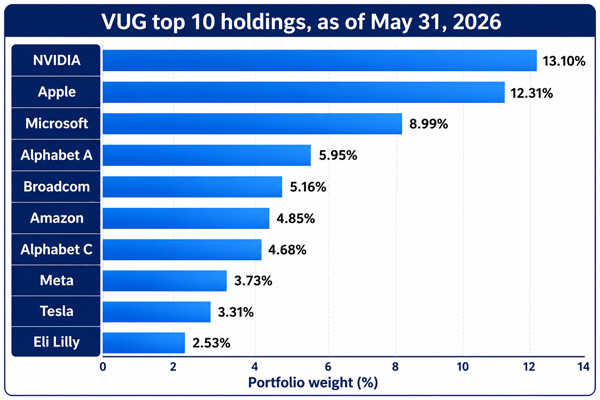
Figure 1. VUG top holdings in the source data used for this article (July, 2026). Holdings and weights change over time.
The practical takeaway: VUG is broader than QQQ by holding count, but it is still heavily influenced by mega-cap growth stocks. If NVIDIA, Apple, Microsoft, Alphabet, Broadcom, Amazon, Meta, and Tesla struggle at the same time, VUG will likely feel it.
4.2 QQQ Top Holdings
| Company | Approx. portfolio weight |
|---|---|
| NVIDIA | 8.01% |
| Apple | 7.26% |
| Micron Technology | 4.78% |
| Microsoft | 4.49% |
| Amazon | Approximately 4% |
The practical takeaway: QQQ gives you targeted Nasdaq-100 exposure. It can benefit strongly when Nasdaq-listed mega-cap growth companies lead the market, but it can also lag when value stocks, small caps, financials, energy, or defensive sectors lead. QQQ holdings are disclosed frequently and can change, so current weights should be checked on the issuer’s website.
5. Performance: Which Has Done Better?
Past performance is useful context, but it should never be treated as a promise. QQQ has a long record of strong returns since its 1999 launch, and Invesco reports that QQQ has often beaten broad equity benchmarks over long periods. For example, Invesco reported QQQ’s 10-year NAV performance at 18.97% versus 14.15% for the S&P 500 as of March 31, 2026.
Recent return data can change quickly. The key lesson is not simply “buy the one that recently won.” The real lesson is that QQQ tends to be more sensitive to Nasdaq leadership, while VUG behaves more like a broad U.S. large-growth allocation.
| Period/context | VUG lesson | QQQ lesson |
|---|---|---|
| Bull markets led by mega-cap tech | Can perform very well because it owns many of the same leaders | May outperform if Nasdaq-100 leaders dominate |
| Markets led by value, financials, energy, or small caps | May lag broad-market ETFs but could hold up better than a narrower Nasdaq bet | Can lag because it excludes financials and is more growth/innovation-sensitive |
| Sharp tech selloffs | Can fall hard because top holdings are growth-heavy | Can fall harder if Nasdaq names are the center of the selloff |
| Long-term compounding | Very low fee helps buy-and-hold investors | Higher fee can be acceptable if the Nasdaq-100 premium continues, but it is not guaranteed |
6. Cost Comparison: Why the Expense Ratio Matters
The expense ratio is the annual cost of owning the ETF. VUG’s expense ratio is 0.03%, while QQQ’s is 0.18%. That means VUG costs about 15 cents less per year for every $100 invested. That sounds tiny, but on large balances and long time periods, fees compound.
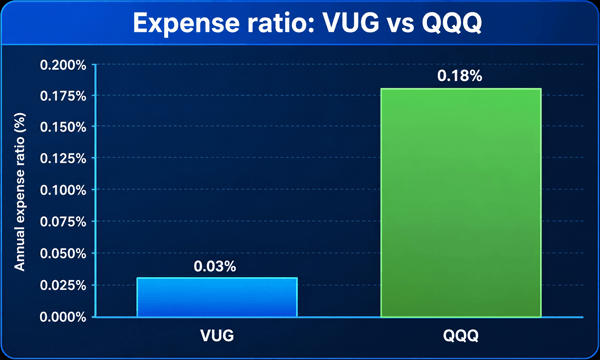
Figure 2. Annual expense-ratio comparison: VUG 0.03% and QQQ 0.18%.
| Investment amount | Annual cost at 0.03% VUG | Annual cost at 0.18% QQQ | Difference per year |
|---|---|---|---|
| $10,000 | $3 | $18 | $15 |
| $50,000 | $15 | $90 | $75 |
| $100,000 | $30 | $180 | $150 |
| $250,000 | $75 | $450 | $375 |
This does not mean VUG will always beat QQQ. A higher-fee fund can outperform if its holdings perform much better. But the fee difference is a guaranteed drag, while outperformance is never guaranteed. That is why cost matters so much for long-term ETF investing.
7. Risk: What Beginners Should Know Before Buying
The biggest risk is not choosing the “wrong” ETF. The biggest risk is buying a growth ETF without understanding how it can behave in a bad market.
- Both ETFs can decline sharply during bear markets, recessions, interest-rate shocks, or technology selloffs.
- Both are heavily influenced by a small group of mega-cap companies, even though they hold many stocks.
- QQQ is more focused on Nasdaq-100 companies, which can mean greater volatility than a broader stock fund.
- VUG is cheaper and broader, but it is still a growth ETF, not a full-market portfolio.
- Neither fund should be judged only by one-year returns, social media hype, or a chart that starts at a lucky date.
8. People’s Real-World Experience: What Investors Often Notice
Long-term investors often like VUG because it feels easy to hold: low fee, familiar Vanguard brand, and broad growth exposure. Many use it as a growth tilt next to a core fund like VTI, VOO, or a target-date fund. The common complaint is that VUG can still feel very concentrated when mega-cap technology stocks dominate the portfolio.
QQQ investors often like the fund because it is simple, liquid, and easy to understand: it is a bet on the Nasdaq-100 and many of the world’s most recognized innovation companies. Traders also like its liquidity. The common complaint is that QQQ can feel painful during tech-led selloffs, and some long-term investors question whether QQQM, a lower-cost Invesco Nasdaq-100 ETF, may be more efficient for buy-and-hold accounts.
A practical investor takeaway: Do not buy either ETF because someone online said it is “the best.” Buy it only after you understand what it owns, how much it costs, how it fits with the rest of your portfolio, and how you would react if it fell 25% to 35%.
9. Practical Examples: How a Beginner Could Use VUG or QQQ
9.1 Example 1: The Simple Long-Term Investor
Maya is 30, invests monthly, and already owns a broad U.S. stock market ETF. She wants extra exposure to large growth companies but does not want to trade. VUG may fit better because it is very low cost and broader than QQQ. She might use VUG as 10% to 20% of her stock allocation, not her entire portfolio.
9.2 Example 2: The Aggressive Growth Investor
Daniel believes Nasdaq-100 companies will continue to lead in AI, cloud computing, semiconductors, and digital platforms. He accepts higher volatility and understands the fund can underperform for years. QQQ may fit as a satellite holding, but he should avoid putting all his money into one growth theme.
9.3 Example 3: The Retirement Account Investor
Sara invests in a Roth IRA and wants long-term growth. She compares VUG, QQQ, and QQQM. Because taxes are not an annual concern inside the Roth IRA, she focuses on fees, diversification, and her willingness to handle volatility. She may choose VUG for a lower-cost large-growth tilt or QQQ/QQQM for a targeted Nasdaq tilt.
10. Which ETF Is Best for 2026?
The honest answer: VUG is the better default for many beginners; QQQ is the better choice for investors who deliberately want Nasdaq-100 exposure. In 2026, the decision mainly comes down to whether you want broad large-cap growth at the lowest cost or a more concentrated innovation-focused index with exceptional liquidity.
| Choose VUG if... | Choose QQQ if... |
|---|---|
| You want a low-cost growth ETF for long-term holding. | You specifically want Nasdaq-100 exposure. |
| You prefer broader large-growth diversification. | You are comfortable with higher concentration and volatility. |
| You do not care about active trading volume as much as cost. | You value high liquidity and the options/trading ecosystem. |
| You want a growth sleeve next to VTI, VOO, or a diversified portfolio. | You want a satellite position tied to technology and innovation themes. |
| You want the lower guaranteed fee drag. | You believe the Nasdaq-100 structure can justify the higher fee. |
11. Beginner Checklist Before Buying Either ETF
- Check the latest expense ratio, holdings, and performance on the official issuer website.
- Look at the top 10 holdings and ask: “Do I already own these through another ETF?”
- Decide the role: core holding, growth tilt, or satellite position.
- Avoid investing money you may need within the next three to five years.
- Use limit orders if trading during volatile markets, especially near the open or close.
- Rebalance once or twice per year instead of constantly reacting to headlines.
- Remember that high past returns often create higher expectations, not guaranteed future returns.
12. Common Mistakes to Avoid
| Mistake | Why it hurts | Better practice |
|---|---|---|
| Buying only because of past returns | You may be chasing a cycle after the easy money has already happened. | Understand holdings, valuation risk, fees, and your time horizon. |
| Thinking QQQ equals the whole technology sector | QQQ tracks the Nasdaq-100, not every technology company. | Read the index methodology and sector allocation. |
| Using VUG as a full portfolio | VUG is growth-heavy and does not cover every part of the market. | Pair growth exposure with broad market, international, bonds, or cash as appropriate. |
| Ignoring overlap | Many investors already own the same mega-cap stocks in VOO, VTI, or target-date funds. | Use an ETF overlap tool before adding more. |
| Panic-selling after a decline | Growth ETFs can be volatile; selling low can lock in losses. | Predefine position size and rebalancing rules before buying. |
13. Frequently Asked Questions
13.1 Is VUG better than QQQ?
VUG may be better for beginners who want cheaper and broader large-growth exposure. QQQ may be better for investors who specifically want Nasdaq-100 exposure and accept more concentration.
13.2 Is QQQ riskier than VUG?
Usually, QQQ can be more concentrated by index design and more sensitive to Nasdaq leadership. VUG is broader by holding count, but both can be volatile because both own many growth and mega-cap companies.
13.3 Can I own both VUG and QQQ?
Yes, but many holdings overlap. Owning both can increase exposure to the same mega-cap growth stocks rather than truly diversifying your portfolio.
13.4 Is VUG good for long-term investing?
VUG can be a useful long-term growth ETF for investors who understand equity risk and want a low-cost growth tilt. It should still be sized appropriately within a diversified portfolio.
13.5 Is QQQ good for beginners?
QQQ is easy to buy but not automatically easy to hold. Beginners should understand that it is a Nasdaq-100 ETF with growth and technology sensitivity.
13.6 What is the cheaper alternative to QQQ?
QQQM is Invesco’s lower-cost Nasdaq-100 ETF designed more for buy-and-hold investors. This article focuses on VUG vs QQQ, but QQQM is worth comparing before investing for the long term.
13.7 Does either ETF pay dividends?
Both may distribute dividends, but they are primarily growth ETFs. Investors looking for income usually compare dividend ETFs or bond funds instead.
13.8 What is the best ETF for 2026?
There is no single best ETF for every investor. The best ETF is the one that fits your goals, risk tolerance, time horizon, tax situation, and overall portfolio.
14. Final Verdict
VUG vs QQQ is not really a fight between “good” and “bad.” It is a choice between two different types of growth exposure. VUG is the cleaner beginner-friendly option for low-cost large-growth exposure. QQQ is the more targeted Nasdaq-100 option for investors who want a stronger innovation tilt and are willing to accept the risks that come with it.
A simple rule: Choose VUG if you want broad, low-cost growth exposure; choose QQQ if you specifically want Nasdaq-100 exposure; choose neither as your entire plan unless it truly matches your full risk profile and financial goals.
Sources Consulted and Checked
The following sources were consulted while preparing this article and checking its accuracy. Fund data, holdings, fees, index rules, and performance figures can change, so readers should review the latest official fund pages and prospectuses before making decisions.
- Vanguard VUG profile
- Vanguard Advisors VUG holdings page
- Invesco QQQ official page
- Invesco QQQ holdings page
- Invesco QQQ performance page
- Nasdaq-100 Index methodology
- Morningstar VUG portfolio page
- Investopedia QQQ overview
Reader Advice
This article is provided only for educational and informational purposes. It is not personalized investment, financial, legal, accounting, or tax advice, and it is not a recommendation or offer to buy or sell any security. Investment decisions should be based on your own objectives, financial circumstances, time horizon, risk tolerance, and independent research. Consider consulting a qualified financial, legal, or tax professional before acting, especially where a decision may materially affect your finances.
ETF holdings, expense ratios, yields, prices, performance figures, index methodologies, tax rules, and regulations may change because of market conditions, issuer decisions, rebalancing, legal developments, or other factors. Past performance does not guarantee future results, and all investments can lose value. Verify current facts and figures through official issuer websites, prospectuses, regulatory filings, and other authoritative sources before making any decision.