VOO vs SPY: Fees, Performance, and Which ETF Is Better
Quick answer: VOO is usually the better choice for long-term buy-and-hold investors because it tracks the same S&P 500 index as SPY but has a lower expense ratio. SPY is still excellent, especially for active traders, institutions, and investors who need very deep liquidity or a large options market. This article explains the difference in plain English, with examples.
1. VOO vs SPY at a glance
| Feature | VOO | SPY | What it means for beginners |
|---|---|---|---|
| Full name | Vanguard S&P 500 ETF | State Street SPDR S&P 500 ETF Trust | Both are S&P 500 ETFs. |
| Ticker | VOO | SPY | The ticker is what you type into your brokerage app. |
| Index tracked | S&P 500 Index | S&P 500 Index | They own essentially the same large U.S. companies. |
| Issuer | Vanguard | State Street Global Advisors | Both are major, established asset managers. |
| Inception | 2010 | 1993 | SPY is older and was the first U.S.-listed ETF. |
| Expense ratio | 0.03% | 0.0945% gross expense ratio | VOO is cheaper for long-term holding. |
| Distribution frequency | Quarterly | Quarterly | Both generally pay dividends quarterly. |
| Best for | Long-term investors, beginners, DCA, retirement accounts | Active traders, options users, very large trades | Most beginners do not need SPY’s trading advantages. |
| Main trade-off | Lower fee, slightly less trading ecosystem than SPY | Higher fee, massive liquidity and options ecosystem | Choose based on how you will actually use the ETF. |
Data notes: VOO’s 0.03% expense ratio was checked against Vanguard’s official fund profile, and SPY’s 0.0945% gross expense ratio was checked against State Street’s official fund page in July 2026. Fund fees, yields, holdings, prices, and performance can change, so readers should verify current information on official issuer pages before making a decision.
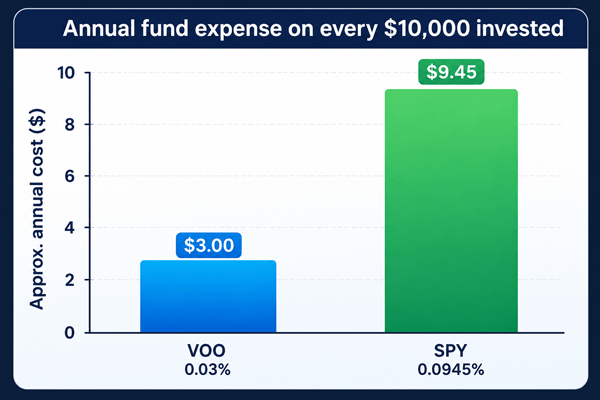
Figure 1. Approximate annual fund expense on each $10,000 invested, based on stated expense ratios.
2. What are VOO and SPY?
VOO and SPY are exchange-traded funds, usually called ETFs. An ETF is a basket of investments that trades on a stock exchange like a single stock. Instead of buying 500 companies one by one, you buy one ETF share and get exposure to the basket inside it.
Both VOO and SPY are designed to track the S&P 500 Index. The S&P 500 is a large-cap U.S. stock market index. In simple words, it follows many of the biggest publicly traded companies in the United States. Because the index is market-cap weighted, bigger companies have a bigger impact on performance than smaller companies.
For a beginner, the most important point is this: VOO and SPY are not two completely different investment ideas. They are two different wrappers around the same core strategy: owning the S&P 500. That is why their long-term performance is usually very close.
2.1 How these ETFs work in real life
When you buy VOO or SPY, you are not buying a promise of fixed income or guaranteed returns. You are buying a fund whose value rises and falls with the stocks inside the S&P 500. If the large U.S. stock market does well, these ETFs generally do well. If the market falls, they can fall too.
The ETF manager handles the complicated part: holding the underlying stocks, adjusting the portfolio when the index changes, collecting dividends, and distributing income to shareholders. You simply see one ticker symbol in your brokerage account.
Example: If you invest $1,000 into VOO, you are not putting all $1,000 into one company. You are spreading that money across the companies in the S&P 500 according to the index weights. That gives instant diversification, but it is still stock market risk. Diversified does not mean risk-free.
3. The simple answer: which one is better?
For most long-term investors, VOO is the more practical choice because it has the lower annual expense ratio. The difference looks tiny, but long-term investors should care about costs because fees come out every year, whether the market is up or down.
SPY can still be the better tool for active traders, professional investors, short-term tactical trades, and options strategies. SPY usually has extremely deep trading volume and a very active options market. Those features matter if you trade frequently. They matter much less if your plan is to buy $100, $500, or $1,000 regularly and hold for years.
A useful rule: If you are asking “Which should I buy for my Roth IRA or long-term brokerage account?”, VOO usually wins. If you are asking “Which ETF should I trade today, hedge with options, or move millions through quickly?”, SPY may justify its higher fee.
4. Fees: the biggest practical difference
VOO’s expense ratio is 0.03%. That means the annual fund operating cost is about $3 per $10,000 invested. SPY’s official gross expense ratio is 0.0945%, or about $9.45 per $10,000 invested. You do not receive a separate bill for this cost. The fund deducts it internally, so your return is shown after expenses.
For a $10,000 position, the difference is about $6.45 per year. That may not sound important. But on a $100,000 portfolio, the difference is about $64.50 per year. Over decades, those dollars also lose the chance to compound. A lower-cost fund does not guarantee higher returns, but when two funds track the same index, lower cost is a real advantage.
This is why many experienced buy-and-hold investors choose the cheapest broad-market index fund that fits their account and trading needs. The fee is one of the few things an investor can control. Market returns are not.
5. Performance: why returns are almost the same
Because both funds track the S&P 500, their performance should be very close over long periods. The small difference mostly comes from expenses, tracking, cash management, dividend handling, and trading details. You should not expect VOO to behave like a growth ETF and SPY to behave like a value ETF. They are trying to follow the same index.
On State Street’s official SPY page, the fund’s market value return as of May 31, 2026 was listed at 11.21% year-to-date, 29.72% for one year, 23.42% annualized for three years, 14.00% annualized for five years, and 15.50% annualized for ten years. These figures are historical and not a promise of future returns.
When comparing performance, do not focus only on one month or one year. A tiny short-term difference can come from the exact time you look, premium/discount to NAV, dividend timing, or market price. For a long-term investor, the more useful question is: which fund gives me the S&P 500 exposure I want with the lowest total cost and least friction?
5.1 Liquidity and bid-ask spread: why SPY is popular with traders
Liquidity means how easily you can buy or sell without moving the price much. SPY is one of the most heavily traded ETFs in the world. That is a major reason traders like it. A tight bid-ask spread can matter when you trade large amounts or trade often.
The bid is what buyers are willing to pay. The ask is what sellers want. The difference is the bid-ask spread. If an ETF has a bid of $100.00 and an ask of $100.02, the spread is $0.02. For a small long-term investor, this cost is usually minor. For active traders, it matters more.
VOO is also highly liquid for ordinary investors. Most beginners should not choose SPY only because it has more trading volume. If you buy and hold, the annual fee difference can matter more than an ultra-small trading advantage you may never use.
5.2 Dividends: what beginners should know
Both VOO and SPY hold dividend-paying companies, so both can distribute dividends to shareholders. Dividend yield changes over time because stock prices, company dividends, and index composition change. Do not choose one only because today’s yield is slightly different.
If you are investing for long-term growth, dividend reinvestment can be powerful. Many brokerages let you automatically reinvest ETF dividends into more shares or fractional shares. This can help your money stay invested without manual action.
In a taxable brokerage account, dividends may create taxes even if you reinvest them. In a retirement account like a Roth IRA, tax treatment may be different. Tax rules depend on your situation, so readers should check with a qualified tax professional rather than relying on a generic article.
5.3 Taxes: VOO vs SPY in a taxable account
Both are ETFs, and ETFs are often tax-efficient compared with many mutual funds because of the ETF creation/redemption structure. But tax efficiency does not mean tax-free. You can still owe taxes on dividends and realized capital gains when you sell at a profit.
For a buy-and-hold investor, the bigger tax mistake is often behavior, not the ETF choice. Selling during panic, switching funds too often, or chasing last year’s winner can create taxes and reduce long-term returns. A simple fund held patiently can be more tax-efficient than a perfect fund traded emotionally.
If you already own SPY with large unrealized gains in a taxable account, switching to VOO just to save 0.0645% per year may not be worth triggering capital gains taxes. In that case, a practical compromise is to keep existing SPY shares and direct new contributions to VOO if it fits your plan.
5.4 Risk: what can go wrong?
The biggest risk is market risk. VOO and SPY can lose money when U.S. stocks fall. In a major bear market, a broad S&P 500 ETF can decline sharply. You should not invest money you need for rent, emergency savings, near-term tuition, or a home down payment if you cannot tolerate a market drop.
The second risk is concentration. The S&P 500 is diversified across many companies and sectors, but it is market-cap weighted. When a few mega-cap companies become very large, they can dominate returns. That can help when those companies perform well and hurt when they struggle.
The third risk is behavior. Many beginners buy after strong returns and sell after scary headlines. The ETF is simple; staying disciplined is hard. A realistic investment plan should include an emergency fund, time horizon, risk tolerance, and a rule for what you will do during a 20%, 30%, or 40% market decline.
6. How beginners can use VOO or SPY
The simplest use is as a core U.S. stock holding. A beginner might use VOO as the main U.S. stock portion of a long-term portfolio and pair it with bonds, cash, or international funds depending on goals and risk tolerance. SPY can serve the same role, but at a higher expense ratio.
Practical example: Sara is 28 and invests $300 per month in a Roth IRA. She wants simple exposure to large U.S. companies and does not plan to trade. VOO is likely the cleaner choice because it is cheaper and does what she needs. She can set recurring investments if her brokerage supports fractional ETF purchases.
Another example: Daniel is an experienced trader using S&P 500 options for short-term hedging. He cares about options liquidity, tight spreads, and fast execution. SPY may be the better trading instrument even though the expense ratio is higher, because his use case is not simple long-term holding.
7. Step-by-step: how to choose between VOO and SPY
First, identify your goal. If the goal is long-term wealth building with broad U.S. stock exposure, start with the lower-cost option. If the goal is frequent trading or options, liquidity may deserve more weight.
Second, check your account type. In a retirement account, switching between similar ETFs may not create current taxable capital gains. In a taxable account, selling one fund to buy another may create taxes. Existing holdings matter.
Third, check your brokerage features. Some brokerages support recurring ETF purchases and fractional shares. Others may make recurring investing easier with mutual funds. The best ETF is not useful if your actual investing process becomes inconsistent.
Fourth, use limit orders when buying ETFs, especially during volatile markets. A limit order lets you set the highest price you are willing to pay. Avoid trading right at market open or close if you are a beginner, because spreads and volatility can sometimes be wider.
8. Common beginner mistakes to avoid
Mistake 1: Thinking SPY is automatically better because it is more famous. SPY is famous for good reasons, but fame is not the same as best fit. For long-term investors, the lower-fee fund often makes more sense.
Mistake 2: Ignoring account taxes. A fund switch that saves a few dollars in annual expense can be a bad deal if it triggers a large tax bill.
Mistake 3: Watching daily returns too closely. These ETFs are designed for market exposure, not guaranteed daily gains. A red day does not mean the strategy is broken.
Mistake 4: Putting all money into stocks without an emergency fund. An S&P 500 ETF is not a savings account. Keep short-term money in safer, liquid places.
Mistake 5: Chasing “best ETF” articles without a personal plan. VOO may be better for most buy-and-hold investors, but your time horizon, taxes, job stability, and emotional tolerance still matter.
9. VOO vs SPY: detailed decision table
| Your situation | Better fit | Why |
|---|---|---|
| You invest monthly and hold for decades | VOO | Lower expense ratio; no need to pay more for trading features. |
| You are building a Roth IRA portfolio | VOO | Simple, low-cost S&P 500 exposure. |
| You use options often | SPY | SPY’s options market is usually deeper and more active. |
| You trade very large dollar amounts | SPY may be better | Liquidity and spread may matter more than the annual fee. |
| You already own SPY in a taxable account with big gains | Maybe keep SPY | Selling may create taxes that outweigh fee savings. |
| You want the “best ETF for beginners” between these two | VOO | Same core exposure with lower ongoing cost. |
| Your brokerage offers only one of them for automated purchases | Use the available one if costs are acceptable | Consistency can matter more than a tiny optimization. |
| You are investing money needed within 1-3 years | Neither may be appropriate | Stocks can fall sharply over short periods. |
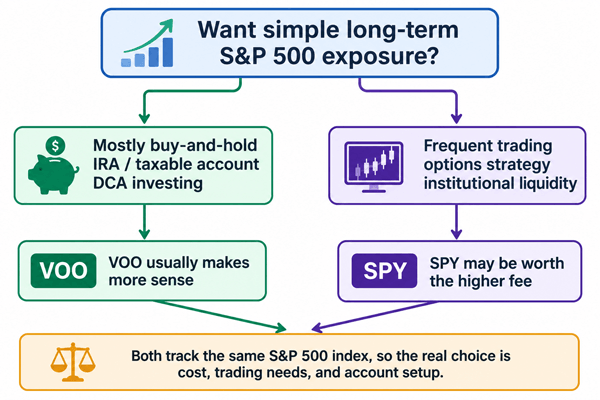
Figure 2. Decision guide comparing the typical long-term-investor use case for VOO with the active-trading use case for SPY.
10. Real-world cost examples
Example 1: $10,000 invested. VOO costs about $3 per year. SPY costs about $9.45 per year. Difference: about $6.45 per year.
Example 2: $100,000 invested. VOO costs about $30 per year. SPY costs about $94.50 per year. Difference: about $64.50 per year.
Example 3: $500,000 invested. VOO costs about $150 per year. SPY costs about $472.50 per year. Difference: about $322.50 per year. At larger balances, small percentages stop feeling small.
These examples are approximate and focus only on fund expense ratios. They do not include taxes, bid-ask spreads, brokerage fees, advisory fees, or behavior-related costs such as buying high and selling low.
11. What about IVV, SPLG, mutual funds, and total market funds?
Many readers comparing VOO vs SPY will also see IVV, SPLG, FXAIX, VFIAX, and total market ETFs like VTI. This article focuses on VOO and SPY, but the broader lesson is simple: when funds track nearly the same index, cost, taxes, trading features, and account convenience become the deciding factors.
VOO is not the only low-cost S&P 500 ETF. SPY is not the only liquid S&P 500 ETF. A reader should not feel forced into one ticker because a headline says it is “best.” The right choice is the one that matches the job.
Total U.S. stock market funds can include smaller companies outside the S&P 500. That gives broader U.S. exposure, but the return pattern is often still heavily influenced by large U.S. companies. Beginners should understand the difference before choosing between an S&P 500 fund and a total market fund.
12. FAQ: VOO vs SPY
12.1 Is VOO better than SPY?
For most long-term buy-and-hold investors, VOO is usually better because it tracks the same S&P 500 index at a lower expense ratio. SPY may be better for active traders and options users.
12.2 Do VOO and SPY hold the same stocks?
They both aim to track the S&P 500, so their holdings are very similar. Exact holdings, cash positions, and timing can vary slightly.
12.3 Why is SPY more expensive?
SPY is an older ETF with a different structure and a huge trading ecosystem. Many investors pay the higher fee because they value its liquidity and options market.
12.4 Can beginners buy VOO?
Yes, if it fits their goals and risk tolerance. Beginners should understand that VOO is a stock ETF, not a savings account, and it can lose money.
12.5 Should I sell SPY and buy VOO?
Not automatically. In a taxable account, selling SPY may trigger capital gains tax. Compare the tax cost with the future fee savings. In retirement accounts, the decision may be easier, but it still depends on your plan.
12.6 Which is better for a Roth IRA?
VOO is usually the more practical choice for a Roth IRA if the investor wants simple, low-cost S&P 500 exposure and does not need SPY’s trading features.
12.7 Is SPY safer than VOO?
No. They track the same market segment, so their market risk is very similar. SPY’s liquidity does not remove stock market risk.
12.8 Are VOO and SPY good for short-term investing?
They are generally better suited for long-term stock exposure. Money needed soon should usually be kept in safer, more stable assets.
12.9 Do I need both VOO and SPY?
Usually no. Holding both creates overlap because they track the same index. Most investors can choose one.
12.10 What is the main takeaway?
VOO vs SPY is mostly a cost-versus-liquidity decision: VOO for lower-cost long-term investing, SPY for active trading and options liquidity.
Final verdict: If you are a beginner building long-term wealth and want one simple S&P 500 ETF, VOO is usually the better fit because it offers the same basic market exposure at a lower annual cost. SPY is not a bad ETF. It is one of the most important ETFs ever created. But its strongest advantages are trading liquidity and options depth, not lower long-term cost. Choose the tool that matches your actual use case.
Reader Advice
This article is provided solely for educational and informational purposes and does not constitute individualized investment, tax, legal, accounting, or financial advice. It does not consider any reader’s objectives, financial circumstances, risk tolerance, tax position, or time horizon. ETF prices, fees, holdings, yields, performance, tax treatment, brokerage features, and applicable rules may change because of market conditions, issuer decisions, laws, regulations, and other factors.
Before acting or making any investment decision, readers should verify current facts and figures through official issuer pages, prospectuses, regulatory sources, and their brokerage, and should consider obtaining advice from appropriately qualified financial, tax, or legal professionals. Past performance does not guarantee future results. All investing involves risk, including market volatility and the possible loss of principal.
Sources Consulted and Checked
These authoritative sources were consulted and checked when preparing this article and reviewing its accuracy. Readers should re-check the latest official fund pages and prospectuses because fees, holdings, yields, performance, and regulatory guidance can change.
- Vanguard VOO official profile: https://investor.vanguard.com/investment-products/etfs/profile/voo
- Vanguard explanation of expense ratios: https://investor.vanguard.com/investor-resources-education/education/expense-ratio
- State Street SPY official fund page: https://www.ssga.com/us/en/intermediary/etfs/state-street-spdr-sp-500-etf-trust-spy
- SEC Investor.gov ETF bulletin: https://www.investor.gov/introduction-investing/general-resources/news-alerts/alerts-bulletins/updated-investor-bulletin-exchange-traded-funds-etfs
- FINRA overview of exchange-traded funds and products: https://www.finra.org/investors/investing/investment-products/exchange-traded-funds-and-products