VTI vs VOO: Key Differences, Returns, and Which ETF to Buy
1. Quick Answer: VTI vs VOO
VTI and VOO are both low-cost Vanguard ETFs that give investors broad exposure to U.S. stocks. The simple difference is this: VTI tries to own nearly the whole U.S. stock market, while VOO owns the companies in the S&P 500. In everyday language, VTI is the wider basket; VOO is the basket of America’s biggest public companies.
For most long-term beginners, the decision is less about finding the “perfect” fund and more about choosing a simple fund they can hold through market ups and downs. VTI is usually the more complete one-fund U.S. stock choice because it includes large, mid, small, and micro-cap companies. VOO is often preferred by investors who want the familiar S&P 500 benchmark, strong large-company exposure, and a fund that is easy to understand.
| Best fit | Pick VTI if... | Pick VOO if... |
|---|---|---|
| Diversification | You want exposure to the total U.S. stock market, including smaller companies. | You mainly want the 500 largest U.S. companies. |
| Simplicity | You want one U.S. stock ETF and do not want to add small-cap funds later. | You want a classic S&P 500 ETF that tracks the market benchmark people quote on the news. |
| Risk style | You are comfortable with slightly more small- and mid-cap exposure. | You prefer a portfolio dominated by large, established companies. |
| Long-term use | Great core holding for retirement accounts and taxable brokerage accounts. | Great core holding for investors who believe the S&P 500 is enough U.S. exposure. |
2. What Is VTI?
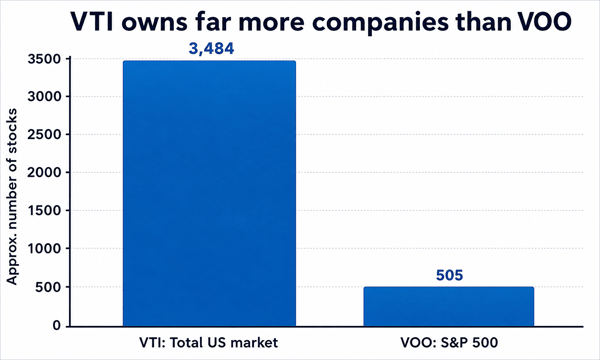
VTI is the Vanguard Total Stock Market ETF. It is designed to track the CRSP US Total Market Index, which means it aims to represent the broad U.S. stock market rather than only the biggest companies. As of the latest Vanguard information reviewed for this article, VTI held about 3,484 stocks and had a 0.03% expense ratio.
Think of VTI as buying a tiny piece of thousands of U.S. public companies in one trade. You are not trying to guess which company will win. You are buying the market and accepting the market’s return, minus a very small annual fee.
| VTI fact | Details |
|---|---|
| Full name | Vanguard Total Stock Market ETF |
| Ticker | VTI |
| Index | CRSP US Total Market Index |
| Expense ratio | 0.03% |
| Approx. holdings | 3,484 stocks as of May 31, 2026 |
| Inception | May 24, 2001 |
| Main use | Broad U.S. stock market core holding |
3. What Is VOO?
VOO is the Vanguard S&P 500 ETF. It tracks the S&P 500 Index, a benchmark made up of large U.S. companies. As of the latest Vanguard information reviewed for this article, VOO held about 505 stocks and had a 0.03% expense ratio.
Think of VOO as buying the large-company engine of the U.S. stock market. It owns companies such as major technology, health care, financial, industrial, consumer, and communication-services businesses. It does not try to cover every publicly traded U.S. company. It focuses on the largest and most influential ones.
| VOO fact | Details |
|---|---|
| Full name | Vanguard S&P 500 ETF |
| Ticker | VOO |
| Index | S&P 500 Index |
| Expense ratio | 0.03% |
| Approx. holdings | 505 stocks as of May 31, 2026 |
| Inception | September 7, 2010 |
| Main use | Large-cap U.S. stock core holding |
4. How ETFs Work in Plain English
An exchange-traded fund, or ETF, pools money from many investors and uses that money to buy a portfolio of securities. ETF shares trade on an exchange during the trading day, similar to a stock. When you buy VTI or VOO, you are not buying one company. You are buying a fund share that represents a slice of a large portfolio.
This matters because a beginner can invest in hundreds or thousands of companies without researching every balance sheet. The trade-off is that you also accept market risk. If the U.S. stock market falls, both VTI and VOO can fall sharply. Diversification reduces company-specific risk, but it does not remove stock-market risk.
Beginner translation
Buying VOO is like saying, “I want the big U.S. companies.” Buying VTI is like saying, “I want the whole U.S. public stock market.”
5. VTI vs VOO: Side-by-Side Comparison
| Category | VTI | VOO | Why it matters |
|---|---|---|---|
| Market coverage | Total U.S. stock market | S&P 500 large-cap stocks | VTI gives broader coverage; VOO is more concentrated in large companies. |
| Number of stocks | About 3,484 | About 505 | More holdings can mean better exposure to smaller companies. |
| Expense ratio | 0.03% | 0.03% | Both are extremely low-cost by industry standards. |
| Current price checked | About $369.99 on June 22, 2026 | About $688.11 on June 22, 2026 | Share price alone does not make one cheaper; expense ratio and valuation matter more. |
| Index | CRSP US Total Market Index | S&P 500 Index | The index determines what the fund owns. |
| Company size tilt | Large, mid, small, and micro-cap | Mostly large-cap | VOO is more mega-cap heavy. |
| Best use | One-fund U.S. stock allocation | Classic S&P 500 exposure | Both can be long-term core ETFs. |
| Overlap | High overlap with VOO | High overlap with VTI | Owning both is usually redundant unless intentional. |
6. Returns: Has VTI or VOO Performed Better?
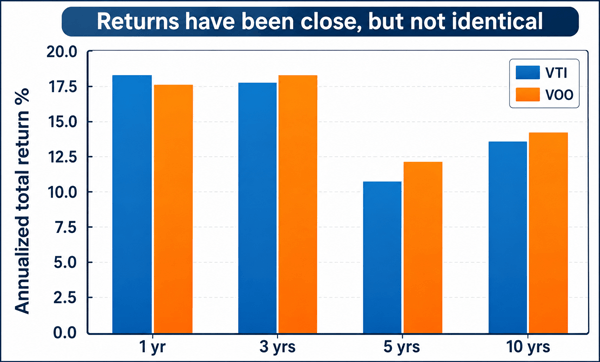
Historically, VTI and VOO have moved very closely because the largest companies dominate both funds. The difference is that VTI includes smaller companies, while VOO does not. In periods when small and mid-sized companies outperform, VTI can get a boost. In periods when mega-cap companies dominate, VOO can lead.
The table below uses Vanguard total return figures for the period ended March 31, 2026. These are historical results, not a forecast.
| Period ended Mar. 31, 2026 | VTI NAV return | VOO NAV return | Observation |
|---|---|---|---|
| 1 year | 18.19% | 17.77% | Very close; VTI slightly ahead. |
| 3 years | 17.86% | 18.28% | VOO slightly ahead. |
| 5 years | 10.78% | 12.02% | VOO ahead during a large-cap-led period. |
| 10 years | 13.68% | 14.12% | VOO slightly ahead. |
6.1 What These Returns Really Mean for Beginners
A common beginner mistake is choosing whichever ETF performed better recently. That sounds logical, but it can lead to performance chasing. The better question is: “Which fund matches the exposure I want to hold for the next 10, 20, or 30 years?”
VOO has recently benefited from very strong returns among large U.S. companies, especially mega-cap technology and AI-related stocks. VTI owns those same giants too, but it also spreads some money into smaller companies. That broader exposure can help when small and mid-cap stocks recover, but it can also lag when the market is led by a few mega-cap names.
7. Fees and Costs: Are VTI and VOO Cheap?
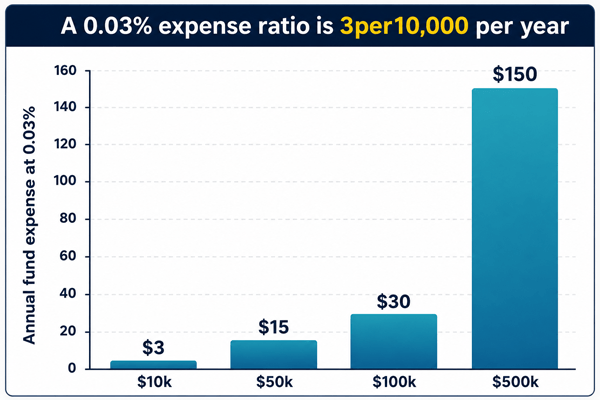
Yes. Both VTI and VOO have an expense ratio of 0.03%, which means the fund cost is about $3 per year for every $10,000 invested. You do not usually see this fee as a separate bill. It is reflected inside the fund’s performance over time.
| Investment amount | Approx. annual fund cost at 0.03% |
|---|---|
| $1,000 | $0.30 |
| $10,000 | $3 |
| $50,000 | $15 |
| $100,000 | $30 |
| $500,000 | $150 |
Also remember the hidden or indirect trading costs: bid-ask spread, possible brokerage fees, and taxes in taxable accounts. For large, liquid ETFs such as VTI and VOO, spreads are usually small, but using limit orders and avoiding frantic trading is still good practice.
8. Holdings and Concentration: What Do You Actually Own?
Both ETFs are market-cap weighted. That means bigger companies get bigger weights. This is why VTI can hold thousands of companies but still behave a lot like VOO: the top large-cap companies are powerful drivers of both funds.
VOO is more concentrated because it has fewer companies and focuses on the S&P 500. VTI is broader, but it is not equally weighted. A small company inside VTI may have only a tiny impact on returns.
| Question | Answer |
|---|---|
| Does VTI include VOO companies? | Mostly yes. The S&P 500 companies are a major part of the total U.S. market. |
| Does VOO include small-cap stocks? | No, not in a meaningful way. It focuses on large-cap U.S. companies. |
| Will VTI and VOO returns be totally different? | Usually no. They often move similarly because large companies dominate both. |
| Is owning both necessary? | Usually no. You can own both, but the overlap is high, so it may not add much diversification. |
9. Which ETF Should a Beginner Buy?
For a beginner who wants one simple U.S. stock ETF, VTI is often the cleaner “own the market” choice. It covers more of the U.S. market and removes the need to decide whether to add separate small-cap or mid-cap funds later.
VOO can still be an excellent choice for beginners who want the simplicity and familiarity of the S&P 500. It is easy to explain, easy to track, and extremely popular. In 2026, Reuters reported that VOO became the first ETF to cross $1 trillion in assets, showing how widely it is used by investors.
| Investor type | Better fit | Reason |
|---|---|---|
| Brand-new investor who wants maximum simplicity | VTI | One fund covers nearly the full U.S. market. |
| Investor who follows the S&P 500 and wants that benchmark | VOO | It tracks the index most people mean when they say “the market.” |
| Investor with a 401(k) that already uses an S&P 500 fund | VTI in taxable/IRA may add broader exposure | It can complement an existing S&P 500-heavy workplace plan. |
| Investor who plans to add small-cap ETFs separately | VOO can work | You can pair it with separate mid/small-cap exposure if desired. |
| Investor who dislikes complexity | Either, but choose one | The most important behavior is consistent long-term investing. |
Honest answer
There is no universal winner. VTI is broader. VOO is simpler and more large-cap focused. Both are low-cost, high-quality core ETFs. The “best” one is the one that fits your plan and that you can hold patiently.
10. Practical Examples
10.1 Example 1: Sarah, a 25-year-old beginner investor
Sarah wants to invest $300 per month for retirement and does not want to manage many funds. VTI is a strong fit because it gives her total U.S. market exposure in one ETF. She could later add international stocks and bonds as her plan grows.
10.2 Example 2: David, a 40-year-old investor who trusts the S&P 500
David understands the S&P 500 and wants to invest in large U.S. companies. VOO is a strong fit. He should understand that he is getting limited small-cap exposure, but for many long-term investors, an S&P 500 fund is still a reasonable core holding.
10.3 Example 3: Maria already owns VOO in her 401(k)
Maria’s workplace retirement account is already heavily invested in an S&P 500 index fund. If she opens a Roth IRA or brokerage account, VTI could give her slightly broader U.S. exposure. She does not need to sell VOO just because VTI exists. She should look at her whole portfolio, not each account in isolation.
11. How to Buy VTI or VOO Step by Step
- Open a brokerage account such as Vanguard, Fidelity, Schwab, Robinhood, or another regulated broker available to you.
- Decide whether the account is taxable, IRA, Roth IRA, or another account type. Taxes can matter.
- Search the ticker: VTI or VOO. Double-check the fund name before buying.
- Choose dollar amount or shares. Many brokers now support fractional ETF investing.
- Use a limit order if you want price control. A market order can be fine for small trades in liquid ETFs, but limit orders teach good habits.
- Set an investing schedule. For long-term investors, consistency often matters more than perfect timing.
- Rebalance periodically if you also own international stocks, bonds, or other assets.
12. VTI vs VOO in Retirement Accounts
In a Roth IRA, traditional IRA, or 401(k), the VTI vs VOO decision is usually about exposure, not taxes. Both can be excellent long-term retirement holdings. A young investor with a long time horizon might use either as the U.S. stock portion of the portfolio, then add international stocks and bonds based on risk tolerance.
In a taxable brokerage account, taxes can matter more. ETFs are generally known for tax efficiency, but dividends and realized capital gains can still create taxable events. Investors should avoid unnecessary switching between VTI and VOO in taxable accounts because selling appreciated shares may trigger capital gains tax.
13. Common Beginner Mistakes to Avoid
| Mistake | Better habit |
|---|---|
| Buying both without understanding overlap | VTI and VOO overlap heavily. Owning both is not wrong, but it is often redundant. |
| Thinking share price means expensive | VOO’s share price can be higher than VTI’s, but that does not mean VOO is more expensive. Expense ratio, valuation, and allocation matter more. |
| Chasing recent performance | Recent winners can lag later. Choose based on your target exposure, not last year’s chart. |
| Ignoring international diversification | Both VTI and VOO are U.S. stock funds. They do not give meaningful non-U.S. exposure. |
| Investing money needed soon | Stock ETFs can drop sharply. Money needed within a few years may belong in safer assets. |
| Trading too often | Frequent buying and selling can create taxes, spreads, emotional mistakes, and lower returns. |
14. VTI vs VOO: Pros and Cons
| ETF | Pros | Cons |
|---|---|---|
| VTI | Broader U.S. market exposure; includes large, mid, small, and micro-cap stocks; strong one-fund U.S. stock core. | Still dominated by large companies; no international stocks; may lag VOO when mega-cap stocks lead. |
| VOO | Simple S&P 500 exposure; very low cost; highly liquid; widely understood benchmark. | Less exposure to smaller U.S. companies; more concentrated in mega-cap names; not a total-market fund. |
15. The Bottom Line
Choose VTI if you want the broadest U.S. stock market exposure in one ETF. Choose VOO if you want the classic S&P 500 and are comfortable focusing on large U.S. companies. Both funds are low-cost, diversified, and suitable as core holdings for many long-term investors.
The real edge is not picking the fund that was slightly better over one period. The real edge is building a simple plan, keeping costs low, investing regularly, staying diversified, and not panicking during market declines.
16. FAQ: VTI vs VOO
16.1 Is VTI better than VOO?
VTI is broader, but not automatically better. It depends on whether you want total U.S. market exposure or S&P 500 exposure.
16.2 Is VOO safer than VTI?
Both are stock ETFs and can lose money. VOO is more large-cap focused, while VTI is broader. Neither is “safe” like cash or short-term Treasuries.
16.3 Can I buy both VTI and VOO?
Yes, but understand the overlap. Many investors would be fine choosing one as their U.S. stock core.
16.4 Which has lower fees?
Both have a 0.03% expense ratio based on the latest data reviewed.
16.5 Which is better for a Roth IRA?
Either can work. VTI may be cleaner for total U.S. market exposure; VOO may be cleaner for S&P 500 exposure.
16.6 Do VTI and VOO pay dividends?
Yes, both distribute dividends from the companies they own. Dividend yields change over time.
16.7 Are VTI and VOO good for beginners?
They can be. Their low costs, diversification, and simple structure make them common beginner-friendly ETF choices, but investors still need to understand stock-market risk.
16.8 Do I need international ETFs too?
Possibly. VTI and VOO are U.S.-focused. Many diversified portfolios also include international stocks and bonds.
Sources Consulted and Checked
The following sources were consulted and checked while preparing this article and verifying its accuracy:
- Vanguard investor and advisor pages for VTI and VOO: fund objective, expense ratio, holdings, risk, and performance information.
- Vanguard VTI fact sheet F0970, data including holdings and performance for period ended March 31, 2026.
- Vanguard VOO fact sheet FS968R, data including holdings and performance for period ended March 31, 2026.
- SEC Investor.gov ETF educational materials explaining ETF structure and risks.
- FINRA ETF educational materials explaining fees, expenses, and bid-ask spreads.
- Reuters, June 2026, reporting VOO crossing $1 trillion in assets.
- Market data checked June 22, 2026 for VTI and VOO prices.
Reader Advice
This article is provided solely for educational and informational purposes and does not constitute personalized investment, financial, tax, or legal advice. Investment products, prices, holdings, returns, fees, tax rules, regulations, and market conditions may change over time and may vary according to jurisdiction, account type, broker, and individual circumstances.
Before making any investment or financial decision, readers should independently verify all facts and figures through current official sources, carefully assess their objectives, time horizon, financial position, and risk tolerance, and consider consulting a qualified, appropriately licensed professional. Past performance does not guarantee future results, and all investments involve risk, including the possible loss of principal.