JEPI vs SCHD: Monthly Income or Dividend Growth - Which ETF Is Better?
Choosing between JEPI and SCHD is really a choice between two different investor needs: cash flow today or dividend growth over time. Both are popular U.S. equity ETFs. Both can fit inside an income portfolio. But they are built very differently, so the “better” ETF depends on what you want the money to do.
JEPI, the JPMorgan Equity Premium Income ETF, is designed to provide current income while still keeping some stock-market exposure. It does this by owning large U.S. companies and using an options strategy to collect option premiums. The fund pays monthly, which is why income investors often like it. SCHD, the Schwab U.S. Dividend Equity ETF, is a low-cost dividend ETF that tracks the Dow Jones U.S. Dividend 100 Index. It focuses on companies with dividend quality, financial strength, and sustainable payouts.
The most important thing for a beginner to understand is this: JEPI is not simply a “better SCHD” because it has a higher yield. SCHD is not simply a “worse JEPI” because it pays less income today. They solve different problems.
| ETF | Best plain-English description | Typical investor use |
|---|---|---|
| JEPI | A monthly income ETF that uses stocks plus option income. | Useful when you want regular cash flow now. |
| SCHD | A dividend growth ETF that owns financially strong dividend-paying companies. | Useful when you want dividends and capital growth over time. |
Quick answer:
JEPI is better for investors who want higher monthly cash flow and understand that covered-call income can limit upside. SCHD is better for investors who want a low-cost dividend growth ETF that can compound over many years. For many beginners, SCHD works better as a long-term core holding, while JEPI works better as an income tool or retirement cash-flow sleeve.
1. What is JEPI?
JEPI is an actively managed ETF from J.P. Morgan. It launched in May 2020 and has become one of the best-known monthly income ETFs. Its official approach is to generate income through a combination of U.S. large-cap stocks, stock dividends, and option premiums. In simple words, JEPI owns a portfolio of big U.S. companies and also sells options linked to the S&P 500 to generate extra income.
That extra option income is why JEPI can often show a much higher yield than a normal dividend ETF. J.P. Morgan reported a 30-day SEC yield of 8.29% and a 12-month rolling dividend yield of 8.33% as of May 31, 2026. The fund also reported annual expenses of 0.35%. These numbers change over time, so they should be checked before investing.
Beginner translation:
JEPI is like owning a basket of large U.S. stocks, but the fund also rents out some market upside through options in exchange for income today. That can help income, but it can also reduce participation when the market strongly rallies.
1.1 How JEPI works in practice
JEPI generates income from two main sources. First, it receives dividends from the stocks it owns. Second, it earns option premiums by selling call options through equity-linked notes. A call option gives another party the right to benefit from some upside in the market. JEPI receives a premium for selling that option exposure.
This structure is why JEPI can be attractive during flat or choppy markets. When the market does not rise sharply, the option premium can be a meaningful part of total return. But in a strong bull market, JEPI may lag a plain S&P 500 fund because some upside has effectively been sold away. That is the core trade-off.
| JEPI feature | What it means for beginners |
|---|---|
| Monthly distributions | Cash flow arrives more frequently than quarterly dividend ETFs. This can help retirees or investors budgeting monthly expenses. |
| High headline yield | The yield can look attractive, but it is not guaranteed and can fall if option premiums decline. |
| Active management | Portfolio managers choose stocks and manage the options strategy, so results depend on their process. |
| Covered-call style income | The strategy may reduce volatility, but it can also cap some upside. |
| 0.35% expense ratio | Higher than SCHD, but lower than many complex income funds. |
2. What is SCHD?
SCHD is the Schwab U.S. Dividend Equity ETF. It launched in October 2011 and tracks the Dow Jones U.S. Dividend 100 Index. The fund is passive, low-cost, and built around dividend quality. Schwab describes the fund as tracking an index focused on the quality and sustainability of dividends, with companies selected using fundamental strength relative to peers.
SCHD does not try to create unusually high income through options. Instead, it owns companies that already pay dividends and meet quality screens. Schwab reported a total expense ratio of 0.06%, 103 holdings, a 30-day SEC yield of 3.31% as of June 17, 2026, and a TTM distribution yield of 3.25% as of May 31, 2026.
Beginner translation:
SCHD is not trying to pay the biggest yield today. It is trying to own dividend-paying companies that have the financial strength to keep paying and potentially grow dividends over time.
2.1 How SCHD works in practice
SCHD is often popular with dividend growth investors because it combines three things beginners usually like: low cost, simplicity, and a rules-based dividend approach. Its holdings change when the index rebalances, but the fund is not trying to time the market every month. It simply tracks its dividend-quality index as closely as possible before fees and expenses.
| SCHD feature | What it means for beginners |
|---|---|
| Quarterly distributions | Income usually arrives four times a year, not every month. |
| Dividend growth focus | The goal is not just yield today, but healthier dividends over time. |
| Passive index strategy | Lower manager risk than an active strategy, but still depends on index rules. |
| Very low cost | The 0.06% expense ratio means investors keep more of the fund return. |
| Stock-market exposure | SCHD can still fall in bear markets because it owns equities. |
3. JEPI vs SCHD: side-by-side comparison
| Category | JEPI | SCHD | What it means |
|---|---|---|---|
| Full name | JPMorgan Equity Premium Income ETF | Schwab U.S. Dividend Equity ETF | Both are U.S. equity ETFs, but strategies are different. |
| Ticker | JEPI | SCHD | Both trade like stocks during market hours. |
| Launch | May 20, 2020 | October 20, 2011 | SCHD has a longer public track record. |
| Strategy | Large-cap stocks plus option premium strategy | Tracks Dow Jones U.S. Dividend 100 Index | JEPI is more complex; SCHD is easier to understand. |
| Management | Active | Passive index tracking | JEPI depends more on manager execution. |
| Distribution schedule | Monthly | Quarterly | JEPI is smoother for monthly cash flow. |
| Recent yield snapshot | 30-day SEC yield 8.29%; 12-month rolling dividend yield 8.33% as of 5/31/2026 | 30-day SEC yield 3.31% as of 6/17/2026; TTM distribution yield 3.25% as of 5/31/2026 | JEPI currently pays more income, but yield can move. |
| Expense ratio | 0.35% | 0.06% | SCHD is much cheaper to hold. |
| Number of holdings | 124 as of 5/31/2026 | 103 as of 6/18/2026 | Both are diversified, but neither replaces a whole-market ETF. |
| Main advantage | Higher monthly income | Dividend growth and low cost | Pick based on your goal, not just yield. |
| Main risk | Upside may be limited; option income varies; taxes can be less friendly | Lower current income; stock-market drawdowns | Both have risks, but the risk source is different. |
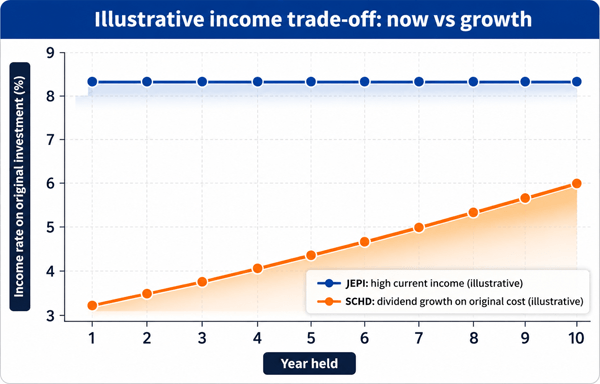
Illustrative income trade-off: now vs growth
4. Monthly income vs dividend growth: the real decision
Many online comparisons stop at the yield. That is a mistake. A high yield tells you how much income the fund recently paid relative to price. It does not tell you whether your wealth will compound faster, whether the income will rise, or whether the tax bill will be friendly. For beginners, the better question is: “Do I need cash flow now, or do I need my money to grow?”
4.1 When JEPI may be better
JEPI may be the better fit when the investor needs income today. For example, a retiree with a $300,000 portfolio who wants regular monthly cash flow may prefer JEPI over SCHD because JEPI is designed to distribute income every month. If JEPI yielded around 8%, a $100,000 allocation could produce roughly $8,000 a year before taxes and before any changes in yield. That is about $667 per month on average. This is only an estimate, not a promise.
JEPI can also be useful for investors who already own growth funds and want an income sleeve. Instead of selling shares every month, they may use JEPI distributions for part of their spending. This can feel emotionally easier, especially for people who dislike selling investments during volatile markets.
| JEPI can make sense if... | But watch out for... |
|---|---|
| You need monthly cash flow. | The monthly payment can vary. It is not a bond coupon. |
| You are retired or near retirement. | A stock-market crash can still reduce the share price. |
| You want lower volatility than broad large-cap stocks. | Lower volatility does not mean no risk. |
| You hold it in an IRA or Roth IRA. | Tax treatment may be simpler inside tax-advantaged accounts. |
| You understand covered-call trade-offs. | Strong bull markets may leave JEPI behind growth-oriented funds. |
4.2 When SCHD may be better
SCHD may be better when the investor wants long-term compounding, dividend growth, and simplicity. For example, a 30-year-old investor who reinvests dividends may care less about monthly payments and more about owning high-quality dividend companies for decades. SCHD’s lower current yield can be acceptable if the investor expects dividend growth and capital appreciation to do the heavy lifting.
SCHD can also be easier for beginners to understand. It owns dividend stocks using an index method. There are no option premiums to decode, no equity-linked note structure to worry about, and no need to understand why covered-call funds may lag during strong rallies. That simplicity is valuable.
| SCHD can make sense if... | But watch out for... |
|---|---|
| You want a long-term dividend growth ETF. | Dividend growth is not guaranteed. |
| You prefer a low expense ratio. | Low cost does not remove market risk. |
| You plan to reinvest dividends. | Quarterly payments may not suit monthly spending needs. |
| You want a simpler strategy. | It can underperform growth-heavy markets. |
| You are building wealth before retirement. | It is still concentrated in dividend-style U.S. equities, not the whole market. |
5. Risk comparison: what beginners often miss
JEPI and SCHD both own stocks, so neither is risk-free. The difference is how the risk shows up. SCHD’s risk is easier to see: if dividend stocks fall, the ETF falls. JEPI’s risk is more layered: the stock portfolio can fall, option income can change, the fund can underperform in a strong rally, and the tax character of distributions can matter.
| Risk | JEPI | SCHD |
|---|---|---|
| Market risk | Yes. It owns stocks and can lose value. | Yes. It owns stocks and can lose value. |
| Income variability | Higher. Option premiums and distributions can change. | Moderate. Dividends can grow, stay flat, or be cut. |
| Upside limitation | More likely because of options strategy. | Less direct upside cap. |
| Complexity risk | Higher. Investors should understand options and ELNs at a basic level. | Lower. Index dividend stock strategy is simpler. |
| Tax friction | Potentially higher in taxable accounts depending on distribution character. | Often simpler, but dividends and capital gains still have tax consequences. |
| Manager/index risk | Active manager process risk. | Index methodology risk. |
6. Tax considerations: do not ignore this part
Taxes can change the answer. In a taxable brokerage account, the highest-yielding fund is not always the best after-tax fund. JEPI’s distributions may include ordinary income and other components because of its options-based strategy. SCHD’s dividends may include qualified dividends when requirements are met, which can receive lower tax rates for many U.S. investors. But tax treatment varies by investor, account type, holding period, and fund distribution details.
A simple rule for beginners: income-focused ETFs often work better in tax-advantaged accounts when possible, especially if distributions are taxed at higher ordinary income rates. Dividend growth ETFs can still create taxable income, but they may be easier to manage in a taxable account than complex option-income funds. Investors should review official tax documents and speak with a qualified tax professional.
Practical tax example:
Suppose two investors each receive $5,000 of ETF distributions. One receives mostly ordinary income; the other receives mostly qualified dividends. Their after-tax cash could be very different even if the pre-tax income looks similar. That is why yield should be compared after tax, not just before tax.
7. Total return matters more than yield alone
A common beginner mistake is to buy the ETF with the highest yield and assume it is the best investment. But total return includes both income and price change. If an ETF pays 8% but its price struggles, it may not beat a lower-yield fund that grows steadily. If an ETF pays 3% and also compounds capital over time, the long-term result may be stronger.
JEPI’s own fact sheet shows that from launch through May 31, 2026, a hypothetical $10,000 investment with dividends and capital gains reinvested grew to $18,670. That is a useful result, but the same fact sheet also shows the S&P 500 benchmark had stronger annual returns in several bull-market years. This illustrates the covered-call trade-off: income and lower volatility can come with less upside capture.
8. What investors usually experience with JEPI and SCHD
Real investor behavior matters. JEPI owners often like the feeling of monthly deposits. The payment can make investing feel more like a paycheck. This is helpful for retirees, income-focused investors, and people who want cash flow without selling shares. The downside is that some investors become too focused on the monthly payout and ignore whether the portfolio is keeping up with inflation and long-term market growth.
SCHD owners often like the feeling of “boring compounding.” The quarterly income is lower, but the strategy is easier to hold for years because it is simple, cheap, and focused on dividend quality. The downside is psychological: when people compare SCHD’s yield with JEPI’s yield, SCHD can look less exciting. Beginners may abandon it too soon because they do not understand that dividend growth investing is usually a slow game.
| Investor feeling | JEPI experience | SCHD experience |
|---|---|---|
| Cash flow satisfaction | Usually higher because distributions are monthly and yield is higher. | Moderate because payments are quarterly and yield is lower. |
| Simplicity | Moderate to low; strategy takes explanation. | High; dividend index ETF is easier to understand. |
| Patience required | Patience required when share price lags in bull markets. | Patience required when current income feels small. |
| Common regret | Buying only for yield without understanding upside limits. | Expecting immediate high income from a dividend growth fund. |
9. How beginners can use JEPI and SCHD in a portfolio
A beginner should not start by asking, “Which ETF is more popular?” A better starting point is the job of the money. Every dollar in a portfolio should have a job: growth, income, stability, emergency savings, or spending. JEPI and SCHD do not serve the same job equally well.
| Portfolio goal | Possible use of JEPI | Possible use of SCHD |
|---|---|---|
| Building wealth for 10+ years | Small income sleeve if desired, but not usually the main growth engine. | Can be a dividend-growth sleeve or core U.S. dividend holding. |
| Retirement income | Can provide monthly cash flow. | Can provide growing dividend income but less current cash. |
| Taxable brokerage account | Use carefully; review tax character. | May be simpler, but still taxable. |
| Roth IRA | Can be useful for income reinvestment or future tax-free withdrawals. | Also useful for long-term compounding. |
| Emergency fund | Not appropriate; both can lose value. | Not appropriate; both can lose value. |
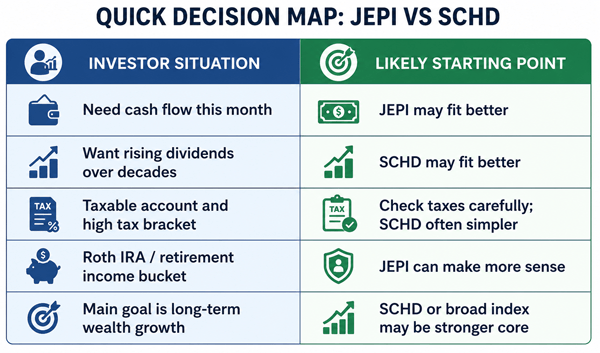
Quick decision map: JEPI vs SCHD
10. Practical allocation examples
The right allocation depends on age, income needs, taxes, risk tolerance, other assets, and whether the investor already owns broad-market funds.
| Investor type | Possible approach | Why |
|---|---|---|
| Young investor, no income need | Mostly broad-market funds; SCHD as a dividend sleeve; little or no JEPI. | Long time horizon usually rewards growth and compounding more than current income. |
| Middle-aged investor building income | SCHD as a core dividend growth position; small JEPI allocation for income practice. | Balances dividend growth with some cash flow. |
| Retiree needing monthly cash | JEPI as part of an income bucket; SCHD for dividend growth; keep cash/bonds for stability. | JEPI can help monthly income, but retirees still need diversification and liquidity. |
| Taxable high-income investor | Be cautious with JEPI; compare after-tax yield; consider SCHD or tax-efficient broad ETFs. | High ordinary-income taxes can reduce the benefit of high distributions. |
| Investor chasing yield | Pause and write an investment plan before buying. | A high yield is not a plan. It can hide risk, taxes, and lower growth. |
11. Simple income example: $100,000 invested
Here is a simple pre-tax example using the recent yield snapshots above. It shows how different the cash-flow profile can look.
| ETF | Illustrative yield | Estimated annual income on $100,000 | Estimated average monthly income |
|---|---|---|---|
| JEPI | 8.29% | $8,290 | $691 |
| SCHD | 3.31% | $3,310 | $276 |
This table explains why JEPI attracts income investors. But it does not prove JEPI is better. The missing pieces are price return, dividend growth, tax treatment, inflation, and the investor’s time horizon.
12. So, which ETF is better?
For a beginner building long-term wealth, SCHD is often the cleaner starting point because it is cheaper, simpler, older, and easier to understand. It can be used as a dividend growth ETF inside a diversified portfolio. It is not a magic fund, and it can still underperform, but its role is clear.
For an investor who specifically needs monthly income, JEPI may be the better tool. It can be useful for retirees, income investors, or people who want a cash-flow sleeve. But JEPI should not be bought just because the yield is high. The investor must understand that option income changes, upside can be limited, and taxes may reduce the appeal in a taxable account.
| Choose... | If your main priority is... |
|---|---|
| JEPI | Monthly cash flow, higher current income, income diversification, lower volatility goal. |
| SCHD | Dividend growth, low cost, simplicity, long-term compounding, easier taxable-account use. |
| Both | A blended income plan where JEPI handles current income and SCHD handles dividend growth. |
| Neither as a full portfolio | If you still need broad diversification across total U.S. stocks, international stocks, bonds, and cash. |
13. Action checklist before buying JEPI or SCHD
- Write your goal first: income now, dividend growth, or total return.
- Check the latest SEC yield, distribution history, expense ratio, holdings, and prospectus.
- Decide which account type makes sense: taxable, traditional IRA, Roth IRA, or retirement plan.
- Compare after-tax income, not just headline yield.
- Do not put emergency money in either ETF.
- Avoid buying JEPI only because it pays monthly.
- Avoid buying SCHD only because influencers call it a “forever ETF.”
- Rebalance if one ETF becomes too large in your portfolio.
- Review performance using total return, not yield alone.
- Read the fund documents and understand the risks before investing.
14. FAQs: JEPI vs SCHD
14.1 Is JEPI better than SCHD?
JEPI is better for monthly income. SCHD is usually better for simple dividend growth and long-term compounding. The better choice depends on your goal.
14.2 Does JEPI pay monthly dividends?
JEPI pays monthly distributions. The amount can change and should not be treated like a guaranteed paycheck.
14.3 Does SCHD pay monthly?
No. SCHD generally pays quarterly distributions.
14.4 Which has the higher yield, JEPI or SCHD?
JEPI usually has the higher current yield because of its options strategy. SCHD usually has a lower yield but may offer better dividend growth potential.
14.5 Which is safer?
Neither is completely safe because both hold stocks. SCHD is simpler. JEPI may reduce some volatility but has strategy complexity and upside trade-offs.
14.6 Can I hold both JEPI and SCHD?
Yes. Some investors use SCHD for dividend growth and JEPI for current income. The key is to avoid overlap with your broader portfolio and to understand taxes.
14.7 Is JEPI good for a taxable account?
It can be used in taxable accounts, but investors should carefully review distribution tax character. High income can create a high tax bill.
14.8 Is SCHD good for beginners?
SCHD can be beginner-friendly because it is low-cost and simple, but beginners should still understand that dividend stocks can fall and are not guaranteed.
14.9 Should I reinvest dividends?
If you do not need the income, reinvesting can help compounding. If you need cash flow, taking distributions may make sense.
14.10 Can either ETF replace the S&P 500?
Not perfectly. JEPI and SCHD have specific income/dividend roles. A broad-market ETF may still be needed for full market exposure.
15. Final verdict
JEPI and SCHD are both useful, but they are not interchangeable. JEPI is an income tool. SCHD is a dividend growth tool. JEPI can make sense when cash flow matters more than maximum upside. SCHD can make sense when compounding, low cost, and simplicity matter more than today’s yield.
The honest answer is that the best ETF is the one that matches the job of your money. If you need monthly income and understand the trade-offs, JEPI deserves a look. If you are building long-term wealth and want a straightforward dividend ETF, SCHD is likely the stronger starting point. Many investors can also use both, with SCHD as the dividend-growth base and JEPI as a smaller income sleeve.
16. Reader Advice
This article is provided solely for educational and informational purposes and does not constitute personalized financial, investment, tax, accounting, or legal advice. The examples are hypothetical and should not be treated as forecasts, promises, or recommendations. ETF yields, distributions, holdings, expenses, tax treatment, market prices, regulations, and performance figures can change because of market conditions, fund decisions, legal rules, and other factors. Before making any decision, readers should verify current facts and figures through official fund pages, prospectuses, regulatory filings, and other authoritative sources, consider their own objectives and risk tolerance, and consult appropriately qualified professionals. Past performance does not guarantee future results, and all investments can lose value.
17. Sources Consulted and Checked
The following sources were consulted and checked while preparing this document and verifying its accuracy:
- J.P. Morgan Asset Management, JPMorgan Equity Premium Income ETF official fund page and May 31, 2026 fact sheet: launch date, expense ratio, yield, holdings, investment approach, risks.
- J.P. Morgan Asset Management, JEPI Fund Story, March 31, 2026: monthly income, options premium explanation, lower-volatility objective, annual expenses.
- Schwab Asset Management, SCHD official fund page: objective, expense ratio, inception, yield, total holdings, index name, passive management style.
- Schwab Asset Management, SCHD holdings and fund data pages: portfolio holdings, sector details, and current fund information.