QQQ vs VOO: Performance, Risk, and Best Choice for Long-Term Investors
1. Quick answer: which ETF is better?
For most long-term beginners, VOO is usually the cleaner core holding because it tracks the S&P 500, owns about 500 large U.S. companies, charges an extremely low expense ratio, and spreads money across more sectors. QQQ can be excellent for investors who deliberately want a stronger growth and technology tilt, but it is more concentrated and can feel more painful in market sell-offs.
The simple rule: use VOO as the foundation, and use QQQ as a satellite if you understand the extra concentration risk. QQQ is not “better” just because it has outperformed in many past periods. It is different. It is a more focused bet on large Nasdaq-listed, non-financial companies, many of which are technology- or growth-oriented businesses.
| Investor situation | More suitable choice | Why |
|---|---|---|
| I want one simple ETF for long-term wealth building | VOO | Broader, cheaper, easier to hold through normal market cycles. |
| I believe megacap innovation and tech-led growth will keep leading | QQQ or QQQ + VOO | More exposure to Nasdaq-100 leaders, but with higher concentration. |
| I panic when my account drops 20% to 35% | VOO | Still risky, but usually less growth-heavy than QQQ. |
| I already own an S&P 500 fund in a retirement account | Maybe a small QQQ allocation | QQQ can add a growth tilt without replacing the core. |
| I want income/dividends | VOO | Neither is a high-dividend ETF, but VOO is usually the more balanced choice. |
2. What are QQQ and VOO in plain English?
2.1 What is QQQ?
QQQ is the Invesco QQQ ETF. It tracks the Nasdaq-100 Index, which is designed to measure the performance of 100 of the largest Nasdaq-listed non-financial companies. The index uses a modified market-cap weighting approach, meaning the biggest companies generally carry the most influence, but rules are used to manage concentration.
In practical terms, buying QQQ is like buying a basket of major innovation and growth companies in one trade. You are not buying only one stock, but you are also not buying the whole U.S. stock market. QQQ is narrower than VOO and has a stronger tilt toward technology, communication services, consumer discretionary, and other growth-oriented businesses.
2.2 What is VOO?
VOO is the Vanguard S&P 500 ETF. It tracks the S&P 500 Index, a float-adjusted market-cap-weighted index representing the large-cap segment of the U.S. equity market. The S&P 500 is composed of 500 constituent companies and is widely used as a proxy for the U.S. stock market.
Buying VOO is like buying a broad slice of large U.S. businesses: technology, healthcare, financials, consumer companies, industrials, energy, utilities, and more. It is not perfectly diversified because it excludes most small- and mid-sized companies, but it is much broader than QQQ.
3. QQQ vs VOO: side-by-side comparison
| Feature | QQQ | VOO | What it means for beginners |
|---|---|---|---|
| Full name | Invesco QQQ ETF / Invesco QQQ Trust | Vanguard S&P 500 ETF | Both are exchange-traded funds that trade like stocks. |
| Index tracked | Nasdaq-100 | S&P 500 | QQQ is narrower; VOO is broader. |
| Number of holdings | About 100+ | About 500 | More holdings does not remove risk, but it spreads company-specific risk. |
| Expense ratio | 0.18% | 0.03% | VOO is cheaper. On $10,000, that is about $3/year for VOO vs $18/year for QQQ. |
| Main style | Large growth / innovation tilt | Large blend / broad U.S. market | QQQ is more aggressive; VOO is more balanced. |
| Sector exposure | Heavy technology and growth sectors; excludes financial companies | All major S&P 500 sectors | VOO is less dependent on one theme. |
| Best role | Satellite growth holding or intentional tech tilt | Core portfolio holding | Many investors use VOO as the base and QQQ as an add-on. |
| Key risk | Concentration risk, valuation risk, tech/growth sell-offs | Market risk, megacap concentration, U.S. large-cap bias | Both can lose money, but QQQ can be more volatile. |
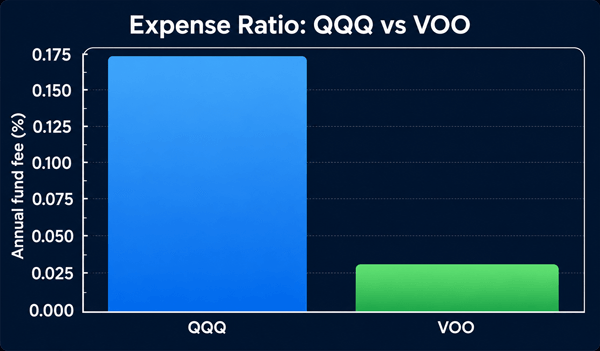
Figure 1. Even small fee differences can matter over decades, especially in retirement accounts and taxable brokerage portfolios.
4. How these ETFs actually work
Both QQQ and VOO are ETFs, or exchange-traded funds. An ETF holds a basket of investments and lets you buy or sell shares during the trading day through a brokerage account. When you buy one share of an ETF, you indirectly own small pieces of all the companies inside the fund.
The fund provider does not sit there trying to pick winners every day. These ETFs are mostly passive: they aim to follow their index. If the index changes its holdings, the ETF adjusts. If the biggest companies in the index rise, they become a larger part of the fund. If they fall, their weight drops.
4.1 Why market-cap weighting matters
Both funds are market-cap weighted in practice. That means larger companies have more influence than smaller companies. This is why a small number of megacap stocks can drive a large part of returns. If Nvidia, Apple, Microsoft, Amazon, Alphabet, or other giants do well, both ETFs may benefit. If those stocks struggle, both can feel it, especially QQQ.
5. Performance: why QQQ often looks stronger
QQQ has often outperformed VOO during periods when technology and growth stocks led the market. Invesco reports that QQQ has historically outperformed the S&P 500 over many periods, including on a cumulative basis since QQQ’s 1999 launch as of March 31, 2026. That kind of performance attracts attention, but investors should avoid assuming the next decade will look exactly like the last one.
VOO has also delivered strong long-term results because the S&P 500 has historically captured the profits of many of America’s largest public companies. Morningstar reported that VOO returned about 14.8% annualized over the 10 years through year-end 2025. This is not a guarantee of future returns, but it shows why broad, low-cost index investing has become popular.
The key point is not “QQQ always wins.” The key point is this: QQQ tends to benefit more when its growth-heavy companies lead, while VOO has advantages in simplicity, diversification, lower cost, and staying power. The best ETF is the one you can hold through ugly markets without constantly second-guessing yourself.
| Performance lesson | What beginners should understand |
|---|---|
| Past outperformance is not a promise | A fund can look unbeatable after its favorite sector has had a great decade. |
| Higher return usually comes with higher discomfort | QQQ can rise faster, but it can also fall harder when growth stocks sell off. |
| Fees are one of the few controllable variables | VOO’s 0.03% expense ratio gives it a cost advantage. |
| Behavior matters as much as fund choice | Selling during a crash can hurt more than choosing the “wrong” ETF. |
6. Risk comparison: the part many articles under-explain
Risk is not only the chance of losing money today. For long-term investors, risk includes concentration, valuation, behavior, time horizon, taxes, and whether the portfolio matches the person’s life. A 25-year-old investing monthly may experience QQQ’s volatility differently from a 60-year-old close to retirement.
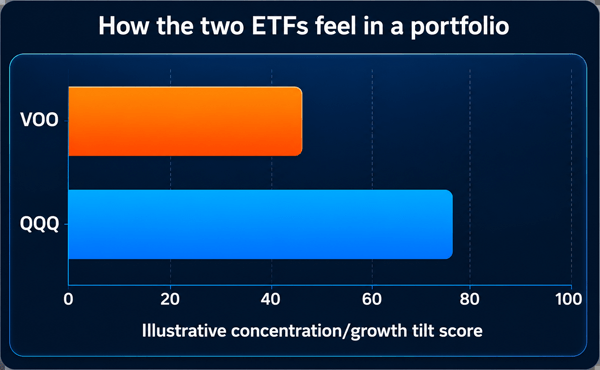
Figure 2. QQQ is usually the stronger growth/concentration tilt; VOO is usually the broader core-market exposure. The score is illustrative, not a standardized investment-risk measure.
6.1 Concentration risk
QQQ owns far fewer companies than VOO and is more dependent on a small group of large growth stocks. That can be great when those companies are winning. It can be painful when investors rotate away from growth, when valuations compress, or when a handful of giants disappoint.
6.2 Sector risk
QQQ excludes financial companies and has a strong tilt toward technology and innovation-related sectors. VOO includes technology too, but it also includes banks, insurers, healthcare companies, industrial firms, consumer staples, energy companies, utilities, and real estate. This wider sector exposure can make VOO feel more balanced.
6.3 Valuation risk
Fast-growing companies often trade at higher prices relative to earnings. When expectations are very high, even good companies can produce poor stock returns if growth slows or interest rates rise. QQQ investors should be comfortable with this risk. VOO also has valuation risk, especially when the S&P 500 is dominated by expensive megacaps, but it is less concentrated in one growth theme than QQQ.
6.4 Behavioral risk
Many investors choose QQQ after seeing strong past returns, then sell when it drops. That is the worst pattern: buying after excitement and selling after fear. A good ETF choice is not the one that looks best on a chart; it is the one you can hold through a bad year without abandoning the plan.
7. Practical examples: how beginners might use QQQ and VOO
7.1 Example 1: The simple beginner portfolio
A beginner with a long time horizon could use VOO as the main U.S. stock holding. This keeps the portfolio simple and low-cost. They might later add international stocks, bonds, or a small QQQ position if they want more growth exposure.
| Portfolio idea | Example allocation | Who it may fit |
|---|---|---|
| Simple core | 100% VOO for the U.S. stock portion | Someone who wants simplicity and broad U.S. exposure. |
| Core plus growth tilt | 80% VOO / 20% QQQ | Someone who wants broad exposure but believes in tech-led growth. |
| Aggressive growth tilt | 60% VOO / 40% QQQ | Someone with high risk tolerance and a long time horizon. |
| Risk-aware balanced investor | VOO plus bonds/cash allocation | Someone who wants growth but cannot emotionally handle large drops. |
7.2 Example 2: Monthly investing
Suppose an investor contributes $500 per month. Instead of trying to guess whether QQQ or VOO will be cheaper next week, they can use dollar-cost averaging: invest on a set schedule. This reduces the emotional pressure of market timing. The investor buys more shares when prices are lower and fewer shares when prices are higher.
7.3 Example 3: Retirement account vs. taxable account
In a retirement account, many investors focus more on allocation and long-term compounding because taxes are deferred or sheltered depending on account type. In a taxable brokerage account, turnover, dividend tax treatment, capital gains, and rebalancing decisions matter more. Both QQQ and VOO are ETFs and can be tax-efficient, but investors should still consider their personal tax situation.
8. Which is best for long-term investors?
VOO is generally the better default choice for long-term beginners because it is broader, cheaper, and easier to understand. It gives exposure to the large-cap U.S. market without making an unusually concentrated bet on Nasdaq-listed growth companies.
QQQ can be the better choice for investors who specifically want a growth tilt and accept the trade-off. It may be appropriate as a satellite holding, especially for someone who already owns a broad core fund and wants extra exposure to large innovation-driven companies. But QQQ should not be treated as a guaranteed shortcut to higher returns.
| Choose VOO if... | Choose QQQ if... |
|---|---|
| You want one main ETF for the U.S. stock portion of your portfolio. | You want a deliberate growth and innovation tilt. |
| You prefer lower fees and broader sector exposure. | You can tolerate deeper drawdowns and higher volatility. |
| You want a fund that is easier to explain to a beginner. | You already have a broad core and want a satellite position. |
| You do not want to bet too heavily on one market theme. | You understand that past tech-led returns may not repeat. |
9. Beginner mistakes to avoid
- Chasing QQQ only because it recently performed better. Performance chasing often leads to buying high and selling low.
- Thinking VOO is “safe.” VOO is diversified, but it is still a stock ETF and can fall sharply in bear markets.
- Owning both without understanding overlap. QQQ and VOO share many megacap stocks, so buying both does not mean you doubled your diversification.
- Ignoring your time horizon. Money needed in the next one to three years should not usually be fully exposed to stock-market risk.
- Checking the account daily. Long-term ETF investing works best when the plan is boring enough to follow.
10. Frequently asked questions
10.1 Is QQQ better than VOO?
QQQ may deliver stronger returns when large technology and growth stocks lead, but VOO is usually the better default core ETF for beginners because it is broader and cheaper. The better choice depends on risk tolerance, time horizon, and portfolio role.
10.2 Is VOO safer than QQQ?
VOO is usually considered less concentrated than QQQ because it tracks about 500 large U.S. companies across more sectors. However, VOO is still a stock ETF and can lose significant value during market downturns.
10.3 Can I invest in both QQQ and VOO?
Yes. Many investors use VOO as the core and QQQ as a smaller growth satellite. A common beginner-friendly structure is 80% VOO and 20% QQQ for the U.S. stock portion, but the right mix depends on personal goals and risk tolerance.
10.4 Does QQQ pay dividends?
QQQ can pay dividends from the companies it owns, but it is not designed as a high-dividend ETF. Investors usually buy QQQ for growth exposure, not income.
10.5 Does VOO pay dividends?
VOO pays dividends from the S&P 500 companies it holds. It is not a high-yield ETF, but it may provide more balanced dividend exposure than QQQ because it owns more sectors.
10.6 Which ETF is better for retirement?
For many retirement investors, VOO is the simpler core choice. QQQ may still have a role for younger or more aggressive investors, but retirees or near-retirees should be careful about concentration and volatility.
11. Final verdict
If you are new and want the most practical answer: start by understanding VOO first. It is broad, low-cost, and works well as a core U.S. stock market ETF. Once you understand that, consider whether QQQ adds something useful to your plan or simply adds excitement.
QQQ is a powerful ETF, but it is not magic. It is a concentrated, growth-oriented Nasdaq-100 fund. VOO is less exciting, but that is often its strength. Long-term investing rewards consistency, patience, low costs, and a portfolio you can actually hold. For most beginners, VOO is the foundation; QQQ is the optional growth tilt.
Sources Consulted and Checked
The following sources were consulted while preparing this document and checking its accuracy. Fund data, holdings, expenses, index rules, and performance figures may change, so readers should review the latest information on the official product and index-provider pages.
- Invesco QQQ ETF – official product page
- Invesco QQQ – holdings and sector allocations
- Invesco QQQ – performance information
- Vanguard VOO – official fund profile
- Nasdaq-100 Index methodology
- S&P U.S. Indices methodology
- Morningstar – QQQ fund page
- Morningstar – VOO fund page
Reader Advice
This article is provided solely for educational and informational purposes. It is not individualized financial, investment, tax, accounting, or legal advice, and it is not a recommendation or solicitation to buy, sell, or hold any security. ETF prices and returns can rise or fall, and investors may lose money.
Before making any decision, readers should consider their goals, time horizon, risk tolerance, tax position, financial circumstances, and overall portfolio, and should seek advice from an appropriately qualified professional where needed. Fund fees, holdings, index methodologies, tax rules, regulations, market conditions, and performance data can change. Readers should therefore verify all facts and figures using current official sources and read the relevant prospectus and disclosures. Past performance does not guarantee future results, and diversification does not ensure a profit or protect against loss.