SCHD vs VTI: Income vs Growth Strategy Explained
SCHD and VTI are both popular low-cost U.S. stock ETFs, but they solve different investor problems. SCHD is built for investors who want a stronger dividend-income focus from large, financially sound U.S. companies. VTI is built for investors who want broad exposure to almost the entire U.S. stock market, including large, mid, small, and micro-cap stocks.
The simplest way to think about it is this: SCHD is an income-and-quality tilt; VTI is the broad U.S. market. SCHD may feel more rewarding to investors who like visible quarterly dividends, while VTI may suit beginners who want one simple long-term growth engine. Neither is automatically “better.” The better choice depends on your goal, time horizon, tax situation, and ability to stay invested during market declines.
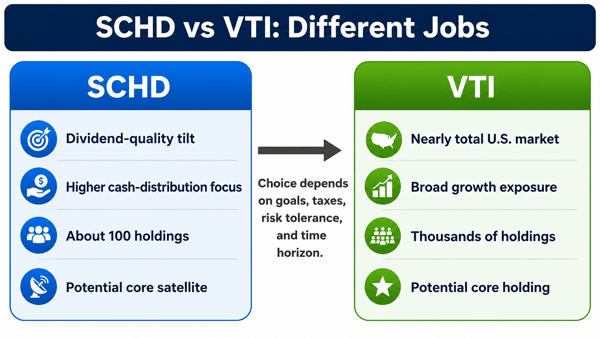
Figure 1. SCHD emphasizes dividend quality and income; VTI emphasizes broad U.S. market exposure.
1. What Are SCHD and VTI?
1.1 SCHD in Plain English
SCHD is the Schwab U.S. Dividend Equity ETF. Its objective is to track the Dow Jones U.S. Dividend 100 Index before fees and expenses. Schwab describes the fund as a low-cost ETF that tracks an index focused on dividend quality and sustainability, using stocks selected for fundamental strength relative to peers. As of June 18, 2026, Schwab listed SCHD’s expense ratio at 0.06% and total holdings at 103.
In everyday language, SCHD tries to own a basket of U.S. companies that have a history of paying dividends and also look financially strong based on rules in the index. It is not simply chasing the highest dividend yield. That matters because an unusually high yield can sometimes be a warning sign that the market expects a dividend cut.
1.2 VTI in Plain English
VTI is the Vanguard Total Stock Market ETF. It seeks to track the CRSP US Total Market Index. Vanguard describes it as a large-, mid-, and small-cap U.S. equity ETF diversified across growth and value styles, using a passively managed index-sampling strategy. Vanguard’s March 31, 2026 investment profile listed VTI’s expense ratio at 0.03%, 3,507 stocks, and a dividend yield around 1.2%.
In everyday language, VTI is a “buy the U.S. market” ETF. Instead of asking which dividend companies are best, it spreads money across almost the full investable U.S. stock market. If U.S. companies as a group grow over time, VTI investors participate. If the market falls, VTI falls with it.
2. Quick Comparison: SCHD vs VTI
| Feature | SCHD | VTI | Beginner takeaway |
|---|---|---|---|
| Full name | Schwab U.S. Dividend Equity ETF | Vanguard Total Stock Market ETF | Both are ETFs, but they follow different indexes. |
| Main strategy | Dividend quality and income tilt | Nearly total U.S. stock market exposure | SCHD is focused; VTI is broad. |
| Index tracked | Dow Jones U.S. Dividend 100 Index | CRSP US Total Market Index | Index rules drive what each ETF owns. |
| Expense ratio | 0.06% according to Schwab | 0.03% according to Vanguard | Both are very low cost; VTI is cheaper. |
| Number of holdings | About 103 as of June 18, 2026 | About 3,507 as of March 31, 2026 | VTI is much more diversified. |
| Dividend yield profile | Generally higher than broad market | Lower, market-like yield | SCHD pays more cash flow, but total return matters too. |
| Growth exposure | Less exposure to non-dividend and high-growth stocks | Includes growth, value, large, mid, small, and micro-cap stocks | VTI captures more of the market’s future winners. |
| Best use case | Income tilt or dividend satellite | Core long-term U.S. stock holding | Many investors can use VTI as core and SCHD as satellite. |
| Main risk | Concentration in dividend/value stocks; may lag growth-led markets | Market-wide stock risk; tech concentration rises when tech dominates market cap | Both can decline sharply in bear markets. |
3. How SCHD Works
SCHD follows a rules-based dividend index. The index is designed to measure high-dividend-yielding U.S. stocks with a record of consistently paying dividends and fundamental strength relative to peers. This is why SCHD is often described as a dividend quality ETF rather than a pure high-yield ETF.
A beginner should know three things about this approach. First, SCHD is selective. It owns far fewer stocks than a total market ETF. Second, SCHD’s income can be attractive, but dividends are not guaranteed. Companies can reduce or suspend dividends. Third, SCHD can underperform when the market is led by fast-growing companies that pay little or no dividend.
4. How VTI Works
VTI follows the broad U.S. stock market. It owns companies across sizes and styles. This means it does not need to predict which sector, company size, or investment style will win next. If a small company becomes a future giant, a total market fund can gradually benefit as that company grows and becomes a larger part of the market.
VTI is market-cap weighted. Bigger companies receive bigger weights. This is efficient and low cost, but it also means VTI can become heavily influenced by the largest U.S. companies. For example, Vanguard’s March 2026 profile showed technology at 36.3% of VTI’s stocks and the top 10 holdings at 33.4% of total net assets. That is not a flaw; it is simply how market-cap weighting works.
5. Income vs Growth: What Beginners Usually Misunderstand
The biggest mistake beginners make is assuming “dividend ETF” means safe and “growth ETF” means risky. The reality is more nuanced. SCHD and VTI both hold stocks. Both can lose value. Both can recover. Both can compound wealth. The difference is how the return is delivered.
| Concept | What beginners often think | More accurate explanation |
|---|---|---|
| Dividend income | Dividends are extra profit. | Dividends are part of total return. The stock price adjusts around dividend payments, and taxes may apply in taxable accounts. |
| Growth investing | Growth means gambling. | Broad-market growth through VTI is not the same as betting on one hot stock. It is diversified ownership of the U.S. market. |
| Yield | Higher yield is always better. | Higher yield may mean more income, but it can also signal slower growth or dividend risk. Quality and sustainability matter. |
| Total return | Only price increase matters. | Total return includes price change plus dividends, assuming dividends are reinvested. |
| Risk | Dividend ETFs cannot fall much. | Dividend ETFs can decline during bear markets, recessions, rate shocks, and sector rotations. |
6. Practical Example: $10,000 Investment
Imagine two beginners each invest $10,000. One buys SCHD for a dividend-focused strategy. The other buys VTI for broad market growth. The SCHD investor may receive more visible cash distributions during the year. The VTI investor may receive less income but owns a wider range of companies, including many that reinvest profits for expansion.
If both investors reinvest dividends, the difference becomes less about cash flow today and more about long-term total return. SCHD may do well when dividend/value stocks lead. VTI may do well when the broad market, especially large growth companies, leads. Over a 20- or 30-year horizon, the best result often depends less on picking the “perfect” ETF and more on saving consistently, keeping costs low, avoiding panic selling, and choosing an allocation the investor can actually hold.
| Investor | Goal | Likely preference | Reason |
|---|---|---|---|
| 25-year-old building retirement wealth | Maximum simplicity and broad compounding | VTI as core | Long time horizon; does not need income now; wants broad market exposure. |
| 45-year-old who likes dividends but still wants growth | Balanced behavior and cash-flow motivation | VTI core + SCHD satellite | VTI keeps diversification; SCHD adds dividend discipline. |
| Retiree needing portfolio income | More cash flow, but still needs diversification | SCHD plus bonds/cash/possibly VTI | SCHD alone is still stock risk; retirees need a withdrawal plan. |
| Taxable account investor in high tax bracket | Tax efficiency and low turnover | Often VTI first; SCHD after tax review | More dividends can mean more annual taxable income. |
7. Dividend Reinvestment: A Simple Beginner Strategy
A beginner who does not need current income can usually turn on dividend reinvestment, often called DRIP, through a brokerage account. This automatically uses dividends to buy more shares. With SCHD, reinvestment can turn higher dividend payments into more shares over time. With VTI, reinvestment also matters, even though the yield is lower, because total market compounding is built from both price growth and distributions.
The practical rule is simple: if you are still accumulating wealth and do not need the cash, reinvesting dividends is usually cleaner than spending them. If you need income, decide whether dividends are enough or whether you also need a systematic withdrawal plan. Living only on dividends can sound safe, but it can create unnecessary concentration in dividend-paying stocks.
8. Taxes: Why Account Type Matters
Taxes can change the SCHD vs VTI decision. The IRS explains that dividends can be ordinary or qualified, and qualified dividends may be taxed at lower capital gain rates. However, tax treatment depends on the dividend type, holding period, account type, and investor situation.
In a taxable brokerage account, a higher-dividend ETF can create more annual taxable income even if you reinvest the dividends. In a Roth IRA, Traditional IRA, or other tax-advantaged account, the annual tax drag may be reduced or deferred, depending on the account rules. This is one reason some investors prefer dividend-heavy holdings inside retirement accounts and broad-market funds in taxable accounts. This is not a universal rule, so readers should confirm with a qualified tax professional.
| Account type | SCHD consideration | VTI consideration |
|---|---|---|
| Taxable brokerage | Higher dividends may increase annual taxable income. | Lower dividend yield may be more tax efficient for long-term accumulation. |
| Roth IRA | Dividend reinvestment can compound without annual tax on qualified withdrawals. | Strong fit for long-term growth compounding. |
| Traditional IRA/401(k) | Income can compound tax-deferred, but withdrawals are generally taxed under account rules. | Broad growth can also compound tax-deferred. |
| Retirement income account | May support cash-flow planning, but dividends can still fluctuate. | May require selling shares for income; not necessarily bad if planned. |
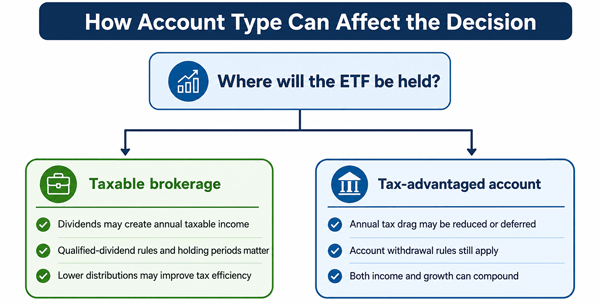
Figure 2. Account type can affect the tax treatment and practical role of dividend distributions.
9. Risk Comparison: What Can Go Wrong?
Neither SCHD nor VTI is a guaranteed investment. Investor.gov explains that ETFs carry risk, investors can lose money, and dividends or interest payments can change as market conditions change. Beginners should read this before focusing on yield charts or past performance.
| Risk | SCHD | VTI | How to manage it |
|---|---|---|---|
| Market risk | Can fall in stock bear markets. | Can fall with the entire U.S. market. | Hold an emergency fund; do not invest short-term money in stock ETFs. |
| Concentration risk | Only around 100 holdings, focused on dividend-quality stocks. | Thousands of stocks, but largest companies can dominate. | Use broad diversification and consider international/bond exposure. |
| Style risk | Can lag during growth-led markets. | Can lag dividend/value strategies in certain periods. | Avoid performance chasing; choose based on purpose. |
| Income risk | Dividends can be cut or grow slowly. | Lower dividend yield may not satisfy income needs. | Use a withdrawal plan, not just yield. |
| Behavior risk | Investor may overvalue cash payouts and ignore total return. | Investor may panic during broad market crashes. | Write an investing policy before buying. |
10. Fees: Small Numbers Still Matter
Both ETFs are low cost. Schwab listed SCHD’s total expense ratio at 0.06%, while Vanguard listed VTI’s expense ratio at 0.03%. The difference between these two is small, but beginners should still learn the habit of checking expense ratios. The SEC’s Investor.gov states that fund fees and expenses reduce investment returns, and a fund with higher costs must perform better than a lower-cost fund to generate the same return.
The good news is that both SCHD and VTI are far cheaper than many actively managed funds. The bigger decision is not 0.06% vs 0.03%; it is whether the strategy fits the investor. A cheap fund that causes you to panic sell is not truly cheap for you.
11. Which One Has Better Performance?
Performance depends on the time period. SCHD can look strong during periods when dividend and value stocks lead. VTI can look stronger when broad market growth, especially technology and large-cap growth, leads. A fair comparison should use total return, not price return alone, because SCHD distributes more of its return as dividends.
Beginners should avoid making a decision based only on a 1-year or 3-year chart. Recent winners often attract attention right before leadership changes. A better question is: “Which strategy can I keep buying during bad years?” Long-term investing rewards patience more reliably than clever switching.
12. SCHD vs VTI for Different Types of Investors
12.1 Beginner with no idea where to start
VTI is often the easier starting point because it gives broad U.S. market exposure in one ETF. A beginner does not need to understand dividend screens, sector tilts, or yield traps before buying. The main job is to invest regularly and avoid selling during downturns.
12.2 Investor who wants passive income
SCHD may be attractive because it is designed around dividend-paying companies. But passive income should not be confused with risk-free income. A dividend ETF can still lose value, and dividend payments can change. For retirees, SCHD can be one part of an income plan, not the whole plan.
12.3 Investor in a taxable account
VTI may be more tax-friendly for some taxable investors because it generally distributes less income than SCHD. However, each investor’s tax situation is different. The decision should consider federal taxes, state taxes, account type, holding period, and whether dividends are qualified.
12.4 Investor who already owns S&P 500 or total market funds
Adding SCHD can create a dividend/value tilt, but it may also duplicate large U.S. stocks already owned. Before adding SCHD, check whether the new fund truly improves your portfolio or simply makes it more complicated.
12.5 Investor who wants one ETF forever
If choosing only between these two, VTI is usually the more complete one-fund U.S. stock solution. It is not a complete global portfolio, because it lacks meaningful international stock exposure and bonds, but it is broader than SCHD within U.S. equities.
13. Can You Own Both SCHD and VTI?
Yes. Many investors treat VTI as the core and SCHD as a satellite. The core holds the broad market. The satellite adds a preference, such as dividends, value, quality, or income. This avoids the false choice of “income or growth” and lets the investor design around behavior and goals.
| Portfolio idea | VTI | SCHD | Who might consider it |
|---|---|---|---|
| Simple broad market | 100% | 0% | Beginner who wants maximum simplicity. |
| Light dividend tilt | 80% | 20% | Long-term investor who wants some income focus without giving up broad diversification. |
| Balanced U.S. equity tilt | 70% | 30% | Investor who values both broad market growth and dividend discipline. |
| Income-heavy stock sleeve | 50% | 50% | Investor nearing retirement, but only after considering bonds, cash, taxes, and risk tolerance. |
These are examples, not recommendations. A complete portfolio may also include international stocks, bonds, cash reserves, and other assets. Asset allocation should match time horizon and risk tolerance.
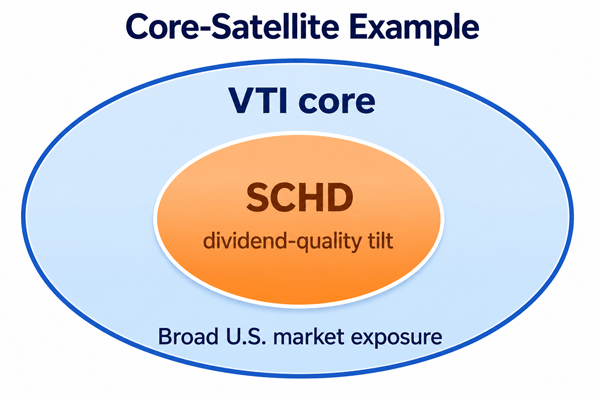
Figure 3. A core-satellite structure can use VTI for broad exposure and SCHD for a deliberate dividend tilt.
14. Beginner Checklist Before Buying SCHD or VTI
- Define the goal: growth, income, retirement, taxable wealth building, or a mix.
- Decide the time horizon. Money needed in the next 3 to 5 years usually should not be heavily exposed to stock ETFs.
- Check the expense ratio, index, number of holdings, top holdings, sector exposure, and dividend yield.
- Understand account type: taxable brokerage, Roth IRA, Traditional IRA, 401(k), or another account.
- Plan what you will do during a 20%, 30%, or 40% market decline before it happens.
- Use limit orders if trading during volatile markets, and avoid overtrading.
- Rebalance on a schedule, not based on headlines.
- Read the fund prospectus and official fund page before investing.
15. Common Mistakes to Avoid
| Mistake | Why it hurts | Better practice |
|---|---|---|
| Chasing the highest yield | High yield can signal risk or a possible dividend cut. | Focus on total return, quality, and sustainability. |
| Ignoring taxes | Dividends can create taxable income even when reinvested. | Match fund type with account type when possible. |
| Comparing price charts only | Price charts may ignore dividends. | Use total return charts with dividends reinvested. |
| Owning too many overlapping ETFs | More funds do not always mean more diversification. | Check overlap and define each fund’s job. |
| Selling after underperformance | Every strategy has periods of lagging. | Choose a strategy you can hold through full cycles. |
16. Actionable Decision Framework
Use this simple framework before deciding:
- Choose VTI if your main goal is broad long-term U.S. stock market exposure with very low cost and minimal complexity.
- Choose SCHD if you intentionally want a dividend-quality tilt and understand that it is narrower than the total market.
- Choose both if VTI will be your core and SCHD will serve a specific purpose, such as income preference or dividend discipline.
- Choose neither as a complete portfolio if you also need international diversification, bonds, cash, or a personalized retirement-income plan.
17. Frequently Asked Questions
17.1 Is SCHD better than VTI?
Not automatically. SCHD may be better for investors who want dividend income and a quality/value tilt. VTI may be better for investors who want broad U.S. market exposure and long-term simplicity.
17.2 Is VTI good for beginners?
VTI can be beginner-friendly because it owns thousands of U.S. stocks and has a very low expense ratio. Beginners still need to understand stock market risk and should not invest short-term emergency money.
17.3 Does SCHD pay monthly dividends?
SCHD has historically paid distributions quarterly, not monthly. Investors should check the official Schwab distribution page for the current schedule.
17.4 Can SCHD replace bonds?
No. SCHD is still a stock ETF. It can provide dividends, but it does not provide the same risk profile as high-quality bonds or cash.
17.5 Can VTI create income in retirement?
Yes, but VTI’s dividend yield is lower than SCHD’s. Retirees using VTI may combine dividends with planned share sales. Selling shares is not automatically bad if it is part of a disciplined withdrawal strategy.
17.6 Which is better for a Roth IRA?
Both can work. VTI offers broad long-term growth exposure, while SCHD can reinvest dividends without annual taxable brokerage-account drag inside a Roth IRA, assuming Roth rules are followed.
17.7 Should I put all my money in SCHD?
That would be a concentrated dividend/value bet compared with the total market. Most beginners should think carefully before making SCHD their only stock holding.
17.8 Should I put all my money in VTI?
VTI is broad within U.S. stocks, but it is not globally diversified and does not include bonds. It can be a strong U.S. equity core, but a complete portfolio may need more than VTI.
18. Final Verdict: SCHD vs VTI
SCHD and VTI are both strong low-cost ETFs, but they are not substitutes for the same job. SCHD is best understood as a dividend-quality ETF that may help investors who want income, dividend growth potential, and a value-oriented tilt. VTI is best understood as a broad U.S. market ETF that may help investors who want simple, diversified long-term exposure to American companies of many sizes and styles.
For beginners, the cleanest answer is often: start with the broad core first, then add tilts only when you understand why you want them. That usually means VTI can be the foundation, while SCHD can be a purposeful addition for income-focused investors. The best strategy is not the one that looks best in the last chart. It is the one you can fund consistently, hold patiently, and use responsibly in a portfolio that fits your real life.
Sources Consulted and Checked
The following official sources were consulted in preparing this article and checking its accuracy. Fund holdings, yields, expense ratios, tax rules, and other details can change, so readers should confirm current information directly with the relevant official source before acting.
- Schwab Asset Management - Schwab U.S. Dividend Equity ETF (SCHD)
- S&P Dow Jones Indices - Dow Jones U.S. Dividend 100 Index
- Vanguard - Vanguard Total Stock Market ETF (VTI)
- Investor.gov - Exchange-Traded Funds (ETFs)
- Investor.gov - Mutual Fund and ETF Fees and Expenses
- Internal Revenue Service - Topic No. 404, Dividends and Other Corporate Distributions
Reader Advice
This article is provided solely for educational and general informational purposes. It does not constitute personalized investment, financial, tax, legal, accounting, or retirement-planning advice, and it does not recommend that any reader buy, sell, or hold a particular security. Investing involves risk, including the possible loss of principal, and dividends, yields, holdings, fees, tax treatment, and market conditions may change. Past performance does not guarantee future results.
Before making any decision, readers should review the latest prospectus, fund reports, distribution information, and other official documents; verify all current facts and figures from authoritative sources; consider their objectives, time horizon, liquidity needs, tax position, and risk tolerance; and consult appropriately qualified professionals where necessary. Examples and portfolio allocations in this article are illustrative only and may not be suitable for every investor or jurisdiction.