SCHD vs VOO: Dividend Yield, Growth, and Total Returns Compared
SCHD and VOO are two of the most searched ETFs among long-term investors. Both are low-cost U.S. stock ETFs. Both can be held in retirement accounts, taxable brokerage accounts, and long-term portfolios. But they are not built for the same job.
VOO is a broad S&P 500 ETF. It owns the biggest profitable U.S. companies across many sectors and is usually used as a core growth-and-market-return holding. SCHD is a dividend-focused ETF. It owns about 100 U.S. companies selected for dividend yield, consistent dividend payments, and fundamental strength. The simplest way to think about the choice is this: VOO is built to capture the broad U.S. stock market through large companies; SCHD is built to provide higher dividend income from profitable, shareholder-friendly companies.
For beginners, the best ETF is not automatically the one with the highest dividend yield. The better question is: do you need current income, long-term growth, tax efficiency, or a mix of all three? This guide compares SCHD vs VOO in plain English and shows how each fund may fit different investor goals.
| Quick answer | SCHD | VOO |
|---|---|---|
| Best known for | Higher dividend yield and dividend growth style | Broad S&P 500 exposure and long-term capital growth |
| Current quoted/TTM yield snapshot | About 3.25% | About 1.03% |
| Expense ratio | 0.06% | 0.03% |
| Number of holdings | 103 | About 504 stocks in the ETF |
| Portfolio style | Dividend/value/quality tilt | Large-cap blend with growth-heavy mega-cap exposure |
| Beginner use case | Income sleeve or dividend-focused allocation | Core U.S. stock market holding |
| Main risk | Can lag when mega-cap growth stocks lead | Lower income and high exposure to top S&P 500 companies |
Bottom line: VOO has historically been the cleaner one-fund choice for many beginners who want simple U.S. market exposure. SCHD can be useful for investors who want more dividend income, prefer mature value-oriented companies, or want to diversify away from the most expensive mega-cap growth names. Many investors do not need to choose only one; a blend can be reasonable if it matches the plan.
1. What Is SCHD?
SCHD is the Schwab U.S. Dividend Equity ETF. Its goal is to track the Dow Jones U.S. Dividend 100 Index before fees and expenses. In simple words, SCHD tries to own a basket of U.S. companies that pay meaningful dividends and pass quality screens. It is not just a fund that buys the highest-yielding stocks. That distinction matters because extremely high yields can sometimes be a warning sign that a dividend is at risk.
The index behind SCHD focuses on U.S. companies with records of consistently paying dividends and then selects companies based on fundamental strength relative to peers. The result is a portfolio that often tilts toward established, profitable companies in sectors such as industrials, financials, health care, energy, consumer staples, and technology hardware or semiconductors, depending on the annual index rebalancing.
- SCHD is usually attractive to investors who like dividend income, dividend growth, and lower valuations.
- It can be used by retirees, near-retirees, or long-term investors who want part of their portfolio to generate more cash flow.
- It is still a stock ETF, so it can fall sharply in bear markets. A dividend ETF is not the same as a savings account or bond fund.
2. What Is VOO?
VOO is the Vanguard S&P 500 ETF. It tracks the S&P 500 Index, which is one of the most widely followed benchmarks for large U.S. companies. VOO owns hundreds of companies and is designed to give investors broad exposure to the large-cap U.S. stock market at a very low cost.
VOO is often used as a core holding because it is simple, diversified, inexpensive, and easy to understand. When people say they are buying “the market,” they often mean an S&P 500 fund like VOO, even though the true total U.S. stock market also includes mid-cap and small-cap companies.
- VOO is usually attractive to beginners who want a simple long-term growth engine.
- It has a lower dividend yield than SCHD because many S&P 500 companies reinvest profits instead of paying large dividends.
- Its performance can be strongly influenced by the largest technology and growth companies because the S&P 500 is market-cap weighted.
3. SCHD vs VOO: How They Work
The biggest difference is the selection method. SCHD filters for dividend and quality characteristics. VOO follows market capitalization. That means VOO gives the biggest weights to the largest companies, while SCHD gives exposure to companies that meet dividend-focused rules. This can lead to very different experiences even though both funds hold U.S. stocks.
| Feature | SCHD | VOO | Why it matters |
|---|---|---|---|
| Index | Dow Jones U.S. Dividend 100 Index | S&P 500 Index | The index decides what the ETF owns. |
| Stock selection | Dividend record, yield, and fundamental strength | Large U.S. companies selected for the S&P 500 | SCHD is more rules-based around dividends; VOO is broad large-cap exposure. |
| Weighting style | Dividend/quality index methodology | Market-cap weighted | VOO concentrates more in the biggest winners; SCHD may look more value-oriented. |
| Income profile | Higher dividend yield | Lower dividend yield | SCHD may feel better for investors who want cash flow. |
| Growth profile | More mature companies; less mega-cap growth exposure | More exposure to fast-growing mega-cap leaders | VOO may do better when growth stocks lead the market. |
| Rebalancing impact | Can replace companies that no longer fit dividend-quality rules | Changes mainly with S&P 500 index membership and market cap | SCHD may rotate more based on dividend and quality screens. |
4. Dividend Yield: SCHD Usually Pays More, but Yield Is Not Everything
Dividend yield is the annual dividend income divided by the ETF price. If an ETF yields 3%, a $10,000 investment would generate roughly $300 over a year before taxes, assuming the dividend rate and price do not change. In real life, dividends change, prices move, and taxes depend on the account type and the investor’s situation.
SCHD’s quoted yield is much higher than VOO’s. Recent public quote data showed SCHD around 3.25% and VOO around 1.03%. On a $100,000 portfolio, that difference can feel large: SCHD might produce about $3,250 in annual dividends while VOO might produce about $1,030, before taxes and before any dividend changes.
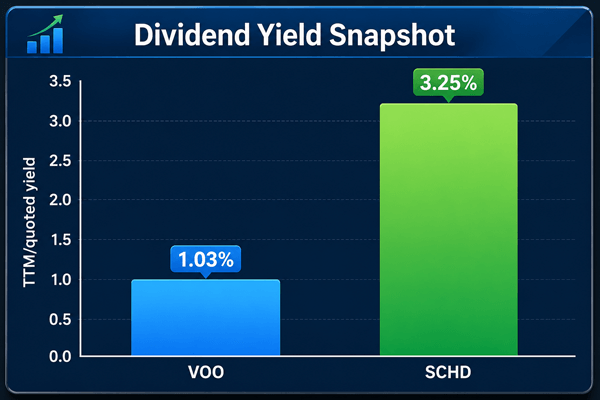
Dividend Yield Snapshot
Chart note: Dividend yield figures are snapshots from public quote data and change with ETF price and distributions.
| Investment amount | Estimated annual dividends from VOO at 1.03% | Estimated annual dividends from SCHD at 3.25% | Difference |
|---|---|---|---|
| $10,000 | $103 | $325 | $222 more from SCHD |
| $50,000 | $515 | $1,625 | $1,110 more from SCHD |
| $100,000 | $1,030 | $3,250 | $2,220 more from SCHD |
| $500,000 | $5,150 | $16,250 | $11,100 more from SCHD |
The practical lesson: SCHD can provide more current income, but VOO may provide more capital appreciation in periods when large growth companies dominate. Dividend yield is only one part of total return. A $300 dividend plus a falling share price is not better than a $100 dividend plus strong price appreciation. Beginners should compare total return, not only yield.
5. Dividend Growth: What Beginners Should Understand
Dividend growth means the income paid by the fund may rise over time as the companies inside the fund raise their dividends. SCHD is popular among dividend growth investors because its strategy is built around companies with established dividend records and quality characteristics. VOO also pays dividends, but dividend growth is not the main purpose of the fund.
A useful beginner mindset is to separate “income today” from “wealth tomorrow.” SCHD may give more cash flow today. VOO may give more exposure to companies that reinvest profits for growth. Neither approach is automatically superior. The right answer depends on the investor’s time horizon, taxes, and need for income.
- If you are young and do not need income, reinvesting dividends and focusing on total return may matter more than current yield.
- If you are retired or building a cash-flow portfolio, a higher-yielding fund like SCHD may reduce the amount you need to sell during normal markets.
- If you hold dividend ETFs in a taxable account, dividends may create annual tax bills even if you reinvest them.
6. Total Returns: Which ETF Has Performed Better?
Total return includes price gains plus dividends, assuming dividends are reinvested. This is the fairest way to compare SCHD vs VOO because SCHD pays more dividends while VOO usually relies more on price growth.
Recent official fund data showed SCHD with about 12.37% average annual 10-year market-price return and VOO with about 14.11% to 14.12% average annual 10-year return, depending on NAV or market price reporting date. The exact comparison changes based on the end date, but the broad pattern has been clear in many recent periods: VOO has often led when mega-cap growth and technology stocks performed strongly, while SCHD has appealed to investors who want more income and value exposure.
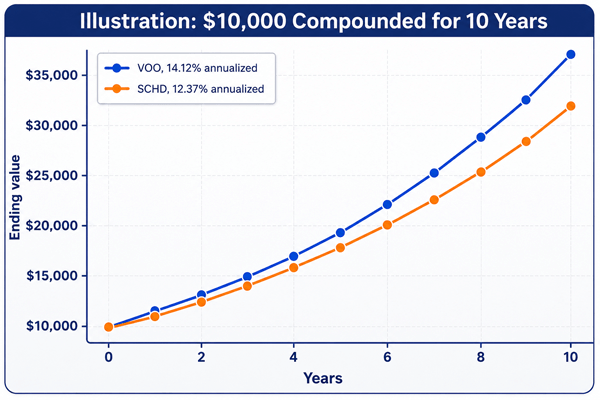
$10,000 Compounded for 10 Years
Chart note: This is an illustration using quoted 10-year annualized returns from official fund materials. It is not a prediction.
| Metric | SCHD | VOO | Beginner takeaway |
|---|---|---|---|
| 10-year annualized return snapshot | About 12.37% | About 14.12% | VOO led in this snapshot, helped by strong mega-cap growth performance. |
| Dividend income | Higher | Lower | SCHD may be more useful for cash flow. |
| Capital appreciation potential | Moderate to strong, but value/dividend tilted | Strong broad-market exposure | VOO may benefit more when the largest growth stocks lead. |
| Best comparison method | Total return with dividends reinvested | Total return with dividends reinvested | Never compare only dividend yield. |
7. Fees and Expense Ratios: Both Are Cheap
Expense ratio is the annual fund fee taken from the ETF assets. It is not a bill you pay separately, but it reduces fund returns over time. VOO’s expense ratio is about 0.03%, and SCHD’s is about 0.06%. Both are low-cost ETFs. On $10,000, VOO costs roughly $3 per year and SCHD costs roughly $6 per year, based on expense ratio alone.
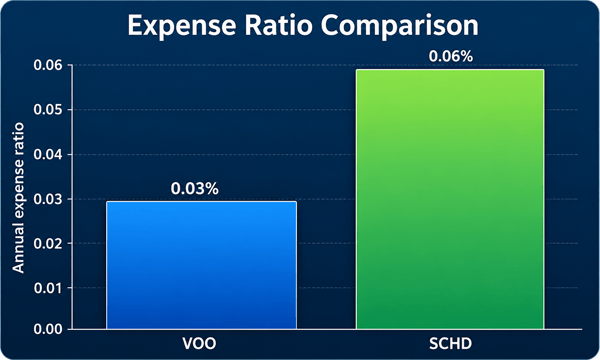
Expense Ratio Comparison
| Portfolio size | VOO at 0.03% | SCHD at 0.06% | Annual fee difference |
|---|---|---|---|
| $10,000 | $3 | $6 | $3 |
| $100,000 | $30 | $60 | $30 |
| $500,000 | $150 | $300 | $150 |
The practical lesson: Fees are important, but the difference between 0.03% and 0.06% is not usually the deciding factor. Asset allocation, tax location, behavior, and time in the market will likely matter much more.
8. Holdings and Sector Exposure: What You Actually Own
VOO owns the S&P 500 and is heavily influenced by the biggest companies in the index. Recent Vanguard materials showed top holdings such as NVIDIA, Apple, Alphabet, Microsoft, Amazon, Broadcom, Meta Platforms, Tesla, Berkshire Hathaway, and JPMorgan Chase. Technology was the largest sector exposure in the fact sheet, which helps explain why VOO can do very well when mega-cap technology stocks lead the market.
SCHD owns far fewer stocks and has a different personality. Recent Schwab data showed 103 total holdings. Public holding snapshots around the same period showed large positions in companies such as Qualcomm, Texas Instruments, UnitedHealth Group, Coca-Cola, and Chevron. SCHD does not simply mirror the S&P 500. It may have less exposure to the hottest mega-cap growth stocks and more exposure to dividend-paying value and quality companies.
| Question | Why it matters | SCHD answer | VOO answer |
|---|---|---|---|
| Do I want a core market fund? | A core fund should be broad and simple. | Can be part of a core, but it is a dividend/value tilt. | Yes, VOO is commonly used as a core U.S. equity holding. |
| Do I want high income? | Income can matter for retirees and cash-flow investors. | Yes, higher yield. | No, yield is lower. |
| Do I want mega-cap tech exposure? | Mega-cap tech has driven many recent S&P 500 returns. | Less direct exposure. | Higher exposure through market-cap weighting. |
| Do I want fewer holdings? | Fewer holdings can mean more concentration. | Yes, around 100 holdings. | No, hundreds of holdings. |
9. Risk Comparison: The Risks Are Different, Not Absent
Both SCHD and VOO are stock ETFs, so both can lose money. A beginner mistake is assuming a dividend ETF is “safe” just because it pays income. Dividends can be cut, sectors can underperform, and ETF prices can decline.
| Risk | SCHD | VOO | How to manage it |
|---|---|---|---|
| Market risk | High: still U.S. stocks | High: still U.S. stocks | Keep an emergency fund and use a long-term time horizon. |
| Concentration risk | Fewer holdings and dividend-style concentration | Top-heavy in mega-cap companies | Avoid making either fund 100% of money needed soon. |
| Style risk | Can lag growth markets | Can lag value/dividend markets | Blend styles or accept cycles. |
| Dividend risk | Companies can reduce payouts; yield can change | Lower yield; dividends not main attraction | Do not rely on yield alone for retirement income. |
| Valuation risk | Dividend stocks can be expensive too | S&P 500 can become expensive after strong rallies | Invest gradually and rebalance. |
10. Taxes: SCHD May Create More Taxable Income
Taxes are one of the most overlooked parts of the SCHD vs VOO decision. In a tax-advantaged account such as a traditional IRA, Roth IRA, or 401(k), dividends usually do not create the same current taxable event as they do in a regular brokerage account. In a taxable brokerage account, dividends may be taxed in the year received, even if you reinvest them.
Because SCHD pays a higher dividend yield, it may create more taxable income than VOO in a taxable account. That does not mean SCHD is bad. It means the investor should know the trade-off. If an investor is in a high tax bracket and does not need current income, VOO or a total-market ETF may be more tax-efficient. If an investor needs income or is in a low tax bracket, SCHD may still make sense.
| Account type | SCHD fit | VOO fit | Practical note |
|---|---|---|---|
| Roth IRA | Strong fit for dividend reinvestment and tax-free qualified withdrawals if rules are met | Strong fit for long-term growth | A Roth can be a good place for high-dividend assets. |
| Traditional IRA/401(k) | Useful for income-focused allocation | Useful for core growth | Withdrawals are usually taxed as ordinary income. |
| Taxable brokerage | Can work, but higher dividends may increase annual tax drag | Often more tax-efficient due to lower yield | Know qualified dividend rules and your tax bracket. |
11. Practical Examples: Which Investor Might Prefer SCHD or VOO?
The right choice depends on the job the ETF is supposed to do. Here are practical examples.
11.1. Example 1: The 25-year-old beginner investing for retirement
A young investor with 30 to 40 years before retirement may not need portfolio income today. For this person, VOO may be the simpler core holding because it captures broad S&P 500 growth at a very low fee. SCHD can still be used, but it should not be chosen only because the dividend feels rewarding. Reinvested dividends are fine, but total return and tax efficiency matter more for long horizons.
11.2. Example 2: The 45-year-old investor building a balanced portfolio
An investor in mid-career may want both growth and income. A blend such as 70% VOO and 30% SCHD, or 60% VOO and 40% SCHD, can create a portfolio that still has broad-market exposure while adding dividend quality and a higher cash-flow profile. The exact mix should depend on the rest of the portfolio, risk tolerance, and tax situation.
11.3. Example 3: The retiree who wants income without picking individual stocks
A retiree may prefer SCHD because it can generate more dividend income than VOO. However, relying only on SCHD can still be risky because it remains an equity ETF. A practical retirement portfolio often includes cash, bonds, and diversified stock funds. SCHD can be one income sleeve, not the entire retirement plan.
| Goal | Possible approach | Why |
|---|---|---|
| Maximum simplicity | Use VOO as the main U.S. equity holding | Easy to understand, broad, low cost. |
| More dividend income | Use SCHD as an income/value sleeve | Higher yield and dividend-oriented screening. |
| Balanced growth and income | Blend VOO and SCHD | Combines broad market exposure with dividend tilt. |
| Retirement cash flow | SCHD plus bonds/cash, not SCHD alone | Dividend income is helpful, but stock volatility still matters. |
12. SCHD vs VOO Portfolio Blends
Many investors online treat SCHD vs VOO like a winner-take-all debate. In practice, a blend can be more realistic. VOO can serve as the growth core, while SCHD can add dividend income and value exposure.
| Portfolio mix | Estimated blended yield using 1.03% VOO and 3.25% SCHD | Investor profile |
|---|---|---|
| 100% VOO | 1.03% | Maximum simplicity and broad S&P 500 exposure. |
| 80% VOO / 20% SCHD | 1.47% | Beginner wants mostly market growth with a small dividend tilt. |
| 60% VOO / 40% SCHD | 1.92% | Investor wants a balanced growth-and-income feel. |
| 50% VOO / 50% SCHD | 2.14% | Investor wants meaningful dividend income without abandoning the S&P 500. |
| 100% SCHD | 3.25% | Investor prioritizes dividends and accepts style concentration. |
This table is only a simple yield illustration. It does not predict returns. A blended portfolio can still decline during market downturns.
13. Common Beginner Mistakes
- Choosing SCHD only because the dividend yield is higher. A higher yield does not automatically mean a better investment.
- Ignoring total return. Always compare price growth plus reinvested dividends.
- Forgetting taxes. Higher dividends can create more taxable income in a brokerage account.
- Assuming VOO is perfectly diversified. It is diversified, but it can become top-heavy in the largest companies.
- Buying both without a plan. SCHD and VOO can work together, but the allocation should have a reason.
- Changing strategy after one bad year. Dividend/value stocks and growth stocks lead in different cycles.
- Using stock ETFs for short-term money. Money needed in the next few years usually should not depend on equity market prices.
14. Actionable Checklist Before Buying SCHD or VOO
- Decide the job of the ETF: core growth, income, or a blend.
- Check the latest yield, expense ratio, holdings, and performance on the official fund pages.
- Compare total return, not only dividend yield.
- Choose the account location: taxable, Roth IRA, traditional IRA, or 401(k).
- Write down your target allocation before buying.
- Use automatic investing if available and keep costs low.
- Rebalance once or twice a year rather than reacting to headlines.
- Review whether the ETF still fits your goal, not whether it beat another ETF last month.
15. Which Is Better: SCHD or VOO?
VOO may be better for beginners who want the simplest long-term U.S. stock market holding, especially investors who do not need current income. It is extremely low cost, broad, and easy to use as a portfolio core.
SCHD may be better for investors who want more dividend income, prefer mature dividend-paying companies, or want a value/quality tilt next to an S&P 500 fund. It can be especially attractive for investors building a dividend portfolio or retirement income strategy, as long as they understand the tax and concentration trade-offs.
The best practical answer for many people is not “SCHD or VOO,” but “VOO as the core and SCHD as a satellite,” if dividend income fits the plan. For example, a long-term investor might use VOO for the majority of U.S. equity exposure and SCHD for a smaller dividend allocation. A retiree might use more SCHD, but still keep bonds and cash for stability.
16. FAQ: SCHD vs VOO
16.1. Is SCHD better than VOO for dividends?
Yes, SCHD usually has a much higher dividend yield than VOO. But dividend yield alone does not measure total wealth creation.
16.2. Is VOO better than SCHD for long-term growth?
VOO has often been stronger in periods led by mega-cap growth stocks. It may be a better one-fund choice for investors who want broad S&P 500 exposure.
16.3. Can I hold both SCHD and VOO?
Yes. Many investors use VOO as a core holding and SCHD as a dividend/value sleeve. The key is choosing an allocation that matches your goals.
16.4. Is SCHD safe for retirement income?
SCHD can be useful for retirement income, but it is still a stock ETF. Retirees usually need a broader plan that may include cash, bonds, and diversified equities.
16.5. Does VOO pay dividends?
Yes. VOO pays dividends, generally quarterly, but its yield is much lower than SCHD because the fund is not designed mainly for income.
16.6. Which ETF is better in a taxable account?
VOO may be more tax-efficient for investors who do not need income because it has a lower dividend yield. SCHD can still be held in taxable accounts, but investors should understand the tax impact of dividends.
16.7. Should beginners buy SCHD, VOO, or both?
A beginner who wants simplicity may start with VOO. A beginner who understands dividends and wants more income may add SCHD. The best choice depends on time horizon, taxes, and risk tolerance.
17. Final Takeaway
SCHD and VOO are both high-quality, low-cost ETFs, but they solve different problems. SCHD is more about dividend income, dividend quality, and value exposure. VOO is more about broad S&P 500 growth and simple market exposure. Beginners should avoid chasing yield and instead ask: What do I need this ETF to do in my portfolio?
For most long-term beginners, VOO is often the easier core building block. For investors who want more income or a dividend-growth tilt, SCHD can be a strong complement. The winning strategy is not finding the perfect ETF. It is building a clear plan, keeping costs low, staying diversified, reinvesting when appropriate, and avoiding emotional decisions during market swings.
Reader Advice
This article is provided solely for educational and informational purposes and does not constitute personalized investment, financial, tax, or legal advice. ETFs involve market risk, including the possible loss of principal, and past performance does not guarantee future results. Yields, prices, holdings, fees, index rules, tax treatment, and performance figures may change over time and may differ by account type, jurisdiction, market conditions, and individual circumstances.
Before making any investment or financial decision, readers should review the latest official fund documents and other authoritative sources and, where appropriate, consult a qualified financial adviser, tax professional, or legal professional. Do not rely on this article alone when making a decision.
Sources Consulted and Checked
The following sources were consulted and checked while preparing this article and reviewing its factual accuracy. Because ETF data can change, readers should verify current figures on the official fund and index-provider websites before acting.
- Schwab Asset Management, Schwab U.S. Dividend Equity ETF (SCHD) fund page, accessed June 22, 2026. Key data used: objective, expense ratio, net assets, holdings count, NAV, and average annual returns. https://www.schwabassetmanagement.com/products/schd
- S&P Dow Jones Indices, Dow Jones U.S. Dividend 100 Index description and methodology materials, accessed June 22, 2026. Key data used: index objective and dividend/quality selection concept. https://www.spglobal.com/spdji/en/indices/dividends-factors/dow-jones-us-dividend-100-index/ and methodology PDF.
- Vanguard, Vanguard S&P 500 ETF (VOO) fact sheet, dated March 31, 2026. Key data used: benchmark, expense ratio, quarterly dividend schedule, holdings count, top holdings, sector diversification, and 10-year annualized return. https://workplace.vanguard.com/iippdf/pdfs/FS968R.pdf
- Morningstar and public quote snapshots, accessed June 2026, used only for yield cross-checks because yields change frequently.
- Finance quote snapshot for SCHD and VOO, June 22, 2026, used as a current price reference. Prices change during market hours.