SPYG vs VOO: Should You Choose a Growth ETF or the S&P 500?
1. Quick answer
VOO is usually the simpler core choice for beginners because it tracks the full S&P 500 and gives broad large-cap U.S. stock exposure in one low-cost ETF. SPYG is more focused: it owns the growth side of the S&P 500, with heavier exposure to fast-growing companies and technology-led businesses. That focus can help when growth stocks lead, but it can also hurt more when expensive growth stocks fall out of favor.
A practical way to think about it: VOO can be the “main meal” of a U.S. stock portfolio; SPYG is more like a growth tilt. Many investors do not need to choose only one. A beginner could use VOO as the core holding, then add a smaller SPYG allocation only if they understand and accept the extra concentration risk.
Data checked: June 2026. Holdings, yields, prices, assets, and expense ratios may change after this date.
2. SPYG vs VOO at a glance
| Feature | SPYG | VOO | What it means for a beginner |
|---|---|---|---|
| Full name | SPDR Portfolio S&P 500 Growth ETF | Vanguard S&P 500 ETF | Both are U.S. stock ETFs, but they do not do the same job. |
| Index tracked | S&P 500 Growth Index | S&P 500 Index | SPYG selects growth-style S&P 500 stocks; VOO tracks the broader S&P 500. |
| Investment style | Large-cap growth | Large-cap blend | SPYG leans toward growth; VOO mixes growth and value. |
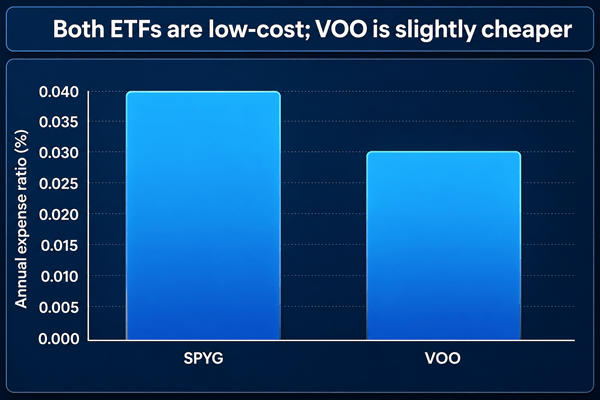
| Expense ratio | 0.04% | 0.03% | Both are very cheap. VOO is slightly cheaper. |
| Number of holdings | About 147 | About 519 | VOO is broader; SPYG is more concentrated. |
| Dividend profile | Lower yield, growth-heavy | Higher yield than SPYG, but still not a high-dividend ETF | Neither is mainly an income ETF. |
| Best role | Growth tilt or satellite holding | Core U.S. stock holding | VOO fits more beginner portfolios as a foundation. |
| Main risk | Concentration in growth and tech-related stocks | General U.S. stock market risk | SPYG can swing harder when growth stocks decline. |
3. What is an ETF?
An ETF, or exchange-traded fund, is a basket of investments that trades on a stock exchange. Instead of buying 50 or 500 individual stocks yourself, you buy one ETF share and get exposure to all the stocks inside the fund. ETFs are popular because they are simple, transparent, usually low-cost, and easy to buy in a brokerage account, IRA, Roth IRA, or other investment account.
For a beginner, the key idea is this: an ETF does not remove risk, but it spreads your money across many companies. That can reduce the damage from one company doing badly. However, if the whole market falls, an ETF like SPYG or VOO can still fall too.
4. What is VOO?
VOO is Vanguard’s S&P 500 ETF. It is designed to track the S&P 500, a widely followed index of large U.S. companies. When people say “the market was up today,” they often mean the S&P 500 or a similar broad index.
VOO owns companies across all major sectors, including technology, financials, health care, consumer companies, industrials, energy, utilities, real estate, and more. It is not equally weighted. Bigger companies have bigger weights, so mega-cap companies can still have a large influence on performance.
4.1 Why beginners like VOO:
- It is easy to understand: one ETF tracking the broad S&P 500.
- It has a very low expense ratio of 0.03%.
- It is diversified across hundreds of large U.S. companies.
- It can work as a long-term core holding for retirement investing, taxable brokerage investing, or general wealth-building.
5. What is SPYG?
SPYG is the SPDR Portfolio S&P 500 Growth ETF. It also starts with the S&P 500 universe, but it does not buy the whole index. It focuses on S&P 500 companies with stronger growth characteristics. State Street describes the growth selection criteria as sales growth, earnings change to price, and momentum.
In plain English, SPYG tries to own the faster-growing side of the S&P 500. That often means heavier exposure to technology and communication-services companies. It may include many familiar names, but the weights are different from VOO.
5.1 Why investors consider SPYG:
- They want more exposure to companies expected to grow faster than the average large U.S. company.
- They have a long time horizon and can tolerate bigger ups and downs.
- They already own a broad index fund and want a growth tilt.
- They prefer a low-cost growth ETF rather than picking individual growth stocks.
6. How SPYG and VOO actually work
Both funds are passive index ETFs. The fund manager is not trying to guess which stock will be the next winner. Instead, the fund follows rules set by its benchmark index. If the index changes, the ETF updates its holdings to keep tracking it.
VOO tracks the S&P 500. SPYG tracks the S&P 500 Growth Index. The difference comes from the index rules. VOO holds the broader basket. SPYG filters the S&P 500 for growth characteristics and then weights those companies by market capitalization.
| Question | VOO answer | SPYG answer |
|---|---|---|
| Do I own real companies? | Yes, indirectly through the ETF portfolio. | Yes, indirectly through the ETF portfolio. |
| Can the price fall? | Yes. It moves with the U.S. stock market. | Yes. It can fall more sharply if growth stocks sell off. |
| Does it pay dividends? | Yes, but it is not a high-income ETF. | Yes, but the yield is usually lower because growth companies often reinvest cash. |
| Is it actively managed? | No. It tracks an index. | No. It tracks a growth index. |
| Is it good for day trading? | This article focuses on long-term investing, not short-term trading. | This article focuses on long-term investing, not short-term trading. |
7. Cost comparison: expense ratio and why it matters
The expense ratio is the annual fee charged by the ETF, expressed as a percentage of assets. If an ETF has a 0.03% expense ratio, that means about $3 per year for every $10,000 invested. If an ETF has a 0.04% expense ratio, that means about $4 per year for every $10,000 invested.
The difference between SPYG and VOO is tiny: SPYG is 0.04%, while VOO is 0.03%. Cost alone should not decide the whole comparison. The bigger decision is whether you want broad S&P 500 exposure or a growth-focused tilt.
| Investment amount | SPYG cost at 0.04% | VOO cost at 0.03% | Difference per year |
|---|---|---|---|
| $1,000 | $0.40 | $0.30 | $0.10 |
| $10,000 | $4.00 | $3.00 | $1.00 |
| $100,000 | $40.00 | $30.00 | $10.00 |
| $500,000 | $200.00 | $150.00 | $50.00 |
8. Holdings comparison: what do you really own?
VOO gives you the full S&P 500 basket. SPYG gives you only the growth side of that basket. That difference can create a very different experience even though both funds are connected to S&P 500 companies.
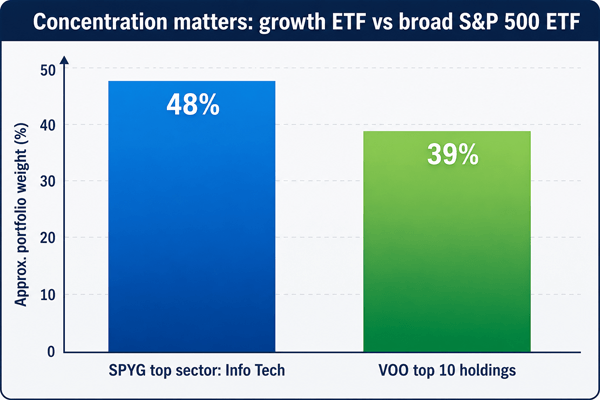
According to State Street’s SPYG fact sheet, SPYG’s top holdings recently included NVIDIA, Microsoft, Apple, Alphabet, Broadcom, Meta, Amazon, Berkshire Hathaway, and Eli Lilly. The same fact sheet showed information technology as nearly half of SPYG’s portfolio. That is a major point for beginners: SPYG is not “just the S&P 500 with a different ticker.” It is a more focused growth portfolio.
VOO also has large weights in mega-cap technology and communication companies, because the S&P 500 itself is market-cap weighted. But VOO still includes more value-oriented, defensive, cyclical, and dividend-paying companies than SPYG.
8.1 Practical takeaway
If you buy VOO, you are saying: “I want broad large-company U.S. market exposure.” If you buy SPYG, you are saying: “I want extra exposure to the growth side of large U.S. companies.” Those are different decisions.
9. Performance: which one has better returns?
There is no permanent winner. Growth ETFs like SPYG can outperform when investors reward fast-growing companies, low interest rates, artificial intelligence themes, software businesses, and other growth stories. But growth stocks can also fall hard when valuations look expensive, interest rates rise, earnings disappoint, or investors rotate into value stocks, dividend stocks, or defensive sectors.
VOO will usually look less exciting than a growth ETF during strong growth-led bull markets. But that is part of its appeal. It does not ask you to predict whether growth or value will win next. It simply owns the broad S&P 500.
| Market environment | SPYG may do better when... | VOO may feel better when... |
|---|---|---|
| Growth-led bull market | Mega-cap growth, technology, AI, cloud, software, and high-valuation companies lead the market. | It still benefits, but may lag SPYG because it owns more sectors. |
| Value rotation | SPYG can lag because investors prefer cheaper or dividend-paying companies. | VOO has more balance across styles and sectors. |
| Rising interest rates | Growth valuations may come under pressure. | VOO can still decline, but it is less purely tied to growth. |
| Recession fears | High-growth stocks may become volatile if earnings expectations fall. | VOO can also drop, but defensive sectors may cushion some weakness. |
| Long-term compounding period | SPYG can reward patience if growth leadership continues. | VOO offers simpler, broader compounding without a style bet. |
10. Risk comparison: the part many beginner articles skip
A beginner often asks, “Which ETF gives higher returns?” A better question is, “Which ETF can I hold through bad years without panicking?” The best ETF on paper is not helpful if you sell it during a market drop.
SPYG’s main risk is concentration. When a few large growth companies drive the fund, your result depends heavily on those companies continuing to perform well. That can be great in strong periods and painful in weak periods.
VOO’s main risk is broad stock market risk. It can still lose a lot in bear markets because it is 100% stocks. But it is less dependent on a single investment style than SPYG.
| Risk | How it affects SPYG | How it affects VOO | Beginner-friendly lesson |
|---|---|---|---|
| Market risk | High | High | Both can lose money. Do not invest short-term cash needed soon. |
| Sector concentration | Higher | Moderate | SPYG is more tied to technology-led growth. |
| Valuation risk | Higher | Moderate | Growth stocks can fall if investors stop paying premium prices. |
| Style risk | Higher | Lower | SPYG depends on growth beating other styles. |
| Behavior risk | Higher for nervous investors | Lower but still real | Choose the ETF you can actually hold. |
11. Beginner portfolio examples
These examples are educational, not personal recommendations. The right allocation depends on your age, income stability, debt, emergency fund, tax situation, retirement plan, and risk tolerance.
| Investor type | Possible ETF structure | Why it may fit | Main caution |
|---|---|---|---|
| True beginner who wants simplicity | 100% VOO for U.S. large-cap exposure, plus separate bond/international funds if needed | Simple, broad, low-cost, easy to understand | Not fully diversified globally; still 100% U.S. large-cap stocks if used alone. |
| Beginner with long horizon and higher risk tolerance | 80% VOO / 20% SPYG within the U.S. stock sleeve | VOO remains the core while SPYG adds a growth tilt | SPYG can increase volatility and concentration. |
| Growth-focused investor | 60% VOO / 40% SPYG within the U.S. stock sleeve | More aggressive exposure to growth leadership | Can underperform badly if growth stocks lag. |
| Investor near retirement | VOO may be used only as part of a diversified portfolio with bonds and cash reserves | Less style-specific than SPYG | Stock ETFs can still drop sharply near withdrawals. |
| Taxable brokerage investor | VOO as core; SPYG only if the growth tilt is intentional and held long term | Low-turnover ETFs can be tax-efficient compared with many active funds | Taxes depend on dividends, sales, income level, and holding period. |
12. How to decide: a simple decision framework
- Start with your goal. Are you investing for retirement, a house down payment, general wealth, or short-term savings? Money needed in the next few years usually should not be in stock ETFs.
- Decide if this is a core holding or a satellite holding. Core holdings should usually be broad, low-cost, and easy to hold. Satellite holdings can be more focused, but should be smaller.
- Check your current overlap. If you already own VOO, VTI, an S&P 500 index fund, or a target-date fund, you may already own many SPYG companies.
- Ask whether you can handle underperformance. SPYG can lag VOO for long stretches. A growth ETF is not guaranteed to beat the S&P 500.
- Choose an allocation you can hold. A modest SPYG tilt may be easier to stick with than making SPYG your whole portfolio.
12.1 A practical “sleep test”
Imagine your ETF falls 30% during a bad market. If you would panic-sell SPYG because it feels too concentrated, VOO may be more suitable. If you would panic-sell both, your stock allocation may be too high, and you may need more cash, bonds, or a more balanced strategy.
13. SPYG vs VOO for retirement accounts
In retirement accounts such as a 401(k), traditional IRA, or Roth IRA, investors often focus on long-term growth, low costs, and simple diversification. VOO can fit well as a core U.S. stock holding. SPYG can fit as a smaller growth tilt for investors who understand the risk.
For Roth IRA investors, growth-oriented assets can be attractive because qualified withdrawals may be tax-free. But that does not automatically make SPYG the best choice. The investment still has to match your risk tolerance and total portfolio.
14. SPYG vs VOO in a taxable brokerage account
ETFs are often tax-efficient, but taxes still matter. Dividends may be taxable in the year received. Selling shares at a gain can create capital gains tax. Holding for more than one year may qualify for long-term capital gains treatment in the U.S., but tax rules vary by person and can change.
VOO may distribute more dividends than SPYG because it owns more mature companies. SPYG may have a lower yield, but it can still create taxable dividends and taxable gains if sold. Do not choose an ETF only because of taxes. Choose the right investment first, then place it wisely.
15. Common mistakes to avoid
- Thinking SPYG and VOO are almost the same. They overlap, but SPYG is more focused on growth. It is not a complete replacement for broad S&P 500 exposure.
- Chasing recent performance. Many investors buy growth ETFs after a strong run, then get disappointed when leadership changes.
- Ignoring concentration. A fund can own more than 100 stocks and still be heavily influenced by a handful of mega-cap names.
- Using stock ETFs for short-term savings. Money needed for rent, tuition, a house deposit, taxes, or emergency expenses should usually be kept safer.
- Forgetting international stocks, bonds, and cash. VOO and SPYG are U.S. stock ETFs. They are not complete financial plans by themselves.
- Checking the portfolio every day. Long-term ETF investing works best when paired with patience, a realistic plan, and disciplined contributions.
16. Which ETF is better for beginners?
For most beginners, VOO is the more natural starting point because it is broader, cheaper by a tiny amount, and easier to explain. It gives exposure to the S&P 500 without requiring a view on whether growth stocks will outperform.
SPYG may be better for a beginner only when the person understands that it is a growth tilt, not a complete market portfolio. It may suit investors with a longer time horizon, higher risk tolerance, and a clear reason for wanting more growth exposure.
| Choose VOO if... | Choose SPYG if... |
|---|---|
| You want a simple core S&P 500 ETF. | You want a focused growth ETF. |
| You do not want to bet on one investment style. | You believe growth exposure belongs in your portfolio and can handle volatility. |
| You are building your first long-term portfolio. | You already have a broad core and want a satellite tilt. |
| You prefer fewer decisions and less tinkering. | You are comfortable monitoring concentration and style risk. |
17. Final verdict
VOO is the stronger default choice for a beginner who wants broad, low-cost U.S. stock exposure. SPYG is not bad; it is simply more specific. The honest answer is not “SPYG is better” or “VOO is better.” The honest answer is: VOO is usually better as the foundation, while SPYG may be useful as a smaller growth tilt if it fits your plan.
A sensible beginner approach is to first build the basics: emergency fund, debt plan, retirement account contributions, a diversified investment portfolio, and a long-term mindset. After that, consider whether adding SPYG improves the portfolio or simply adds excitement. Good investing is usually more about discipline than finding the hottest ETF.
18. FAQ
18.1 Is SPYG safer than VOO?
No. SPYG is generally more concentrated in growth stocks, which can make it more volatile. VOO is broader, but it is still a stock ETF and can lose money.
18.2 Can I own both SPYG and VOO?
Yes. Many investors use a broad S&P 500 ETF as the core and a growth ETF as a smaller tilt. Just remember that there is overlap, so owning both increases exposure to many of the same large companies.
18.3 Is VOO enough for a full portfolio?
VOO can be a strong U.S. stock core, but it is not a complete global portfolio. Many investors also consider international stocks, bonds, cash reserves, and other assets based on their goals.
18.4 Is SPYG good for long-term investing?
It can be, but only for investors who want growth exposure and can handle periods of underperformance. Long-term does not mean risk-free.
18.5 Which is better for a Roth IRA?
Either can be used in a Roth IRA. VOO is simpler as a core holding. SPYG may be used as a growth tilt if the investor has a long horizon and accepts higher concentration risk.
18.6 Does SPYG pay dividends?
Yes. But it typically has a lower yield than broader or value-oriented ETFs because many growth companies reinvest earnings instead of paying large dividends.
Sources Consulted and Checked
The following sources were consulted and checked while preparing this article and reviewing its factual accuracy.
- State Street Investment Management, SPDR Portfolio S&P 500 Growth ETF (SPYG) official product page and fact sheet, accessed June 2026: https://www.ssga.com/us/en/intermediary/etfs/state-street-spdr-portfolio-sp-500-growth-etf-spyg and https://www.ssga.com/library-content/products/factsheets/etfs/us/factsheet-us-en-spyg.pdf
- Vanguard, Vanguard S&P 500 ETF (VOO) official product page, accessed June 2026: https://investor.vanguard.com/investment-products/etfs/profile/voo
- Vanguard Advisors product page for VOO, accessed June 2026: https://advisors.vanguard.com/investments/products/voo/vanguard-sp-500-etf
- Yahoo Finance and Morningstar holdings pages were checked for current VOO top-holding context because Vanguard’s public page can be difficult to parse in static form.
- Reuters, report on VOO crossing $1 trillion in assets, June 2026.
Reader Advice
This article is provided solely for educational and informational purposes. It is not personal financial, investment, legal, accounting, or tax advice, and it is not a recommendation or solicitation to buy, sell, or hold SPYG, VOO, or any other security. Investments can rise or fall in value, and you may lose money. Before making any decision, consider your objectives, time horizon, financial circumstances, risk tolerance, account type, fees, and tax position, and seek advice from an appropriately qualified professional where necessary.
ETF holdings, prices, yields, assets, expense ratios, tax rules, market conditions, and regulatory requirements can change. Readers should therefore verify current facts, figures, product documents, and applicable rules through official fund-provider, regulator, tax-authority, or other authoritative sources before acting. Past performance does not guarantee future results, and examples in this article are illustrative rather than personalized recommendations.