Stablecoin Regulation: Complete Guide, Examples, Risks and Best Practices
1. What Is Stablecoin Regulation?
Stablecoin regulation is the set of laws, licensing rules, supervisory standards and compliance duties that apply to stablecoin issuers, exchanges, wallets, payment companies and sometimes merchants that use stablecoins. A stablecoin is a crypto token designed to keep a stable value, usually by tracking a fiat currency such as the U.S. dollar or the euro.
The basic promise is simple: one token should be worth one unit of the asset it tracks, such as 1 USDC = 1 U.S. dollar. Regulation focuses on whether that promise is reliable, whether users can redeem tokens, whether reserves are safe, and whether the stablecoin is being used lawfully.
A useful way to think about stablecoin regulation is this: it tries to make privately issued digital money behave more like trustworthy payment money and less like an unverified internet IOU.
2. Stablecoins Explained in Plain English
A stablecoin is not the same thing as cash in a bank account. It is usually a blockchain-based token issued by a private company or protocol. Users hold the token in a crypto wallet or on an exchange. The issuer or protocol tries to keep the price stable by backing the token with reserves, collateral, or an algorithmic design.
| Term | Simple meaning | Why it matters for regulation |
|---|---|---|
| Issuer | The company or protocol that creates the stablecoin. | Regulators want to know who is responsible if something goes wrong. |
| Peg | The target price, such as $1. | Rules often focus on how the issuer keeps the peg stable. |
| Reserve assets | Cash, bank deposits, Treasury bills or other assets backing the token. | Poor reserves can create run risk and losses. |
| Redemption | The process of turning stablecoins back into fiat money. | Users need clear rights and timelines. |
| Attestation or audit | A report on reserves, controls or financial position. | Transparency helps users and supervisors assess risk. |
| Custody | How tokens or reserve assets are held and protected. | Weak custody can lead to loss, theft or insolvency disputes. |
3. Why Stablecoin Regulation Matters
Stablecoins are widely used in crypto trading, cross-border transfers, DeFi, remittances, payroll experiments and tokenized finance. When adoption is small, failure may mostly hurt individual users. When adoption grows, failure can affect payment systems, banks, short-term funding markets and financial stability.
3.1 The main reasons regulators care
- Consumer protection: Users need to know whether they can redeem at par, what fees apply, and what happens if the issuer fails.
- Financial stability: A large stablecoin run can force reserve asset sales or transmit stress to banks and money markets.
- Anti-money laundering and sanctions compliance: Stablecoins can move quickly across borders, so issuers and platforms need controls against illicit finance.
- Market integrity: Regulators want accurate disclosures, no misleading reserve claims and no manipulation of stablecoin markets.
- Monetary sovereignty: In some countries, dollar stablecoins can compete with local currency and complicate monetary policy.
- Operational resilience: Smart contract bugs, cyberattacks, bridge failures and wallet compromises can damage users even when reserves are sound.
4. How Stablecoin Regulation Works
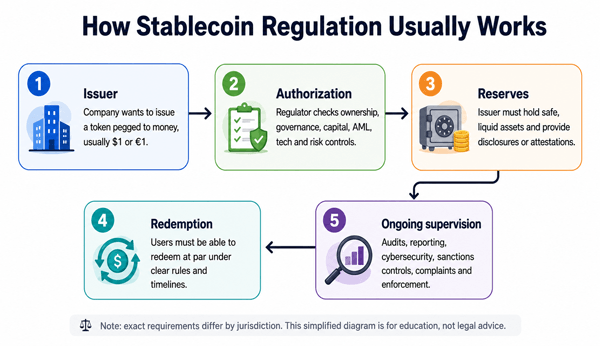
Exact rules differ by country, but most stablecoin frameworks follow a similar pattern. A business that wants to issue a payment stablecoin usually needs authorization, must hold high-quality reserves, must give users redemption rights, must publish disclosures, and must maintain compliance controls.
The diagram below shows the usual regulatory flow.
4.1 The typical regulatory process
- Classify the token: The regulator decides whether the token is a payment stablecoin, e-money token, asset-referenced token, security, commodity, deposit, stored value product or something else.
- Identify responsible parties: Regulators look at the issuer, reserve manager, custodians, exchanges, wallets, payment processors and governance arrangements.
- Require licensing or registration: Issuers may need approval before offering tokens to the public.
- Set reserve and redemption rules: The issuer must hold eligible assets and explain how users can redeem.
- Apply financial crime controls: AML, KYC, sanctions screening, suspicious activity reporting and transaction monitoring may apply.
- Supervise ongoing activity: Regulators require reports, audits, governance controls, cybersecurity plans, risk management and sometimes stress testing.
- Enforce rules: Regulators can fine firms, restrict activities, revoke licenses or require remediation.
5. Types of Stablecoins and How Regulation Differs
| Type | How it tries to stay stable | Regulatory concern | Beginner example |
|---|---|---|---|
| Fiat-backed stablecoin | Backed by cash, bank deposits, Treasury bills or similar fiat assets. | Are reserves real, safe, segregated and redeemable? | A dollar stablecoin claiming each token is backed by dollar assets. |
| Crypto-collateralized stablecoin | Backed by crypto assets, often overcollateralized. | Collateral volatility, liquidation risk, protocol governance and smart contract risk. | A token minted by locking ETH or BTC-like collateral. |
| Algorithmic stablecoin | Uses incentives, supply changes or related tokens to target a peg. | Peg failure, reflexive collapse and misleading stability claims. | A token that expands/contracts supply without full external reserves. |
| Commodity-backed stablecoin | Backed by gold or another commodity. | Storage, verification, redemption rights and commodity price risk. | A token claiming to represent a fixed amount of gold. |
| Bank-issued tokenized deposit | A bank liability represented on a ledger. | Banking regulation, deposit insurance status and payment settlement rules. | A bank-issued digital deposit token for institutional payments. |
Most new stablecoin laws focus on fiat-backed payment stablecoins because they are the most common in payments and crypto trading. Algorithmic stablecoins receive tougher scrutiny because past failures showed that a stable price promise can break quickly when confidence disappears.
6. Key Stablecoin Regulatory Requirements
6.1 Licensing and authorization
Many jurisdictions now require stablecoin issuers to be approved before issuing tokens to the public. Licensing helps regulators check who controls the issuer, whether the business has enough capital, whether it has competent management, and whether it can handle redemptions and operational failures.
6.2 Reserve backing
Reserve rules are at the center of stablecoin regulation. For a fiat-backed payment stablecoin, regulators often require reserves to be high quality, liquid, low risk and separated from the issuer’s own assets. Common eligible assets include cash, central bank deposits, insured bank deposits, short-term government securities and certain overnight repurchase agreements, depending on the jurisdiction.
6.3 Redemption rights
A stablecoin is only as useful as the user’s ability to redeem it. Regulations may require redemption at par, meaning one token can be redeemed for one unit of the referenced currency. Good rules also explain who can redeem, how fast redemption must happen, what fees can be charged, and what happens during stress events.
6.4 Disclosures and transparency
Users should not have to guess what backs a stablecoin. Regulations often require white papers, reserve reports, risk disclosures, fee disclosures and information about redemption procedures. Some frameworks require independent attestations or audits of reserve assets.
6.5 Capital, liquidity and risk management
Reserves protect token holders, but issuers also need their own capital and liquidity to run the business, pay expenses, manage operational problems and absorb losses that should not fall on customers. Risk management includes policies for reserve investment, concentration limits, conflicts of interest and stress testing.
6.6 AML, KYC and sanctions compliance
Stablecoin issuers and service providers may be treated as financial institutions for anti-money laundering purposes. Practical duties can include customer due diligence, sanctions screening, transaction monitoring, suspicious activity reporting, recordkeeping and controls around high-risk wallets or jurisdictions.
6.7 Custody and segregation
Regulators often require reserve assets and customer assets to be segregated from the issuer’s corporate assets. This matters in insolvency. If an issuer fails, users need a clear legal claim to reserves rather than becoming ordinary unsecured creditors.
6.8 Technology, cybersecurity and operational resilience
Stablecoin systems depend on wallets, blockchains, smart contracts, APIs, custodians and exchanges. Regulations increasingly expect cybersecurity controls, incident reporting, business continuity planning, third-party risk management and procedures for forks, bridges, blacklisting, freezes or contract upgrades.
7. Stablecoin Regulation by Region: Practical Examples
The regulatory map is still developing. The examples below show how major frameworks approach stablecoins, but they are simplified and should not be used as legal advice.
| Region / framework | What it does | Practical takeaway |
|---|---|---|
| United States - GENIUS Act | The U.S. enacted a federal payment stablecoin framework in July 2025. Proposed implementing rules in 2026 focus on permitted payment stablecoin issuers, AML obligations and sanctions compliance. | Issuers serving the U.S. market need to evaluate whether they qualify as permitted issuers and prepare for bank-like compliance obligations. |
| European Union - MiCA | MiCA creates EU-wide rules for crypto-assets, including asset-referenced tokens and e-money tokens. It covers authorization, supervision, disclosure, reserve and conduct requirements. | Stablecoin issuers targeting the EU must classify tokens carefully and comply with MiCA-specific issuer and white paper rules. |
| United Kingdom | The UK has been developing a framework for fiat-backed stablecoins used in payments, including Bank of England oversight for systemic sterling stablecoins. | UK rules are moving toward regulated payment use, with emphasis on redemption, backing assets and systemic risk. |
| Global - FSB recommendations | The Financial Stability Board recommends consistent regulation, supervision and oversight of global stablecoin arrangements across jurisdictions. | Large stablecoins should expect cross-border cooperation, stronger governance and regulation before they become systemic. |
| International policy debate - BIS / IMF | International bodies warn about reserve risk, runs, monetary sovereignty, operational risk and legal uncertainty. | Stablecoin growth may bring innovation, but weak design can create risks beyond crypto markets. |
8. Real-World Examples of Stablecoin Regulation Issues
8.1 A fully reserved dollar stablecoin
A company issues a dollar stablecoin and claims every token is backed by cash and short-term Treasury bills. Regulators ask: Are the assets actually there? Are they held separately from the company’s own money? Can users redeem quickly? Are the reserve reports independent? Does the issuer follow AML and sanctions rules?
8.2 A stablecoin used for remittances
A migrant worker sends a dollar stablecoin to family abroad. The transfer may be faster and cheaper than some traditional channels, but regulation matters. The recipient needs a safe way to convert tokens to local currency, protection against scams, and clarity on whether the wallet or exchange is licensed.
8.3 A stablecoin listed on an exchange
An exchange lists a stablecoin for trading pairs. The exchange should review the issuer, reserve disclosures, redemption history, blockchain risks and legal status. A weak listing process can expose customers to depegging or frozen withdrawals.
8.4 An algorithmic stablecoin promising stability
A protocol claims its token will stay at $1 through incentives rather than high-quality fiat reserves. Regulators and users should treat this differently from a fully reserved stablecoin. The main risk is that confidence can disappear, causing a rapid spiral in price and liquidity.
9. Benefits of Good Stablecoin Regulation
- Greater user trust because reserve and redemption rules are clearer.
- Lower risk of misleading claims about backing or safety.
- Better protection if an issuer becomes insolvent.
- More confidence for banks, merchants and payment companies that want to use stablecoins.
- Improved AML and sanctions compliance for legitimate financial use.
- More consistent expectations for issuers operating across borders.
- Potential support for faster and cheaper digital payments when risks are properly managed.
10. Risks and Limitations of Stablecoin Regulation
Regulation can reduce risk, but it cannot remove every risk. A regulated stablecoin can still face cyberattacks, operational failures, liquidity stress, legal disputes, wallet hacks, blockchain congestion or market panic.
| Risk | What can go wrong | How regulation helps | What users should still do |
|---|---|---|---|
| Reserve risk | Assets backing the token lose value or are hard to sell. | Limits eligible assets and requires reporting. | Check reserve composition and issuer reports. |
| Run risk | Many users redeem at the same time. | Requires liquidity planning and redemption rules. | Avoid keeping all funds in one stablecoin. |
| Issuer failure | The company becomes insolvent or mismanaged. | Requires governance, segregation and capital controls. | Understand legal claim and redemption rights. |
| Operational risk | Systems go down or transfers fail. | Requires resilience and incident management. | Use reputable wallets and keep backup access. |
| Smart contract risk | Code bugs or exploits affect tokens. | May require audits and risk controls. | Avoid unknown protocols and bridges. |
| Regulatory risk | A token becomes restricted in a country. | Creates clearer legal paths. | Check local rules before using stablecoins. |
| Fraud and scam risk | Fake tokens, phishing and impersonation scams. | Enforcement and disclosures help. | Verify contract addresses and never share seed phrases. |
11. Stablecoin Regulation vs Traditional Banking Regulation
| Topic | Stablecoin issuer | Traditional bank |
|---|---|---|
| Main product | Blockchain token designed to keep a stable value. | Deposits, loans, payment accounts and other banking services. |
| User claim | Depends on stablecoin terms and law. | Usually a deposit claim against the bank. |
| Deposit insurance | Usually not insured unless specific law says otherwise. | Often insured up to legal limits in many countries. |
| Reserve model | May require one-to-one backing with safe assets. | Fractional reserve banking; deposits fund loans and assets. |
| Redemption | Token holders may redeem through issuer or intermediaries. | Account holders withdraw through banking channels. |
| Technology | Public or permissioned blockchain plus wallets. | Bank ledgers, card networks, payment rails and online banking systems. |
A common beginner mistake is assuming a regulated stablecoin is the same as an insured bank deposit. In most cases, it is not. A stablecoin may be safer if properly reserved and supervised, but users should read disclosures carefully and understand what legal protection actually applies.
12. Best Practices for Stablecoin Issuers
- Choose a clear legal classification before launch and document the reasoning.
- Obtain required licenses or permissions before offering tokens in target markets.
- Hold reserves in high-quality, liquid assets and keep them segregated from corporate assets.
- Publish clear redemption terms, including fees, timelines, eligibility and stress-event procedures.
- Use independent audits or attestations and make reserve reports easy to understand.
- Maintain strong governance, including board oversight, risk committees and conflict-of-interest controls.
- Build AML, KYC, sanctions, transaction monitoring and suspicious activity reporting into operations from the start.
- Prepare cybersecurity, smart contract, incident response and business continuity plans.
- Monitor third-party risks involving custodians, banks, auditors, exchanges, market makers and blockchain infrastructure.
- Avoid marketing language that suggests risk-free returns, deposit insurance or government backing unless legally true.
13. Best Practices for Exchanges, Wallets and Payment Companies
- Perform due diligence before listing or supporting a stablecoin.
- Review issuer licenses, reserve reports, redemption history and legal opinions where available.
- Disclose supported networks clearly so users do not send tokens to the wrong chain.
- Monitor depegging, liquidity, sanctions exposure and suspicious transaction patterns.
- Have a plan for pausing deposits or withdrawals during severe incidents, and explain it to users.
- Do not present stablecoins as cash, savings accounts or guaranteed investments.
- Support customer education about wallet security, phishing and fake token contracts.
14. Best Practices for Everyday Users
Stablecoins can be useful, but beginners should use them carefully. The safest approach is to treat stablecoins as payment tools, not guaranteed savings products.
- Use well-known stablecoins with transparent reserve reports and clear redemption policies.
- Check whether the issuer and platform are regulated in your country or region.
- Do not assume all stablecoins are backed the same way.
- Avoid algorithmic or obscure stablecoins unless you fully understand the risks.
- Keep only the amount you need for your purpose, especially on exchanges or DeFi platforms.
- Use hardware wallets or reputable custodians for larger balances.
- Verify token contract addresses from official sources before receiving or sending tokens.
- Beware of “stablecoin yield” offers; yield usually means someone is taking risk with your money.
- Understand tax rules, reporting duties and local restrictions before using stablecoins for business.
15. Stablecoin Compliance Checklist
| Question | Why it matters |
|---|---|
| Is the token legally classified in each target jurisdiction? | Different classifications create different licensing and disclosure duties. |
| Who is the responsible issuer? | Users and regulators need a legally accountable party. |
| Are reserves one-to-one and held in eligible assets? | Backing quality is central to peg stability. |
| Are reserves segregated from corporate assets? | Segregation protects users if the issuer fails. |
| Can users redeem at par? | Stable value depends on reliable redemption. |
| Are reserve reports independent and frequent? | Transparency reduces information gaps. |
| Are AML and sanctions controls effective? | Stablecoins are cross-border and can be misused. |
| Are smart contracts audited and monitored? | Technical failures can create losses even with sound reserves. |
| Is there an incident response plan? | Fast action matters during hacks, depegs or operational outages. |
| Are marketing claims accurate? | Misleading claims create legal, reputational and consumer-protection risk. |
16. Common Misconceptions About Stablecoin Regulation
16.1 “Stablecoin” means risk-free
Stable means the token aims to keep a stable price. It does not mean the token is guaranteed, insured or immune from failure.
16.2 All stablecoins are backed by dollars in a bank
Some are backed by cash and short-term securities, some by crypto collateral, some by commodities, and some by algorithms. The risk profile can be completely different.
16.3 Regulation automatically protects every user
Regulation improves standards, but protection depends on the exact law, the user’s location, the platform used and the stablecoin’s legal structure.
16.4 Reserve reports are the same as full audits
An attestation may confirm certain reserve balances at a point in time. A full audit may review broader financial statements and controls. Users should understand what type of assurance is being provided.
16.5 A high yield stablecoin product is just like a bank savings account
Stablecoin yield often comes from lending, DeFi liquidity, leverage, trading or other risk-taking. It should not be treated as risk-free income.
17. Future of Stablecoin Regulation
Stablecoin regulation is moving from broad crypto policy into detailed payment, banking, securities, AML and operational-resilience rules. The direction is clear: large stablecoin issuers will face stronger supervision, clearer reserve requirements, redemption obligations, financial crime controls and more cross-border coordination.
The next debates will likely focus on whether stablecoin issuers should pay interest, how stablecoins interact with bank deposits, how foreign-issued stablecoins should be treated, whether decentralized stablecoins can meet regulatory standards, and how tokenized deposits and central bank digital currency projects compete or connect with private stablecoins.
18. FAQs About Stablecoin Regulation
18.1 What is stablecoin regulation in simple terms?
It is the legal rulebook for stablecoins. It decides who can issue them, what assets must back them, how users can redeem them, what disclosures are required, and what compliance controls must exist.
18.2 Are stablecoins legal?
Stablecoins may be legal in many places, restricted in some places and subject to licensing in others. Legality depends on the country, token design and how the token is offered or used.
18.3 Are regulated stablecoins safe?
Regulation can make stablecoins safer, but not risk-free. Users should still consider issuer risk, reserve quality, redemption rules, wallet security, platform risk and local legal protection.
18.4 Do stablecoins have deposit insurance?
Usually no. Most stablecoins are not bank deposits and are not automatically covered by deposit insurance. Users should check the issuer’s legal disclosures.
18.5 Why do regulators worry about stablecoins?
They worry about runs, weak reserves, misleading claims, money laundering, sanctions evasion, cyber failures, consumer losses and possible effects on banks or monetary policy.
18.6 What is the difference between a payment stablecoin and an investment token?
A payment stablecoin is mainly designed for payments and value transfer at a stable price. An investment token may represent profit rights, securities, yield or ownership interests and may fall under different laws.
18.7 Can a stablecoin lose its peg?
Yes. A stablecoin can depeg if users lose confidence, reserves are weak, redemptions are delayed, markets become illiquid, or the mechanism supporting the peg fails.
18.8 What should beginners check before using a stablecoin?
Check the issuer, reserve reports, redemption rights, supported blockchain networks, platform reputation, local legality, fees and whether the stablecoin has a history of maintaining its peg.
18.9 How does MiCA affect stablecoins in the EU?
MiCA creates EU-wide rules for crypto-assets, including asset-referenced tokens and e-money tokens. It requires authorization, disclosures and ongoing supervision for covered issuers.
18.10 How does the U.S. GENIUS Act affect stablecoins?
The GENIUS Act establishes a U.S. federal framework for payment stablecoin activity. Implementing rules address permitted issuers and compliance duties such as AML and sanctions controls.
19. Final Thoughts
Stablecoin regulation is about trust. The goal is not only to control crypto companies, but to make sure stablecoins used for payments and financial activity have reliable backing, clear redemption rights, honest disclosures, strong compliance controls and resilient technology.
For beginners, the most important lesson is simple: do not judge a stablecoin by its name or popularity alone. Look at who issued it, what backs it, how redemption works, where it is regulated, and what could happen in a stressful market. Good regulation helps, but careful use still matters.
Sources Consulted and Checked
The following sources were consulted and checked while preparing this article and reviewing its accuracy.
- Federal Register, “Implementing the Guiding and Establishing National Innovation for U.S. Stablecoins Act,” proposed rule, March 2, 2026.
- U.S. Department of the Treasury, “Treasury Proposes Rule to Implement the GENIUS Act’s AML and Sanctions Compliance Obligations,” April 8, 2026.
- Office of the Comptroller of the Currency, Bulletin 2026-3, “GENIUS Act Regulations: Notice of Proposed Rulemaking,” February 25, 2026.
- European Securities and Markets Authority, “Markets in Crypto-Assets Regulation (MiCA),” updated November 28, 2025.
- Financial Stability Board, “High-level Recommendations for the Regulation, Supervision and Oversight of Global Stablecoin Arrangements,” final report, July 17, 2023.
- Financial Stability Board, thematic review on implementation gaps in crypto and stablecoin recommendations, October 16, 2025.
- Bank for International Settlements, Annual Economic Report 2025, “The next-generation monetary and financial system,” June 24, 2025.
- International Monetary Fund, “Understanding Stablecoins,” 2025 discussion paper.
- Bank of England stablecoin policy reporting and 2026 framework developments, including Reuters coverage, June 22, 2026.
Reader Advice
This article is provided for educational and informational purposes only and is not personalized legal, tax, financial, investment, or compliance advice or a recommendation. Stablecoin rules, regulatory policies, official guidance, market practices, and statistics can change over time and may vary by country or region. Before issuing, listing, buying, holding, transferring, or using a stablecoin for business or investment purposes, verify current requirements through official sources and seek qualified professional advice where appropriate. Stablecoins can involve depegging, reserve, issuer, liquidity, cybersecurity, smart-contract, platform, fraud, and regulatory risks, and users may lose some or all of the value involved.