Is Cryptocurrency Legal? Complete Guide, Examples, Risks and Best Practices
1. Quick Answer: Is Cryptocurrency Legal?
Cryptocurrency is legal in many countries, restricted in some countries, and heavily limited or banned in a smaller number of places. The important point is that “legal” does not mean “unregulated.” In most major markets, people may be allowed to buy or hold crypto, but exchanges, wallet providers, stablecoin issuers, payment services, tax reporting, anti-money-laundering checks, advertising, and investment products may all be regulated.
For a beginner, the safest way to think about crypto legality is this: the law depends on where you live, what you are doing, which crypto asset you are using, and whether the service provider is licensed or registered. Owning Bitcoin may be allowed in one country, while using an unlicensed exchange, promoting a token sale, avoiding taxes, or using crypto for payments may create legal problems.
This article explains cryptocurrency legality in plain English.
2. What Does “Cryptocurrency Is Legal” Actually Mean?
When people ask whether cryptocurrency is legal, they often mean several different things at the same time. A country may allow one crypto activity and restrict another. That is why simple yes-or-no answers can be misleading.
| Question | What it means | Example |
|---|---|---|
| Can I own crypto? | Whether individuals may legally hold coins or tokens in a wallet. | A person buys Bitcoin and holds it as a long-term asset. |
| Can I trade crypto? | Whether buying and selling through exchanges is allowed. | A user trades ETH for stablecoins on a registered platform. |
| Can I pay with crypto? | Whether merchants may accept crypto for goods or services. | A shop accepts USDT or Bitcoin, if local payment rules allow it. |
| Can a business offer crypto services? | Whether exchanges, brokers, custodians, staking providers, or token issuers need licenses. | A crypto exchange registers with a regulator before serving customers. |
| How is crypto taxed? | Whether gains, income, mining rewards, staking rewards, or payments must be reported. | A trader reports profit from selling crypto on a tax return. |
| Is a token a security? | Whether securities laws apply because the asset resembles an investment contract or financial product. | A token sale promising profit from a team’s work may trigger securities rules. |
3. Why Crypto Laws Differ So Much by Country
Cryptocurrency does not fit neatly into one legal category. Depending on the facts, the same asset can look like money, property, a commodity, a security, a payment instrument, software, a collectible, or a high-risk investment product. Countries also have different priorities. Some want innovation and financial inclusion. Others focus on capital controls, consumer protection, tax collection, fraud prevention, or financial stability.
Regulators usually care about four big issues: who controls customer money, whether investors are being misled, whether criminals can move funds anonymously, and whether people are paying tax. This is why the most common crypto rules are about exchange registration, know-your-customer checks, anti-money-laundering controls, stablecoin reserves, marketing warnings, and reporting transactions to tax authorities.
4. Global Snapshot: Where Crypto Is Legal, Restricted, or Banned
A useful global tracker by the Atlantic Council found that among 75 studied jurisdictions, cryptocurrency was legal in 45, partially banned in 20, and generally banned in 10. The exact status can change, but the pattern is clear: most major economies regulate crypto rather than completely ban it.
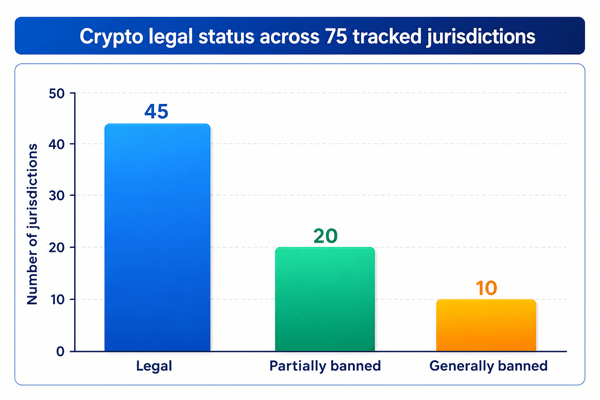
Chart: Crypto legal status across 75 tracked jurisdictions. Source: Atlantic Council Cryptocurrency Regulation Tracker.
4.1 Common legal categories
| Category | What it usually means | Typical examples | Beginner takeaway |
|---|---|---|---|
| Legal but regulated | Individuals may use crypto, while businesses must meet licensing, AML, securities, tax, or consumer-protection rules. | United States, European Union, United Kingdom, Canada, many others. | Use registered platforms and keep tax records. |
| Partially restricted | Some uses are allowed, but banking access, exchanges, payments, derivatives, mining, marketing, or foreign platforms may be limited. | Varies by country and year. | Do not assume that owning crypto means all crypto activity is allowed. |
| Generally banned or tightly prohibited | Trading, exchange services, payments, or financial institution involvement may be banned or treated as illegal financial activity. | China is a major example for mainland crypto trading and related financial activities. | Avoid local transactions unless you have country-specific legal advice. |
| Legal tender or special official status | A government gives a crypto asset special payment status, though this is rare and politically sensitive. | El Salvador adopted Bitcoin as legal tender in 2021 but later scaled back mandatory acceptance policies under IMF-linked reforms. | Legal tender status is exceptional, not the global norm. |
5. Examples of Cryptocurrency Legal Status in Major Markets
The examples below are simplified snapshots for beginners.
| Jurisdiction | Basic status | Key rules beginners should know | Practical example |
|---|---|---|---|
| United States | Crypto ownership and trading are generally allowed, but regulation is split among agencies. | Tax reporting applies. Exchanges may need money-transmission/AML controls. Some tokens or products may fall under securities or commodities rules. | Buying Bitcoin on a compliant exchange may be lawful, but issuing a token that promises profit can trigger securities law. |
| European Union | Crypto is regulated under MiCA, an EU-wide framework for crypto-asset issuers and service providers. | MiCA applies to stablecoin issuers and crypto-asset service providers, with authorization requirements for services such as custody, trading platforms, exchange, and transfer. | An exchange serving EU customers generally needs CASP authorization or must operate within transition rules. |
| United Kingdom | Crypto is not banned, but firms face AML registration, financial-promotion rules, and a new regulatory regime expected to come into force in 2027. | Consumers should check FCA registration and understand that many crypto assets remain high risk. | A UK user should be cautious of platforms that market to UK customers without proper approvals. |
| Canada | Crypto trading is allowed, but platforms may be subject to securities regulation and must be registered or authorized. | A business saying it is “registered” as a company is not the same as being registered with a securities regulator. | A Canadian user should use a platform listed by securities regulators as authorized to do business with Canadians. |
| India | Crypto is not treated as legal tender, but trading and holding have been subject to tax rules for virtual digital assets. | Profits from virtual digital assets are generally taxed under the special VDA framework, and tax deducted at source can apply to transfers. | A trader may legally owe tax even if crypto itself is not recognized as official money. |
| China (mainland) | Crypto trading and related financial activities are heavily prohibited. | Authorities have treated virtual currency-related business activities as illegal financial activity and do not recognize crypto as legal tender. | Using offshore exchanges to serve mainland customers can create serious compliance risk. |
| Pakistan | The position has been evolving. Recent reporting indicates movement toward licensing virtual asset service providers and banking access for licensed firms. | Because policy has changed over time, users should check current State Bank, Ministry of Finance, and virtual asset regulator guidance before using services. | A Pakistani user should not assume an old ban, a news headline, or a foreign exchange ad is enough; current local rules matter. |
6. Is Bitcoin Legal?
Bitcoin is legal to own and trade in many countries, but not everywhere. In places where it is allowed, it is usually not official money. It is more commonly treated as property, a digital asset, a commodity-like asset, or a taxable asset. This means selling Bitcoin for a profit can create a tax obligation, even if you never converted it directly into your local currency.
Bitcoin also has different legal treatment depending on the activity. Holding Bitcoin in a personal wallet is different from operating a Bitcoin exchange, running a custody business, selling investment products linked to Bitcoin, mining at industrial scale, or accepting Bitcoin as a merchant.
7. Are Stablecoins Legal?
Stablecoins are crypto assets designed to track the value of another asset, usually a fiat currency such as the U.S. dollar. They are often used for trading, payments, remittances, and DeFi. Because stablecoins can function like private digital money, regulators pay close attention to reserves, redemption rights, issuer governance, financial stability, and anti-money-laundering compliance.
In the EU, MiCA has specific rules for asset-referenced tokens and e-money tokens. In other countries, stablecoin rules may be covered by payment law, securities law, banking law, money-transmission law, or new digital asset laws. A stablecoin being popular does not automatically make it legal for every use in every country.
8. Are Crypto Exchanges Legal?
A crypto exchange may be legal in one country and unlicensed in another. For users, the biggest question is not only “Can I buy crypto?” but also “Is this platform allowed to serve customers where I live?”
Regulated exchanges usually have to verify customer identity, monitor suspicious activity, protect customer assets, disclose risks, follow advertising rules, and cooperate with law enforcement or tax reporting obligations. Unregulated platforms may offer easy sign-up, high leverage, or attractive rewards, but they can create legal, financial, and recovery risks if something goes wrong.
8.1 How to check an exchange before using it
- Look for the regulator that supervises crypto platforms in your country or region.
- Search the platform on the official regulator register, not only on the company website.
- Check whether the license covers the exact service you want to use, such as spot trading, custody, staking, derivatives, lending, or payments.
- Read risk warnings, fee schedules, and withdrawal rules before depositing funds.
- Be cautious if the platform hides its legal entity, headquarters, license number, or customer-support process.
9. Crypto Taxes: Legal Does Not Mean Tax-Free
One of the most common beginner mistakes is thinking crypto is tax-free because it is decentralized. In many countries, tax authorities treat crypto transactions as taxable events. The details vary, but common taxable events include selling crypto for fiat currency, trading one crypto for another, using crypto to buy goods or services, earning mining rewards, receiving staking rewards, receiving airdrops, and getting paid in crypto.
In the United States, the IRS says income from digital assets is taxable and taxpayers may have to report digital asset transactions on their tax returns. Other countries have their own tax rules, reporting forms, withholding systems, and penalties.
9.1 Basic crypto tax record checklist
- Date and time of each transaction.
- Asset bought, sold, transferred, received, mined, staked, or spent.
- Amount of crypto and value in local currency at the time of the transaction.
- Exchange, wallet address, transaction hash, and fees.
- Purpose of the transaction: investment, payment, business income, gift, transfer, reward, or donation.
- Cost basis, sale price, gains, losses, and supporting statements.
10. What Activities Can Create Legal Risk?
For ordinary users, the biggest legal risks usually come from taxes, scams, unlicensed platforms, sanctions, prohibited products, and misunderstanding token rules. For businesses, the risk is wider because operating a crypto service can trigger licensing and compliance obligations.
| Activity | Possible legal issue | Safer practice |
|---|---|---|
| Buying and holding crypto | Allowed in many countries, but may be restricted in some places. | Check local legality and use a regulated platform. |
| Trading frequently | Tax reporting, market abuse rules, leverage restrictions, or exchange licensing issues. | Keep records and avoid unlicensed high-leverage platforms. |
| Using crypto for payments | May be treated as a taxable disposal, and merchants may face payment or accounting rules. | Record fair market value and comply with merchant rules. |
| Mining | Electricity, business registration, environmental, tax, or local restrictions. | Check local energy, business, and tax rules before scaling. |
| Staking or yield products | May be regulated as investment, lending, securities, or financial services. | Use transparent providers and understand lockups, slashing, and tax treatment. |
| Launching a token | Securities, consumer protection, marketing, disclosure, and fraud laws. | Get legal advice before selling or promoting tokens. |
| Using privacy tools | May raise AML, sanctions, or exchange-compliance concerns. | Understand local restrictions and avoid suspicious funds. |
| Sending funds cross-border | Capital controls, sanctions, reporting, AML, and money-transmission issues. | Use compliant channels and verify recipient and purpose. |
11. Crypto Legality Decision Flow for Beginners
Before using crypto, run through this simple decision flow. It can help you avoid the most common legal and compliance mistakes.
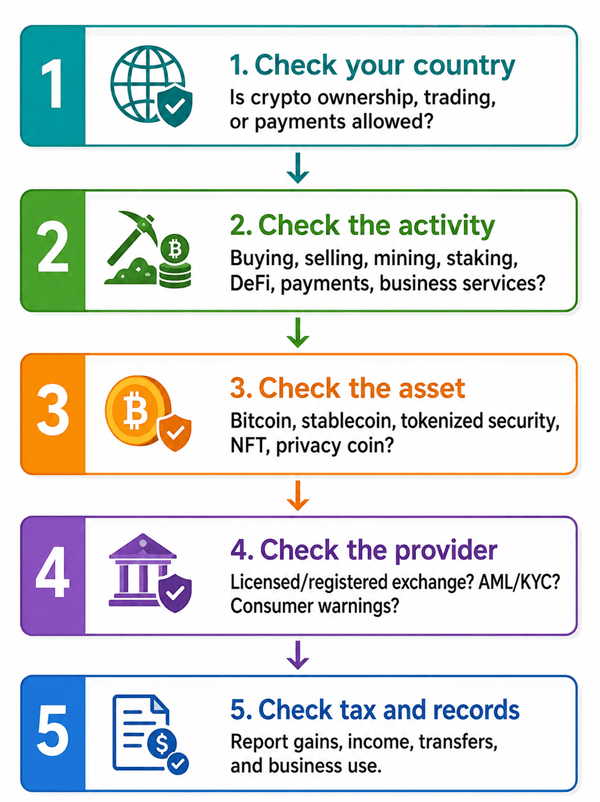
Diagram: A practical beginner decision flow for checking crypto legality.
12. Crypto as Money, Property, Commodity, or Security
The same crypto asset can be described differently depending on the law being applied. For tax purposes, it may be property. For trading oversight, it may be a commodity-like asset. For an investment scheme, it may be a security. For payments, it may be treated under money-transmission or payment-services rules. This is why two regulators in the same country can appear to talk about crypto differently.
A practical example: Bitcoin bought and held by an individual may be treated differently from a token sold by a startup to fund a business. A stablecoin used for transfers may raise different issues from an NFT linked to a collectible or a DeFi lending token that pays yield.
13. Misconceptions About Cryptocurrency Legality
13.1 Misconception 1: “Crypto is illegal because it is not government money.”
Not being legal tender does not automatically make an asset illegal. Gold, loyalty points, game items, and foreign currencies are not all legal tender for domestic debts, but they can still be owned or traded under certain rules. Crypto may be legal without being official money.
13.2 Misconception 2: “If an exchange lets me sign up, it must be legal.”
A website may accept users from a country even when it is not properly licensed there. Always check official regulator registers and not just marketing claims.
13.3 Misconception 3: “DeFi has no rules because there is no company.”
DeFi can reduce reliance on intermediaries, but laws may still apply to developers, front-end operators, promoters, token issuers, validators, governance participants, or users depending on the activity and country.
13.4 Misconception 4: “I only owe tax when I cash out to my bank.”
In many tax systems, exchanging one crypto for another, earning rewards, or spending crypto can be taxable even if no fiat currency reaches your bank account.
13.5 Misconception 5: “Anonymous means legal risk-free.”
Blockchains are often more traceable than beginners expect. Exchanges and investigators can analyze transaction histories. Trying to hide proceeds, avoid sanctions, or evade tax can lead to serious consequences.
14. Benefits of Clear Crypto Regulation
Crypto regulation is often criticized for slowing innovation, but clear rules can also help responsible users and businesses. Good regulation can reduce fraud, improve custody standards, require better disclosures, create tax clarity, and make it easier for banks and payment companies to work with legitimate crypto firms.
- Users can better identify legitimate platforms.
- Businesses know when they need a license and what standards apply.
- Tax authorities can provide clearer reporting rules.
- Stablecoin users can understand reserve and redemption protections.
- Institutional investors may participate with stronger risk controls.
15. Risks and Limitations Even When Crypto Is Legal
Legal does not mean safe. A legal crypto asset can still lose most of its value, be hacked, be difficult to withdraw, or be connected to a scam. Regulations may reduce some risks, but they do not eliminate volatility, smart contract bugs, private-key mistakes, phishing, market manipulation, or poor project management.
15.1 Main risks for beginners
- Price volatility: crypto prices can rise or fall sharply in hours.
- Custody risk: if you lose private keys or recovery phrases, funds may be unrecoverable.
- Exchange risk: platforms can freeze withdrawals, fail, or be hacked.
- Scam risk: fake giveaways, romance scams, phishing links, fake support accounts, and Ponzi schemes are common.
- Tax risk: poor records can make reporting difficult and penalties expensive.
- Regulatory risk: a platform or token allowed today may face restrictions later.
- Sanctions and AML risk: receiving or sending funds connected to illicit activity can create compliance problems.
16. Best Practices for Using Cryptocurrency Legally and Safely
16.1 Start with your local law
Search your country’s central bank, securities regulator, tax authority, and financial conduct authority. Do not rely only on social media posts, influencers, or outdated forum answers. Crypto rules can change quickly.
16.2 Use regulated or registered platforms where possible
A regulated platform is not risk-free, but it is generally safer than an anonymous website. Check the official register and confirm the entity name, website, services covered, and warnings.
16.3 Keep detailed records from day one
Tax reporting becomes much harder if you wait until the end of the year. Export exchange history, save wallet addresses, and note the reason for unusual transfers.
16.4 Avoid products you do not understand
High-yield staking, leveraged trading, liquidity pools, bridges, wrapped tokens, and algorithmic stablecoins can have complex legal and financial risks. Do not treat a high advertised return as proof of safety.
16.5 Separate personal investing from business activity
If you accept crypto payments, run a crypto-related business, manage funds for others, or promote tokens, you may have extra legal, accounting, and licensing obligations.
16.6 Protect your wallet security
Use strong passwords, two-factor authentication, hardware wallets for larger holdings, and offline backup of recovery phrases. Never share a seed phrase with anyone, including someone claiming to be exchange support.
16.7 Be careful with cross-border transfers
Crypto can move globally, but laws do not disappear at national borders. Capital controls, sanctions, tax reporting, and money-transmission laws may apply.
17. Practical Scenarios
17.1 Scenario 1: A beginner buys $200 of Bitcoin
In many countries, this is allowed if done through a lawful platform. The user should still keep records, understand volatility, secure the account, and check whether selling later creates a taxable gain or loss.
17.2 Scenario 2: A freelancer is paid in USDT
The freelancer may need to report the payment as income at the local currency value when received. Later selling or converting the USDT may create another reportable event depending on local tax rules. The freelancer should also confirm whether accepting stablecoins for services is allowed where they operate.
17.3 Scenario 3: A startup sells tokens to fund a project
This is much more legally complex than simply buying crypto. Token sales can trigger securities, consumer protection, advertising, AML, and cross-border fundraising rules. A startup should not launch a public token sale without specialized legal advice.
17.4 Scenario 4: A trader uses an offshore exchange
The exchange may be popular, but it may not be authorized to serve users in the trader’s country. The trader may face withdrawal problems, weak consumer protection, tax-reporting gaps, or legal issues if local rules restrict offshore platforms.
17.5 Scenario 5: A shop wants to accept Bitcoin
The shop should check payment rules, accounting treatment, tax reporting, refund policies, consumer disclosures, and whether it will hold crypto or instantly convert to local currency. Accepting crypto is a business decision, not just a technical wallet setup.
18. Beginner Checklist: How to Check Whether Crypto Is Legal for You
- Identify your country and, if relevant, your state or province.
- Check whether individuals may buy, hold, sell, and use crypto.
- Check whether the exchange or wallet provider is licensed, registered, or authorized for your location.
- Check whether the specific token type has special rules, especially stablecoins, security tokens, privacy coins, derivatives, and DeFi yield products.
- Check tax rules before trading, spending, mining, staking, or receiving crypto as income.
- Check whether your bank allows transfers to and from crypto platforms.
- Check sanctions, AML, and source-of-funds rules for large or cross-border transfers.
- Keep records and consult a qualified professional for large transactions, business use, or uncertain situations.
19. FAQs About Cryptocurrency Legality
19.1 Is cryptocurrency legal everywhere?
No. Crypto is legal in many countries, restricted in some, and generally banned or heavily prohibited in others. Even where it is legal, exchanges, taxes, advertising, payments, and investment products may be regulated.
19.2 Is Bitcoin legal tender?
Usually no. Bitcoin is not official money in most countries. El Salvador made Bitcoin legal tender in 2021 but later scaled back mandatory-use policies. Legal tender status is rare and should not be assumed.
19.3 Can I go to jail for using crypto?
Ordinary lawful ownership is not usually a criminal issue in countries where crypto is allowed. Legal risk increases if you use crypto for fraud, money laundering, sanctions evasion, tax evasion, unlicensed financial services, illegal gambling, prohibited payments, or activity banned in your country.
19.4 Do I have to pay tax on cryptocurrency?
In many countries, yes. Selling, trading, spending, mining, staking, airdrops, and getting paid in crypto may be taxable. Rules vary, so check your tax authority.
19.5 Is using a foreign crypto exchange legal?
Not always. A foreign exchange may not be authorized to serve your country. You may also have fewer protections and more tax-reporting difficulty.
19.6 Are NFTs legal?
NFTs are generally treated differently from cryptocurrencies, but legal issues can still arise around intellectual property, securities law, fraud, gambling mechanics, taxes, and consumer protection.
19.7 Is crypto mining legal?
Mining is legal in some places and restricted or banned in others. Rules may involve electricity use, business licensing, environmental limits, taxes, and local regulations.
19.8 Can banks block crypto transactions?
Yes, in some countries or under some bank policies. Banks may restrict transfers to crypto platforms because of risk, fraud, AML obligations, or local regulation.
19.9 How do I know if a crypto platform is licensed?
Use your regulator’s official website or public register. Search the exact company name and domain. Do not rely only on a badge, screenshot, influencer link, or claim on the platform’s own website.
19.10 Is DeFi legal?
DeFi is not automatically illegal, but specific activities can trigger rules on securities, lending, derivatives, AML, sanctions, tax, consumer protection, or money transmission. The legal position is still developing in many countries.
20. Final Thoughts
Cryptocurrency legality is not a single global rule. In many places, crypto ownership and trading are allowed, but the surrounding activities are regulated. The safest beginner approach is to check your local rules, use authorized platforms, keep careful records, avoid suspicious offers, and treat crypto as a high-risk financial activity rather than a shortcut around the law.
If you remember one thing, remember this: crypto may be decentralized, but users, exchanges, businesses, and taxpayers still operate inside legal systems. Good compliance habits are not just for companies; they protect everyday users too.
Sources Consulted and Checked
The following sources were consulted and checked while preparing this article and reviewing its accuracy.
- Atlantic Council Cryptocurrency Regulation Tracker
- ESMA - Markets in Crypto-Assets Regulation (MiCA)
- EUR-Lex - Regulation (EU) 2023/1114 on markets in crypto-assets
- Central Bank of Ireland - MiCAR overview and application dates
- IRS - Digital assets
- IRS - Virtual currency transaction FAQs
- SEC Investor.gov - Crypto asset securities investor alert
- FATF - Virtual assets topic page
- FATF - 2025 targeted update on virtual assets and VASPs
- UK FCA - Cryptoassets information
- UK FCA - New regime for cryptoasset regulation
- Government of Canada - Crypto assets
- Canadian Securities Administrators - Authorized crypto platforms
- Reuters - China central bank reaffirms crackdown on virtual currency
- Reuters - Pakistan central bank opens banking to licensed virtual asset service providers
- IMF - El Salvador program addressing Bitcoin risks
Reader Advice
This article explains cryptocurrency legality in plain English and is provided for educational and informational purposes only. It is not personalized legal, tax, financial, investment, or regulatory advice or a recommendation to buy, sell, hold, or use any crypto asset or service. The examples are simplified snapshots for beginners and are not a substitute for local professional advice, because rules can differ by country, state or province, regulator, token type, activity, and business model. Crypto laws, licensing requirements, tax treatment, banking policies, enforcement practices, market conditions, and statistics can change over time and vary by region, so verify current information through official regulators, tax authorities, central banks, and authorized service-provider registers before acting.
Cryptocurrency involves substantial risks, including price loss, fraud, hacking, platform failure, loss of private keys, tax liabilities, sanctions or anti-money-laundering concerns, and limited recovery options. Consider your circumstances and seek advice from a suitably qualified professional before making significant transactions or business decisions.