Crypto Regulation in the US: Meaning, How It Works, Key Laws, Benefits & Risks
Crypto regulation in the United States is not one single law or one regulator. It is a layered system in which the legal treatment of a coin, token, platform, wallet, stablecoin, derivative, payment service, or investment product depends on what the asset does, how it is sold, who controls it, and which activity is being performed.
As of August 2, 2026, the framework has become clearer but remains incomplete. The GENIUS Act, signed on July 18, 2025, established a federal framework for payment stablecoins. In March 2026, the Securities and Exchange Commission (SEC), joined by the Commodity Futures Trading Commission (CFTC), issued a major interpretation explaining how federal securities laws apply to certain crypto assets and transactions. However, Congress has not yet enacted a comprehensive market-structure law governing the entire spot crypto market. State licensing, money-transmission, consumer-protection, tax, sanctions, banking, commodities, securities, and criminal laws therefore continue to overlap.
Quick takeawayBuying or holding cryptocurrency is generally legal in the United States. Legality does not mean every token, platform, yield product, exchange, or promotion is approved, insured, registered, or safe. The correct question is not “Is crypto regulated?” but “Which rules apply to this asset, transaction, business, and state?”
| Question | Practical answer |
|---|---|
| Is cryptocurrency legal in the US? | Generally yes, but particular activities or offerings may violate securities, commodities, banking, money-transmission, sanctions, tax, or consumer-protection rules. |
| Is Bitcoin legal? | Yes. It can generally be owned and traded, subject to applicable tax, AML, sanctions, platform, and state rules. |
| Who regulates crypto? | The SEC, CFTC, Treasury/FinCEN, IRS, banking regulators, OFAC, FTC, DOJ, state financial regulators, state attorneys general, and others may all have roles. |
| Are crypto accounts FDIC insured? | Crypto assets themselves are not FDIC-insured deposits. Pass-through insurance may apply only to qualifying fiat deposits held under specific arrangements. |
| Are crypto profits taxable? | Yes. Digital assets are generally treated as property for federal tax purposes, and income or gains may be reportable. |
| Is there a US stablecoin law? | Yes. The GENIUS Act creates a federal payment-stablecoin framework, with implementation rules still being finalized in 2026. |
| Is all crypto covered by one federal market law? | No. Broader digital-asset market-structure legislation remains pending as of August 2, 2026. |
1. What Does Crypto Regulation Mean?
Crypto regulation means the laws, regulations, licensing requirements, supervisory standards, court decisions, agency interpretations, tax rules, and enforcement practices that govern digital assets and the businesses that create, sell, exchange, custody, lend, transmit, or promote them.
The term covers more than cryptocurrencies such as Bitcoin. It can include stablecoins, tokenized securities, non-fungible tokens (NFTs), decentralized finance (DeFi), staking services, crypto derivatives, custody arrangements, payment applications, mining, wallet providers, crypto ATMs, and digital-asset investment funds.
1.1 A simple way to understand it
US regulators generally regulate the economic reality of an activity, not merely the label used by a project. Calling an asset a “utility token,” a “governance token,” or a “digital collectible” does not automatically determine its legal status. Regulators examine how it functions, what buyers were promised, who exercises control, how profits are expected, and what service the business provides.
Expert tipSeparate the asset from the transaction. A crypto asset may not itself be a security in every context, while a particular offer, sale, investment arrangement, staking program, lending account, or tokenized claim involving that asset may still be subject to securities law.
2. Why Crypto Regulation in the US Is Fragmented
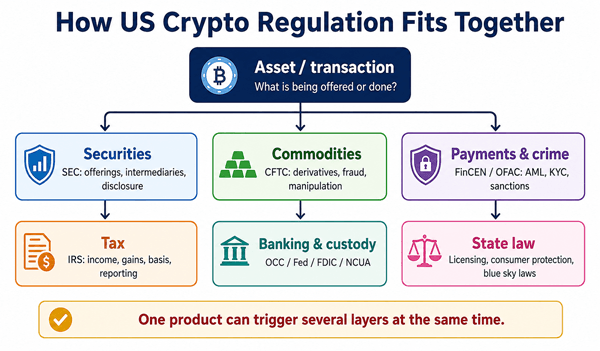
Figure 1. Regulatory layers: the same crypto product can trigger federal market, financial-crime, tax, banking and state rules.
The United States regulates financial markets through multiple federal and state authorities. Crypto did not enter a blank legal system; it entered a system already divided among securities, commodities, banking, payments, taxation, anti-money-laundering, sanctions, consumer protection, and state licensing laws.
- Federal securities laws govern securities and securities transactions.
- The Commodity Exchange Act governs derivatives and gives the CFTC anti-fraud and anti-manipulation authority over commodity spot markets.
- The Bank Secrecy Act applies to many financial intermediaries and money transmitters.
- State laws may require money-transmitter licenses or a specialized crypto license.
- Tax laws apply to gains, losses, income, compensation, mining, staking, gifts, and business transactions.
- Consumer-protection and criminal laws apply to deceptive practices, theft, fraud, hacking, market manipulation, and money laundering.
This activity-based structure means the same company can answer to several regulators. A crypto exchange might be a money-services business under federal AML rules, a money transmitter in multiple states, a securities intermediary for some products, a commodities venue for others, a tax-reporting broker, and a consumer-facing business subject to unfair-practices laws.
| Layer | Main concern | Typical examples |
|---|---|---|
| Federal securities | Disclosure, registration, market integrity, investor protection | Token offerings, crypto asset securities, tokenized stocks, securities exchanges and brokers |
| Federal commodities | Derivatives, manipulation, fraud in commodity markets | Bitcoin futures, options, swaps, leveraged retail commodity transactions |
| Federal financial crime | AML, customer identification, suspicious activity, sanctions | Exchanges, hosted-wallet providers, payment stablecoin issuers, money transmitters |
| Federal tax | Income, gains, losses, basis, reporting | Sales, swaps, staking rewards, mining, compensation, 1099-DA reporting |
| State licensing | Money transmission, virtual-currency activity, custody, consumer protection | State money-transmitter licenses, New York BitLicense |
| Bank regulation | Safety, soundness, custody, capital, operational risk | Banks offering custody, stablecoin, payment, or tokenized-asset services |
3. Who Regulates Cryptocurrency in the United States?
| Authority | Primary role in crypto | What readers should know |
|---|---|---|
| SEC | Securities offerings, exchanges, brokers, investment advisers, funds, disclosure, fraud | Jurisdiction depends on whether a crypto-related asset, instrument, transaction, or arrangement is a security. |
| CFTC | Crypto derivatives; fraud and manipulation involving commodities in interstate commerce | Bitcoin and certain other non-security crypto assets may be commodities, but ordinary spot platforms have not historically had a complete federal registration regime. |
| FinCEN | Bank Secrecy Act, money-services-business registration, AML reporting | Many administrators and exchangers of convertible virtual currency can be money transmitters. |
| OFAC | Economic sanctions | US persons and businesses must avoid prohibited dealings with sanctioned persons, addresses, entities, and jurisdictions. |
| IRS | Federal taxation and information reporting | Digital assets are generally property; taxable events and reporting obligations can arise even without cashing out to dollars. |
| OCC, Federal Reserve, FDIC, NCUA | Banks and credit unions | They supervise permissible crypto activities, safety and soundness, custody, capital, and operational controls. |
| FTC and CFPB | Consumer protection | Deceptive marketing, unfair practices, payment and consumer-finance issues may trigger jurisdiction. |
| DOJ and federal law enforcement | Criminal enforcement | Fraud, theft, sanctions evasion, money laundering, unlicensed money transmission, and cybercrime. |
| State regulators and attorneys general | Licensing, consumer protection, state securities laws | Requirements vary by state and may apply even when federal registration is not required. |
4. How Crypto Classification Works
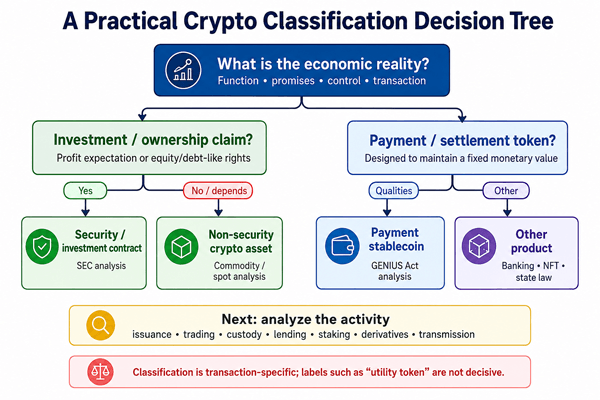
Figure 2. Classification decision tree: begin with economic reality, then analyze the specific activity and transaction.
Classification is the gateway issue because different categories trigger different rules. The analysis is functional and facts-and-circumstances based.
4.1 Common legal categories
| Category | Basic meaning | Likely regulatory focus |
|---|---|---|
| Crypto asset security | A security represented, issued, or transferred using distributed-ledger technology | SEC registration, exemptions, disclosure, broker/exchange/custody rules |
| Non-security crypto asset / digital commodity | A crypto asset that is not a security in the relevant context and may fall within commodity law | CFTC derivatives rules and anti-fraud/anti-manipulation authority; state platform rules |
| Payment stablecoin | A qualifying digital asset designed to maintain a stable value and used for payment or settlement | GENIUS Act licensing, reserves, redemption, disclosures, AML and sanctions |
| Tokenized security | A conventional security or security entitlement represented on a blockchain | Securities laws apply regardless of tokenized format |
| NFT or collectible token | A unique or limited token linked to an item, right, access, or media | Treatment depends on economic reality, marketing, pooling, fractionalization, and promises |
| Derivative | A futures contract, option, swap, or similar instrument whose value references crypto | CFTC-regulated venues and intermediaries; special rules for retail leverage |
| Deposit or bank liability | A claim against a bank, even if recorded using DLT | Banking and deposit laws rather than payment-stablecoin rules in many cases |
4.2 The asset-versus-contract distinction
The SEC’s March 2026 interpretation emphasizes that a non-security crypto asset can be sold as part of an investment contract. In practical terms, the token and the legal promises surrounding its sale may be analyzed separately. A token may later trade without the issuer-linked promises that made an earlier offering a securities transaction, but that conclusion depends on the facts.
This distinction is important for issuers, exchanges, investors, and courts because it moves the analysis away from the assumption that a token must be permanently “a security” or permanently “not a security” in every transaction.
5. Securities Regulation and the SEC
5.1 When can a crypto transaction involve a security?
Federal securities laws define “security” broadly. A central concept is the investment contract. Under the Howey test, courts generally examine whether there is an investment of money in a common enterprise with a reasonable expectation of profits derived from the entrepreneurial or managerial efforts of others.
- How the project marketed the token and what purchasers were led to expect.
- Whether a promoter or identifiable group promised to build, manage, or increase the value of the network.
- Whether buyers depend on essential managerial efforts rather than using a functioning product.
- Whether proceeds are pooled or used to develop the enterprise.
- Whether purchasers reasonably expect profit from the work of others.
- Whether contractual rights, revenue shares, equity-like claims, or debt-like promises are attached.
5.2 What securities regulation can require
- Registration of an offering with the SEC unless an exemption applies.
- Accurate, complete, and non-misleading disclosures.
- Registration or lawful exemption for exchanges, broker-dealers, clearing agencies, transfer agents, and investment advisers where applicable.
- Custody, recordkeeping, capital, market-surveillance, conflict-management, and customer-protection controls.
- Anti-fraud liability even when a transaction is exempt from registration.
ImportantSEC registration is not a government endorsement. It is primarily a disclosure and market-regulation framework. A registered investment can still lose substantial or all value.
5.3 Tokenized securities remain securities
Putting a stock, bond, fund interest, security entitlement, or other security on a blockchain does not remove it from securities law. The technology used to record ownership or transfer does not change the underlying legal nature of the instrument.
5.4 Crypto investment products
Exchange-traded products that provide exposure to Bitcoin, Ether, or other crypto assets operate within securities-market rules, but the underlying asset can remain volatile. Investors also face product fees, tracking differences, liquidity considerations, market-price premiums or discounts, custody risks at the fund level, and the possibility of loss.
6. Commodities, Derivatives, and the CFTC
The CFTC regulates futures, options, swaps, and certain leveraged retail commodity transactions. It also has enforcement authority against fraud and manipulation in interstate commerce involving commodities, including certain crypto assets.
6.1 Spot versus derivatives markets
| Market | Example | Regulatory treatment |
|---|---|---|
| Spot | Buying Bitcoin for prompt delivery and holding it in a wallet | Historically no single comprehensive federal spot-market registration regime; state, AML, consumer, tax, and anti-fraud rules still apply. |
| Futures | A regulated contract based on Bitcoin’s future price | Generally traded on CFTC-regulated designated contract markets through regulated intermediaries. |
| Options and swaps | Contracts whose value depends on a crypto asset or index | CFTC rules can apply, including registration, clearing, reporting, and business-conduct requirements. |
| Leveraged retail commodity transaction | Retail customer receives leverage and does not obtain actual delivery within the legal timeframe | May be treated like a futures transaction and required to occur on a regulated venue. |
A common misunderstanding is that calling an asset a commodity means its trading platform is automatically comprehensively regulated by the CFTC. Commodity status and venue regulation are separate questions. The CFTC can police fraud and manipulation in commodity spot markets, but Congress has continued to debate a broader federal spot-market structure.
7. Stablecoin Regulation Under the GENIUS Act
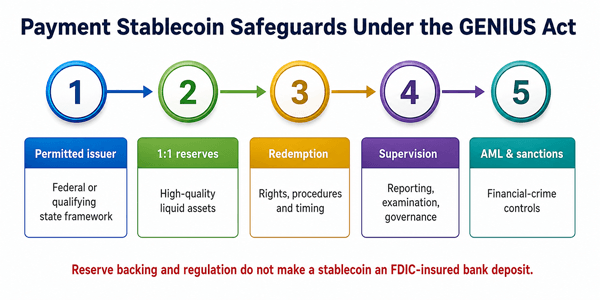
Figure 3. GENIUS Act framework: issuer permission, reserves, redemption, supervision and financial-crime controls work together.
The Guiding and Establishing National Innovation for U.S. Stablecoins Act, commonly called the GENIUS Act, became law on July 18, 2025. It created the first federal regulatory framework specifically for payment stablecoins in the United States.
7.1 What is a payment stablecoin?
In simplified terms, a payment stablecoin is a digital asset designed to maintain a stable value relative to a fixed monetary amount and intended for payment or settlement. The statutory definition contains exclusions and technical conditions, so not every token marketed as a “stablecoin” necessarily qualifies.
7.2 Core GENIUS Act features
- Only permitted payment stablecoin issuers may issue qualifying payment stablecoins in the United States, subject to statutory exceptions and implementation rules.
- Reserves must generally back outstanding payment stablecoins on at least a one-to-one basis using permitted high-quality liquid assets.
- Issuers face licensing, supervision, examination, reserve, redemption, disclosure, risk-management, and governance requirements.
- Payment stablecoin issuers are subject to Bank Secrecy Act and sanctions-compliance obligations.
- Qualifying smaller issuers may be able to operate under a substantially similar state regime, subject to the law’s conditions and thresholds.
- Implementation depends on rules from Treasury and relevant federal banking and credit-union regulators.
7.3 Why implementation status matters
A statute can be enacted before every operational rule takes effect. During 2026, Treasury, the OCC, and other regulators have been proposing and developing regulations. Businesses should distinguish statutory requirements already fixed by law from proposed rules, transition periods, licensing procedures, and final implementation dates.
Investor warningA stablecoin’s target price does not guarantee redemption at that price. Examine the issuer, reserve composition, redemption rights, legal structure, liquidity, operational controls, and whether the product falls under the federal framework.
8. AML, KYC, Sanctions, and Money Transmission
8.1 FinCEN and the Bank Secrecy Act
FinCEN has long treated many administrators and exchangers of convertible virtual currency as money transmitters. A covered business may need to register as a money-services business, establish an AML program, maintain records, file suspicious activity reports and currency transaction reports when required, and comply with other Bank Secrecy Act duties.
8.2 KYC is part of a larger compliance system
“Know your customer” usually refers to customer-identification and due-diligence controls. Effective compliance also includes transaction monitoring, sanctions screening, suspicious-activity escalation, recordkeeping, risk assessments, independent testing, staff training, and designated compliance responsibility.
8.3 OFAC sanctions
Blockchain transactions are not exempt from US sanctions. US persons and businesses must avoid prohibited dealings with sanctioned persons, entities, jurisdictions, and digital-currency addresses. A transaction can violate sanctions even if it is technically possible on a decentralized network.
8.4 The Travel Rule
Certain financial institutions must transmit specified originator and beneficiary information with qualifying funds transfers and transmittals. Applying these rules to digital-asset transfers can create technical and cross-border compliance challenges, but use of blockchain technology does not by itself remove the obligation.
9. State Crypto Regulation
State regulation is one of the most operationally significant parts of the US framework. A business serving customers nationwide may need to analyze licensing and compliance requirements in many jurisdictions.
9.1 Money-transmitter licensing
Many states regulate businesses that receive money or monetary value for transmission. Whether a crypto business requires a license depends on the state’s statutes, regulations, guidance, exemptions, custody model, and exact flow of funds or digital assets.
9.2 New York BitLicense
New York requires entities conducting specified virtual-currency business activity involving New York or New York residents to obtain a BitLicense or an appropriate charter under New York Banking Law, unless an exemption applies. A BitLicense does not replace other licenses that may be required, such as a money-transmission license for fiat activity.
- Capital and financial-condition requirements.
- Cybersecurity and business-continuity controls.
- AML and sanctions compliance.
- Consumer disclosures and complaint handling.
- Books, records, examinations, and supervisory assessments.
- Policies governing custody and virtual-currency listings.
9.3 State securities and consumer laws
State securities regulators can pursue unregistered offerings and fraud under state “blue sky” laws. State attorneys general and consumer agencies can also act against deceptive marketing, unfair practices, privacy failures, and scams. Federal compliance therefore does not automatically satisfy every state obligation.
10. Banking, Custody, and Deposit Insurance
10.1 Can banks offer crypto services?
Banks may engage in permissible crypto-related activities when conducted safely, soundly, and in compliance with applicable law. Activities can include custody, payment services, certain stablecoin functions, and tokenized-asset services, depending on the institution’s charter, regulator, risk controls, and approvals or notices required by current rules.
10.2 Custody models
| Model | Who controls the private keys? | Main risks |
|---|---|---|
| Self-custody | The owner | Loss of seed phrase, theft, malware, irreversible transfers, estate-access problems |
| Exchange or hosted wallet | The platform or its custodian | Hacking, insolvency, withdrawal freezes, commingling, legal ownership uncertainty |
| Qualified or regulated custodian | A regulated custody provider, depending on structure | Operational, legal, cyber, counterparty, and concentration risks remain |
| Fund or ETP custody | The product’s custodian | Investor owns fund shares, not usually direct on-chain control; fees and tracking risk apply |
10.3 FDIC insurance: what it does not cover
FDIC insurance protects qualifying deposits at an FDIC-insured bank, subject to coverage rules and limits. It does not insure cryptocurrency, protect against a crypto company’s failure, guarantee token value, or cover losses from theft or price decline. A crypto company’s relationship with an insured bank does not make the company itself FDIC-insured.
Ask before depositingWhat exactly is my legal claim? Where are customer assets held? Are they segregated? Can the company lend or pledge them? What happens in bankruptcy? Is any fiat balance an eligible deposit at an insured bank, and are pass-through requirements satisfied?
11. US Crypto Tax Rules
The IRS generally treats digital assets as property for federal income-tax purposes. This means sales and exchanges can create capital gains or losses, while mining, staking, compensation, business receipts, airdrops, and other transactions may create ordinary income depending on the facts.
11.1 Common taxable events
| Transaction | Typical federal tax result |
|---|---|
| Sell crypto for US dollars | Capital gain or loss based on proceeds minus adjusted basis, unless held as inventory or in another business context |
| Trade one crypto asset for another | Generally a taxable disposition of the asset given up |
| Use crypto to buy goods or services | Generally a taxable disposition, even for a small purchase |
| Receive crypto as compensation | Ordinary income generally based on fair market value when received or vested, subject to specific rules |
| Mine crypto | Potential ordinary income when received, plus later gain or loss on disposition; self-employment and business rules may apply |
| Receive staking rewards | Potential taxable income under applicable law and guidance; timing and characterization can be fact-sensitive |
| Transfer between your own wallets | Generally not a sale, but fees and documentation should be tracked |
| Donate appreciated crypto | Potential charitable-deduction and appraisal rules; gain may be avoided if requirements are met |
| Lose access or suffer theft | Deductibility is limited and highly fact-specific |
11.2 Form 1099-DA
Broker reporting for certain digital-asset dispositions began with transactions on or after January 1, 2025. Brokers generally furnish Form 1099-DA to report covered proceeds. Most 2025 forms do not report cost basis; mandatory basis reporting phases in for certain covered digital assets acquired and sold under the applicable 2026 rules. Taxpayers must therefore maintain their own records and calculate gain or loss correctly.
11.3 Records to keep
- Date and time acquired and disposed.
- Quantity and type of digital asset.
- Fair market value in US dollars at each transaction.
- Fees and transaction costs.
- Wallet addresses, exchange statements, and transaction IDs.
- Cost-basis method and lot identification.
- Purpose of transfers between wallets.
- Documentation for gifts, donations, mining, staking, airdrops, and business use.
Tax noteA 1099 form does not determine the correct tax by itself. It is an information report. Taxpayers remain responsible for accurate basis, holding period, character, income, and deductions.
12. Regulation by Product and Activity
| Activity or product | Main legal questions |
|---|---|
| Buying and holding crypto | Platform licensing, custody, tax reporting, sanctions, fraud, consumer protection |
| Token issuance or ICO | Security status, registration exemption, disclosures, marketing, AML, state laws |
| Centralized exchange | State licensing, FinCEN registration, securities/commodities status, custody, market surveillance, tax reporting |
| Decentralized exchange | Control, governance, front-end operation, fees, intermediary functions, sanctions, securities/commodities rules |
| Staking service | Custody, pooling, promises, managerial efforts, securities analysis, disclosure, tax treatment |
| Crypto lending or yield account | Securities, banking, lending, insolvency, disclosure, consumer-protection, state interest and licensing rules |
| Mining | Tax, business, environmental, land-use, utility, sanctions, equipment and hosting contracts |
| NFT sale | IP rights, securities analysis, royalties, consumer claims, tax, money transmission |
| Crypto ATM | FinCEN and state money-transmitter rules, KYC/AML, fraud controls, consumer disclosures |
| Stablecoin issuance | GENIUS Act, reserves, redemption, licensing, AML, sanctions, state/federal supervision |
| Crypto derivatives | CFTC venue and intermediary rules, leverage, customer protections |
| Tokenized stocks or bonds | Full securities-law treatment, custody, transfer, trading venue, disclosure |
13. Real-World Examples of How Regulation Works
13.1 Example 1: Buying Bitcoin on a US platform
A retail customer opens an account, completes identity verification, links a bank account, and buys Bitcoin. The platform may have FinCEN registration and state licenses. The purchase is recorded for tax purposes. The Bitcoin is not FDIC insured. If the customer later sells, spends, or swaps it, a taxable gain or loss may arise.
13.2 Example 2: A startup sells tokens before building a network
The startup raises money by promising that management will build a platform and increase token value. Buyers are passive and expect profit from the team’s work. Even if the token later has a functional use, the initial offering may involve an investment contract and require securities registration or an exemption.
13.3 Example 3: A dollar stablecoin issuer
The issuer promises one-dollar redemption and holds reserve assets. Under the GENIUS Act framework, it must determine whether it is a permitted payment stablecoin issuer, maintain qualifying reserves, satisfy redemption and disclosure rules, and operate AML and sanctions programs. Final agency rules and transition periods must be reviewed.
13.4 Example 4: A platform offers 12% “guaranteed” crypto yield
The platform pools customer assets and deploys them in lending or trading strategies. This may raise securities, lending, custody, disclosure, consumer-protection, and insolvency issues. “Guaranteed” return language is a major fraud warning sign. The customer should not assume that the account is a bank deposit or insured product.
13.5 Example 5: A New York customer uses an exchange
The exchange must analyze New York’s virtual-currency rules and may need a BitLicense or banking charter, plus any separate money-transmission authority. A platform available in most states may lawfully restrict New York products because state requirements differ.
14. Benefits and Risks of Crypto Regulation
| Potential benefits | Potential drawbacks or risks |
|---|---|
| Clearer rules can reduce uncertainty and legal costs. | Overlapping rules can create high compliance costs and barriers to entry. |
| Reserve and custody standards can protect customer assets. | Rules may create a false sense that every regulated product is safe. |
| Disclosure requirements improve decision-making. | Disclosure can be difficult to standardize for decentralized systems. |
| AML and sanctions controls deter illicit finance. | Poorly designed controls can reduce privacy or exclude lawful users. |
| Market-surveillance rules can reduce manipulation. | Excessive restrictions can push activity offshore or into opaque channels. |
| Licensing creates accountability and supervisory access. | A state-by-state system creates duplication and inconsistent access. |
| Tax reporting improves compliance and record consistency. | Forms may contain incomplete basis information or create reconciliation burdens. |
| Bank participation may improve custody and payments. | Financial-system links can increase concentration and contagion risks. |
14.1 The central policy trade-off
Effective regulation must protect consumers, investors, markets, and national security without treating every blockchain application as identical. Rules that are too weak may invite fraud, runs, manipulation, and loss. Rules that are too rigid may prevent useful innovation, entrench large incumbents, and move activity outside US oversight.
15. What Crypto Regulation Means for Investors
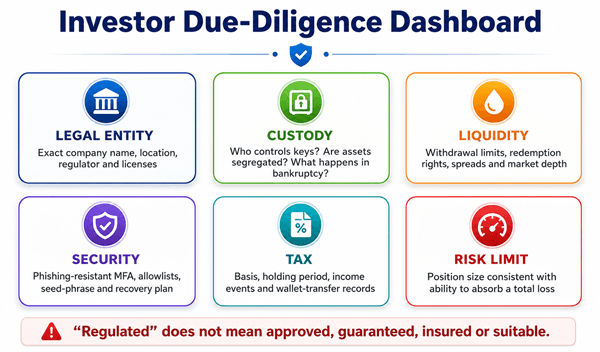
Figure 4. Investor due-diligence dashboard: six checks to complete before funding a crypto account or position.
15.1 A practical decision framework
- Identify the product: coin, stablecoin, tokenized security, fund, derivative, lending account, staking program, or wallet service.
- Identify the legal entity: determine the company name, location, regulator, licenses, and terms, not only the app or brand name.
- Check registration and licensing claims using official databases.
- Read the custody and bankruptcy terms. Determine who owns the assets and whether they can be lent, pledged, or commingled.
- Understand fees: trading spreads, commissions, withdrawal charges, network fees, custody fees, management fees, liquidation costs, and tax costs.
- Assess liquidity and redemption. Ask whether withdrawals can be delayed, limited, or suspended.
- Use strong security: unique password, phishing-resistant multifactor authentication, withdrawal allowlists, and safe seed-phrase storage.
- Plan for taxes before trading. Frequent swaps can create many taxable events.
- Limit exposure to an amount consistent with your risk capacity and overall financial plan.
- Assume that “regulated” does not mean guaranteed, insured, approved, or suitable.
15.2 Red flags
- Guaranteed profit or no-risk claims.
- Pressure to act immediately or keep the investment secret.
- A request to send crypto to “protect” money, pay taxes, unlock funds, or satisfy a government agency.
- Unverifiable licenses, fake regulator logos, or vague corporate identity.
- No clear explanation of custody, reserves, fees, or withdrawals.
- Returns that depend mainly on recruiting new participants.
- Unexpected contact through social media, messaging apps, romance platforms, or impersonated support accounts.
- A demand for additional deposits before withdrawals are allowed.
16. What Regulation Means for Crypto Businesses
Compliance should begin with a product and funds-flow analysis, not with filing forms. A company must map every entity, customer type, jurisdiction, asset, transaction, custody relationship, revenue stream, and contractual promise.
16.1 Core compliance workstreams
| Workstream | Key tasks |
|---|---|
| Legal classification | Analyze securities, commodities, stablecoin, payments, banking, lending, derivatives, and state-law status. |
| Licensing and registration | FinCEN MSB registration; state licenses; SEC/CFTC or banking registrations where applicable. |
| AML and sanctions | Risk assessment, customer identification, beneficial ownership, monitoring, SARs, recordkeeping, OFAC screening. |
| Custody and asset protection | Key management, segregation, reconciliation, bankruptcy analysis, incident response, insurance review. |
| Consumer and investor disclosures | Fees, conflicts, risks, reserves, redemption, volatility, legal rights, complaints, marketing review. |
| Market integrity | Surveillance, wash-trading controls, manipulation detection, listing governance, employee trading. |
| Cybersecurity | Access control, secure development, vendor risk, penetration testing, vulnerability management, recovery planning. |
| Tax and reporting | 1099-DA, transaction records, withholding where applicable, accounting, information security. |
| Governance | Board oversight, policies, independent testing, compliance officer, audits, regulatory change management. |
16.2 Why “decentralized” is not a complete compliance answer
Regulators may examine who develops and operates interfaces, controls governance keys, sets fees, upgrades code, markets the protocol, receives revenue, or can block transactions. A protocol may be technologically distributed while a legally relevant group still performs intermediary or managerial functions.
17. Crypto Compliance Checklist
| Checklist item | Investor | Business |
|---|---|---|
| Verify legal entity and regulator | Yes | Yes |
| Confirm state availability and licenses | Yes | Yes |
| Classify each asset and product | Helpful | Essential |
| Review custody and bankruptcy terms | Yes | Essential |
| Understand all fees and spreads | Yes | Essential disclosure |
| Maintain AML and sanctions controls | N/A for ordinary investor | Usually essential |
| Maintain tax records | Yes | Essential |
| Use cybersecurity controls | Yes | Essential |
| Document complaints and incidents | Helpful | Essential |
| Monitor rule changes | Helpful | Essential |
18. Common Misunderstandings
| Myth | Reality |
|---|---|
| “Crypto is unregulated.” | Many laws apply, but coverage is fragmented and gaps remain. |
| “If a token is a commodity, its exchange is CFTC-approved.” | Commodity status does not automatically create comprehensive CFTC regulation of every spot venue. |
| “A stablecoin is the same as an insured dollar deposit.” | Stablecoins are distinct instruments; reserve backing and regulation do not equal FDIC insurance. |
| “SEC registration means the government approves the investment.” | Registration is not approval or a guarantee against loss. |
| “Taxes apply only when crypto is converted to cash.” | Crypto-to-crypto trades and purchases can be taxable disposals. |
| “Self-custody avoids all regulation and risk.” | It may reduce counterparty risk but increases key-management, theft, loss, and operational risk. |
| “Decentralized projects cannot be regulated.” | People, entities, interfaces, governance, marketing, and revenue activities may remain subject to law. |
| “A platform’s FinCEN registration proves it is safe.” | MSB registration is not a safety rating, investment approval, or guarantee of solvency. |
19. Future of US Crypto Regulation
The direction of US policy changed materially in 2025 and 2026. The GENIUS Act created a stablecoin framework, federal banking agencies eased or clarified paths for permissible bank crypto activity, and the SEC and CFTC coordinated on a new securities-law interpretation. Regulators are also developing rules for stablecoins, custody, tokenization, and market infrastructure.
The largest unresolved question is comprehensive market structure for non-stablecoin spot markets. Pending legislation has sought to define SEC and CFTC jurisdiction, registration categories, disclosures, customer-asset protections, and pathways for digital commodities. As of August 2, 2026, readers should treat such proposals as pending rather than enacted law.
19.1 What to watch
- Final GENIUS Act implementing regulations and effective dates.
- Congressional action on digital-asset market-structure legislation.
- SEC rules or exemptions for token offerings, trading, custody, and tokenized securities.
- CFTC registration and market rules for crypto derivatives and any expanded spot authority.
- Federal and state coordination on licensing and stablecoins.
- IRS basis reporting and broader Form 1099-DA implementation.
- Court decisions interpreting investment contracts, decentralization, custody, and intermediary status.
- Rules for DeFi interfaces, staking, lending, privacy tools, and cross-border activity.
20. Frequently Asked Questions
20.1 Is cryptocurrency regulated in the United States?
Yes, but through multiple laws and regulators rather than one comprehensive code. Securities, commodities, AML, sanctions, tax, banking, consumer, criminal, and state licensing rules may apply.
20.2 Who is the main US crypto regulator?
There is no single regulator. The SEC and CFTC are central for markets; FinCEN and OFAC cover financial crime and sanctions; the IRS covers taxes; banking and state regulators oversee institutions and licenses.
20.3 Is Bitcoin a security?
Bitcoin is generally treated as a non-security crypto asset and commodity, but products, contracts, or schemes involving Bitcoin may still be securities or derivatives.
20.4 Is Ethereum a security or commodity?
Legal treatment can depend on the transaction and product. Investors should avoid assuming that one label resolves every staking, offering, fund, or platform issue.
20.5 Are stablecoins regulated?
Yes. The GENIUS Act established a federal payment-stablecoin framework, and agencies were implementing it through regulations in 2026. Other stable-value products may fall outside its definition and face different rules.
20.6 Are crypto exchanges legal in the US?
They can operate legally if they satisfy applicable federal and state requirements. Availability and products differ by state, and a platform may lawfully restrict certain customers or services.
20.7 How can I check whether a crypto company is regulated?
Search official databases for the exact legal entity: SEC IAPD and BrokerCheck where relevant, CFTC/NFA records, FinCEN MSB registration, NMLS and state regulator records, and New York DFS virtual-currency listings. Registration alone is not a safety guarantee.
20.8 Is Coinbase, Kraken, or another exchange FDIC insured?
The crypto assets held on an exchange are not FDIC-insured. A qualifying fiat balance may be held through an insured bank arrangement, but coverage depends on the precise structure and pass-through requirements.
20.9 Do I pay taxes if I only trade crypto for another crypto?
Generally yes. A crypto-to-crypto exchange is normally a taxable disposition of the asset surrendered.
20.10 Do I pay tax for transferring crypto between my wallets?
A transfer between wallets you own is generally not a sale, but records are essential to prove ownership and preserve basis.
20.11 What is Form 1099-DA?
It is an IRS information return used by brokers to report certain digital-asset proceeds. It does not replace the taxpayer’s need to calculate accurate basis, gain, loss, and income.
20.12 Is crypto mining legal?
Generally yes, but miners must consider tax, business, utility, zoning, environmental, contract, sanctions, and local rules.
20.13 Is crypto staking legal?
Staking itself is not categorically illegal. Custodial staking programs, pooled arrangements, marketing promises, and yield products can raise securities, custody, disclosure, and tax issues.
20.14 Can US residents use offshore crypto exchanges?
Access may violate the platform’s terms or applicable law, and offshore use can create major custody, sanctions, tax, enforcement, and recovery risks. US obligations do not disappear because a platform is overseas.
20.15 Can the government ban or freeze cryptocurrency?
Authorities can prohibit specific transactions, sanction addresses, seize assets with legal process, enforce against businesses, and restrict unlawful activities. A decentralized network may continue operating even when particular persons or services are legally restricted.
20.16 Does regulation eliminate crypto risk?
No. Regulation can reduce certain risks and improve accountability, but it cannot eliminate volatility, technology failures, fraud, operational errors, liquidity problems, or investment losses.
20.17 What is the safest way to invest in crypto?
There is no risk-free method. Use a properly vetted service, strong security, diversified financial planning, careful custody, complete tax records, and exposure limited to losses you can absorb.
20.18 What should I do if I am scammed?
Stop sending funds, preserve transaction records and communications, contact the platform and financial institutions immediately, and report the incident to appropriate law-enforcement and consumer-protection channels. Recovery services that demand upfront crypto payments are often additional scams.
21. Conclusion
Crypto regulation in the United States is best understood as a layered, activity-based system. The rules depend on the asset, transaction, intermediary, customer, and state. The framework is more developed than the phrase “unregulated crypto” suggests, yet less unified than the regulation of traditional securities or banking.
The most important recent developments are the GENIUS Act’s federal payment-stablecoin framework and the SEC-CFTC clarification of federal securities-law treatment in 2026. At the same time, comprehensive spot-market legislation remains unfinished. Investors should verify licenses, custody, insurance claims, fees, tax consequences, and withdrawal rights. Businesses should perform detailed classification, licensing, AML, sanctions, custody, cybersecurity, disclosure, and state-law analysis before launch, not after enforcement begins.
Actionable takeawayTreat regulation as a due-diligence tool, not a substitute for judgment. Verify claims through official sources, understand exactly what you own, and never assume that legal availability means low risk.
Sources Consulted and Checked
The following official sources were consulted and checked while preparing this article and reviewing its accuracy.
1. SEC, “Application of the Federal Securities Laws to Certain Types of Crypto Assets and Certain Transactions” (March 2026). Official source
2. SEC, Crypto Assets and the Federal Securities Laws. Official source
3. SEC, Crypto Task Force. Official source
4. CFTC, Joint SEC-CFTC interpretation announcement (March 17, 2026). Official source
5. CFTC, FAQs on registrant and registered-entity crypto activities (March 20, 2026). Official source
6. White House, GENIUS Act signed into law (July 18, 2025). Official source
7. US Treasury, proposed rules implementing GENIUS Act AML and sanctions obligations (April 8, 2026). Official source
8. OCC, GENIUS Act Regulations: Notice of Proposed Rulemaking. Official source
9. FinCEN, Application of Regulations to Persons Administering, Exchanging, or Using Virtual Currencies. Official source
10. FinCEN, 2019 Convertible Virtual Currency Guidance. Official source
11. IRS, Digital Assets. Official source
12. IRS, Frequently Asked Questions on Digital Asset Transactions. Official source
13. IRS, Form 1099-DA. Official source
14. New York DFS, Virtual Currency Business Licensing. Official source
15. FDIC, Deposit Insurance. Official source
16. Investor.gov, Crypto Assets. Official source
17. Investor.gov, Crypto Asset Custody Basics for Retail Investors. Official source
18. FTC, What To Know About Cryptocurrency and Scams. Official source
Reader Advice
This article is provided for educational and informational purposes only. It is not personalized legal, tax, financial, or investment advice, and it is not a recommendation to buy, sell, hold, or use any cryptocurrency, token, platform, or service. Crypto laws, regulatory policies, tax rules, official guidance, and statistics can change over time and may vary by state, jurisdiction, transaction, and individual circumstances. Verify current requirements through the relevant official federal and state sources before making a decision, and seek qualified professional advice where appropriate. Cryptocurrency and related products can involve substantial risks, including volatility, fraud, cyberattacks, loss of access, platform failure, liquidity constraints, tax consequences, and partial or total loss of funds.