Stablecoin Regulation in the US: Complete Guide to Rules, Risks & Best Practices
1. Executive Summary
Stablecoins are blockchain-based digital assets designed to maintain a relatively stable value, most often one U.S. dollar per token. Their usefulness comes from combining the programmability and round-the-clock transfer features of crypto networks with a value reference that is less volatile than Bitcoin or Ether. Their central weakness is equally important: a token is only as reliable as the issuer, reserve assets, redemption process, technology, custodians and legal framework behind it.
The United States moved from a fragmented system of state money-transmission, trust-company, banking, securities, commodities and anti-money-laundering rules to a dedicated federal framework when the GENIUS Act became law on July 18, 2025. The Act regulates a defined category called a “payment stablecoin” and restricts issuance in the United States to permitted issuers operating under federal or qualifying state supervision.
Key takeaway
A dollar price on an exchange does not prove that a stablecoin is federally approved, fully redeemable, insured or risk-free. Users should verify the issuer, regulator, reserve disclosures, redemption rights, network contract address and applicable fees before relying on any token.
- Permitted payment stablecoin issuers must maintain identifiable reserves backing outstanding tokens on at least a one-to-one basis.
- Reserve assets are limited mainly to cash, deposits, short-dated U.S. government obligations, qualifying repurchase transactions and certain money market funds invested in eligible assets.
- Issuers must provide clear redemption policies and monthly reserve composition disclosures supported by certification or examination requirements.
- Issuers cannot market payment stablecoins as legal tender, federally guaranteed or deposit-insured, and generally cannot pay interest or yield solely for holding, using or retaining the token.
- Permitted issuers are treated as financial institutions for Bank Secrecy Act purposes and must implement AML, sanctions, customer-identification and lawful-order capabilities.
- State-supervised nonbank issuers can remain under a qualifying state framework while outstanding issuance stays at or below $10 billion; larger issuers generally must transition to joint federal-state oversight unless a waiver applies.
- The law excludes qualifying payment stablecoins from federal securities treatment after the Act becomes effective, but other stablecoins, yield products, tokenized funds and related arrangements may still be securities or commodities depending on their structure.
2. What Is a Stablecoin?
A stablecoin is a digital token designed to track the value of another asset or reference. In the U.S. market, the reference is usually the U.S. dollar. A user may acquire one token for about $1, transfer it over a blockchain, and later sell or redeem it for approximately $1. The word “stable” describes the design objective, not a guarantee.
2.1 Common stablecoin models
| Model | How stability is attempted | Typical strengths | Main risks |
|---|---|---|---|
| Fiat-reserve backed | Issuer holds cash and highly liquid traditional assets against tokens | Simple concept; direct redemption may support the peg | Issuer, custodian, reserve, liquidity and legal risks |
| Crypto-collateralized | Smart contracts hold other crypto assets, often with overcollateralization | On-chain transparency; less reliance on one bank | Collateral volatility, liquidation, oracle and smart-contract risks |
| Algorithmic or endogenous | Code, incentives or a related token manage supply and demand | Can reduce reliance on traditional reserves | High de-peg and run risk; reflexive collapse |
| Commodity or asset referenced | Token tracks gold, another currency or a basket | Exposure and transferability | Custody, valuation, legal and redemption complexity |
| Tokenized deposit or fund share | Digital representation of a bank deposit or regulated investment product | May sit within familiar legal frameworks | Not necessarily a payment stablecoin; different rights and regulation |
2.2 What the GENIUS Act means by “payment stablecoin”
The federal framework focuses on digital assets used or designed for payment or settlement that the issuer is obligated to redeem, convert or repurchase for a fixed amount of monetary value and that are represented as maintaining a stable value relative to monetary value. Deposits, certain securities and other excluded instruments are not treated as payment stablecoins merely because they are tokenized.
Important distinction“Stablecoin” is a broad market label. “Payment stablecoin” is a defined legal category. A token can call itself a stablecoin yet fall outside the GENIUS Act because of its reference asset, yield features, redemption terms, issuer status or legal structure.
3. The GENIUS Act: The Core US Stablecoin Law
The Guiding and Establishing National Innovation for U.S. Stablecoins Act—commonly called the GENIUS Act—was signed into law as Public Law 119-27 on July 18, 2025. It created the first comprehensive federal framework specifically for payment stablecoin issuance.
3.1 When does the law take effect?
The Act’s principal effective date is the earlier of:
- January 18, 2027, which is 18 months after enactment; or
- 120 days after the primary federal payment stablecoin regulators issue final implementing regulations.
As of August 3, 2026, the OCC, FDIC, Federal Reserve and other agencies had issued or advanced multiple proposed rules and reporting frameworks, but the core operating standards were not yet final. Proposed numerical standards, forms and compliance details may change before adoption.
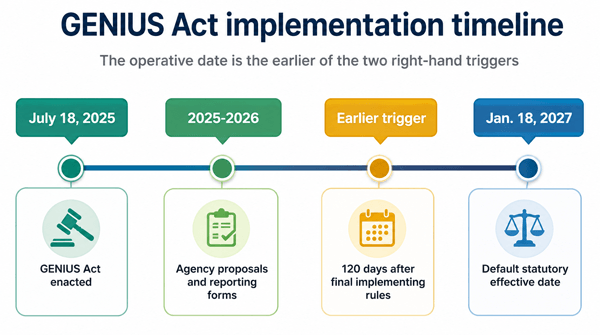
Figure 1. Statutory implementation timeline. Proposed rules are not final rules.
3.2 What the law is trying to accomplish
- Protect holders through high-quality reserves and redemption rights.
- Create a clear approval path for banks, credit unions and qualified nonbank issuers.
- Preserve a role for state regulation when state regimes are substantially similar to federal standards.
- Reduce illicit-finance and sanctions risks.
- Clarify the securities-law status of permitted payment stablecoins.
- Support payment innovation while limiting run, liquidity, operational and contagion risks.
4. Who Regulates Stablecoins in the US?
Stablecoin regulation is shared. The regulator depends on the issuer’s charter, ownership, state, activities and whether the product qualifies as a permitted payment stablecoin.
| Regulator | Primary role under or around the framework |
|---|---|
| Office of the Comptroller of the Currency (OCC) | Approves and supervises federal qualified payment stablecoin issuers and relevant national-bank or federal-branch structures; issues core prudential rules. |
| Federal Reserve Board | Supervises relevant state-member-bank subsidiaries and participates in interagency rules. |
| Federal Deposit Insurance Corporation (FDIC) | Supervises relevant state nonmember bank subsidiaries and establishes application and prudential standards within its jurisdiction. |
| National Credit Union Administration (NCUA) | Oversees permitted issuance involving insured credit unions and relevant subsidiaries. |
| State payment stablecoin regulators | License and supervise state-qualified issuers under state regimes determined to be substantially similar to the federal framework. |
| Treasury / FinCEN / OFAC | Implement BSA/AML, customer-identification and sanctions-compliance requirements and address foreign-issuer comparability. |
| SEC | Generally does not regulate qualifying permitted payment stablecoins as securities after the Act’s effective date, but may regulate other stablecoins, yield arrangements, tokenized funds and securities-market activities. |
| CFTC | Retains authority over derivatives, fraud and manipulation involving commodities and has addressed regulated payment stablecoins as collateral in derivatives markets. |
| State attorneys general and consumer agencies | May enforce applicable state consumer-protection, fraud, privacy and commercial laws. |
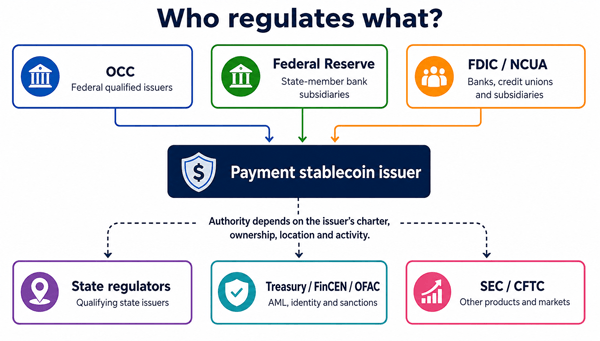
Figure 3. Regulatory responsibilities depend on issuer type, charter and activity.
5. Federal and State Licensing Paths
5.1 Depository-institution subsidiary
An insured bank or credit union generally issues through a separately approved subsidiary. The relevant federal banking or credit-union regulator reviews the application and supervises safety, soundness, governance, reserves, capital, liquidity, technology and compliance.
5.2 Federal qualified nonbank issuer
A qualifying nonbank, uninsured national bank or eligible federal branch can seek OCC approval. This route provides a national federal framework but does not turn the stablecoin into a bank deposit or provide FDIC insurance to token holders.
5.3 State qualified issuer
A state-established issuer can operate under a state payment stablecoin regulator when the state regime is determined to be substantially similar to the federal framework. This preserves state innovation while setting a federal floor.
5.4 The $10 billion threshold
A state-qualified nonbank issuer with no more than $10 billion in consolidated outstanding payment stablecoins may generally remain under the qualifying state regime. Once issuance exceeds $10 billion, the issuer generally must transition to a jointly administered federal-state framework within the statutory period or stop net new issuance while reducing below the threshold, unless a permitted waiver allows continued state-only supervision.
For usersDo not treat “state regulated” as automatically weak or “federally regulated” as automatically risk-free. Compare the actual regulator, reserve rules, audit or attestation quality, redemption access, enforcement history and operational controls.
6. Reserve Requirements
Reserve quality is the foundation of a redeemable stablecoin. The GENIUS Act requires permitted issuers to maintain identifiable reserves with a fair value at least equal to the par value of outstanding payment stablecoins. The assets must be segregated from the issuer’s other property and held directly or with eligible custodians.
6.1 Permitted reserve categories
- U.S. dollars, coins and Federal Reserve notes.
- Demand deposits or similar balances at eligible insured depository institutions or credit unions.
- Balances held at a Federal Reserve Bank, when available under applicable law and rules.
- Treasury bills, notes or bonds with remaining maturity of 93 days or less.
- Other similarly liquid federal-government-issued assets approved by the regulator.
- Qualifying repurchase agreements and reverse-repurchase agreements backed by eligible government obligations.
- Shares of registered money market funds invested solely in qualifying reserve assets.
- Tokenized versions of otherwise eligible reserve assets, subject to regulatory conditions.
The Act also restricts pledging, rehypothecation or reuse of reserves, except in narrow circumstances needed to satisfy permitted liquidity arrangements. This reduces the chance that the same reserve asset supports multiple obligations.
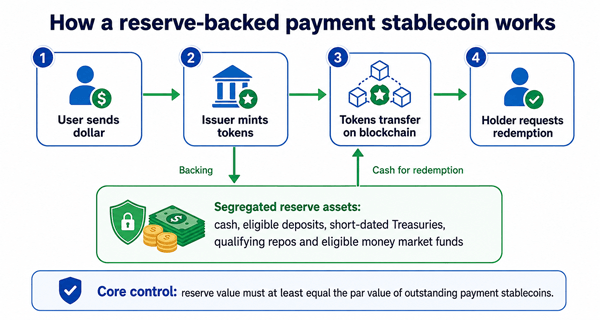
Figure 2. Simplified issuance, reserve custody, transfer and redemption lifecycle.
6.2 Why one-to-one backing does not eliminate risk
- Market-value risk: even short-term securities can move in price before maturity.
- Liquidity risk: an asset may be safe but difficult to sell quickly during a run.
- Custodian risk: reserves can be temporarily inaccessible if a bank or custodian fails or freezes activity.
- Concentration risk: too much exposure to one bank, fund, counterparty or asset type can create a single point of failure.
- Legal risk: segregation language must work in insolvency and across jurisdictions.
- Operational risk: the issuer must be able to convert reserves into cash quickly enough to meet redemptions.
7. Redemption Rights and Fees
A stablecoin’s practical value depends on whether holders can redeem at par—not merely sell on an exchange. Permitted issuers must establish publicly disclosed procedures for timely redemption at a fixed monetary value. Regulators may set standards for timing, minimum redemption amounts, identity verification, fees and exceptional restrictions.
7.1 Direct redemption vs exchange trading
| Method | What happens | Main issue |
|---|---|---|
| Direct issuer redemption | Holder returns tokens to the issuer and receives dollars under the issuer’s policy | May require account opening, KYC, minimums, banking access and fees |
| Exchange sale | Holder sells to another market participant | Price may be above or below $1; exchange spread and withdrawal fees apply |
| DeFi swap | Holder exchanges through a smart contract or liquidity pool | Slippage, smart-contract, bridge, oracle and network-fee risks |
| Merchant payment | Holder transfers stablecoins for goods or services | Merchant acceptance, tax records, fraud and finality issues |
Hidden cost warningA token can trade at $1 while still being expensive to use. Total cost may include purchase spread, card or bank-funding fees, blockchain gas, exchange withdrawal charges, bridge costs, redemption fees and foreign-exchange conversion at the receiving end.
8. Disclosure, Certification and Marketing Rules
Permitted issuers must publish monthly information about outstanding payment stablecoins and the composition of reserve assets. The framework also requires executive certification and independent accounting involvement, with exact forms and frequencies being developed by regulators.
- Reserve reports should show asset categories, values and relevant maturity or location information.
- Redemption policies must be clear, conspicuous and operationally realistic.
- Marketing cannot falsely imply that a stablecoin is legal tender, issued by the U.S. government, federally guaranteed or covered by deposit insurance.
- Names and branding cannot be deceptive.
- Material risks, fees and restrictions should be understandable before purchase.
8.1 Attestation is not the same as an audit
An attestation generally tests specific management assertions—such as whether reported reserves existed at a point in time. A financial-statement audit evaluates a broader set of accounts, controls and disclosures over a period. Users should read the scope, date, accounting basis, responsible firm, exceptions and whether the report addresses liabilities, custody and legal ownership—not just the headline reserve number.
9. Interest and Yield: What Is Prohibited?
A permitted payment stablecoin issuer generally may not pay interest or yield, in cash, tokens or other consideration, solely because a holder owns, uses or retains the payment stablecoin. This is intended to preserve the token’s payments character and reduce deposit-like competition and investment-product confusion.
The rule does not mean that every reward connected to stablecoins is automatically prohibited or safe. Exchanges, wallets, lending protocols and affiliates may offer incentives, lending returns or promotional rewards under separate arrangements. Those products can introduce counterparty, securities, lending, bankruptcy, liquidity and smart-contract risks. A user should identify who actually pays the yield and what activity generates it.
10. AML, Sanctions and Customer Identification
The GENIUS Act treats permitted payment stablecoin issuers as financial institutions for Bank Secrecy Act purposes. Treasury, FinCEN, OFAC and banking regulators have proposed detailed requirements tailored to issuer size and complexity.
- A written, risk-based AML program overseen by a responsible officer.
- Customer identification and verification for relevant account holders and transactions.
- Risk assessments, monitoring and suspicious activity reporting.
- Recordkeeping and information-sharing capabilities.
- Sanctions screening and an effective OFAC compliance program.
- Technical ability to block, freeze, reject or otherwise respond to lawful orders involving issuer-controlled functions.
- Enhanced due diligence where customer, geography, transaction pattern or product risk warrants it.
10.1 What this means for self-hosted wallets
Public blockchains allow transfers between wallets that may not be hosted by a regulated institution. The issuer may still control functions in the token’s smart contract, such as freezing specific addresses, while intermediaries may screen transactions and counterparties. Rules for secondary-market activity remain a difficult policy area because the issuer may not have a direct relationship with every wallet holder.
11. Foreign Stablecoins and Access to the US Market
A foreign-issued payment stablecoin is not automatically eligible for broad U.S. distribution. The framework contemplates Treasury determinations that a foreign jurisdiction’s regime is comparable, OCC registration or oversight, reserve and reporting conditions, and technical capability to comply with lawful U.S. orders. U.S. exchanges and service providers must also consider sanctions, AML, consumer-protection and state-law obligations.
Practical ruleDo not assume that a globally popular token is a permitted U.S. payment stablecoin. Verify the issuer’s legal entity, jurisdiction, U.S. registration or approval status, reserve location and direct redemption terms.
12. How Major Stablecoin Models Fit the Framework
The following examples are educational classifications, not endorsements or real-time regulatory approvals. A token’s status can change, and similarly named tokens may exist on multiple networks.
| Example type | Likely regulatory focus | Key due-diligence question |
|---|---|---|
| Dollar-backed custodial stablecoin such as USDC-style design | Issuer permission, reserves, redemption, AML, custody and monthly reporting | Can eligible holders redeem directly at par, and who legally owns the reserves? |
| Foreign-issued dollar stablecoin such as USDT-style design | Foreign-regime comparability, U.S. access conditions, reserves, lawful-order capability | Is the specific issuer and token permitted for the intended U.S. activity? |
| Crypto-collateralized decentralized stablecoin | May fall outside the permitted-payment-stablecoin issuer model; securities, commodities, AML and software issues may apply | Who is obligated to redeem, and what happens during collateral liquidation? |
| Algorithmic stablecoin | High consumer-protection and market-risk concern; may not qualify as a permitted payment stablecoin | What supports the peg when confidence disappears? |
| Tokenized money market fund | Securities and investment-company framework, not merely stablecoin rules | Does the holder own a fund share, and what are the redemption and transfer restrictions? |
| Tokenized bank deposit | Banking and deposit law; excluded from payment-stablecoin definition when legally a deposit | Is the claim against the bank and is deposit insurance applicable to this specific structure? |
13. Benefits of Regulated Stablecoins
- Faster settlement, including nights and weekends, subject to network and intermediary availability.
- Potentially lower cross-border transfer costs in some corridors.
- Programmable payments, escrow, conditional settlement and machine-to-machine transactions.
- A common digital settlement asset across exchanges, wallets and tokenized markets.
- Improved reserve and redemption transparency compared with unregulated issuance.
- Potential competition and innovation in merchant payments, treasury management and capital markets.
These benefits are not automatic. Real-world speed and cost depend on onboarding, compliance reviews, banking rails, exchange liquidity, network congestion, off-ramp availability and local regulation.
14. Risks Stablecoin Users Should Understand
| Risk | How it can affect users | Risk-reduction step |
|---|---|---|
| De-peg risk | Token trades below the reference value | Use liquid, well-disclosed tokens and monitor redemption conditions |
| Issuer insolvency | Redemption delayed or impaired | Review legal segregation, regulator and insolvency protections |
| Reserve shortfall | Not enough high-quality assets to meet claims | Read current reserve reports and auditor scope |
| Custodian failure | Reserves become temporarily unavailable | Check concentration and custodian diversification |
| Exchange failure | Tokens trapped despite healthy issuer | Avoid unnecessary exchange balances; understand withdrawal rules |
| Smart-contract exploit | Tokens stolen, frozen or improperly minted | Use verified contract addresses and mature networks |
| Bridge failure | Wrapped token loses backing on another chain | Prefer native issuance where practical; verify bridge design |
| Sanctions/freeze risk | Address or funds become blocked | Use lawful services and understand issuer control features |
| Privacy risk | Blockchain activity may be permanently traceable | Do not assume pseudonymous means private |
| Scam-token risk | Fake token copies a legitimate name or symbol | Verify contract address from official sources |
| Tax-record risk | Frequent transfers create reporting complexity | Keep complete cost-basis and transaction records |
| Policy-change risk | Eligibility, redemption or platform support changes | Recheck rules before large or long-term use |
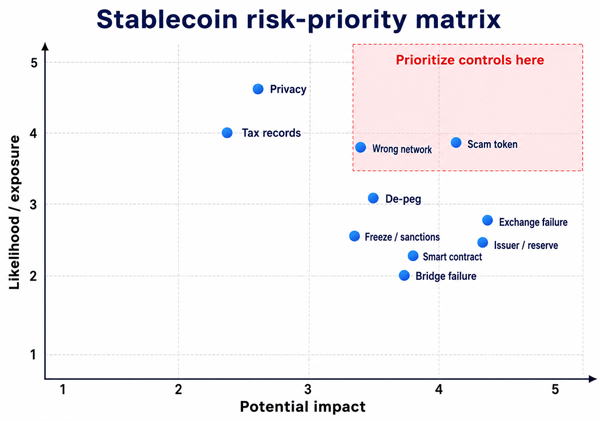
Figure 5. Illustrative prioritization tool; actual likelihood depends on the token, platform, network and user behavior.
15. Are Stablecoins FDIC Insured?
Generally, no. A payment stablecoin is not a bank deposit merely because its reserve includes bank deposits or because a bank-affiliated entity issues it. FDIC insurance protects eligible deposit accounts at insured banks within statutory limits and conditions; it does not automatically protect token holders from issuer failure, exchange failure, theft, smart-contract loss or a decline in token market value.
Do not confuse these claims“Reserves are held at an FDIC-insured bank” is different from “your stablecoins are FDIC insured.” The first describes where some assets may be kept. The second is generally false unless a specific legally recognized deposit structure and pass-through requirements apply.
16. Tax Treatment of Stablecoins in the US
The IRS generally treats digital assets as property for federal tax purposes. Stablecoins are digital assets, so transactions can create reporting obligations even when the dollar value changes only slightly.
- Buying a stablecoin with U.S. dollars generally establishes cost basis but usually does not itself create gain or loss.
- Selling or redeeming a stablecoin for dollars can create a small capital gain or loss based on the difference between proceeds and adjusted basis, including fees.
- Exchanging a stablecoin for another cryptocurrency, token, good or service is generally a taxable disposition.
- Receiving stablecoins as compensation, business revenue, staking income, rewards or interest can create ordinary income measured at fair market value when received.
- Businesses must keep records for date, amount, fair market value, basis, fees, wallet and transaction identifiers.
- Digital-asset broker reporting is being phased in. Depending on the transaction and year, taxpayers may receive Form 1099-DA, but they remain responsible for checking proceeds, basis and gain or loss against their own records and current IRS instructions.
State taxes, sales taxes, accounting treatment and cross-border reporting may also apply. A stable $1 target does not eliminate tax compliance.
17. Best Practices for Individual Users
- Confirm the exact issuer and official contract address. Never rely only on a token symbol.
- Check whether the token and issuer are permitted or otherwise legally available for your location and intended use.
- Read the latest reserve report, not an old marketing page. Note reserve composition, date, auditor and exceptions.
- Understand direct redemption eligibility, timing, minimums, fees and banking requirements.
- Check whether you hold native tokens or bridged/wrapped versions.
- Use a small test transaction before sending a large amount.
- Protect wallet seed phrases and use hardware security or strong account controls for meaningful balances.
- Avoid treating stablecoins as insured savings accounts or emergency cash unless you fully understand access risks.
- Diversify operational exposure when balances are large: issuer, custodian, exchange, wallet and network risk can differ.
- Keep tax and transaction records from the beginning.
18. Best Practices for Businesses
- Adopt a written stablecoin acceptance and treasury policy approved at the appropriate governance level.
- Define approved issuers, networks, wallets, transaction limits and counterparties.
- Perform legal analysis for money transmission, payments, securities, commodities, sanctions, privacy, consumer protection and tax.
- Use institutional custody or carefully controlled multisignature arrangements.
- Separate operating wallets from long-term or reserve balances.
- Screen addresses and transactions using proportionate, lawful controls.
- Reconcile on-chain records to accounting systems daily.
- Model de-peg, bank outage, chain congestion, custodian failure and mass-redemption scenarios.
- Disclose conversion rates, fees, refund process and payment finality to customers.
- Maintain an incident-response plan covering key compromise, token freeze, chain fork, bridge failure and regulatory order.
19. Compliance Roadmap for a Prospective Issuer
- Define the product. Determine whether it is a payment stablecoin, deposit, security, fund share, commodity-linked token or another instrument.
- Select the legal and regulatory path: depository subsidiary, federal qualified issuer or state qualified issuer.
- Engage regulators early and prepare a detailed business plan, ownership structure and financial projections.
- Design reserves, custody, segregation, valuation, liquidity, concentration limits and daily monitoring.
- Build redemption systems that can operate during stress and support clear customer disclosures.
- Implement governance, capital, operational backstop, risk management, cyber controls and third-party oversight.
- Create AML, customer-identification, sanctions, transaction-monitoring and lawful-order capabilities.
- Arrange independent accounting, monthly public reporting and regulatory reporting.
- Test smart contracts, key management, mint/burn controls, chain governance, upgrades and recovery procedures.
- Prepare recovery, wind-down and insolvency plans that prioritize stablecoin holders as required by law.
- Validate marketing, naming, yield features and distribution agreements.
- Monitor final rules and update the program before the statutory effective date.
20. Decision Framework: Is a Stablecoin Appropriate?
| Question | A “yes” supports use | A “no” suggests caution or an alternative |
|---|---|---|
| Do you need 24/7 blockchain settlement? | Stablecoin utility may be meaningful | ACH, wire, card or bank transfer may be simpler |
| Can you verify issuer and reserves? | Risk can be assessed | Avoid or limit exposure |
| Can you redeem or access deep liquidity? | Exit risk is lower | You may depend on volatile secondary markets |
| Is the network secure and supported? | Operational risk is manageable | Use another network or payment rail |
| Are compliance and tax systems ready? | Business use may scale | Manual errors and penalties may outweigh benefits |
| Can you tolerate temporary freezes or de-pegs? | Exposure can fit risk limits | Use insured deposits or Treasury products instead |
| Is yield the main reason for holding it? | Evaluate the separate yield product carefully | Do not assume stablecoin regulation protects the yield arrangement |
21. Common Mistakes
- Assuming every token priced near $1 is a regulated stablecoin.
- Assuming reserves held in a bank make the token FDIC insured.
- Confusing an attestation with a full audit.
- Ignoring direct redemption restrictions.
- Holding a bridged version without understanding the bridge.
- Chasing yield without identifying the borrower or risk source.
- Sending tokens on the wrong network.
- Using an unofficial contract address.
- Keeping large balances on one exchange.
- Failing to record taxable swaps and payments.
- Relying on proposed rules as though they are final.
22. Frequently Asked Questions
22.1 Are stablecoins legal in the United States?
Yes, stablecoins can be legally issued, held and used, but issuers and intermediaries must comply with applicable federal and state laws. After the GENIUS Act becomes effective, issuing a payment stablecoin in the United States generally requires permitted-issuer status.
22.2 Is USDC regulated by the US government?
USDC has operated through regulated entities and state frameworks, but users should verify the current issuer, regulator and GENIUS Act approval status for the specific token and date. Market familiarity is not the same as a permanent federal guarantee.
22.3 Is USDT legal in the US?
U.S. users may encounter USDT through lawful platforms, but foreign-issued stablecoins face specific U.S. market-access, comparability, registration and compliance requirements. Availability can differ by platform, state and activity.
22.4 Are stablecoins securities?
Qualifying payment stablecoins issued by permitted issuers are excluded from securities treatment by the GENIUS Act after its effective date. Other stablecoins, tokenized funds, yield products or investment arrangements may still be securities based on their facts and structure.
22.5 Are stablecoins commodities?
Some digital assets may be treated as commodities for certain Commodity Exchange Act purposes. The CFTC regulates derivatives and can pursue fraud or manipulation within its authority. The precise status depends on the product and activity.
22.6 Can stablecoin issuers pay interest?
Permitted payment stablecoin issuers generally cannot pay interest or yield solely for holding, using or retaining the token. A third-party lending or rewards product is separate and carries additional risk.
22.7 Are stablecoins safer than Bitcoin?
They are usually less price-volatile when the peg works, but they introduce issuer, reserve, redemption, freeze and counterparty risks that Bitcoin does not have in the same form.
22.8 Can a stablecoin lose its peg?
Yes. De-pegs can result from reserve concerns, exchange dislocation, liquidity stress, smart-contract failures, banking problems, sanctions events or loss of confidence.
22.9 Can the issuer freeze my stablecoins?
Many centralized stablecoins include smart-contract controls that can freeze or blacklist addresses, often to comply with sanctions, court orders, theft investigations or other legal obligations.
22.10 Do I owe tax when I spend stablecoins?
Potentially. Spending or swapping a stablecoin generally disposes of a digital asset and can create gain or loss. Receiving stablecoins for services or rewards can create income.
22.11 When does the GENIUS Act take effect?
The main framework takes effect on the earlier of January 18, 2027, or 120 days after the primary federal regulators issue final implementing rules.
22.12 What happens to state-regulated issuers?
They may continue under qualifying state regimes that are substantially similar to federal standards, subject to the $10 billion threshold and transition or waiver provisions.
22.13 What is the safest stablecoin?
No stablecoin is risk-free. The strongest candidates generally have a permitted or well-established regulated issuer, transparent high-quality reserves, reliable redemption, diversified custody, mature technology and deep liquidity.
22.14 Should I keep emergency savings in stablecoins?
Stablecoins can be useful for payments and settlement, but they are generally not insured deposits. Emergency savings usually require dependable access, legal protection and minimal operational risk, so insured bank deposits or government-backed instruments may be more appropriate.
22.15 How can I verify a stablecoin?
Use the issuer’s official website and regulator records to confirm the legal entity, approval status, contract address, reserve reports, redemption policy and supported networks. Cross-check before transferring funds.
23. Conclusion
U.S. stablecoin regulation has entered a new phase. The GENIUS Act creates a federal floor built around permitted issuers, one-to-one high-quality reserves, redemption rights, monthly transparency, prudential supervision and financial-crime controls. It also preserves a meaningful state pathway and clarifies that qualifying payment stablecoins are not securities after the law becomes effective.
The framework improves legal clarity, but it does not make every stablecoin safe. Users still face de-peg, issuer, custodian, exchange, blockchain, bridge, sanctions, privacy and tax risks. Businesses and issuers must also prepare for final regulations that may differ from 2026 proposals. The best approach is to treat stablecoins as specialized payment and settlement tools, not as automatically insured cash, and to verify the legal, financial and technical structure before using them.
23.1 Sources Consulted and Checked
These official and authoritative sources were consulted and checked while preparing this article and reviewing its accuracy.
- White House — President signed S. 1582, the GENIUS Act (July 18, 2025)
- OCC — Proposed rule implementing the GENIUS Act (Federal Register, March 2, 2026)
- FDIC — Proposed prudential standards for supervised issuers (April 10, 2026)
- Treasury / FinCEN / OFAC — Proposed AML and sanctions requirements (April 2026)
- Federal Register — Proposed AML/CFT rule for permitted issuers
- Federal Reserve — Proposal on customer identification programs (June 18, 2026)
- SEC — Statement on the GENIUS Act and securities status (July 18, 2025)
- CFTC — Updated payment stablecoin no-action letter (February 6, 2026)
- New York DFS — Guidance on U.S. dollar-backed stablecoins
- IRS — Digital assets tax information
23.2 Reader Advice
This article is provided for educational and informational purposes only. It is not personalized financial, legal, tax, investment, regulatory, or other professional advice or a recommendation to buy, sell, issue, hold, or use any stablecoin or digital-asset product.
Stablecoin rules, regulatory guidance, policies, market practices, fees, statistics, tax treatment, and product availability can change over time and may vary by state, country, platform, and individual circumstances. Stablecoins also involve financial, legal, operational, technology, liquidity, counterparty, de-peg, fraud, sanctions, privacy, and tax risks. Verify current information through relevant official sources and consider qualified professional advice before making a significant decision.