Crypto Regulation Explained: Meaning, How It Works, Examples, Benefits and Risks
Crypto regulation is the set of laws, rules, licenses, reporting duties, and enforcement actions that governments use to oversee cryptocurrency activity. It affects exchanges, wallet providers, stablecoin issuers, token projects, investors, businesses that accept crypto, and sometimes even software developers. For beginners, the easiest way to understand crypto regulation is to think of it as the rulebook that decides who can offer crypto services, what they must disclose, how they protect customer funds, how they prevent crime, and how users report taxes.
The topic can feel confusing because crypto is not one single thing. Bitcoin may be treated differently from a tokenized stock. A stablecoin may face payment and reserve rules. A crypto exchange may need anti-money-laundering controls, licensing, cybersecurity policies, customer disclosures, and tax reporting systems. A decentralized protocol may raise different questions again. Regulation also changes from country to country, so a service that is allowed in one market may be restricted or unavailable in another.
This guide explains crypto regulation in simple words.
| Quick answer | Beginner explanation |
|---|---|
| What is crypto regulation? | Rules for crypto assets, exchanges, wallets, stablecoins, token issuers, tax reporting, anti-money-laundering checks, custody, marketing, and investor protection. |
| Why does it exist? | To reduce fraud, protect customers, support market integrity, collect taxes, fight illicit finance, and make responsible innovation easier. |
| Does regulation make crypto risk-free? | No. It can reduce some risks, but crypto can still be volatile, hacked, mismanaged, manipulated, or legally uncertain. |
1. What Is Crypto Regulation?
Crypto regulation means the legal and supervisory framework that applies to digital assets and crypto-related services. It can cover how crypto businesses register, how stablecoin issuers hold reserves, how exchanges list tokens, how companies advertise returns, how suspicious transactions are reported, and how users report gains or losses on tax returns.
A useful definition is: crypto regulation is the system of rules that tells crypto market participants what they can do, what they must disclose, what controls they need, and what happens if they break the rules.
| Area of regulation | What it controls | Simple example |
|---|---|---|
| Licensing and registration | Who can legally run crypto services | An exchange may need approval before serving customers in a jurisdiction. |
| AML and KYC | Customer checks and suspicious activity monitoring | A platform asks for ID before allowing large withdrawals. |
| Securities and commodities rules | Whether a token is an investment product, commodity, or another asset type | A token sale promising profits from a team’s work may trigger securities laws. |
| Stablecoin rules | Reserve backing, redemption rights, disclosures, and issuer supervision | A dollar stablecoin issuer may need safe reserves and regular reporting. |
| Tax rules | How gains, income, staking rewards, mining, and payments are reported | Selling Bitcoin at a profit may create a taxable capital gain. |
| Consumer protection | Risk warnings, marketing, custody, complaint handling, and transparency | A wallet provider may need to explain who controls private keys. |
| Market integrity | Fraud, manipulation, insider trading, wash trading, and misleading conduct | Regulators may investigate a token pump-and-dump scheme. |
2. Why Crypto Regulation Matters
Crypto was originally built to let people transfer value without relying on traditional banks. That innovation created new opportunities, but it also created difficult questions. Who is responsible if a centralized exchange loses customer funds? Should a token promoter be allowed to promise unrealistic returns? How should governments track taxable gains? How can law enforcement prevent sanctioned groups or criminals from moving money through digital assets?
Regulation matters because crypto connects money, technology, public trust, and financial risk. Without basic rules, users may struggle to know whether a platform is legitimate. With overly strict or unclear rules, useful innovation can move offshore or become available only to large companies that can afford legal teams. The goal of good regulation is not simply to stop crypto. The better goal is to make the market safer, more transparent, and more accountable while allowing legitimate use cases to develop.
3. How Crypto Regulation Works in Practice
Crypto regulation usually works through a combination of laws, regulator guidance, licensing, supervision, enforcement, and reporting. The process differs by country, but the building blocks are similar.
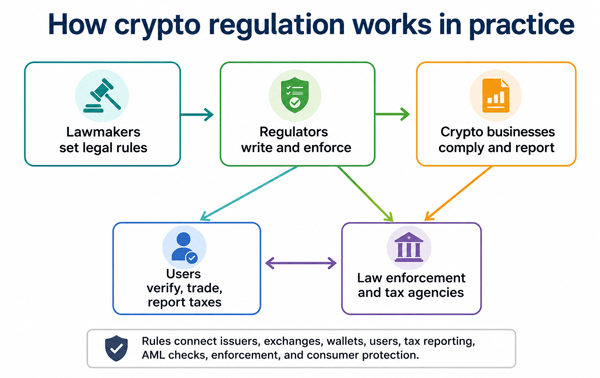
Diagram: A simple view of how crypto regulation connects lawmakers, regulators, businesses, users, and enforcement agencies.
- Lawmakers pass legislation. A parliament or congress decides broad legal categories, agency powers, penalties, and consumer protections.
- Regulators publish rules and guidance. Financial agencies explain how existing laws apply or create detailed compliance rules.
- Crypto businesses register, apply for licenses, or stop offering certain services. Exchanges, custodians, brokers, payment firms, and stablecoin issuers often face the most direct obligations.
- Businesses build compliance systems. This can include identity verification, transaction monitoring, cybersecurity controls, segregation of customer assets, disclosures, audits, and complaint handling.
- Regulators supervise and enforce. Agencies may inspect firms, demand reports, issue warnings, impose fines, suspend licenses, or bring civil and criminal cases.
- Users still have responsibilities. Individuals may need to understand risk warnings, protect wallets, avoid scams, and report taxable transactions.
4. Who Regulates Crypto?
There is usually no single crypto regulator. Different agencies may oversee different parts of the same transaction. This is one reason crypto regulation often feels fragmented.
| Regulator type | Main role | Crypto example |
|---|---|---|
| Securities regulator | Protects investors and regulates securities offerings and markets | Reviews token offerings that may be investment contracts or tokenized securities. |
| Commodities or derivatives regulator | Oversees derivatives, commodity markets, futures, and market manipulation rules | Regulates Bitcoin futures or crypto derivatives platforms. |
| Banking or payments regulator | Supervises banks, payment firms, stablecoin issuers, and custody risks | Sets reserve, redemption, or safeguarding rules for payment stablecoins. |
| Financial intelligence unit | Handles AML/CFT rules and suspicious transaction reporting | Requires crypto money transmitters or exchanges to monitor suspicious activity. |
| Tax authority | Collects income, capital gains, and information reports | Requires users or brokers to report taxable crypto disposals. |
| Consumer protection agency | Polices unfair, deceptive, or misleading practices | Investigates misleading ads or hidden fees. |
| Data protection regulator | Protects personal information and privacy rights | Reviews how exchanges collect and store KYC documents. |
5. Real-World Examples of Crypto Regulation
5.1 European Union: MiCA
The European Union’s Markets in Crypto-Assets Regulation, commonly called MiCA or MiCAR, is one of the most important comprehensive crypto frameworks. It creates uniform EU market rules for crypto-assets not already covered by existing financial services law. Its core areas include transparency, disclosures, authorization, supervision, and rules for issuers and crypto-asset service providers. In practical terms, a crypto business that wants to serve EU customers may need authorization as a crypto-asset service provider, and compliant firms can use a passporting model to operate across the EU.
For beginners, MiCA matters because it shows the direction many regulators are taking: clearer licensing, stronger disclosures, stablecoin requirements, and more direct responsibility for platforms that custody or trade crypto for customers.
5.2 United States: Multiple agencies and evolving rules
The United States has historically regulated crypto through a mix of securities law, commodities law, money transmission law, tax law, sanctions rules, banking supervision, and state-level licensing. The SEC, CFTC, FinCEN, IRS, banking regulators, state regulators, and courts have all played roles. This creates both flexibility and uncertainty. For example, a crypto exchange may face securities questions, derivatives rules, AML obligations, state money transmitter requirements, tax reporting duties, and consumer protection issues at the same time.
For ordinary users, the most practical U.S. lesson is that legality does not mean absence of rules. Crypto activity can be legal and still subject to taxes, anti-fraud rules, sanctions screening, platform restrictions, and reporting duties.
5.3 FATF Travel Rule: Global AML standard
The Financial Action Task Force, or FATF, is not a national regulator, but its standards heavily influence national anti-money-laundering rules. FATF treats virtual assets as digital representations of value that can be digitally traded or transferred, and it expects countries to apply AML/CFT controls to virtual asset service providers. The Travel Rule is especially important: it generally requires regulated crypto service providers to collect and transmit certain originator and beneficiary information for qualifying transfers.
5.4 OECD CARF: International crypto tax reporting
The OECD’s Crypto-Asset Reporting Framework, or CARF, is designed to help tax authorities receive information about crypto-asset transactions, including cross-border activity. The practical impact is that users should expect more exchanges and crypto service providers to collect tax residency information and report certain transactions to tax authorities as implementation expands.
6. What Types of Crypto Assets Can Be Regulated?
| Crypto asset or activity | How it may be regulated | Beginner note |
|---|---|---|
| Bitcoin and similar payment tokens | May be treated as commodities, property, payment instruments, or virtual assets depending on jurisdiction | Buying and holding may be simple, but exchanges and taxes are still regulated. |
| Stablecoins | Often subject to reserve, redemption, disclosure, payment, and AML rules | Stable does not mean risk-free; reserve quality and issuer governance matter. |
| Utility tokens | May be treated as consumer access tokens, but can become investment products if marketed for profit | Labels do not decide legal status; facts matter. |
| Security tokens and tokenized securities | Usually regulated under securities laws | A tokenized share or bond is still likely a regulated financial product. |
| NFTs | Often treated differently from fungible tokens, but can trigger fraud, tax, IP, gambling, or securities issues | An art NFT and an NFT promising revenue share are very different. |
| DeFi protocols | May raise questions about intermediaries, governance, front ends, sanctions, and investor protection | Decentralization can reduce some intermediaries but does not automatically remove legal risk. |
| Staking, lending, and yield products | May trigger securities, banking, lending, consumer protection, or tax rules | High yield often comes with legal, smart contract, and counterparty risk. |
7. Practical Examples for Beginners
7.1 Example 1: You buy Bitcoin on a licensed exchange
You create an account, submit identity documents, buy Bitcoin, and hold it. Regulation may affect you through KYC checks, trading disclosures, platform custody rules, tax records, and limits on withdrawals. If you later sell at a profit, tax rules may apply.
7.2 Example 2: A company launches a new token
The company says the token will rise in value because the team will build a platform. Regulators may examine whether buyers are investing money with an expectation of profit based mainly on the company’s efforts. If so, securities rules may apply. The company may need disclosures, registration, exemptions, or a different launch structure.
7.3 Example 3: A stablecoin issuer promises one token equals one dollar
Regulators may ask: What backs the token? Are reserves safe and liquid? Can customers redeem? Are reports audited? Who supervises the issuer? Stablecoin regulation focuses on confidence, redemption, payment risk, and prevention of runs.
7.4 Example 4: An exchange lists hundreds of tokens
The exchange may need listing standards, market surveillance, custody controls, cybersecurity policies, anti-money-laundering systems, risk warnings, and customer support procedures. If it lists tokens that are regulated securities or derivatives without permission, it may face enforcement action.
7.5 Example 5: A user moves crypto to a self-custody wallet
Self-custody may give the user more control, but also more responsibility. A regulated exchange may still ask for information before withdrawal, especially for large or risky transfers. Once funds are in a private wallet, losing the seed phrase can mean losing access permanently.
8. Benefits of Crypto Regulation
- Better consumer protection: Users receive clearer risk warnings, complaint processes, and safeguards for custody or redemption.
- Less fraud and market manipulation: Regulators can investigate scams, misleading promotions, wash trading, insider abuse, and false claims.
- More institutional confidence: Banks, funds, payment companies, and public companies are more likely to participate when rules are clear.
- Clearer tax compliance: Reporting standards help users and tax authorities understand taxable events and reduce accidental non-compliance.
- Improved stablecoin trust: Reserve, audit, and redemption rules can make payment tokens more reliable.
- Better business planning: Crypto companies can design products around known requirements instead of guessing after enforcement actions.
- Financial crime prevention: AML/CFT rules help reduce abuse by scammers, hackers, sanctioned actors, and organized crime.
9. Risks, Costs, and Limitations of Crypto Regulation
- Regulation cannot remove volatility. A legal token can still lose most of its value.
- Compliance costs can reduce competition. Smaller startups may struggle with legal, audit, reporting, and licensing expenses.
- Rules can be unclear or inconsistent. The same token may receive different treatment in different countries.
- Overregulation can push activity offshore. Users may move to less regulated platforms that are riskier.
- False sense of safety is dangerous. A licensed platform is not automatically risk-free.
- Privacy concerns may increase. KYC and tax reporting require collection of sensitive personal data.
- Decentralized systems remain hard to supervise. Regulators may struggle to identify who is responsible for open-source protocols or decentralized governance.
10. Regulated vs Unregulated Crypto Platforms
| Feature | More regulated platform | Less regulated or offshore platform |
|---|---|---|
| Identity checks | Usually required | May be minimal or absent |
| Customer disclosures | More likely to provide risk, fee, and custody information | May provide vague or limited information |
| Legal recourse | More likely to have complaint channels and supervisor oversight | May be difficult to sue or contact |
| Product availability | May restrict risky products or certain tokens | May offer more tokens, leverage, or yield products |
| Privacy | Collects more personal data | May collect less data but create other risks |
| Failure risk | Still possible, but subject to some controls | May be higher due to weak governance or no oversight |
| Tax records | Often easier to obtain reports | May provide poor or incomplete records |
11. Common Crypto Compliance Requirements
Crypto businesses usually face the heaviest compliance burden. However, users benefit from understanding these requirements because they explain why platforms ask for information or restrict certain actions.
| Requirement | What it means | Why it matters |
|---|---|---|
| KYC | Know-your-customer checks such as identity verification | Helps prevent fake accounts, fraud, sanctions evasion, and money laundering. |
| AML/CFT monitoring | Monitoring transactions for suspicious behavior | Helps detect criminal finance and terrorist financing risk. |
| Custody safeguards | Controls for holding customer assets securely | Reduces risk of theft, misuse, or commingling. |
| Disclosures | Clear information about risks, fees, reserves, and conflicts of interest | Helps users make informed decisions. |
| Licensing | Permission to operate from a regulator | Creates minimum standards and supervisory accountability. |
| Market surveillance | Monitoring for manipulation and abusive trading | Supports fairer markets. |
| Tax reporting | Collecting and reporting transaction data where required | Helps users and authorities calculate taxes. |
| Cybersecurity controls | Systems to protect wallets, keys, accounts, and infrastructure | Crypto platforms are frequent targets for hackers. |
12. Common Misconceptions About Crypto Regulation
12.1 Misconception 1: “Crypto is completely unregulated.”
This is not accurate. Many crypto activities are already covered by tax rules, AML rules, sanctions laws, fraud laws, derivatives rules, consumer protection laws, and sometimes securities laws. What is often missing is one simple, unified framework in every country.
12.2 Misconception 2: “If a token is decentralized, no rules apply.”
Decentralization matters, but it is not a magic shield. Regulators may look at who promotes the token, who controls the front end, who earns fees, who manages upgrades, and whether users are relying on a group’s efforts.
12.3 Misconception 3: “A licensed exchange means my investment is safe.”
Licensing may improve standards, but it does not guarantee profits or eliminate hacking, insolvency, market crashes, or user mistakes.
12.4 Misconception 4: “I only owe tax when I cash out to my bank.”
In many tax systems, taxable events can occur when crypto is sold, exchanged, spent, or received as income. Rules differ by country, but waiting until money reaches a bank account is often not the correct approach.
12.5 Misconception 5: “Stablecoins are always as safe as bank deposits.”
Stablecoins can have reserve, redemption, operational, legal, and issuer risks. Some are well regulated and transparent; others are not. A stable price target is not the same as deposit insurance.
13. Best Practices for Crypto Users
- Check whether the platform is registered or licensed in your country before depositing funds.
- Read custody terms carefully. Know whether you control the private keys or the platform controls them.
- Keep your own transaction records, including dates, amounts, wallet addresses, fees, and fair market values.
- Do not assume tax rules are optional because crypto uses blockchain technology.
- Avoid guaranteed return claims. High, fixed, risk-free crypto yield is a major warning sign.
- Use strong account security: hardware security keys, two-factor authentication, withdrawal allowlists, and unique passwords.
- Test small transfers before moving large amounts.
- Separate long-term holdings from experimental DeFi or high-risk trading funds.
- Check stablecoin reserve reports and redemption terms before treating a stablecoin like cash.
- Be cautious with influencers, private groups, airdrop links, wallet signature requests, and urgent offers.
14. Best Practices for Crypto Businesses and Projects
- Map your product before launch: token type, users, jurisdictions, custody model, revenue model, and marketing claims.
- Get legal advice early, especially for token sales, staking, lending, stablecoins, derivatives, custody, and cross-border services.
- Build compliance into the product rather than adding it after a regulator asks questions.
- Avoid misleading language such as guaranteed returns, risk-free yield, bank-like safety, or vague reserve claims.
- Maintain written policies for AML, cybersecurity, custody, conflicts of interest, token listing, complaints, and incident response.
- Prepare for tax reporting and recordkeeping requirements before scaling internationally.
- Use independent audits where appropriate, but do not market an audit as a guarantee of safety.
- Have a clear plan for customer asset segregation, insolvency scenarios, and operational failures.
15. Red Flags That a Crypto Platform May Be Unsafe
- No clear company name, address, leadership, or regulator information.
- Promises of guaranteed daily, weekly, or monthly returns.
- Pressure to deposit quickly or recruit other users.
- No clear explanation of fees, custody, withdrawal rules, or risks.
- Poor support, blocked withdrawals, or constant excuses about “maintenance.”
- Fake endorsements from celebrities, regulators, or well-known companies.
- Requests for your seed phrase, private key, or remote access to your device.
- A stablecoin or yield product with no credible reserve, audit, or risk disclosure.
16. How Crypto Regulation Differs by Country
Crypto regulation is local. A global exchange may need one approach for the EU, another for the United States, another for the United Kingdom, and another for countries that ban or restrict certain activities. Beginners should remember three principles.
- Legality and licensing are different. Crypto may be legal to own, but a platform may still need permission to operate.
- Token classification changes outcomes. The same asset might be treated as a commodity, security, payment token, property, or virtual asset depending on the rule being applied.
- Your tax residence matters. A person living in one country may owe tax there even if the exchange is located abroad.
17. Important Crypto Regulation Trends to Watch
- Stablecoin rules: More countries are focusing on reserves, redemption, payments, and issuer supervision.
- Exchange licensing: Regulators increasingly expect crypto-asset service providers to obtain authorization before serving local customers.
- Tax transparency: Broker reporting and international information exchange are expanding, including frameworks such as OECD CARF.
- DeFi accountability: Regulators are studying how to address decentralized front ends, governance, admin keys, and protocol revenue.
- Tokenization of real-world assets: Tokenized bonds, funds, deposits, and securities are bringing crypto rails closer to traditional finance regulation.
- Consumer protection and advertising: Risk warnings, suitability, influencer promotions, and misleading yield claims are likely to receive more scrutiny.
- Cybersecurity and custody: After major exchange failures and hacks, regulators are paying closer attention to how customer assets are stored and protected.
18. Crypto Regulation Checklist for Beginners
| Question | Why it matters |
|---|---|
| Is the platform licensed or registered where I live? | It may indicate minimum standards and gives you a regulator to contact. |
| Who controls the private keys? | This decides whether you have self-custody or platform custody risk. |
| What happens if the platform fails? | Customer asset treatment can differ from bank deposits. |
| Are fees, spreads, and withdrawal limits clear? | Hidden costs can be significant. |
| Can I download complete transaction records? | Tax reporting and dispute resolution require records. |
| Does the product promise fixed high returns? | This is a common scam and regulatory red flag. |
| Does the stablecoin disclose reserves and redemption terms? | Stablecoin safety depends heavily on backing and governance. |
| Am I using leverage, lending, staking, or DeFi? | These activities usually carry more legal, tax, and financial risk than simple holding. |
19. FAQs About Crypto Regulation
19.1 Is cryptocurrency legal?
In many countries, owning or trading cryptocurrency is legal, but it is usually subject to rules. Some countries restrict certain services, exchanges, mining, payments, derivatives, or token offerings. Always check local law.
19.2 Does crypto regulation mean the government controls Bitcoin?
No. Governments usually regulate businesses and people who interact with crypto, such as exchanges, brokers, custodians, stablecoin issuers, advertisers, and taxpayers. They do not directly control decentralized networks like Bitcoin.
19.3 Why do crypto exchanges ask for my ID?
Regulated exchanges often must follow KYC and AML rules. They use identity checks to reduce fraud, sanctions violations, money laundering, and other illegal activity.
19.4 Can regulators shut down crypto?
A government can restrict local businesses, block certain services, prosecute illegal activity, or ban some uses. But decentralized networks can be technically difficult to shut down globally. Regulation usually focuses on access points such as exchanges, payment firms, and custodians.
19.5 Are stablecoins regulated?
Increasingly, yes. Many regulators focus on stablecoin reserves, redemption rights, issuer governance, disclosures, payments use, and AML controls. Rules vary by country.
19.6 Are NFTs regulated?
Some NFTs may only raise ordinary consumer, tax, intellectual property, or fraud issues. Others may trigger securities, gambling, financial promotion, or money laundering concerns, especially if marketed as investments or tied to revenue sharing.
19.7 Do I have to pay taxes on crypto?
Many jurisdictions tax crypto gains or income. Common taxable events can include selling, exchanging, spending, mining, staking rewards, airdrops, or receiving crypto as payment. The details depend on local tax law.
19.8 Does regulation protect me from scams?
It can reduce scam risk, but it does not eliminate it. Scammers often pretend to be regulated, operate offshore, or target users through social media, messaging apps, fake websites, and wallet-draining links.
19.9 What is the Travel Rule?
The Travel Rule is an AML standard that requires certain information about the sender and receiver to travel with qualifying transfers between regulated financial or crypto service providers.
19.10 What should beginners do before using a crypto platform?
Check licensing, read custody and withdrawal terms, start small, enable strong security, keep tax records, avoid guaranteed returns, and never share seed phrases or private keys.
20. Conclusion
Crypto regulation is not just a technical legal topic. It shapes how ordinary people buy, sell, store, use, and report digital assets. Good regulation can reduce fraud, improve disclosures, strengthen stablecoin reserves, clarify tax reporting, and make responsible crypto businesses easier to trust. But regulation cannot remove every risk. Crypto users still need to understand volatility, custody, scams, tax duties, and the difference between a regulated platform and a safe investment.
The practical takeaway is simple: treat crypto like a real financial activity, not a game. Use reputable platforms, keep records, understand custody, question unrealistic promises, and stay aware that rules differ by country. For businesses, the best time to think about compliance is before launch, not after users and regulators are already involved.
Sources Consulted and Checked
These sources were consulted and checked while preparing this document to support accuracy and clarity.
- European Securities and Markets Authority (ESMA): Markets in Crypto-Assets Regulation (MiCA)
- Financial Action Task Force (FATF): Virtual Assets
- Internal Revenue Service (IRS): Digital Assets
- IRS: Frequently Asked Questions on Digital Asset Transactions
- FinCEN: Guidance on Virtual Currencies and Regulatory Responsibilities
- U.S. Treasury: FinCEN guidance on convertible virtual currency responsibilities
- CFTC: Digital Assets and Virtual Currency Risk Resources
- OECD: International Standards for Automatic Exchange of Information in Tax Matters, including CARF
Reader Advice
This article is provided for educational and informational purposes only and is not personalized legal, tax, financial, or investment advice or a recommendation to buy, sell, or use any crypto asset or service. Crypto rules, policies, laws, regulatory interpretations, and statistics can change over time and vary by country or region, so readers should confirm current requirements through relevant official sources and seek qualified professional advice before making important decisions. Crypto involves risks including price volatility, scams, hacking, loss of private keys, platform failure, tax consequences, and possible loss of funds; use appropriate caution and conduct independent research.