Crypto Taxes in the US: Meaning, How They Work, Tax Rules, Benefits & Risks
1. Quick Answer
In the United States, cryptocurrency is generally treated as property for federal income tax purposes, not as cash. That means selling crypto, trading one token for another, spending crypto, or paying a fee with crypto can create a taxable disposition. Receiving crypto through work, mining, staking, rewards or certain airdrops can create ordinary income. Simply buying crypto with dollars and holding it is generally not taxable, and moving assets between wallets you own is generally not taxable unless the transfer itself involves a disposition, such as paying the network fee with crypto.
Most important point: You can owe tax even when no U.S. dollars reach your bank account. A crypto-to-crypto swap may create a gain or loss because the asset you gave up is treated as sold at its U.S.-dollar fair market value.
| Question | Practical answer |
|---|---|
| Is buying crypto taxable? | Usually no, when purchased with U.S. dollars and simply held. |
| Is selling crypto taxable? | Yes. Report the capital gain or loss. |
| Is swapping BTC for ETH taxable? | Yes. The BTC disposition is measured in U.S. dollars. |
| Is spending crypto taxable? | Usually yes. Spending is treated as disposing of the crypto. |
| Are mining and staking rewards taxable? | Generally ordinary income when the taxpayer has dominion and control; later sale can create a second gain or loss. |
| Do wallet-to-wallet transfers create tax? | Generally no when both wallets are yours, but records and fee treatment matter. |
| Must I report without a tax form? | Yes. Tax reporting is required even if no Form 1099-DA or other information return arrives. |
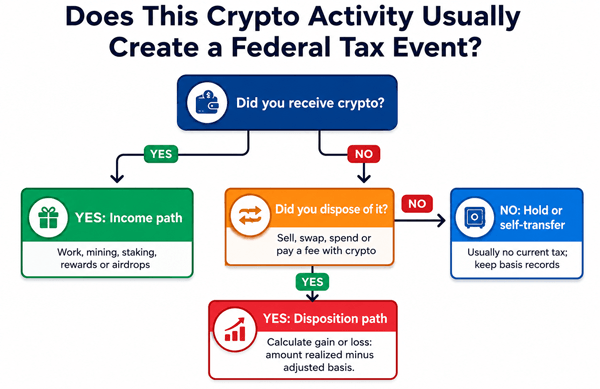
Figure 1. A fast decision map for distinguishing income receipts, taxable dispositions and generally non-taxable holding or self-transfers.
2. What Crypto Taxes Mean in the US
“Crypto taxes” is a convenient phrase for the existing U.S. tax rules that apply to digital assets. The IRS uses the broader term digital asset, which can include cryptocurrency, stablecoins, non-fungible tokens (NFTs) and other digital representations of value recorded on cryptographically secured distributed ledgers or similar technology.
There is no single flat “crypto tax.” The tax result depends on what happened, why you held the asset, how long you held it, your tax status, your income, whether the activity was personal, investment-related or a trade or business, and whether special rules apply.
2.1 The basic federal rule: crypto is property
Because digital assets are generally treated as property, familiar property-tax concepts apply: basis, amount realized, gain, loss, holding period, capital asset status and ordinary income. This treatment is why a token exchange is not tax-free merely because dollars were not involved.
2.2 Who may be affected
- Individual investors and traders
- Employees and freelancers paid in crypto
- Miners, validators and staking participants
- DeFi users and liquidity providers
- NFT creators, buyers and sellers
- Businesses accepting digital assets
- Donors and recipients of crypto gifts
- Taxpayers using domestic or foreign exchanges and self-custody wallets
3. How Crypto Taxation Works
Most crypto tax calculations follow one of two paths: a disposition of property or receipt of income.
3.1 Path 1: You dispose of a digital asset
A disposition occurs when ownership or a financial interest is transferred. Common examples include selling for dollars, swapping for another token, buying goods or services, gifting in a transaction that is not a bona fide gift, and using crypto to pay a transfer or transaction fee.
Capital gain or loss = Amount realized − Adjusted basis
The amount realized is generally the U.S.-dollar fair market value of what you received, reduced or adjusted as required for transaction costs. Basis is generally what you paid in U.S. dollars, including properly allocable acquisition costs, and may change because of later adjustments.
3.2 Path 2: You receive digital assets as income
When crypto is received for services, wages, mining, staking rewards or another income-producing activity, the fair market value in U.S. dollars at the time of receipt is generally included in income. That same fair market value usually becomes the basis of the received asset. When the asset is later sold, a separate capital gain or loss may arise.
Two-tax-event concept: Receiving 1 token as income and later selling it can create two reportable events: ordinary income when received and a capital gain or loss when sold.
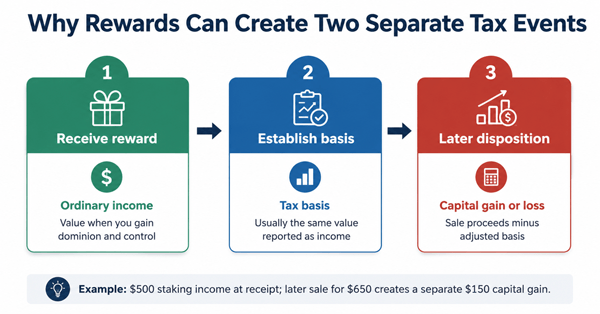
Figure 2. Rewards may be taxed once as ordinary income when received and again through a capital gain or loss when later disposed of.
4. Taxable vs. Non-Taxable Crypto Events
| Event | Usually taxable now? | Typical treatment |
|---|---|---|
| Buy crypto with U.S. dollars | No | Establishes basis; retain records. |
| Hold crypto without a transaction | No | No gain or loss merely from price movement. |
| Transfer between wallets you own | Generally no | Preserve lot and basis records; fee treatment can complicate the result. |
| Sell crypto for dollars | Yes | Capital gain or loss for an investor. |
| Trade one crypto for another | Yes | Disposition of the crypto given up; basis established in the crypto received. |
| Spend crypto on goods or services | Yes | Gain or loss on the crypto used, plus normal sales-tax or business consequences where applicable. |
| Receive crypto for work | Yes | Wages or self-employment/business income at fair market value. |
| Receive mining or staking rewards | Generally yes | Ordinary income when dominion and control exists; later disposition creates gain or loss. |
| Receive a bona fide gift | Generally no to recipient at receipt | Special carryover/dual-basis rules apply. |
| Donate to a qualified charity | Generally no gain on donation | Potential noncash charitable deduction, subject to substantiation and appraisal rules. |
| Hard fork without receipt of new units | Generally no | No income if no new asset is received. |
| Airdrop following a hard fork with dominion and control | Generally yes | Ordinary income based on fair market value when received and controlled. |
5. Cost Basis and Gain Calculations
5.1 What cost basis includes
For a straightforward purchase, basis generally starts with the U.S.-dollar cost of the asset. Certain transaction fees may be capitalized into basis or reduce proceeds depending on the transaction. A fee paid using crypto can itself be a disposition of the crypto used to pay the fee.
5.2 Identifying which units were sold
Tax results can differ significantly depending on which units are treated as sold. Specific identification is available only when the required units are identified on time and adequate records are maintained. For transactions after December 31, 2025, a standing order or instruction generally must be in place with a custodial broker no later than the date and time of the disposition and must use identifiers the broker accepts as sufficiently specific. If valid identification is not made, the applicable default ordering rule can control. Wallet-by-wallet basis rules make contemporaneous records especially important.
Recordkeeping rule: Never rely only on the final balance shown by an exchange. You need acquisition dates, acquisition values, quantities, fees, transfers and disposal details for each tax lot.
5.3 Fair market value
Every reportable transaction must be measured in U.S. dollars. Use a reasonable, consistently applied method based on a digital asset exchange or aggregator that analyzes worldwide indices and calculates the value at an exact date and time. Keep evidence of the valuation source, especially for thinly traded tokens, NFTs and decentralized transactions.
6. Capital Gains, Ordinary Income and Self-Employment Tax
6.1 Short-term and long-term capital gains
A capital asset held for one year or less generally produces short-term gain or loss. A capital asset held for more than one year generally produces long-term gain or loss. Short-term net gains are generally taxed at ordinary federal income-tax rates. Long-term net gains may qualify for preferential rates, depending on taxable income and other factors.
6.2 Capital losses
Capital losses first offset capital gains. For individuals, net capital losses can generally reduce other income by up to $3,000 per year, or $1,500 for married taxpayers filing separately. Unused losses generally carry forward, subject to applicable rules.
6.3 Ordinary income
Ordinary income may arise from wages paid in crypto, independent-contractor compensation, mining, staking, referral rewards, promotional awards, interest-like yield, certain airdrops and business receipts. The correct form depends on the activity. An employee may receive wage reporting; a freelancer or business generally uses Schedule C; miscellaneous income may be reported on Schedule 1.
6.4 Self-employment tax
A person conducting mining, validation, consulting, content creation, NFT production or another crypto activity as a trade or business may owe self-employment tax in addition to income tax. Whether an activity is a business depends on the facts, including continuity, regularity and a profit motive. Business deductions may be available for ordinary and necessary expenses, but personal and investment expenses are treated differently.
7. Form 1099-DA and Broker Reporting
Form 1099-DA, Digital Asset Proceeds From Broker Transactions, is the federal information return used by covered brokers to report certain digital asset dispositions. Reporting began for covered 2025 transactions, with statements reaching many taxpayers in early 2026. For 2025 sales, many forms report gross proceeds without basis. For 2026 and later sales, broker basis reporting becomes more important for covered securities, while noncovered assets may still require taxpayer-supplied basis.
| Reporting period | What many taxpayers should expect | Why it matters |
|---|---|---|
| 2025 transactions / 2026 filing season | Form 1099-DA may report proceeds; basis often omitted. | Taxpayers must reconstruct basis and reconcile their own records. |
| 2026 transactions and beyond | Gross proceeds reporting continues; basis reporting generally expands for covered digital assets acquired after 2025. | Broker records may help, but transferred assets, self-custody and noncovered lots still create gaps. |
| No form received | Reporting obligation still applies. | A missing form does not make income or gains non-taxable. |
2026 filing alert: For 2025 covered dispositions, most Forms 1099-DA report gross proceeds without basis. Do not report gross proceeds as profit; reconstruct basis from your own records and reconcile the form before filing.
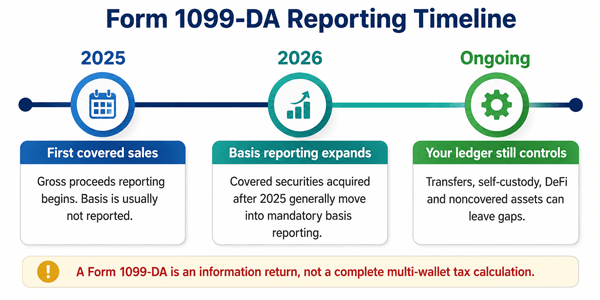
Figure 3. Broker reporting becomes more useful in 2026, but it still does not replace a complete taxpayer ledger.
A 1099-DA is not necessarily a complete tax return calculation. It may not reflect transactions across multiple wallets, basis from another platform, decentralized trades, gifts, inherited assets, fees, lost records or adjustments. Compare every form with your own ledger before filing.
8. How to File Crypto Taxes Step by Step
- Collect all exchange statements, wallet histories, blockchain transaction IDs, receipts, prior-year returns and Forms 1099-DA, 1099-MISC, 1099-NEC, W-2 or other tax documents.
- Create a complete transaction ledger covering purchases, income receipts, sales, swaps, spending, transfers, fees, gifts, donations, mining, staking, DeFi and NFTs.
- Separate non-taxable transfers from taxable dispositions. Match outgoing transfers from one wallet to incoming transfers in another wallet you own.
- Determine fair market value in U.S. dollars at each relevant date and time.
- Assign basis and holding period to each disposed tax lot using a supportable identification method.
- Calculate gain or loss for each disposition and classify it as short-term or long-term.
- Classify receipts as wages, self-employment income, business income, other ordinary income, gifts, loans or another category.
- Reconcile Forms 1099-DA and other information returns to your calculations. Investigate discrepancies rather than ignoring them.
- Report capital transactions on Form 8949 and Schedule D when required. Report ordinary income on the form or schedule appropriate to the activity.
- Answer the digital asset question on the federal income-tax return accurately, even if the answer is “No.”
- Retain source documents and calculation workpapers with the return records. Amend prior returns when a material omission is discovered and professional advice supports correction.
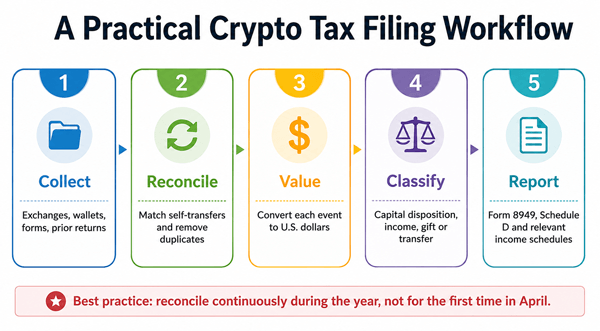
Figure 4. A five-stage workflow that reduces duplicate transactions, missing basis and information-return mismatches.
9. Detailed Crypto Tax Examples
9.1 A 10-Minute Year-Round Control
Once each month, export new exchange activity, label self-transfers, record the U.S.-dollar value of rewards, and save transaction hashes with receipts. This small routine prevents the most expensive filing-season problem: reconstructing basis after platforms, token symbols or wallet access have changed.
9.2 Example 1: Selling Bitcoin for a profit
Maya buys Bitcoin for $8,000, including allowable acquisition costs. Fourteen months later she sells it for net proceeds of $11,500. Her long-term capital gain is $3,500. The applicable federal rate depends on her taxable income and other circumstances.
9.3 Example 2: Crypto-to-crypto trade
Daniel bought ETH for $2,000. When the ETH is worth $3,200, he exchanges it for another token. Daniel has a $1,200 capital gain on the ETH disposition. His initial basis in the token received is generally $3,200, adjusted for relevant transaction costs.
9.4 Example 3: Spending appreciated crypto
A taxpayer bought crypto for $300 and later uses it to buy a laptop when the crypto is worth $900. The purchase creates a $600 gain on the crypto. The taxpayer also has a $900 cost basis in the laptop for applicable tax purposes. There is no broad personal-use exemption for small crypto gains under current federal law.
9.5 Example 4: Staking reward followed by sale
Priya receives staking rewards worth $500 when she has the ability to sell or otherwise control them. She generally recognizes $500 of ordinary income and takes a $500 basis. If she later sells the rewards for $650, she has a separate $150 capital gain. If she sells for $400, she generally has a $100 capital loss, subject to the normal rules.
9.6 Example 5: Capital loss and annual limitation
Andre has $9,000 of crypto capital losses and $4,000 of stock capital gains. The losses first offset the $4,000 gains, leaving a $5,000 net capital loss. He may generally deduct up to $3,000 against other income for the year and carry the remaining $2,000 forward, assuming he is not married filing separately and no special limitation applies.
9.7 Example 6: Wallet transfer fee
Leah transfers tokens between two wallets she owns. The transfer itself is generally non-taxable. However, if she pays the network fee with a separate digital asset, the units used for the fee may be treated as disposed of, potentially producing a small gain or loss. Software often misses this detail.
10. Mining, Staking, DeFi, NFTs and Other Activities
10.1 Mining
Mining rewards are generally included in gross income at fair market value when received. If mining rises to the level of a trade or business, Schedule C reporting, business deductions and self-employment tax may apply. Equipment depreciation, electricity allocation, pool fees and home-office issues require careful documentation and fact-specific analysis.
10.2 Staking
Under IRS Revenue Ruling 2023-14, a cash-method taxpayer generally includes staking rewards in gross income when the taxpayer gains dominion and control over the rewards. Locked, restricted, disputed or technically inaccessible rewards may require closer analysis of when control exists.
10.3 DeFi lending, liquidity pools and wrapped tokens
DeFi transactions do not have one universal tax treatment. Depositing assets into a protocol may be a non-taxable transfer, a taxable exchange for a receipt token, a loan or another arrangement depending on legal rights and economic substance. Liquidity-pool deposits, LP tokens, impermanent loss, yield farming, rebasing tokens, wrapped assets and liquid staking tokens should be reviewed transaction by transaction. Labels used by a protocol do not control federal tax treatment.
10.4 NFTs
NFT sales can produce capital gain, ordinary business income or creator income depending on the taxpayer and activity. Creators may owe income and self-employment tax on primary sales and royalties. Investors may have capital gains or losses. Some NFTs may be treated as collectibles based on the underlying rights or asset, which can affect the maximum long-term capital-gain rate. Valuation and qualified-appraisal issues can be significant for donations.
10.5 Stablecoins
A stablecoin transaction can still be taxable. Exchanging one stablecoin for another or using a stablecoin to buy an asset is generally a disposition, even when the economic gain is near zero. Small differences, rewards and fees still require records.
10.6 Airdrops, forks and promotional rewards
A hard fork does not necessarily create income by itself. Income generally arises when a taxpayer receives new units and has dominion and control. Promotional airdrops and rewards may also be ordinary income. Scam tokens or unsolicited assets with no meaningful market or control require a careful valuation and facts-based analysis.
11. Gifts, Donations and Inheritance
11.1 Receiving a crypto gift
A bona fide gift is generally not income to the recipient when received. The recipient’s gain basis generally carries over from the donor, while the loss-basis rule may use the lower of the donor’s basis or fair market value at the gift date. Holding period may also carry over when properly documented. Without donor records, basis problems can be severe.
11.2 Giving crypto
The donor generally does not recognize gain merely by making a bona fide gift, but federal gift-tax reporting may be required when gifts exceed the applicable annual exclusion or when other rules apply. Gift tax is separate from income tax, and most donors who file Form 709 do not immediately pay gift tax because of the lifetime exemption framework.
11.3 Charitable donations
Donating appreciated crypto directly to a qualified charity may avoid recognition of the embedded capital gain and may produce a charitable deduction if all requirements are met. For assets held more than one year, the deduction is often based on fair market value, subject to limitations. For assets held one year or less, the deduction is generally limited to the lower of basis or fair market value. Crypto is noncash property for substantiation purposes. Form 8283 is generally required when total noncash deductions exceed $500; a qualified appraisal and Section B are generally required when the claimed deduction for a digital asset exceeds $5,000, subject to specific rules and exceptions.
11.4 Inheritance
Inherited digital assets generally receive basis determined under the estate-tax basis rules, often fair market value at the decedent’s date of death or an alternate valuation date if properly elected. Inherited property is generally treated as long-term when later sold. Executors should secure wallet access, valuations and ownership records while following estate and cybersecurity procedures.
12. Losses, Scams, Theft and Worthless Assets
A drop in market value is not deductible while the taxpayer still owns the asset. A deduction usually requires a sale, exchange or another identifiable event recognized by tax law. Tokens that become illiquid, delisted or nearly worthless do not automatically create a deductible loss.
Losses from hacks, scams, private-key loss, exchange collapse and theft are especially complex. Personal casualty and theft-loss deductions are heavily restricted under current federal law, while investment loss, bad-debt, abandonment, worthless-security and transaction-loss theories have different requirements and may not apply to many digital assets. Recoveries, bankruptcy claims, insurance and litigation rights can postpone or change the result.
Do not guess: Before claiming a crypto theft, scam, abandonment or worthlessness deduction, obtain advice based on the precise facts and the tax year involved. Aggressive loss claims are a common audit risk.
13. State Taxes
Federal treatment is only part of the picture. Most states with an individual income tax begin with federal income concepts but may use different rates, capital-loss rules, conformity dates, sourcing rules or business classifications. States without a broad individual income tax may still impose business, franchise, gross-receipts, sales, use, property or other taxes.
Remote work, relocation, multi-state residency, mining locations, business operations and token compensation can create sourcing questions. Taxpayers moving between states should document residency dates and where income-producing services were performed.
14. Benefits and Risks of the US Crypto Tax Framework
| Potential benefit | Practical value |
|---|---|
| Property framework | Uses established rules for basis, holding period, gifts, inheritance and capital gains. |
| Long-term capital-gain treatment | Qualifying investment gains may receive lower federal rates than ordinary income. |
| Capital-loss offsets | Realized losses can offset gains and, within limits, other income. |
| Charitable planning | Direct donations of appreciated crypto may avoid gain and support a deduction when requirements are met. |
| Improved information reporting | Form 1099-DA can make certain centralized-platform transactions easier to reconcile over time. |
| Risk or drawback | Why it matters |
|---|---|
| Taxable swaps and spending | Tax can arise without cash proceeds, creating liquidity problems. |
| Fragmented records | Multiple exchanges, wallets and chains make basis reconstruction difficult. |
| Valuation uncertainty | NFTs and thinly traded tokens may lack reliable market prices. |
| Ordinary-income timing | Rewards can be taxed at receipt even if value later collapses. |
| Information-return mismatch | Broker-reported proceeds may not include correct basis or off-platform history. |
| Changing guidance | Reporting rules and interpretations continue to develop. |
| Penalties and interest | Underreporting, late payment and inaccurate information can become expensive. |
15. Tax Planning Strategies
Tax planning should manage risk and cash flow, not merely chase deductions. The following strategies may help when applied lawfully and with complete records.
- Hold investment assets for more than one year when consistent with your risk tolerance and investment plan, so gains may qualify as long-term.
- Harvest genuine capital losses before year-end to offset realized gains, while considering market risk, transaction costs and any future legislative changes.
- Use specific identification only when documentation supports the exact units sold and the method is applied correctly.
- Set aside cash for tax when receiving staking, mining, compensation or business income in volatile assets.
- Consider direct charitable gifts of appreciated crypto rather than selling first, but follow appraisal and substantiation rules.
- Coordinate estimated tax payments to avoid underpayment penalties.
- Reconcile exchanges and self-custody wallets throughout the year instead of waiting until filing season.
- Analyze entity choice and accounting methods before operating a substantial mining, validation, trading or NFT business.
- Plan interstate moves carefully and preserve residency evidence.
- Use amended returns or other corrective procedures when prior reporting was materially incomplete.
15.1 What about the wash-sale rule?
The statutory wash-sale rule generally applies to stock or securities. Many widely held cryptocurrencies are not treated as stock or securities for this specific tax rule, so a sale at a loss followed by a rapid repurchase may not be disallowed under the traditional wash-sale provision. However, the law can change, some digital assets may have different legal characteristics, and related-party, economic-substance, straddle or other anti-abuse rules may matter. Do not treat “no wash sale” as permission for artificial transactions lacking real economic effect.
16. Common Crypto Tax Mistakes
| Mistake | Better practice |
|---|---|
| Reporting only cash withdrawals | Report sales, swaps, spending and income whether or not cash leaves the platform. |
| Assuming a 1099 is complete | Reconcile forms to a full multi-wallet ledger. |
| Ignoring fees | Track acquisition fees, disposal fees and crypto-paid network fees. |
| Treating every wallet movement as a sale | Match self-transfers and preserve original basis. |
| Using today’s price for old transactions | Use fair market value at the actual date and time. |
| Missing the second event after rewards | Record income at receipt and gain or loss at later sale. |
| Using zero basis unnecessarily | Reconstruct basis from bank records, exchange exports, blockchain data and prior returns. |
| Deducting unrealized losses | A price decline alone is not a tax event. |
| Ignoring state tax | Review residence, sourcing and business rules. |
| Waiting until April | Maintain records continuously and estimate tax during the year. |
17. Crypto Tax Recordkeeping Checklist
- Date and exact time of every transaction
- Asset name, symbol, token contract and blockchain
- Quantity acquired or disposed
- Transaction type and business purpose
- U.S.-dollar fair market value and valuation source
- Acquisition cost and allocable fees
- Disposal proceeds and allocable fees
- Wallet addresses, exchange accounts and transaction hashes
- Transfers between accounts you own
- Income classification and payer information
- Holding period and tax-lot identification
- Forms 1099-DA and other information returns
- Gift records, donor basis and holding period
- Donation acknowledgments, Form 8283 and qualified appraisals
- Mining or business expenses and supporting receipts
- Prior-year capital-loss carryforwards
- Copies of filed returns and calculation reports
18. When to Hire a Crypto Tax Professional
Professional help is especially valuable when you have high transaction volume, missing basis, multiple chains, DeFi activity, NFTs, mining or staking as a business, foreign accounts, major gifts, charitable donations, inherited assets, entity structures, state moves, exchange bankruptcy claims, hacks or scams, an IRS notice, or unreported transactions from prior years.
Selection tipChoose a credentialed professional who understands both federal tax law and blockchain transaction data. Ask how they handle basis reconciliation, wallet transfers, DeFi classifications, information-return mismatches and audit support.
19. Frequently Asked Questions
19.1 Do I pay tax just for owning crypto?
No. Merely holding a digital asset generally does not create tax. Tax usually arises when you dispose of it or receive it as income.
19.2 Do I have to report crypto if I lost money?
Yes. Report taxable dispositions even when they produce losses. Properly reported capital losses may reduce gains and, within limits, other income.
19.3 Is converting crypto to a stablecoin taxable?
Generally yes. You disposed of the original asset and acquired the stablecoin.
19.4 Are small crypto purchases exempt?
Federal law currently provides no broad de minimis exemption for personal crypto spending. Even a small purchase can create a gain or loss.
19.5 Is transferring crypto to my hardware wallet taxable?
Generally no when you own both the sending and receiving wallets. Keep records proving the transfer and track any fee paid with crypto.
19.6 What happens if my exchange does not send a form?
You still must report taxable income, gains and losses using your own records.
19.7 What if Form 1099-DA shows proceeds but no basis?
Calculate basis from your records and report the correct gain or loss. Do not treat gross proceeds as taxable profit.
19.8 Can the IRS see crypto transactions?
Centralized brokers may report transactions, blockchain records are often public, and the IRS uses information reporting and enforcement tools. Assume reportable activity must be accurately disclosed.
19.9 Are staking rewards taxed before I sell them?
Generally yes when you have dominion and control over the rewards. The later sale produces a separate capital gain or loss.
19.10 Can I deduct gas fees?
Treatment depends on the transaction. Fees may increase basis, reduce proceeds, be deductible business expenses, or create a disposition when paid in crypto.
19.11 How are airdrops taxed?
Airdrops can create ordinary income when received and controlled. The facts, rights and market value matter.
19.12 Are crypto loans taxable?
A genuine loan is generally not a sale, but many DeFi arrangements may economically transfer ownership or issue a new token. Review the legal and economic terms.
19.13 Can I donate crypto without selling it?
Yes. A direct donation to a qualified charity may avoid gain recognition and may qualify for a deduction, subject to holding-period, appraisal and substantiation rules.
19.14 Does receiving crypto as a gift create income?
Generally no. But the recipient needs the donor’s basis and holding-period records to calculate future gain or loss.
19.15 What tax forms are commonly used?
Form 8949 and Schedule D for capital dispositions; Schedule 1 for certain ordinary income; Schedule C for business or self-employment activity; and other forms depending on wages, gifts, donations or foreign reporting.
19.16 Can crypto losses offset stock gains?
Generally yes. Capital gains and losses from different capital assets are netted under the capital-gain rules.
19.17 What if I forgot to report crypto in a prior year?
Review the materiality and facts with a qualified tax professional. An amended return may be appropriate, and prompt voluntary correction is generally better than ignoring the issue.
19.18 Are foreign crypto exchanges reportable?
Foreign-account and information-reporting rules are complex and evolving. Depending on custody, entity ownership and account structure, forms such as FBAR, Form 8938 or business-entity reports may need analysis.
19.19 How long should I keep records?
Keep records for at least as long as they may be needed to support the return, including basis records that can remain relevant until after the asset is disposed of. Longer retention is prudent for digital assets with incomplete third-party reporting.
19.20 Will crypto tax rules change?
Yes, reporting procedures and guidance continue to evolve. Verify rules for the specific tax year before filing.
20. Final Takeaways
- Crypto is generally property for U.S. federal tax purposes.
- Sales, swaps, spending and crypto-paid fees can be taxable dispositions.
- Mining, staking, work payments and many rewards can create ordinary income before sale.
- Basis and holding-period records determine whether your tax calculation is correct.
- Form 1099-DA improves reporting but does not replace your own complete ledger.
- Capital losses can be valuable, but unrealized declines, thefts and worthless tokens require careful analysis.
- Federal, state, business, gift, charity and estate rules may overlap.
- Accurate year-round records are the best defense against overpaying tax, underreporting income and facing penalties.
20.1 Sources Consulted and Checked
These sources were consulted and checked while preparing this document to support accuracy and reliability.
- Internal Revenue Service, “Digital assets,” updated June 28, 2026.
- Internal Revenue Service, “Frequently asked questions on digital asset transactions,” including guidance added December 15, 2025.
- Internal Revenue Service, “Understanding your Form 1099-DA,” updated June 28, 2026.
- Internal Revenue Service, “Reminders for taxpayers about digital assets,” January 28, 2026.
- Internal Revenue Service, Instructions for Form 1099-DA (2026).
- Internal Revenue Service, Notice 2014-21, federal tax treatment of virtual currency.
- Internal Revenue Service, Revenue Ruling 2019-24, hard forks and airdrops.
- Internal Revenue Service, Revenue Ruling 2023-14, staking rewards.
- Internal Revenue Service, Publication 550 (2025), Investment Income and Expenses.
- Internal Revenue Service, Form 8949 and 2025 Instructions for Form 8949.
- Internal Revenue Service, Schedule D (Form 1040) and 2025 Instructions.
- Internal Revenue Service, Publication 526 (2025), Charitable Contributions.
- Internal Revenue Service, Instructions for Form 8283 (Rev. December 2025).
- IRS Taxpayer Advocate Service, Digital Assets guidance.
20.2 Reader Advice
This article is for educational and informational purposes only and is not personalized tax, legal, financial, or investment advice or a recommendation. Cryptocurrency transactions can involve tax, market, liquidity, cybersecurity, custody, fraud, and recordkeeping risks, and the correct treatment depends on your facts and circumstances. Tax rules, reporting forms, thresholds, policies, laws, guidance, and statistics can change over time and may vary by state, locality, and region.
Before making a decision or filing a return, verify the rules for the relevant tax year through official sources, including the IRS and applicable state or local authorities. For complex transactions, substantial holdings, missing records, prior-year errors, or uncertain classifications, consider guidance from a qualified tax professional or attorney.