Crypto Accounting Basics in the US: Beginner's Guide to Key Concepts, Best Practices & Common Mistakes
0.1 Executive Summary
Crypto accounting is the system used to capture, classify, value, reconcile, and report digital-asset activity. It includes ordinary bookkeeping, tax-lot tracking, financial-statement accounting, internal controls, and document retention. The difficulty is not that every transaction is complicated; it is that a single wallet transfer, token swap, reward, or fee may create several accounting consequences at once.
The core rule for beginners
Keep three separate views: (1) operational records showing what happened, (2) tax records showing income, basis, proceeds, and gain or loss, and (3) financial-statement records prepared under the accounting framework your business uses. These views overlap, but they are not identical.
| Question | Practical answer |
|---|---|
| Is crypto treated as cash for U.S. federal tax? | Generally no. The IRS treats digital assets as property, so selling, spending, or swapping them can create taxable gain or loss. |
| Does moving crypto between my own wallets create taxable gain? | Usually no, but records must prove common ownership. A fee paid in crypto may itself be a disposition. |
| Are rewards and crypto payments income? | Often yes. Income is generally measured at fair market value in U.S. dollars when received or when dominion and control is obtained. |
| What changed for businesses using U.S. GAAP? | FASB ASU 2023-08 requires qualifying crypto assets to be measured at fair value through net income for fiscal years beginning after December 15, 2024. |
| Will a 1099-DA replace my records? | No. Broker reporting helps, but taxpayers remain responsible for complete and accurate reporting, including off-platform activity and basis details not shown on a form. |
1. What Crypto Accounting Means
Crypto accounting is broader than “crypto taxes.” It is the complete recordkeeping and reporting process for digital assets such as Bitcoin, Ether, stablecoins, and other tokens. A sound system answers five basic questions: What asset moved? When did it move? Why did it move? What was its U.S.-dollar value? What accounting and tax consequence followed?
1.1 Who needs crypto accounting?
- Investors who buy, sell, swap, spend, stake, or transfer digital assets.
- Freelancers and employees paid in crypto.
- Small businesses that accept crypto, hold treasury assets, pay vendors, or use decentralized-finance protocols.
- Miners, validators, creators, traders, and businesses that issue or receive tokens.
- Companies preparing financial statements under U.S. GAAP or another formal reporting framework.
1.2 Why crypto records become difficult
Banks usually provide a single statement in one currency. Crypto activity can be spread across exchanges, self-custody wallets, blockchains, smart contracts, and protocols. Transactions may settle in seconds, but the accounting record may require price data, wallet ownership evidence, fee treatment, tax-lot identification, and classification of a token or right.
Important terminology
“Digital asset” is the broader tax term used by the IRS. “Crypto asset” is often used in financial reporting. “Cryptocurrency” is common in everyday language. The precise accounting treatment depends on the asset’s rights and features, not only its label.
2. The Three Accounting Layers
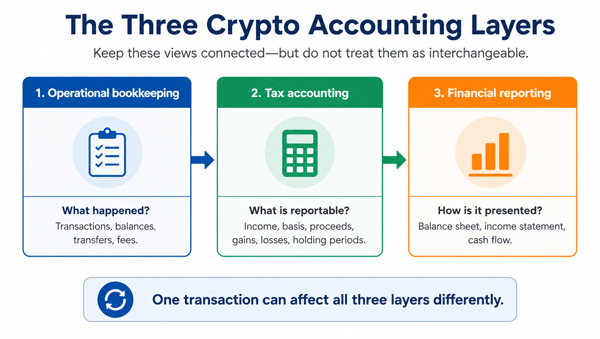
Figure 1. Operational, tax and financial-reporting records overlap, but each answers a different question.
| Layer | Purpose | Typical outputs |
|---|---|---|
| Operational bookkeeping | Create a complete ledger of receipts, payments, transfers, fees, assets, liabilities, income, and expenses. | General ledger, wallet register, exchange balances, reconciliation reports. |
| Tax accounting | Determine taxable income, cost basis, proceeds, holding period, character, deductions, and reportable forms. | Form 8949 support, Schedule D totals, business income schedules, documentation. |
| Financial reporting | Prepare statements under U.S. GAAP, tax basis, cash basis, or another framework. | Balance sheet, income statement, cash-flow statement, disclosures, audit support. |
A taxpayer can have a tax gain even when no dollars enter a bank account. For example, exchanging Bitcoin for Ether is generally a disposition of Bitcoin for tax purposes. A business may also recognize book income or expense differently from taxable income, creating book-tax differences.
3. The Records You Need
3.1 Minimum transaction-level data
| Field | Why it matters |
|---|---|
| Date and exact time | Determines tax year, holding period, sequence, and price source. |
| Transaction ID or blockchain hash | Provides independent evidence and prevents duplicates. |
| Wallet or account | Establishes location, ownership, and transfer path. |
| Asset and quantity | Identifies what was received, sent, or exchanged. |
| Transaction type | Purchase, sale, swap, transfer, reward, payment, fee, gift, donation, loan, or other event. |
| U.S.-dollar fair market value | Supports income, expense, proceeds, basis, and financial-statement amounts. |
| Fees | May affect basis, amount realized, or expense classification. |
| Counterparty and business purpose | Supports classification and deductibility. |
| Tax lot used | Connects a disposition to its acquisition date and basis. |
| Source document | Exchange statement, invoice, receipt, contract, payroll record, or protocol report. |
3.2 Records to retain
- Complete exchange CSV exports and monthly statements, not only screenshots.
- Public wallet addresses and a documented ownership map.
- Invoices, receipts, contracts, payroll records, and business-purpose notes.
- Price-source methodology and historical price evidence.
- Prior-year tax-lot schedules and carryforward data.
- Forms 1099-DA and other information returns, while reconciling them to your own books.
- Private documentation of lost keys, theft, scams, bankruptcies, or inaccessible accounts when relevant.
Security warning
Never give an accountant, bookkeeper, or tax-software provider your seed phrase or private key. Read-only wallet addresses, exchange exports, and properly scoped API keys are normally sufficient.
4. Core Concepts and Formulas
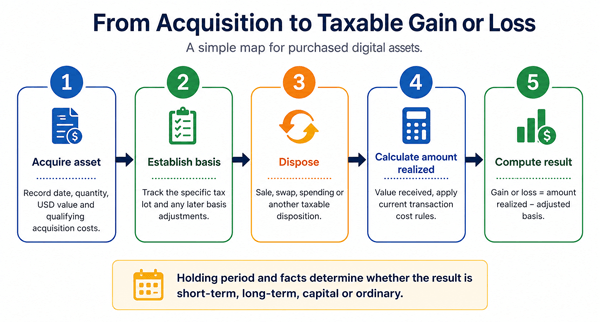
Figure 2. The basic record trail from acquisition through gain-or-loss calculation.
4.1 Fair market value
Fair market value is the U.S.-dollar value of the digital asset at the relevant time. Use a reasonable, consistently applied source that reflects the market where the transaction occurred. For thinly traded assets, document the pricing method and any judgment used.
4.2 Cost basis
Cost basis is generally your tax investment in the asset. For a purchase, it commonly starts with the purchase price plus qualifying acquisition costs. Basis may differ when crypto is received as income, a gift, an inheritance, or in another special transaction.
Basic gain or loss formula
Gain or loss = amount realized − adjusted basis. A positive result is a gain; a negative result is a loss. Holding period and transaction facts determine whether the result is short-term, long-term, ordinary, capital, or subject to another rule.
4.3 Amount realized
Amount realized generally includes the fair market value of what you receive, reduced or adjusted for transaction costs under applicable rules. The IRS issued updated rules for digital-asset transaction costs for transactions occurring on or after January 1, 2025, so older software assumptions may not always be reliable.
4.4 Holding period
A capital asset held for more than one year generally produces long-term capital gain or loss when disposed of. One year or less is generally short-term. Assets held as inventory or in a trade or business may receive different treatment.
4.5 Tax lots and identification methods
A tax lot is a specific quantity acquired at a particular date, time, and basis. When part of a holding is sold, the taxpayer must identify which lot was disposed of under applicable rules. Specific identification can be useful when properly documented. Default or fallback rules may apply when identification is inadequate. Consistency between instructions, exchange records, and the tax return is essential.
4.6 Realized versus unrealized changes
| Concept | Tax view | Book view |
|---|---|---|
| Unrealized price increase | Usually not taxable merely because market value rises. | Under ASU 2023-08, qualifying crypto assets are remeasured to fair value through net income. |
| Sale or swap | Generally creates a realized taxable gain or loss. | Removes the asset and recognizes the accounting result under the applicable framework. |
| Transfer between owned wallets | Usually not a sale, but evidence is required. | Reclassification between accounts; network fees still require analysis. |
5. Common Transaction Types
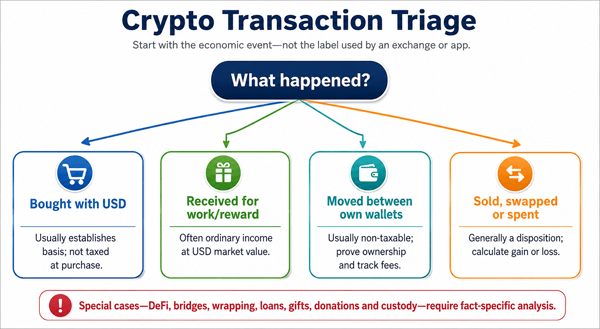
Figure 3. A first-pass decision map for common crypto events; complex transactions require additional analysis.
| Transaction | Typical accounting issue | Typical U.S. tax issue |
|---|---|---|
| Buy crypto with dollars | Record asset and fees. | Usually no gain at purchase; establish basis. |
| Sell crypto for dollars | Record proceeds, remove asset, recognize result. | Capital or ordinary gain/loss depending on facts. |
| Swap one token for another | Record disposal and acquisition at fair value. | Generally taxable disposition of the asset surrendered. |
| Spend crypto | Record expense or asset purchase and crypto disposal. | Possible gain/loss on crypto plus underlying purchase. |
| Receive crypto for services | Record revenue and asset at fair value. | Generally ordinary income; later disposition creates separate gain/loss. |
| Mining or staking reward | Record income and asset when recognized. | Generally income when dominion and control is obtained; later basis equals recognized value. |
| Transfer between own wallets | Move balance between accounts. | Usually non-taxable if ownership does not change; document both sides. |
| Network fee paid in crypto | Record fee and reduce crypto. | May affect basis/amount realized or create a separate disposition depending on facts. |
| Airdrop or hard fork | Determine whether an asset was received and controlled. | May create income under applicable guidance. |
| Gift | Remove asset and preserve documentation. | Donor and recipient basis/holding-period rules can be complex; gift-tax reporting may apply. |
| Charitable donation | Remove asset and record contribution under applicable rules. | Potential deduction and appraisal/substantiation requirements; no automatic deduction. |
| Loan, collateral, bridge, wrap, liquidity pool | Analyze legal and economic substance. | Treatment can be uncertain and highly fact-specific; do not assume “non-taxable.” |
6. Step-by-Step Crypto Accounting Workflow
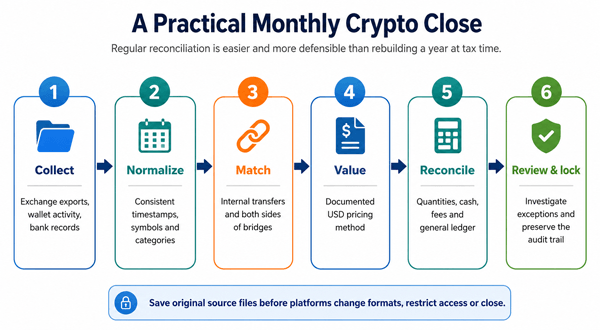
Figure 4. A repeatable monthly close reduces missing-basis and unmatched-transfer problems.
- Create an inventory of every exchange, wallet, blockchain, protocol, and payment processor used during the year.
- Export complete transaction histories and save original files before platforms change formats or close accounts.
- Build a wallet-ownership map distinguishing personal, business, customer, custodial, and unknown addresses.
- Import and normalize transactions into a single ledger using consistent timestamps, asset symbols, and transaction categories.
- Match internal transfers so they are not misclassified as income or sales.
- Assign U.S.-dollar values using a documented and consistent pricing policy.
- Classify income, purchases, sales, swaps, fees, gifts, donations, rewards, loans, and other events.
- Calculate tax lots, proceeds, basis, gain or loss, and holding period.
- Reconcile ending quantities to exchange and wallet balances asset by asset.
- Reconcile crypto-related cash activity to bank statements and the general ledger.
- Investigate missing basis, negative balances, duplicate transactions, and unmatched deposits or withdrawals.
- Prepare tax reports, book entries, financial-statement adjustments, and a permanent year-end documentation package.
Best practice
Close the crypto books monthly or quarterly. Waiting until tax season multiplies missing-data problems and makes fraud, duplicate imports, and unreconciled transfers harder to detect.
7. Worked Examples
7.1 Example 1: Buying and later selling Bitcoin
Maya buys 0.10 BTC for $4,000 and pays a $40 acquisition fee. Her initial basis is $4,040. Eight months later, she sells the 0.10 BTC for net proceeds of $5,300. Her gain is $1,260 ($5,300 − $4,040). Because she held the asset for one year or less, the gain is generally short-term if Bitcoin was a capital asset in her hands.
7.2 Example 2: Swapping Ether for another token
A business exchanges Ether with a $1,800 adjusted basis for tokens worth $2,250. The Ether disposition generally creates a $450 gain. The new tokens generally begin with a tax basis tied to their fair market value and transaction-cost rules. The general ledger should show both the removal of Ether and acquisition of the new token.
7.3 Example 3: Freelancer paid in crypto
Noah completes a design project and receives crypto worth $3,000 when received. He generally records $3,000 of business revenue and a digital asset with a $3,000 starting basis. If he later sells it for $3,400, the later sale creates a separate $400 gain, subject to character and other rules.
7.4 Example 4: Staking rewards
Lena receives staking rewards worth $600 when she gains dominion and control. She generally recognizes $600 of income at that time. Her basis in the reward units is generally $600. If she later sells them for $525, she has a separate $75 loss, subject to the applicable character and limitation rules.
7.5 Example 5: Transfer between personal wallets
Omar transfers 2 ETH from an exchange account he owns to a self-custody wallet he owns. The transfer itself usually does not change beneficial ownership and generally is not a taxable sale. He should match the withdrawal and deposit using transaction hash, time, and quantity. Any fee paid in crypto requires separate analysis and should not simply disappear from the ledger.
7.6 Example 6: Stablecoin used to pay a vendor
A company pays a $5,000 vendor invoice with stablecoins. It records the business expense and removes the stablecoins. Even if the stablecoin closely tracks one dollar, the company should compare the amount realized with tax basis and account for any small gain, loss, or fee. “Stable” does not automatically mean “cash” or “no tax event.”
8. Bookkeeping and Journal Entries
The following entries are simplified examples. Actual account names and treatment depend on the business, accounting framework, materiality, and facts.
8.1 Purchase of crypto for treasury
| Account | Debit | Credit |
|---|---|---|
| Crypto assets | $10,100 | — |
| Cash | — | $10,100 |
This assumes the purchase price and qualifying acquisition costs are included in the recorded asset amount under the company’s policy.
8.2 Receipt of crypto for services
| Account | Debit | Credit |
|---|---|---|
| Crypto assets | $2,000 | — |
| Service revenue | — | $2,000 |
8.3 Payment of an operating expense with crypto
Assume a company pays a $1,200 invoice using crypto with a $900 carrying amount immediately before disposal.
| Account | Debit | Credit |
|---|---|---|
| Operating expense | $1,200 | — |
| Crypto assets | — | $900 |
| Gain on crypto disposal | — | $300 |
8.4 Period-end fair-value adjustment under ASU 2023-08
Assume qualifying crypto assets have a carrying amount of $50,000 before remeasurement and a period-end fair value of $58,000.
| Account | Debit | Credit |
|---|---|---|
| Crypto assets | $8,000 | — |
| Unrealized gain in net income | — | $8,000 |
Do not copy entries blindly
Tax-basis books, cash-basis books, managerial records, and U.S. GAAP financial statements may require different entries. Businesses should document the reporting framework used.
9. U.S. Tax Reporting Basics
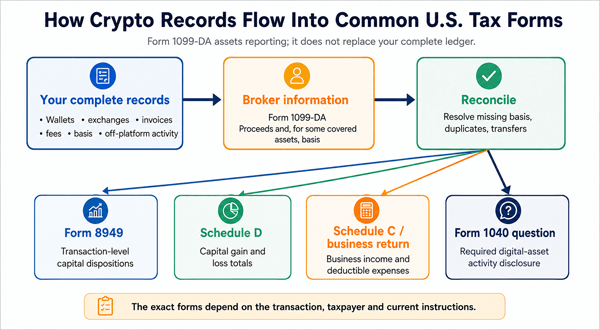
Figure 5. Broker reporting must be reconciled with the taxpayer’s complete transaction records.
9.1 The federal property framework
The IRS treats digital assets as property for federal income-tax purposes. That means ordinary property principles apply. A sale, exchange, or other disposition may create gain or loss. Crypto received as compensation, business revenue, mining income, or staking rewards may create ordinary income when received or controlled.
9.2 The digital-asset question
Federal income-tax returns include a digital-asset question that generally asks whether the taxpayer received digital assets or sold, exchanged, or otherwise disposed of a digital asset or financial interest during the year. Merely holding an asset, purchasing it with real currency, or transferring it between accounts you own can be treated differently from receiving or disposing of it. The question must be answered accurately even when no taxable gain is due.
9.3 Forms commonly involved
| Form or schedule | Common use |
|---|---|
| Form 8949 | Lists many capital-asset dispositions and adjustments. |
| Schedule D | Summarizes capital gains and losses. |
| Schedule C | May report crypto-related trade or business income and expenses for a sole proprietor. |
| Schedule 1 or other income lines | May apply to certain income depending on facts and current instructions. |
| Form 1099-DA | Broker statement reporting digital-asset proceeds and, for certain covered transactions, basis information. |
| Form 1040 digital-asset question | Required yes/no disclosure based on the taxpayer’s activity. |
| Business returns | Partnership, S corporation, C corporation, trust, estate, or exempt-organization forms may be relevant. |
9.4 What Form 1099-DA changes
Brokers began reporting gross proceeds for reportable digital-asset dispositions effected on or after January 1, 2025. Basis reporting generally begins for certain covered digital assets acquired on or after January 1, 2026 and later disposed of through the same custodial broker. Most 2025 statements therefore do not include basis. A Form 1099-DA is an information document, not a complete tax return and not a substitute for the taxpayer’s own records.
9.5 Income versus gain
| Event | First tax consequence | Possible later consequence |
|---|---|---|
| Crypto received for work | Ordinary compensation or business income at fair market value. | Gain or loss when later disposed of. |
| Staking reward | Income when dominion and control is obtained. | Gain or loss from later disposition. |
| Purchased investment | Usually no income at purchase. | Capital gain or loss when disposed of, if held as a capital asset. |
| Crypto held as inventory | Business accounting and inventory rules may apply. | Ordinary business result rather than capital treatment may apply. |
9.6 State and local taxes
State conformity, income-tax rates, sales-tax treatment, business taxes, and reporting requirements vary. A transaction can be correctly reported federally yet still require a separate state adjustment. Multi-state businesses should track customer, employee, and business locations and obtain state-specific advice.
9.7 Estimated taxes and withholding
Receiving crypto does not remove the need to pay taxes in dollars. Employees may have withholding; self-employed taxpayers and investors may need estimated payments. Volatility creates a cash-flow risk when income is recognized at a high value and the asset later falls before taxes are paid.
Tax cash-flow rule
When crypto is received as taxable income, consider setting aside enough dollars, or promptly converting a prudent portion, to cover income and self-employment taxes. Do not assume the token will retain its value until the tax deadline.
9.8 Wash-sale and loss questions
Do not assume that every rule applying to stocks applies identically to all digital assets. The statutory wash-sale rule has historically focused on stock or securities, but asset classification, related transactions, economic-substance rules, and future legislation can change outcomes. Avoid artificial loss arrangements and obtain current advice before implementing tax-loss strategies.
10. GAAP Financial Reporting for Businesses
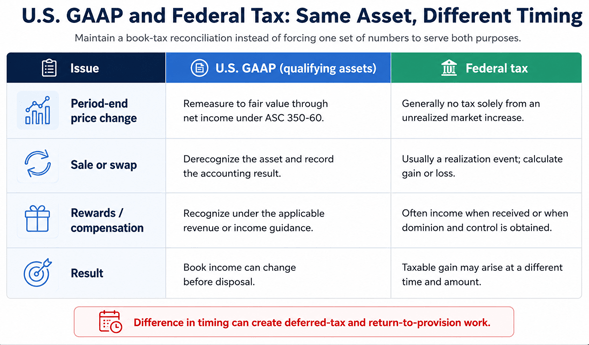
Figure 6. Book and tax treatment may recognize income or gains in different periods.
10.1 ASU 2023-08 in plain English
FASB Accounting Standards Update 2023-08 created new U.S. GAAP guidance for qualifying crypto assets. In-scope assets are subsequently measured at fair value, with changes recognized in net income each reporting period. The standard also requires separate presentation and enhanced disclosures. It is effective for all entities for fiscal years beginning after December 15, 2024, including interim periods within those fiscal years; early adoption was permitted.
10.2 Which assets are in scope?
An asset must satisfy the scope criteria in ASC 350-60. In simplified terms, it must meet the definition of an intangible asset, not provide enforceable rights to underlying goods, services, or other assets, be created or reside on a distributed ledger or similar technology, be secured through cryptography, be fungible, and not be created or issued by the reporting entity or its related parties. This means many common cryptocurrencies may qualify, while NFTs, certain tokens with contractual rights, and issuer-created tokens may not.
10.3 Presentation and disclosures
- Present in-scope crypto assets separately from other intangible assets on the balance sheet.
- Present changes from remeasurement separately in the income statement.
- Classify cash receipts from nearly immediate sale of crypto received as noncash consideration in operating activities when the standard’s conditions are met; otherwise analyze normal cash-flow classification rules.
- Disclose significant holdings, fair value, cost basis, restrictions, and activity during the period as required.
- Apply fair-value guidance and valuation controls, including principal-market and observable-input analysis where relevant.
10.4 Assets outside ASU 2023-08
Out-of-scope digital assets must be analyzed under other GAAP. Depending on their rights and use, guidance for inventory, financial instruments, receivables, prepaid assets, investments, derivatives, or intangible assets may apply. Stablecoins should not automatically be recorded as cash equivalents merely because they target a one-dollar value.
10.5 Custody accounting
SEC Staff Accounting Bulletin 121, which addressed obligations to safeguard crypto assets held for platform users, was rescinded by SAB 122 effective January 30, 2025. Entities with custody obligations must still apply appropriate U.S. GAAP, disclosure, internal-control, regulatory, and legal analyses. Rescission did not eliminate custody risk or create a universal off-balance-sheet answer.
10.6 Book-tax differences
Fair-value gains recognized in GAAP net income may not be taxable until disposition. Conversely, tax income from rewards or compensation may arise at receipt and then produce a separate book or tax result later. Businesses may need deferred-tax accounting, return-to-provision adjustments, and detailed rollforwards.
11. Reconciliation and Internal Controls
11.1 A reliable reconciliation has four dimensions
| Dimension | Control question |
|---|---|
| Quantity | Does the ledger quantity equal the on-chain or exchange quantity for every asset? |
| Ownership | Can the business prove which wallets and accounts it controls or beneficially owns? |
| Valuation | Is the price source documented, consistent, and appropriate at transaction and reporting dates? |
| Classification | Are transfers, income, fees, sales, loans, customer assets, and treasury holdings categorized correctly? |
11.2 Essential controls for a small business
- Maintain an approved list of business wallets and exchanges.
- Separate personal and business wallets completely.
- Require dual approval for large transfers and changes to withdrawal addresses.
- Use hardware security, multifactor authentication, and role-based access.
- Keep private keys outside the accounting system and restrict seed-phrase access.
- Reconcile monthly and independently review unusual transactions.
- Back up exports, wallet maps, policies, and valuation evidence.
- Document customer assets or custodial balances separately from company assets.
- Investigate negative asset balances, missing basis, and unmatched transfers immediately.
11.3 Red flags
- Large deposits from unknown wallets.
- Multiple accounts sharing credentials.
- Round-dollar journal entries unsupported by transaction data.
- Balances in accounting software that exceed on-chain balances.
- Unexplained manual changes to cost basis or acquisition dates.
- Personal transactions routed through business wallets.
- Rewards or token distributions recorded without valuation support.
12. Software and Professional Help
12.1 What good crypto accounting software should do
- Import transactions from exchanges, wallets, and blockchains while preserving source data.
- Detect and match transfers without deleting fees.
- Support multiple tax-lot methods and documented specific identification where permitted.
- Handle token swaps, staking, mining, DeFi, NFTs, and custom transactions—or clearly flag unsupported items.
- Maintain an audit trail of classifications and manual edits.
- Export tax reports, general-ledger entries, reconciliation schedules, and source-level detail.
- Support entity and wallet separation, user permissions, and secure read-only access.
12.2 Questions to ask before selecting software
- Which chains, protocols, and exchanges are supported today?
- How are failed transactions, gas fees, bridges, wrapped tokens, and liquidity pools handled?
- Can the system show why a tax lot was selected?
- Can historical calculations be locked after filing?
- How is data encrypted, retained, and deleted?
- Can reports be reproduced if a platform integration changes?
- Does the provider offer accountant access without private keys?
12.3 When professional help is especially valuable
- High transaction volume or multiple years of missing records.
- DeFi, liquidity pools, derivatives, lending, wrapping, bridges, or token issuance.
- Business custody of customer assets.
- Financial statements under U.S. GAAP or an audit/review requirement.
- Foreign accounts, entities, exchanges, or cross-border activity.
- Gifts, donations, inheritance, bankruptcy, theft, scams, or lost access.
- IRS notices, mismatched information returns, or amended-return questions.
13. Common Mistakes
| Mistake | Why it causes problems | Better practice |
|---|---|---|
| Treating every deposit as income | Transfers and refunds can be overstated as revenue. | Match both sides and document ownership. |
| Ignoring token-to-token swaps | Taxable dispositions can be omitted. | Record the asset disposed of and acquired at fair value. |
| Using only year-end exchange summaries | Basis and transaction details may be missing. | Preserve full transaction-level exports. |
| Deleting network fees | Asset quantities will not reconcile and basis may be wrong. | Record fees explicitly and apply current rules. |
| Mixing personal and business wallets | Ownership, deductions, and controls become unclear. | Use separate wallets and accounts. |
| Assuming stablecoins equal cash | Small gains/losses and classification issues may be missed. | Analyze basis, rights, and reporting framework. |
| Relying completely on Form 1099-DA | The form may omit basis or off-platform activity. | Reconcile it to complete records. |
| Using one price source inconsistently | Income and gains become hard to defend. | Adopt and document a consistent valuation policy. |
| Failing to preserve prior-year lots | Future gains cannot be calculated accurately. | Carry forward detailed lot schedules. |
| Giving seed phrases to service providers | Creates catastrophic theft risk. | Use read-only data and limited permissions. |
| Assuming GAAP fair-value income equals taxable income | Creates incorrect tax provisions and returns. | Maintain book-tax reconciliations. |
| Waiting until filing season | Missing data and classification errors compound. | Reconcile monthly or quarterly. |
14. Year-End Checklist
- Confirm every exchange, wallet, chain, and protocol used during the year.
- Download original statements, CSV files, 1099-DA forms, invoices, and contracts.
- Reconcile quantities for every asset to December 31 balances.
- Match transfers and investigate unknown deposits or withdrawals.
- Review all rewards, airdrops, forks, compensation, and business receipts.
- Confirm pricing sources and period-end fair values.
- Validate tax lots, acquisition dates, basis, proceeds, and holding periods.
- Review business expenses, fees, donations, gifts, and personal-use transactions.
- Reconcile tax reports to the general ledger and financial statements.
- Prepare book-tax difference schedules and deferred-tax analysis when applicable.
- Back up the final ledger, source files, wallet map, policies, and filed reports.
- Have a qualified professional review material, unusual, or uncertain transactions.
Year-end deliverable package
Keep one permanent folder containing source exports, wallet ownership documentation, transaction ledger, reconciliation reports, tax-lot rollforward, valuation policy, price evidence, information returns, journal entries, and filed tax reports.
15. Frequently Asked Questions
15.1 Is buying crypto with U.S. dollars taxable?
The purchase itself generally does not create gain or loss, but it establishes basis. Fees and later dispositions must be tracked.
15.2 Is selling crypto taxable if I reinvest immediately?
Generally yes. Reinvesting proceeds does not normally erase the disposition or resulting gain or loss.
15.3 Is swapping crypto taxable?
Generally, exchanging one digital asset for another is a disposition of the asset surrendered and may create gain or loss.
15.4 Is transferring crypto between my own wallets taxable?
Usually not when beneficial ownership does not change, but you must prove both wallets are yours and account for transaction fees.
15.5 Do I owe tax if I never received a 1099?
You must generally report taxable digital-asset income and dispositions whether or not you receive an information return.
15.6 What is cost basis in crypto?
It is generally your tax investment in the asset, often including purchase price and qualifying acquisition costs, adjusted for applicable events.
15.7 How do I value crypto received as payment?
Use its fair market value in U.S. dollars when received under a reasonable and consistently applied valuation method.
15.8 Are staking rewards taxable?
IRS guidance generally includes the fair market value of staking rewards in income when a cash-method taxpayer gains dominion and control.
15.9 Are mining rewards taxable?
Mining receipts generally create gross income when received, and a mining trade or business can also raise self-employment, expense, and equipment issues.
15.10 Can I deduct crypto losses?
Recognized losses may be deductible subject to character, capital-loss limitations, basis, related-party rules, and other restrictions. A market decline alone generally is not enough.
15.11 Does a hacked wallet automatically create a tax deduction?
No. Theft, casualty, abandonment, worthlessness, and investment-loss rules are complex and depend on facts and current law.
15.12 Is a stablecoin transaction taxable?
It can be. A disposition may produce a small gain or loss even when the token targets one dollar.
15.13 Does Form 1099-DA show everything I need?
Not necessarily. It may not include all basis information or transactions outside the reporting broker. Reconciliation to your own records remains necessary.
15.14 Can I use FIFO for all wallets together?
Tax-lot identification rules and broker-by-broker reporting can be technical. Use a method supported by current rules and maintain documentation at the account or wallet level as required.
15.15 What if my exchange closed?
Use saved exports, emails, bank records, blockchain data, wallet histories, and reasonable reconstruction methods. Document assumptions and uncertainty.
15.16 How long should I keep crypto records?
Keep records at least as long as they may be material to an open tax year, basis calculation, financial statement, or legal claim. Because basis carries forward until disposition, acquisition records may need to be retained for many years.
15.17 Do small businesses need GAAP crypto accounting?
Not always. Many private businesses use tax basis, cash basis, or another special-purpose framework. Lenders, investors, contracts, regulators, or audit requirements may require GAAP.
15.18 Are NFTs covered by FASB ASU 2023-08?
Generally, the standard’s fungibility criterion means many NFTs are outside its scope and require analysis under other GAAP.
15.19 Should customer crypto be recorded as company assets?
Not automatically. Legal ownership, custody terms, control, safeguarding obligations, and applicable accounting guidance must be analyzed carefully.
15.20 Can my accountant access my wallet safely?
Provide public addresses, exports, and read-only or restricted API access. Never share seed phrases or private keys.
16. Conclusion
Good crypto accounting is not a one-time tax calculation. It is a repeatable system that links blockchain activity to business purpose, U.S.-dollar value, tax lots, general-ledger accounts, and financial reporting. The strongest systems preserve original data, separate personal and business activity, reconcile quantities regularly, and document judgment before a return or financial statement is prepared.
For beginners, the best starting point is simple: list every account and wallet, export all records, match transfers, value each event consistently, and keep tax accounting separate from financial-statement accounting. Complexity should be addressed transaction by transaction rather than hidden inside an unexplained software total.
Regulatory update note: Time-sensitive federal tax, broker-reporting, FASB and SEC references were rechecked against official sources on August 3, 2026.
16.1 Sources Consulted and Checked
These sources were consulted and checked while preparing this article to support its accuracy and reliability.
- Internal Revenue Service, “Digital assets,” updated June 28, 2026.
- Internal Revenue Service, “Frequently asked questions on digital asset transactions.”
- Internal Revenue Service, “Final regulations and related IRS guidance for reporting by brokers on sales and exchanges of digital assets.”
- Internal Revenue Service, “Understanding your Form 1099-DA.”
- Internal Revenue Service, Revenue Ruling 2023-14 (staking rewards).
- Internal Revenue Service, Publication 551, Basis of Assets (December 2025).
- Financial Accounting Standards Board, ASU 2023-08, Accounting for and Disclosure of Crypto Assets.
- Financial Accounting Standards Board, project summary for Accounting for and Disclosure of Crypto Assets.
- U.S. Securities and Exchange Commission, Staff Accounting Bulletin No. 122.
16.2 Reader Advice
This article is provided for educational and informational purposes only and is not personalized financial, tax, accounting, legal, or investment advice or a recommendation. Cryptocurrency rules, policies, laws, accounting standards, tax requirements, market conditions, and statistics can change over time and may vary by jurisdiction and individual circumstances. Digital assets can involve significant volatility, loss, security, custody, fraud, and compliance risks. Before making a decision, verify current information through relevant official sources and consider consulting a qualified CPA, tax professional, attorney, or financial adviser who can assess your particular situation.