Crypto Taxes Explained: Meaning, How It Works, Examples, Benefits and Risks
1. Quick Answer: What Are Crypto Taxes?
Crypto taxes are taxes that may apply when you sell, trade, spend, earn, mine, stake, receive, or otherwise dispose of cryptocurrency or other digital assets. In many tax systems, crypto is not treated like ordinary cash. It is often treated as property, a capital asset, or a taxable investment, depending on your country and how you use it.
The basic idea is simple: when crypto creates income or when you dispose of it for more or less than your cost, there may be a tax result. You may owe tax on gains, be allowed to claim certain losses, or need to report income based on the fair market value at the time you received it.
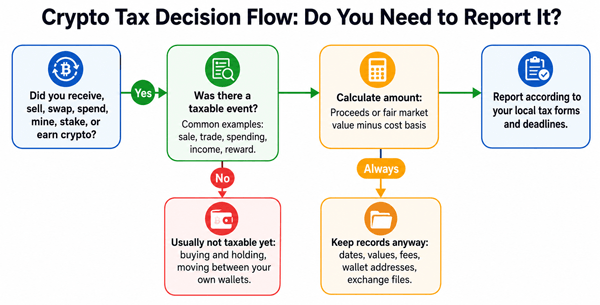
Diagram: A simple decision flow for common crypto tax reporting situations. Rules differ by country, so treat this as a practical starting point, not a substitute for local tax advice.
2. Crypto Tax Basics at a Glance
| Crypto activity | Usually taxable? | Why it matters |
|---|---|---|
| Buying crypto with regular money | Usually no | You normally create a cost basis but do not realize a gain or income yet. |
| Holding crypto | Usually no | Price changes are generally unrealized until you sell, trade, spend, or otherwise dispose of the asset. |
| Selling crypto for cash | Often yes | You may have a capital gain or loss based on sale proceeds minus cost basis. |
| Trading one crypto for another | Often yes | Many countries treat this as disposing of the first crypto, even if no cash was received. |
| Spending crypto on goods or services | Often yes | Spending crypto can be treated like selling it at its market value. |
| Mining, staking, airdrops, rewards | Often yes | These can be treated as income when received, with later gains or losses when sold. |
| Moving crypto between your own wallets | Usually no | Transfers between wallets you own usually do not create gain or income, but fees may matter. |
| Gifts, donations, inheritance | Depends | Special rules may apply for valuation, basis, reporting, exemptions, or deductions. |
3. What Counts as Crypto for Tax Purposes?
Crypto taxes can apply to more than Bitcoin. They may apply to many types of digital assets, including cryptocurrencies, stablecoins, NFTs, governance tokens, exchange tokens, wrapped tokens, liquidity pool tokens, and some tokenized assets.
For beginners, the safest approach is to assume that any digital asset with economic value may need to be tracked. Even if a token seems small, free, or experimental, it can still create a tax record if you receive it, sell it, swap it, or use it.
4. Why Crypto Is Taxed
Tax systems generally tax income and gains. Crypto can create both. If you earn crypto from work, mining, staking, rewards, referral bonuses, or an airdrop, that can look like income. If you buy crypto and later sell it for more than you paid, that can look like a capital gain.
Crypto also makes tax reporting harder because users may hold assets across exchanges, wallets, blockchains, DeFi protocols, and NFT marketplaces. Tax authorities increasingly expect better records, and international reporting standards are expanding.
5. How Crypto Taxes Work in Simple Terms
The basic crypto tax formula is: tax result equals what you received minus what the asset cost you, adjusted for fees and local rules. The details vary, but most calculations start with four questions: what did you acquire, when did you acquire it, what did it cost, and what did you receive when you disposed of it?
Your cost basis is usually the amount you paid to acquire the crypto, including eligible fees. Your proceeds are usually the value you received when you sold, traded, spent, or otherwise disposed of it. The difference is your gain or loss.
6. Capital Gains and Losses: The Core Crypto Tax Concept
A capital gain happens when you dispose of crypto for more than your cost basis. A capital loss happens when you dispose of it for less than your cost basis. The word “dispose” is important because it can include more than selling for cash.
6.1 Simple example: selling Bitcoin
- You buy 0.10 BTC for $3,000, including fees.
- Later, you sell that 0.10 BTC for $4,200.
- Your gain is $1,200 before applying any country-specific adjustments.
- Depending on your country and holding period, that gain may be taxed as a short-term gain, long-term gain, capital gain, or another category.
6.2 Simple example: selling at a loss
- You buy a token for $1,000.
- You later sell it for $650.
- Your capital loss is $350 before any limits or local adjustments.
- Some tax systems allow losses to offset gains; others limit how and when losses can be used.
7. Taxable Events vs. Usually Non-Taxable Events
| Event | Common treatment | Example | Beginner tip |
|---|---|---|---|
| Sell crypto for cash | Often taxable | Sell ETH for USD, EUR, GBP, PKR, etc. | Record sale date, proceeds, fee, and cost basis. |
| Swap one crypto for another | Often taxable | Trade SOL for USDC. | Do not assume it is tax-free just because no bank cash arrived. |
| Spend crypto | Often taxable | Use BTC to buy a laptop. | You may have a gain or loss on the crypto used. |
| Receive crypto as payment | Often taxable income | Freelancer is paid in USDT. | Record fair market value when received. |
| Staking or mining rewards | Often taxable income | Receive new tokens as rewards. | Track value at receipt and later sale. |
| Buy and hold | Usually not taxable yet | Buy BTC and keep it in a wallet. | Still save purchase records. |
| Transfer to your own wallet | Usually not taxable | Move ETH from exchange to Ledger wallet. | Keep proof that both wallets are yours. |
| Gift or donation | Depends | Donate crypto to charity or gift to family. | Check local gift, donation, and valuation rules. |
8. Crypto Income: When Crypto Is Treated Like Earnings
Crypto income is different from a capital gain. Income usually arises when you receive crypto as payment, compensation, rewards, yield, mining proceeds, staking rewards, referral bonuses, certain airdrops, or other economic benefits.
In many cases, the income amount is based on the fair market value of the crypto at the time you receive control over it. That value may become your cost basis for calculating a later gain or loss when you sell or swap the asset.
8.1 Example: paid in crypto for freelance work
A designer completes a project and receives 500 USDT. If USDT is worth about $500 when received, the designer may have $500 of income under many tax systems. If the designer later swaps the USDT for another token or sells it, that later transaction may create a separate gain or loss.
8.2 Example: staking rewards
A user receives 20 tokens from staking. The tokens are worth $2 each when credited and available. The user may have $40 of income. If the user later sells the 20 tokens for $70, there may also be a $30 capital gain, depending on local rules.
9. What Is Cost Basis?
Cost basis is the starting value used to calculate gain or loss. For crypto you buy, it is usually the purchase price plus eligible fees. For crypto you receive as income, it is often the fair market value at the time it became taxable income.
Cost basis matters because small errors can multiply quickly. Active traders may have hundreds or thousands of transactions, and choosing or applying a cost basis method incorrectly can change the final tax result.
10. Common Cost Basis Methods
| Method | Meaning | Practical note |
|---|---|---|
| FIFO | First in, first out: the earliest units acquired are treated as sold first. | Common and simple, but may produce higher or lower gains depending on price history. |
| Specific identification | You identify the exact units sold, if your records meet local requirements. | Can be useful but requires strong documentation. |
| Average cost or pooling | Some systems average or pool costs instead of tracking individual lots. | Used in some countries; do not assume it is allowed everywhere. |
| Exchange-provided basis | The exchange estimates cost basis from its own records. | Convenient, but may be incomplete if you moved assets between platforms. |
11. Records You Should Keep for Crypto Taxes
Good records are the difference between a simple tax season and a stressful one. Crypto activity often happens across multiple platforms, so do not rely on memory or screenshots alone.
- Transaction date and time
- Asset name and ticker
- Amount bought, sold, swapped, received, or spent
- Value in your local currency at the time of the transaction
- Fees and gas costs
- Exchange, wallet, or protocol used
- Transaction hash or blockchain address where relevant
- Purpose of the transaction, such as investment, payment, transfer, staking reward, or NFT purchase
- Proof that wallet-to-wallet transfers were between accounts you own
12. Benefits of Understanding Crypto Taxes
Crypto taxes may sound like a burden, but understanding them has real benefits. You can avoid surprise tax bills, reduce mistakes, claim eligible losses, make better trading decisions, and prepare clean records if a platform reports your transactions to tax authorities.
Good tax awareness also helps you compare strategies more honestly. A profitable trade before tax may be less attractive after tax. A loss may still have value if it can offset gains under your local rules.
13. Main Risks and Mistakes to Avoid
The biggest risk is assuming crypto is invisible or tax-free. Public blockchains are traceable, exchanges increasingly collect identity information, and reporting rules are expanding. Another common mistake is reporting only cash withdrawals while ignoring crypto-to-crypto trades, DeFi activity, NFT sales, or rewards.
Other mistakes include mixing personal wallets without records, losing exchange history, ignoring small transactions, double-counting transfers as sales, using the wrong cost basis method, and forgetting that stablecoin transactions may still be reportable even if the gain is tiny.
14. DeFi, NFTs, and Advanced Crypto Tax Situations
DeFi and NFTs can create complicated tax questions because the activity may not look like a normal buy or sell. Examples include adding liquidity, removing liquidity, receiving LP tokens, borrowing against crypto, lending crypto, wrapping tokens, bridging assets across chains, earning yield, minting NFTs, selling NFTs, and receiving creator royalties.
The safest beginner approach is to record every step and avoid assuming that a transaction is non-taxable just because it happened inside a protocol. Some actions may be treated differently across countries or even remain unclear until local authorities publish guidance.
15. Stablecoins Are Not Automatically Tax-Free
Many beginners think stablecoins do not matter for tax because they are designed to stay near $1. In practice, selling or swapping a stablecoin can still be a disposal in many systems. The gain or loss may be very small, but the transaction may still need to be tracked and sometimes reported.
16. Lost, Stolen, or Scammed Crypto
Lost or stolen crypto is painful, and the tax treatment is not always generous. Some countries restrict deductions for theft or casualty losses. Others may allow a loss only in specific circumstances. If you are hacked or scammed, keep evidence such as police reports, exchange support tickets, wallet addresses, transaction hashes, and recovery attempts.
17. Crypto Tax Best Practices Checklist
- Download exchange CSV files regularly, not only at year-end.
- Label wallet transfers so they are not mistaken for sales.
- Track cost basis from the day you buy or receive crypto.
- Record the local currency value at the time of each taxable event.
- Separate personal investing, business income, and client payments where possible.
- Use reputable crypto tax software, but review the results manually.
- Reconcile exchange records with wallet transactions and blockchain explorers.
- Do not ignore DeFi, NFT, staking, airdrop, and stablecoin activity.
- Save tax reports, raw CSV files, transaction hashes, and assumptions used.
- Speak with a qualified tax professional if you have large gains, business activity, cross-border issues, DeFi complexity, or past unreported transactions.
18. Country Rules Differ: What Beginners Should Know
This guide explains common principles, but the exact rules depend on where you are tax resident. For example, the U.S. Internal Revenue Service states that digital assets are generally treated as property for federal tax purposes. The UK tax authority HMRC has a dedicated cryptoassets manual covering individuals, businesses, DeFi, and compliance. The OECD has also developed the Crypto-Asset Reporting Framework to improve international tax transparency for crypto assets.
The practical lesson is simple: do not copy a tax rule from another country without checking whether it applies to you. Tax rates, exemptions, forms, reporting deadlines, loss rules, and cost basis methods can be very different.
19. Step-by-Step: How to Prepare Your Crypto Taxes
| Step | What to do | Why it matters |
|---|---|---|
| 1. Collect your data | Download transaction files from every exchange, wallet, NFT marketplace, DeFi protocol, and payment platform you used. | Reduces errors and supports your tax position if questioned. |
| 2. Classify each transaction | Separate buys, sells, swaps, transfers, income, rewards, fees, gifts, donations, and losses. | Reduces errors and supports your tax position if questioned. |
| 3. Calculate cost basis | Match sold assets to their original acquisition cost using a method allowed in your country. | Reduces errors and supports your tax position if questioned. |
| 4. Calculate gains, losses, and income | Convert values into your local currency using acceptable exchange rates and timestamps. | Reduces errors and supports your tax position if questioned. |
| 5. Review errors | Check duplicate imports, missing transfers, incorrect token prices, and unsupported DeFi transactions. | Reduces errors and supports your tax position if questioned. |
| 6. Prepare tax forms or reports | Use your country’s required forms, schedules, or self-assessment system. | Reduces errors and supports your tax position if questioned. |
| 7. Keep your records | Save both the final report and the raw data used to create it. | Reduces errors and supports your tax position if questioned. |
20. Pros and Cons of Crypto Tax Software
| Pros | Cons / limits |
|---|---|
| Imports many exchange and wallet transactions | May misread complex DeFi or NFT activity |
| Can calculate gains, losses, and income faster than spreadsheets | Still depends on accurate imports and user review |
| Helps identify missing cost basis and duplicate transfers | May not support every local tax rule |
| Can create reports for accountants or tax filing | Can be expensive for high transaction counts |
21. FAQs About Crypto Taxes
21.1 Do I pay crypto tax if I only bought and held?
Usually, buying and holding crypto does not create a taxable gain by itself. However, you should keep purchase records because you will need them if you later sell, trade, spend, or gift the asset.
21.2 Is swapping Bitcoin for Ethereum taxable?
In many countries, yes. A crypto-to-crypto swap can be treated as selling the first asset and buying the second. That may create a gain or loss even if you never received cash.
21.3 Are staking rewards taxable?
Often, staking rewards may be taxable when received, and a later sale can create a second tax event. The timing and classification depend on local rules.
21.4 Do I need to report small crypto transactions?
Small transactions can still matter. Some countries have thresholds, allowances, or de minimis rules, while others require reporting even when the tax due is small. Keep records first, then apply local rules.
21.5 Can crypto losses reduce my taxes?
Sometimes. Many tax systems allow capital losses to offset capital gains, but limits and deadlines vary. Losses from scams, theft, or lost private keys may follow different rules.
21.6 Are wallet transfers taxable?
Transfers between wallets you own are usually not taxable disposals, but you should keep records proving ownership. Network fees may still affect records or basis depending on the situation.
21.7 Do exchanges report crypto activity to tax authorities?
Increasingly, yes. Reporting requirements differ by country and platform, but global tax transparency rules for crypto are expanding. Do not assume an exchange report is complete or that unreported wallet activity can be ignored.
21.8 What happens if I forgot to report crypto in past years?
Do not panic, but do not ignore it. Many countries have amendment or voluntary disclosure processes. Gather records, estimate missing activity carefully, and consider professional help.
22. Final Thoughts
Crypto taxes are not just for professional traders. Beginners, long-term investors, freelancers, miners, stakers, NFT collectors, and DeFi users may all create taxable events. The main skill is not memorizing every rule. It is understanding the pattern: income when you receive value, gain or loss when you dispose of an asset, and records for everything.
Start simple: track dates, values, fees, and transaction types. Separate transfers from sales. Review crypto-to-crypto trades. Save your data before exchanges close accounts or change exports. Then apply your local tax rules or work with a professional. That approach will help you avoid common mistakes and make better decisions throughout the year.
Sources Consulted and Checked
These sources were consulted and checked while preparing this document to support its accuracy.
- IRS Digital Assets page
- IRS Frequently Asked Questions on Virtual Currency Transactions
- IRS Frequently Asked Questions on Digital Asset Transactions
- IRS Publication 544, Sales and Other Dispositions of Assets
- HMRC Cryptoassets Manual
- OECD Crypto-Asset Reporting Framework overview
- OECD CARF implementation update 2025
Reader Advice
This article is provided for educational and informational purposes only and is not personalized tax, legal, financial, or investment advice or a recommendation. Crypto tax rules, reporting policies, laws, rates, deadlines, and statistics can change over time and vary by country, region, tax residency, transaction type, and individual circumstances. Before filing a return or making a financial decision, verify current requirements through the relevant official tax authority and consider consulting a qualified tax professional. Crypto transactions can involve tax liabilities, penalties for incorrect or late reporting, market losses, fraud, scams, lost access, and record-keeping errors, so keep complete records and assess the risks carefully.