Crypto Accounting Basics: Beginner Guide, Key Concepts, Examples and Common Mistakes
Crypto accounting is the process of recording, valuing, organizing, and reporting transactions involving cryptocurrencies and other digital assets. It sounds technical, but the basic idea is simple: every time crypto moves, changes value, is earned, spent, swapped, transferred, or sold, you need a clear record of what happened and what it was worth at the time.
This matters because crypto activity can affect taxes, business accounts, investor reporting, audits, and personal financial records. A person who only buys bitcoin once and holds it may have a simple recordkeeping job. A business that accepts crypto payments, pays freelancers in stablecoins, trades tokens, stakes assets, or uses DeFi protocols has a much more detailed accounting task.
This beginner guide explains the practical foundations of crypto accounting: key terms, transaction types, cost basis, gains and losses, accounting records, examples, tools, best practices, and common mistakes to avoid.
1. What Is Crypto Accounting?
Crypto accounting means tracking and reporting digital asset activity in a way that is accurate, consistent, and explainable. It covers both bookkeeping and financial reporting. In many cases, it also supports tax reporting, although tax accounting and financial accounting are not always the same.
For example, a business may need to record crypto on its books under accounting rules, while also calculating taxable income, capital gains, deductible fees, or foreign reporting obligations under tax rules. These two systems often use the same transaction data, but they may apply different rules.
1.1 Simple definition
Crypto accounting is the process of answering five basic questions for every crypto transaction: What happened? When did it happen? Which asset was involved? How much was it worth in your reporting currency? What accounting or tax result did it create?
2. Why Crypto Accounting Is Different From Normal Bookkeeping
Traditional bookkeeping usually deals with bank deposits, invoices, card payments, payroll, bills, and standard investment accounts. Crypto adds extra complexity because transactions happen across blockchains, wallets, exchanges, bridges, smart contracts, and decentralized apps.
| Traditional accounting | Crypto accounting |
|---|---|
| Banks and brokers usually provide statements | Crypto activity may be spread across wallets, exchanges, and blockchains |
| Cash balances are normally stable in one currency | Crypto values can change every second |
| Transfers are often easy to identify | Wallet-to-wallet transfers can look like sales unless properly labeled |
| Fees are usually charged in cash | Network fees may be paid in crypto and affect cost basis or gains |
| Transactions are often reversible or traceable through institutions | Blockchain transactions are usually irreversible and may require wallet-level evidence |
3. The Core Crypto Accounting Concepts Beginners Must Know
Before you try to calculate taxes or prepare financial statements, you need to understand a few basic concepts. These are the building blocks of almost every crypto accounting workflow.
3.1 Digital asset
A digital asset is a digital representation of value recorded or transferred electronically. In crypto accounting, this may include bitcoin, ether, stablecoins, governance tokens, NFTs, tokenized assets, or other blockchain-based assets. The IRS says income from digital assets is taxable and that taxpayers may need to report digital asset transactions on their returns.
3.2 Wallet
A wallet is a tool that stores private keys and lets you control crypto assets. A wallet can be custodial, meaning an exchange or platform controls the keys, or non-custodial, meaning you control them. From an accounting perspective, each wallet should be tracked because it helps prove whether a movement was a transfer, sale, payment, or loss.
3.3 Exchange
An exchange is a platform where users buy, sell, or swap crypto. Exchange statements are useful, but they are not always complete if you moved assets in or out, used several platforms, or traded on decentralized exchanges.
3.4 Fair market value
Fair market value is the value of the crypto in your reporting currency at a specific date and time. For example, if you receive 0.05 ETH as payment when ETH is worth $3,000, the payment value is $150. The exchange rate source and timestamp matter.
3.5 Cost basis
Cost basis is generally the amount you paid to acquire an asset, including certain fees where applicable. Cost basis is used to calculate gain or loss when the asset is later sold, swapped, spent, or otherwise disposed of.
3.6 Realized gain or loss
A realized gain or loss happens when a transaction causes you to dispose of crypto. Selling BTC for dollars, swapping ETH for USDC, paying a supplier with SOL, or using crypto to buy a laptop can all create a realized gain or loss in many tax systems.
3.7 Unrealized gain or loss
An unrealized gain or loss is a change in value while you still hold the asset. If you buy BTC for $40,000 and it rises to $50,000, you may have an unrealized gain of $10,000 until you dispose of it. Under U.S. GAAP, FASB ASU 2023-08 now requires certain in-scope crypto assets to be measured at fair value each reporting period with changes recognized in net income, but this applies to financial reporting for entities and not automatically to every tax calculation.
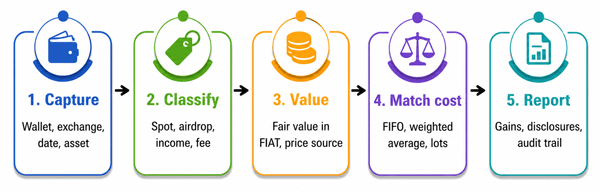
Diagram: A simple crypto accounting workflow from transaction capture to reporting.
4. Common Crypto Transaction Types and How to Think About Them
The easiest way to learn crypto accounting is to classify transactions. Classification tells you whether the activity is a purchase, sale, transfer, income event, expense, fee, or something else.
| Transaction type | Accounting idea | Example |
|---|---|---|
| Buy crypto with cash | Usually creates a new cost basis | Buy 1 ETH for $3,000 plus a $20 fee |
| Sell crypto for cash | Usually creates realized gain or loss | Sell ETH for $3,600 after buying it for $3,020 |
| Swap one crypto for another | Often treated like disposing of one asset and acquiring another | Swap ETH for SOL |
| Receive crypto as payment | Usually income at fair market value when received | Freelancer receives 500 USDC |
| Pay with crypto | May create both an expense and a gain/loss on the crypto used | Business pays a contractor with BTC |
| Transfer between own wallets | Usually not a sale, but fees still need tracking | Move BTC from Coinbase to a hardware wallet |
| Staking or mining rewards | Often income when received, depending on local rules | Receive 0.2 tokens as staking reward |
| Airdrop | May be income if you control and can use the tokens | Receive governance tokens from a protocol |
| Lost or stolen crypto | Requires evidence and local tax analysis | Private key lost or wallet hacked |
5. How Crypto Accounting Works Step by Step
- Collect all transaction data from exchanges, wallets, blockchains, payment processors, and DeFi platforms.
- Separate real transactions from internal transfers between your own wallets.
- Classify each transaction type: buy, sell, swap, income, expense, fee, transfer, reward, gift, loss, or adjustment.
- Assign fair market value in your reporting currency at the transaction date and time.
- Calculate cost basis for assets sold, swapped, spent, or transferred out.
- Calculate realized gains, losses, income, expenses, and ending asset balances.
- Reconcile wallet and exchange balances to the accounting records.
- Prepare reports for bookkeeping, tax filing, financial statements, management review, or audit support.
5.1 Example 1: Buying and Later Selling Crypto
You buy 1 BTC for $40,000 and pay a $100 trading fee. Your cost basis is $40,100. Later, you sell the BTC for $45,000 and pay a $100 selling fee. If the selling fee reduces your proceeds, your net proceeds are $44,900. Your gain is $44,900 minus $40,100, or $4,800.
5.2 Example 2: Receiving Crypto as Freelance Income
A designer receives 1,000 USDC for a project. If USDC is worth $1 per token at receipt, the designer records $1,000 of income. If the designer later sells the 1,000 USDC for $998 after fees, there may be a small gain or loss depending on local rules and cost basis treatment.
5.3 Example 3: Swapping ETH for SOL
You bought ETH for $2,000. Months later, you swap that ETH for SOL when the ETH is worth $2,700. Many tax systems treat this as selling ETH for $2,700 and buying SOL for $2,700. That creates a $700 realized gain on ETH and a new $2,700 cost basis in SOL.
5.4 Example 4: Paying a Supplier With Crypto
A business buys 0.1 BTC for $4,000. Later it uses the 0.1 BTC to pay a supplier when it is worth $4,600. The business may record a $4,600 business expense, but it may also have a $600 gain on the BTC used for payment. This is why paying bills with appreciated crypto can create hidden tax and accounting work.
6. Crypto Financial Accounting vs Crypto Tax Accounting
Beginners often confuse financial accounting with tax accounting. They overlap, but they are not the same.
| Area | Financial accounting | Tax accounting |
|---|---|---|
| Purpose | Show financial position and performance | Calculate taxable income, gains, losses, and disclosures |
| Audience | Owners, lenders, investors, auditors, regulators | Tax authority and taxpayer records |
| Rules | Accounting standards such as U.S. GAAP or IFRS | Local tax law and tax authority guidance |
| Timing | Reporting periods such as monthly, quarterly, yearly | Tax year and filing deadlines |
| Crypto value changes | May be recognized depending on accounting framework and asset scope | Often taxed when realized, but rules vary by country and activity |
Under IFRS, the IFRS Interpretations Committee concluded in 2019 that holdings of cryptocurrency meeting the characteristics it considered are generally accounted for under IAS 38 as intangible assets, unless held for sale in the ordinary course of business, in which case IAS 2 inventories may apply. Under U.S. GAAP, FASB ASU 2023-08 introduced fair value measurement and disclosure requirements for certain crypto assets within its scope. These differences show why the applicable accounting framework matters.
7. What Records Should You Keep for Crypto Accounting?
Good crypto accounting starts with good records. Blockchain data is helpful, but it does not always show the business purpose, owner, tax identity, fiat value, invoice, customer, supplier, or reason for the transaction.
- Date and time of each transaction, including time zone.
- Transaction hash or exchange trade ID.
- Wallet address, exchange account, and counterparty when known.
- Asset name and ticker, such as BTC, ETH, USDC, or SOL.
- Quantity received, sent, bought, sold, swapped, or paid as a fee.
- Fair market value in your reporting currency at the transaction time.
- Exchange rate source used for valuation.
- Fees, gas costs, spreads, and commissions.
- Business purpose, invoice, receipt, contract, or payment note.
- Cost basis method used and supporting calculation.
- Screenshots or exports for unusual events such as hacks, lost keys, failed transactions, airdrops, or token migrations.
8. Cost Basis Methods: FIFO, Specific Identification, and Average Cost
Cost basis method determines which units are treated as sold when you dispose of only part of your holdings. The allowed methods vary by country and by asset type, so do not assume one method is available everywhere.
| Method | How it works | Practical note |
|---|---|---|
| FIFO | First in, first out. Oldest units are sold first. | Simple and widely used. May create larger gains in rising markets. |
| Specific identification | You identify exactly which units were disposed of. | Can be tax-efficient, but requires detailed records before or at disposal. |
| Average cost | Uses an average cost per unit. | Allowed in some contexts and countries, but not universal. |
Example: You buy 1 ETH for $1,500 and later buy 1 ETH for $2,500. Then you sell 1 ETH for $3,000. Under FIFO, your cost basis may be $1,500 and your gain $1,500. Under a specific identification method, if allowed and properly documented, you may identify the $2,500 unit and report a $500 gain instead.
9. Special Crypto Accounting Situations
9.1 Stablecoins
Stablecoins may seem simple because they aim to track a currency such as the U.S. dollar, but they still need records. Buying, selling, redeeming, earning, or using stablecoins may create reportable transactions, fees, income, or small gains and losses.
9.2 Staking rewards
Staking rewards often create income questions. You need to know when rewards are received, when you have control, the fair value at that time, and whether later disposal creates a separate gain or loss.
9.3 Mining income
Mining can involve revenue, equipment costs, electricity, pool fees, depreciation, and inventory-like tracking. A casual miner and a professional mining business may have very different accounting results.
9.4 DeFi lending and liquidity pools
DeFi can be difficult because adding liquidity, receiving LP tokens, earning rewards, borrowing, repaying, and withdrawing assets may each need separate classification. Platform exports may be incomplete, so blockchain-level review is often needed.
9.5 NFTs
NFT accounting depends on the purpose. A creator selling NFTs, a collector buying NFTs, a business holding NFTs for marketing, and a trader flipping NFTs may all have different accounting and tax outcomes.
9.6 Token migrations and wrapped tokens
A token migration, bridge, or wrapped asset transaction can be a transfer, swap, or taxable event depending on the facts and local rules. Record the old asset, new asset, quantities, dates, and values carefully.
10. Crypto Accounting Best Practices
- Separate personal and business wallets. Mixing personal trading with business funds makes reconciliation harder and can weaken audit evidence.
- Use one primary reporting currency. Most reports should convert crypto values into your accounting currency, such as USD, EUR, GBP, or PKR.
- Export data regularly. Exchanges can change formats, restrict access, merge products, or close accounts. Monthly exports are safer than year-end panic.
- Document wallet ownership. Keep a list of wallet addresses, exchange accounts, and who controls each wallet.
- Reconcile balances every month. Your accounting records should match actual wallet and exchange balances.
- Record the business reason for each transaction. A blockchain hash proves a transaction happened, but not why it happened.
- Track fees separately. Network fees, trading fees, and spreads can affect cost basis, expenses, or proceeds.
- Use consistent valuation sources. Switching price sources without reason can make reports harder to defend.
- Review DeFi transactions manually. Automated tools are helpful, but complex DeFi labels are often wrong or incomplete.
- Ask for professional help early when activity becomes complex. It is easier to set up good records now than to repair thousands of transactions later.
11. Common Crypto Accounting Mistakes
| Mistake | Why it matters | Better practice |
|---|---|---|
| Treating every wallet transfer as a sale | Internal transfers are usually not sales, but they must be matched correctly. | Label owned wallets and reconcile transfer pairs. |
| Ignoring crypto-to-crypto swaps | A swap may be a disposal even if no cash was received. | Track fair market value and cost basis for both sides of the swap. |
| Using exchange reports only | They may miss external wallets, DeFi activity, or cost basis from transferred-in assets. | Combine exchange, wallet, and blockchain data. |
| Forgetting fees | Fees can change cost basis, proceeds, expenses, and gains. | Record network fees and trading fees separately. |
| Not valuing income at receipt | Income usually needs a value when received, not just when sold. | Capture timestamped fair market value. |
| Assuming stablecoins have no reporting impact | Stablecoins can still involve sales, income, fees, or small gains/losses. | Track stablecoin transactions like other assets. |
| Changing cost basis methods casually | Inconsistent methods can produce unreliable reports. | Choose a permitted method and document it. |
| Waiting until tax season | Missing data becomes harder to reconstruct over time. | Reconcile monthly or quarterly. |
12. Do You Need Crypto Accounting Software?
A spreadsheet may work for a person with a few simple exchange trades. Software becomes useful when you use multiple exchanges, wallets, DeFi protocols, staking platforms, NFTs, or business payments. However, software does not replace judgment. You still need to review categories, fix missing cost basis, identify transfers, and confirm unusual transactions.
| Option | Best for | Pros | Cons |
|---|---|---|---|
| Spreadsheet | Very simple activity, learning, or small number of transactions | Cheap and flexible | Manual, error-prone, hard to scale |
| Crypto tax software | Individuals and investors with exchange/wallet activity | Imports data and calculates gains/losses | May misclassify DeFi, transfers, or special events |
| Accounting software plus crypto subledger | Businesses and finance teams | Supports bookkeeping, reconciliation, and reporting | Setup and review require expertise |
| Professional crypto accountant | Complex DeFi, business use, audits, high-value holdings, or unclear tax treatment | Better judgment and defensible reporting | Costs more than DIY |
13. Beginner Crypto Accounting Checklist
- List every exchange account and wallet you used during the year.
- Download CSV reports from exchanges and payment processors.
- Export wallet histories or use blockchain explorers for on-chain activity.
- Label wallets that belong to you so transfers are not mistaken for sales.
- Identify all income: payments, rewards, airdrops, mining, staking, referral bonuses, and grants.
- Calculate cost basis for every disposal: sales, swaps, spending, redemptions, and some DeFi exits.
- Record fees and gas costs.
- Reconcile ending balances against actual wallet and exchange holdings.
- Save reports, invoices, screenshots, and calculation files.
- Review uncertain transactions with a qualified adviser.
14. FAQs About Crypto Accounting Basics
14.1 Is crypto accounting only for businesses?
No. Individuals, freelancers, investors, creators, miners, and businesses may all need crypto records. The complexity depends on the number and type of transactions.
14.2 Is buying crypto taxable?
In many places, simply buying crypto with cash is not a taxable disposal, but it creates cost basis that matters later. Rules vary, so check your jurisdiction.
14.3 Is swapping one crypto for another taxable?
Often yes. Many tax systems treat a crypto-to-crypto swap as disposing of one asset and acquiring another. That may create a gain or loss even though no cash was received.
14.4 Do I need to track wallet-to-wallet transfers?
Yes. Transfers between your own wallets may not create gain or loss, but you need records to prove they were internal transfers and to preserve cost basis.
14.5 How do I value crypto transactions?
Use fair market value in your reporting currency at the date and time of the transaction. Keep the source of the exchange rate or price feed.
14.6 Are stablecoin transactions reportable?
They can be. Stablecoins may create income, fees, gains, losses, or payment records. Do not ignore them just because their value is designed to stay near $1.
14.7 Can I do crypto accounting in Excel?
Yes, if your activity is small and simple. For many wallets, DeFi, NFTs, staking, or business payments, dedicated software or professional help is usually safer.
14.8 What is the biggest beginner mistake?
The biggest mistake is waiting too long. Crypto records become much harder to fix after exchanges, wallets, prices, invoices, and transaction context are forgotten or unavailable.
14.9 Do accounting rules treat crypto as cash?
Usually no. Under IFRS, many cryptocurrency holdings are treated as intangible assets unless inventory accounting applies. Under U.S. GAAP, certain crypto assets are now subject to FASB’s fair value model, but that does not mean every digital asset is cash.
14.10 Do I need an accountant for crypto?
Not always. Simple buy-and-hold activity may be manageable. You should consider professional help for business use, DeFi, staking, mining, NFTs, token launches, large gains, losses, missing records, audits, or cross-border issues.
15. Final Takeaway
Crypto accounting is not just about taxes. It is about building a reliable record of digital asset activity so you can understand your gains, losses, income, expenses, balances, and reporting obligations. The best approach is simple: capture all transactions, classify them correctly, value them at the right time, calculate cost basis consistently, reconcile balances, and keep evidence.
For beginners, the most important habit is regular recordkeeping. A few minutes of monthly reconciliation can prevent days of confusion later. As crypto activity becomes more complex, especially with DeFi, staking, mining, NFTs, or business payments, the value of good systems and professional advice increases quickly.
Sources Consulted and Checked
These sources were consulted and checked while preparing this article to support accuracy and clarity.
- IRS - Digital assets
- IRS - Frequently asked questions on virtual currency transactions
- FASB - ASU 2023-08 Accounting for and Disclosure of Crypto Assets
- FASB - summary news on crypto asset accounting standard
- IFRS - Holdings of Cryptocurrencies agenda decision, June 2019
- OECD - Crypto-Asset Reporting Framework implementation update
Reader Advice
This article is for educational and informational purposes only and does not provide personalized legal, tax, accounting, investment, or financial advice or recommendations. Crypto treatment depends on the reader’s jurisdiction, accounting framework, business model, transaction facts, and reporting status. Rules, policies, laws, official guidance, market practices, and statistics can change over time and may vary by country or region, so readers should verify important information through current official sources and consult a suitably qualified professional before making decisions. Crypto assets and related activities can involve price volatility, tax exposure, recordkeeping errors, technology failures, fraud, loss of access, and regulatory risk; readers should assess these risks carefully and keep complete supporting records.