KYC, AML and Travel Rule: Complete Guide, Examples, Risks and Best Practices
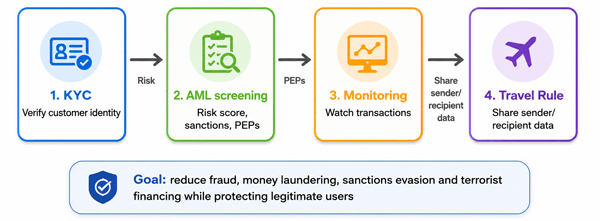
Diagram: How KYC, AML and the Travel Rule fit together in a typical compliance workflow.
1. Introduction: Why KYC, AML and the Travel Rule Matter
KYC, AML and the Travel Rule are three closely connected ideas in financial compliance. They are used by banks, payment companies, crypto exchanges and other financial businesses to understand who their customers are, reduce financial crime risk and keep enough information about transfers so suspicious activity can be investigated.
For beginners, these terms can sound technical or intimidating. In practice, the basic idea is simple: a financial business should not accept customers blindly, should not ignore suspicious behavior, and should not move money or crypto without knowing enough about the sender and receiver when the law requires it.
These rules are especially important in crypto because digital assets can move quickly across borders, may be held in self-custody wallets, and can be mixed with scams, hacks, ransomware, sanctions evasion or darknet activity. At the same time, compliance must be balanced with privacy, security, fair access and good customer experience.
| Term | Full name | Simple meaning | Main purpose |
|---|---|---|---|
| KYC | Know Your Customer | Verifying who a customer is and understanding their profile. | Prevent fake accounts, fraud, identity abuse and misuse of financial services. |
| AML | Anti-Money Laundering | Policies and controls to detect and prevent criminal money flows. | Stop money laundering, terrorist financing, sanctions evasion and related crimes. |
| Travel Rule | Information accompanying transfers | Required sender and recipient data must travel with certain transfers. | Give institutions and authorities an information trail for transfers. |
2. What Is KYC?
KYC stands for Know Your Customer. It is the process a regulated business uses to identify a customer, verify the customer’s identity, understand the customer’s expected activity and decide whether the customer’s risk level is acceptable.
In everyday terms, KYC is why a crypto exchange, bank or payment app may ask for your legal name, date of birth, address, government ID, selfie, source of funds or business documents before you can use all features.
2.1 Common KYC checks
- Identity verification: checking a passport, national ID card, driving licence or other official document.
- Liveness or selfie check: confirming that the person opening the account is a real person and matches the ID.
- Address verification: checking proof of address, geolocation, utility bills, bank statements or official records where required.
- Sanctions and watchlist screening: checking whether the person or business appears on sanctions, terrorism or enforcement lists.
- PEP screening: identifying politically exposed persons who may require closer review because of bribery or corruption risk.
- Beneficial ownership checks: identifying the real people who own or control a company account.
- Source of funds or source of wealth checks: understanding where the customer’s money came from when risk is higher.
2.2 KYC example
A beginner opens an account on a crypto exchange. The exchange allows the user to browse prices, but before the user can deposit funds or withdraw crypto, it asks for a government ID and selfie. The exchange checks that the ID is valid, the face matches, the name is not on a sanctions list and the user’s country is supported. If everything is normal, the user receives standard account limits. If the user wants much higher limits, the exchange may ask for additional information.
3. What Is AML?
AML means Anti-Money Laundering. It is a broad set of laws, policies, procedures and controls designed to stop criminals from using financial services to hide, move or use money linked to crime.
Money laundering usually has three stages: placement, layering and integration. Placement means introducing criminal funds into the financial system. Layering means moving the funds through many transactions to make the trail harder to follow. Integration means making the funds look legitimate, for example through investments, businesses, property or luxury goods.
| AML stage | What it means | Simple crypto or fintech example |
|---|---|---|
| Placement | Criminal value enters a financial system. | A scammer deposits funds into several accounts or buys crypto with stolen money. |
| Layering | Funds are moved around to hide the origin. | The funds pass through multiple wallets, exchanges, bridges, mixers or coins. |
| Integration | Funds re-enter the economy as apparently legitimate value. | The criminal sells crypto, buys property, invests in a company or pays for goods. |
3.1 Core parts of an AML program
- Risk assessment: identifying the business’s exposure to customers, products, countries, channels and transaction types.
- Customer due diligence: collecting and checking customer information based on risk.
- Enhanced due diligence: deeper checks for higher-risk customers, countries, products or transactions.
- Transaction monitoring: detecting unusual behavior, such as rapid movement of funds or activity inconsistent with the customer profile.
- Sanctions screening: blocking or investigating prohibited persons, entities, jurisdictions or addresses.
- Suspicious activity reporting: reporting activity that may involve crime to the relevant authority where required.
- Recordkeeping: preserving customer and transaction records for legally required periods.
- Training and governance: ensuring staff know how to spot risks and escalate concerns.
4. What Is the Travel Rule?
The Travel Rule is a requirement that certain information about the originator and beneficiary of a transfer must be collected, held and transmitted between financial institutions or crypto-asset service providers when a qualifying transfer takes place.
The rule is called the Travel Rule because identifying information should 'travel' with the transfer. In traditional finance, this concept has existed for wire transfers for many years. In crypto, FATF extended similar expectations to virtual asset service providers, often called VASPs. In the EU, the term crypto-asset service provider, or CASP, is commonly used under newer crypto regulation.
FATF’s virtual asset standards require originating VASPs to obtain and hold required originator and beneficiary information and submit the required information to the beneficiary VASP or financial institution immediately and securely. Beneficiary VASPs must obtain and hold the required information and make it available to authorities when required [2].
| Role | Plain-English meaning | Typical Travel Rule responsibility |
|---|---|---|
| Originator | The sender of funds or crypto. | Provide identity and account or wallet-related information to the sending provider. |
| Beneficiary | The receiver of funds or crypto. | Provide recipient information to the receiving provider when required. |
| Originating VASP/CASP | The exchange or provider sending the transfer for its customer. | Collect, verify as required, hold and securely transmit required data. |
| Beneficiary VASP/CASP | The exchange or provider receiving the transfer for its customer. | Receive, check, hold and act on missing or suspicious information. |
| Intermediary provider | A provider in the transfer chain. | Preserve or pass on required information and detect missing data when applicable. |
5. KYC vs AML vs Travel Rule: What Is the Difference?
| Question | KYC | AML | Travel Rule |
|---|---|---|---|
| Main question | Who is this customer? | Is this activity suspicious or prohibited? | What information must accompany this transfer? |
| Timing | Mostly at onboarding, then updated over time. | Before, during and after the customer relationship. | At or before qualifying transfers. |
| Scope | Customer identity and profile. | Financial crime risk controls across the business. | Data sharing and recordkeeping for transfers. |
| Typical evidence | ID, address, selfie, business documents, ownership information. | Risk scores, screening results, transaction alerts, investigations, reports. | Originator and beneficiary information sent securely to another provider. |
| Beginner analogy | Checking a person’s ID at the door. | Watching for risky behavior inside the building. | Attaching sender/receiver details to a package shipment. |
6. How KYC, AML and the Travel Rule Work Together
These controls are not separate silos. A good compliance program connects them. KYC creates the customer profile. AML monitoring compares real behavior against that profile. The Travel Rule makes sure required transfer information is available to the receiving institution and, where legally required, to competent authorities.
- Customer signs up and provides required KYC information.
- The business verifies the information and screens the customer against sanctions and risk databases.
- The customer is assigned a risk level, such as low, medium or high.
- The customer starts using the service. Transactions are monitored for unusual activity.
- For qualifying transfers, required originator and beneficiary information is collected and securely shared with the receiving provider.
- If data is missing, suspicious, inconsistent or linked to sanctions, the business may pause, reject, review or report the transaction depending on law and policy.
- The business keeps records and updates the customer profile when new risks appear.
7. What Information Is Usually Collected?
The exact information depends on the country, product and risk level. However, these are common categories.
| Category | Examples | Why it matters |
|---|---|---|
| Personal identity | Full legal name, date of birth, nationality, ID number, address. | Confirms the customer is real and helps prevent impersonation. |
| Business identity | Company name, registration number, registered address, directors. | Confirms the company exists and is not a shell used to hide risk. |
| Beneficial ownership | Individuals who own or control the company. | Prevents criminals from hiding behind corporate structures. |
| Risk information | Occupation, source of funds, expected activity, countries involved. | Helps determine whether activity is normal or suspicious. |
| Transfer information | Sender and recipient names, account numbers, wallet details, provider details, transaction references. | Supports Travel Rule compliance and investigations. |
| Technical crypto data | Wallet addresses, transaction hashes, blockchain analytics risk indicators. | Helps trace crypto flows and detect links to hacks, scams or sanctions. |
8. Real-World Examples
8.1 Example 1: A normal exchange withdrawal
A customer buys Bitcoin on a regulated exchange and withdraws it to another regulated exchange account in their own name. The exchange already completed KYC, checks the destination provider, prepares required Travel Rule data, sends it securely and records the transaction. The user may notice only a short confirmation screen.
8.2 Example 2: Missing recipient information
A customer tries to send crypto to another platform but enters incomplete recipient details. The sending exchange may ask for more information, delay the withdrawal or reject it. This can feel inconvenient, but the provider may be required to avoid sending transfers with missing or unreliable information.
8.3 Example 3: Higher-risk activity after onboarding
A customer passes KYC with small expected monthly activity, then suddenly receives many transfers from unrelated wallets connected to phishing scams. AML monitoring may flag the activity. The provider may request source-of-funds documents, restrict withdrawals, file a suspicious activity report or close the account depending on the facts and local law.
8.4 Example 4: Business account with hidden ownership
A company opens an account and says it is a software business, but ownership documents show complex offshore layers and unclear controllers. The provider may request beneficial ownership information and enhanced due diligence before approving the account. The issue is not that complex companies are always illegal; the issue is whether the provider can understand who controls the business and what risk it presents.
9. Crypto-Specific Issues: VASPs, CASPs and Self-Custody Wallets
In crypto, the Travel Rule is more complicated than a bank wire because blockchain transfers do not automatically include personal identity data. A blockchain transaction may show wallet addresses and transaction hashes, but not the real-world identities of the sender and recipient. That is why VASPs and CASPs often need a separate secure messaging system to exchange Travel Rule data.
A self-custody wallet is a wallet controlled directly by the user, not by an exchange or custodian. Travel Rule obligations for transfers involving self-custody wallets vary by jurisdiction. Some regimes require additional verification above certain thresholds, while others focus mainly on transfers between regulated providers. Businesses should not assume one global rule applies everywhere.
| Transfer type | Compliance challenge | Practical response |
|---|---|---|
| Exchange to exchange | Both sides may be regulated but may use different Travel Rule systems. | Identify the counterparty provider, exchange required data securely and handle data mismatches. |
| Exchange to self-custody wallet | There may be no receiving institution to accept Travel Rule data. | Collect wallet ownership information where required and apply risk-based blockchain analytics. |
| Self-custody wallet to exchange | The receiving provider may not know who controlled the sending wallet. | Ask the customer for wallet ownership details and screen transaction history. |
| Cross-chain bridge transfer | Funds may move across chains, making tracing harder. | Use blockchain analytics and risk rules for bridges, mixers and high-risk protocols. |
| Privacy coin or mixer exposure | Identity and transaction trail may be intentionally obscured. | Apply enhanced due diligence, restrictions or rejection depending on policy and law. |
10. Key Legal and Regulatory Context
FATF is not a national regulator, but its Recommendations strongly influence national AML/CFT laws. FATF updated Recommendation 15 in 2019 to apply AML/CFT measures to virtual assets and virtual asset service providers [6]. Its Travel Rule expectations for virtual asset transfers are linked to Recommendation 16 on payment transparency [2].
In the United States, FinCEN guidance explains that transactions involving convertible virtual currency can qualify as transmittals of funds and may fall within the Funds Travel Rule. FinCEN’s 2019 CVC guidance states that a transmittal of funds of $3,000 or more, or its equivalent in CVC, may trigger certain Travel Rule requirements for money transmitters [3].
In the European Union, Regulation (EU) 2023/1113 extends information requirements to certain crypto-asset transfers [4]. The European Banking Authority’s Travel Rule Guidelines under that regulation became applicable on 30 December 2024 and describe steps providers should take to detect and manage missing or incomplete transfer information [5].
11. Benefits of KYC, AML and the Travel Rule
- Helps reduce scams, account takeovers, stolen identity use and mule accounts.
- Creates an information trail that can support investigations into hacks, ransomware, fraud and terrorism financing.
- Protects platforms from becoming easy gateways for illicit finance.
- Improves trust with banks, payment partners, regulators and institutional customers.
- Can help legitimate users recover from fraud because providers have better records.
- Supports broader crypto adoption by making regulated services more acceptable to mainstream finance.
12. Risks, Limitations and Criticisms
KYC, AML and the Travel Rule are useful, but they are not perfect. Poorly designed compliance can create new risks.
| Risk or limitation | Why it matters | Best-practice response |
|---|---|---|
| Privacy risk | Sensitive identity data can be exposed if stored poorly. | Collect only necessary data, encrypt it, limit access and define retention rules. |
| Data breach risk | KYC databases are valuable targets for criminals. | Use strong security controls, vendor due diligence and incident response planning. |
| False positives | Legitimate users may be delayed or rejected by automated alerts. | Use human review for serious decisions and tune monitoring rules. |
| Financial exclusion | People without standard ID documents may struggle to access services. | Use risk-based alternatives where legally allowed and design inclusive onboarding. |
| Compliance theatre | Collecting documents without real risk analysis does not stop crime. | Connect KYC, monitoring, investigations and governance. |
| Fragmented Travel Rule implementation | Different countries and providers may use different thresholds or messaging systems. | Maintain a jurisdiction matrix and counterparty due diligence process. |
| Over-collection | Collecting too much data increases customer friction and liability. | Apply data minimization and proportionality. |
| Evasion by criminals | Criminals may use mixers, mule accounts, fake IDs or offshore platforms. | Combine identity checks with behavioral monitoring and blockchain analytics. |
13. Best Practices for Businesses
13.1 Start with a real risk assessment
Do not copy another company’s compliance program. Map your own risks: products, customers, countries, transaction sizes, blockchain assets, delivery channels, custody model and counterparties. A retail exchange, NFT marketplace, stablecoin issuer and cross-border payments company do not have the same risk profile.
13.2 Make KYC risk-based, not one-size-fits-all
Low-risk customers may need standard checks. Higher-risk customers may require enhanced due diligence, proof of source of funds, management approval or lower limits. Risk-based compliance is more practical than treating every user as equally risky.
13.3 Screen continuously, not only at signup
A customer may be low risk at onboarding but become risky later. Sanctions lists change, wallets receive tainted funds, account behavior changes and customers may move to new countries. Ongoing screening and monitoring are essential.
13.4 Build Travel Rule workflows before launch
A crypto business should decide how it will identify counterparty VASPs, transmit Travel Rule data securely, handle rejected transfers, manage self-custody wallet transfers and document decisions. Waiting until after regulators ask questions is risky.
13.5 Protect customer data as seriously as funds
KYC data can be as harmful as stolen money if leaked. Use encryption, access controls, audit logs, vendor security reviews, retention limits and breach response planning. Staff should see sensitive data only when their role requires it.
13.6 Explain requirements clearly to users
Many users get frustrated because they do not understand why information is requested. Clear onboarding screens, plain-language notices and accurate help-center articles can reduce support tickets and build trust.
13.7 Keep evidence of decisions
Regulators often care not only what decision was made, but why. Keep records of risk assessments, alerts, investigations, escalations, approvals, rejected transfers and policy changes.
14. Best Practices for Individual Users
- Use regulated platforms that clearly explain their identity, security and privacy practices.
- Keep your ID documents and account credentials secure. Do not send KYC documents through random chats or unofficial support channels.
- Make sure the name on your bank account, exchange account and identity document is consistent where required.
- Expect extra checks for large transfers, unusual activity, business accounts, cross-border activity or high-risk assets.
- Do not use someone else’s account or allow others to move money through your account. That can look like mule activity.
- Keep basic records of deposits, withdrawals, wallet ownership and source of funds, especially for large crypto transactions.
- Be cautious with mixers, privacy tools, unknown bridges and funds received from strangers; they can create compliance and legal risk.
15. Common Mistakes and Misconceptions
| Misconception | Reality |
|---|---|
| KYC means my account is completely safe. | KYC reduces identity risk but does not remove phishing, hacking, market or scam risk. |
| AML is only for banks. | AML rules can apply to crypto exchanges, payment companies, money transmitters, brokers and other regulated businesses. |
| The Travel Rule puts personal data on the blockchain. | In most implementations, personal data is transmitted off-chain through secure messaging, not written publicly to the blockchain. |
| A small crypto transfer is never monitored. | Even when Travel Rule thresholds do not apply, platforms may still screen and monitor transactions under AML and sanctions rules. |
| Self-custody wallets are illegal. | Self-custody is not automatically illegal, but transfers involving self-custody wallets may trigger extra checks in some jurisdictions. |
| Compliance is just collecting passports. | Good compliance combines identity verification, risk assessment, monitoring, investigations, reporting, governance and data protection. |
| All countries follow the same Travel Rule threshold. | Thresholds and details vary. The US, EU and other jurisdictions do not apply identical rules. |
16. Practical Compliance Checklist
| Area | Checklist questions |
|---|---|
| Governance | Who owns AML compliance? Is there a qualified compliance officer? Are policies approved and reviewed? |
| Risk assessment | Have customer, product, geography, channel and transaction risks been assessed and documented? |
| KYC/CDD | What information is collected? How is it verified? When is enhanced due diligence required? |
| Sanctions | Are customers, counterparties, wallet addresses and transactions screened against relevant lists? |
| Monitoring | Are alerts based on real risk typologies such as structuring, rapid movement, scam exposure or high-risk wallet links? |
| Travel Rule | Can the business identify counterparty providers, transmit data securely and manage missing information? |
| Self-custody wallets | What information is required, when, and how is wallet ownership assessed? |
| Investigations | Are alerts reviewed, escalated and closed with clear reasons? |
| Reporting | When is suspicious activity reported and who approves it? |
| Records and privacy | How long are records kept, who can access them and how are they protected? |
| Training | Do staff understand red flags, escalation paths and tipping-off rules? |
| Testing | Is the program independently tested or audited at appropriate intervals? |
17. Compliance Maturity Levels
| Level | What it looks like | Main weakness |
|---|---|---|
| Level 1: Basic | Manual ID checks, simple sanctions screening, limited monitoring. | Too slow and inconsistent as volume grows. |
| Level 2: Developing | Documented policies, automated KYC vendor, basic transaction rules. | Alerts may be noisy and Travel Rule workflows may be incomplete. |
| Level 3: Managed | Risk-based onboarding, ongoing monitoring, Travel Rule messaging, case management. | Requires good data quality and staff training. |
| Level 4: Advanced | Integrated KYC, blockchain analytics, behavioral monitoring, vendor governance, regular testing. | Can become complex and expensive if not focused on real risks. |
| Level 5: Optimized | Continuous risk tuning, strong privacy controls, clear metrics, independent assurance. | Needs sustained leadership support and regulatory awareness. |
18. FAQ: KYC, AML and the Travel Rule
18.1 Is KYC the same as AML?
No. KYC is one part of AML. KYC focuses on identifying and understanding customers. AML is the broader program for preventing, detecting and reporting financial crime risk.
18.2 Why do crypto exchanges ask for my ID?
They may be legally required to verify customers, screen sanctions risk, prevent fraud and maintain AML records. Requirements depend on the exchange, country, product and account limits.
18.3 Does the Travel Rule apply to every crypto transaction?
Not always. It usually applies to qualifying transfers involving regulated providers, but thresholds and details vary by jurisdiction. Some countries also have rules for transfers involving self-custody wallets.
18.4 Is my personal information written on the blockchain?
Usually no. Travel Rule identity information is normally sent off-chain through secure provider-to-provider systems. Public blockchains generally show wallet addresses and transaction data, not KYC records.
18.5 What happens if Travel Rule information is missing?
A provider may request more information, delay the transfer, reject it, return it, restrict the account or investigate further depending on law, risk and internal policy.
18.6 What is enhanced due diligence?
Enhanced due diligence means deeper checks for higher-risk customers or transactions. It may include source-of-funds evidence, senior approval, more frequent reviews or stricter limits.
18.7 What is a politically exposed person?
A politically exposed person, or PEP, is someone with a prominent public role, or sometimes a close family member or associate. PEPs are not automatically criminals, but they can present higher corruption or bribery risk.
18.8 What is beneficial ownership?
Beneficial ownership means the real person or people who ultimately own or control a company or legal structure. AML rules often require businesses to identify them.
18.9 Can KYC stop all financial crime?
No. KYC is useful, but criminals can use fake documents, stolen identities, mule accounts and unregulated platforms. That is why transaction monitoring and investigations are also needed.
18.10 Why do platforms sometimes freeze accounts?
They may freeze or restrict accounts because of sanctions hits, suspicious activity, missing documents, chargebacks, law enforcement requests, fraud concerns or policy violations.
18.11 Is using a self-custody wallet allowed?
In many places, yes. But transfers between regulated platforms and self-custody wallets may require extra information or checks depending on local rules and platform policy.
18.12 How can users reduce compliance delays?
Use accurate personal details, avoid moving funds for others, keep records for large transfers, respond to document requests through official channels and avoid high-risk sources of funds.
19. Conclusion
KYC, AML and the Travel Rule are not just compliance buzzwords. They are practical systems for identifying customers, detecting suspicious activity and preserving transfer information. In crypto and fintech, they help reduce fraud and illicit finance risk, but they also create privacy, security and usability challenges if handled poorly.
The best approach is risk-based, transparent and proportionate: collect the information that is genuinely needed, protect it strongly, monitor activity intelligently and explain requirements clearly. For businesses, the goal is not to create paperwork for its own sake. The goal is to build a financial service that legitimate customers can trust and criminals cannot easily exploit.
Sources Consulted and Checked
- The following sources were consulted and checked while preparing this document and reviewing its accuracy:
- FATF, Virtual Assets topic page, including risk-based approach and targeted updates.
- FATF, Best Practices in Travel Rule Supervision, 2025.
- FinCEN, Application of FinCEN Regulations to Certain Business Models Involving Convertible Virtual Currencies, FIN-2019-G001.
- European Union, Regulation (EU) 2023/1113 on information accompanying transfers of funds and certain crypto-assets.
- European Banking Authority, Travel Rule Guidelines under Regulation (EU) 2023/1113.
- FATF Recommendations, including Recommendation 15 and Recommendation 16 updates.
Reader Advice
This article is provided for educational and informational purposes only. It is not personalized legal, regulatory, tax, financial, or compliance advice, and it should not be treated as a recommendation for any specific business, transaction, platform, or jurisdiction. KYC, AML, sanctions, data-protection, recordkeeping, reporting, and Travel Rule requirements, including thresholds, definitions, procedures, and statistics, can change over time and vary by country, region, licence, business model, customer type, and transfer type. Before acting, readers should verify current requirements through official regulators, legislation, and qualified professional advisers.
Crypto and financial services also involve risks such as fraud, account restrictions, privacy or data-security incidents, transfer delays, loss of funds, and regulatory action; use appropriate care, protect sensitive information, and make decisions based on your own circumstances and risk assessment.