DAO Legal Structures in the US: Complete Guide to Legal Frameworks, Risks & Best Practices
Entity choices • liability • regulation • tax • governance • formation
A decentralized autonomous organization can coordinate people, capital and software without a conventional boardroom. It cannot, however, operate outside the law. In the United States, a DAO may be treated as a legal entity created under a state statute, an ordinary LLC or nonprofit corporation with blockchain-based governance, or—when no wrapper exists—an unincorporated association or general partnership. That classification affects who owns assets, who can sign contracts, how disputes are handled, how taxes are reported and whether token holders may face personal liability.
For most operating DAOs, the best legal structure is not simply the state with the most crypto-friendly statute. The right answer depends on the DAO’s purpose, profit model, token economics, governance mechanics, member geography, regulatory exposure, need for banking and whether the community can identify real people to fulfill legal and tax responsibilities.
Bottom line: A legal wrapper is a risk-management tool, not a regulatory safe harbor. A Wyoming DAO LLC, Wyoming DUNA, Tennessee decentralized organization, Utah limited liability DAO or Vermont BBLLC can clarify entity status and internal governance, but none automatically makes a token non-security, eliminates tax reporting, authorizes money transmission or excuses sanctions compliance.
| Question | Practical answer |
|---|---|
| Does every DAO need a legal entity? | Not always, but any DAO that holds material assets, hires contributors, signs contracts, sells tokens, earns revenue or serves users should seriously evaluate one. |
| What is the most common wrapper? | A conventional LLC remains the most flexible and familiar option. A state-specific DAO LLC may be useful when on-chain governance must be integrated expressly into the entity documents. |
| When is a nonprofit structure better? | When the mission is genuinely noncommercial or ecosystem-oriented and distributions to members are not the central purpose. “Nonprofit” does not automatically mean federal tax-exempt. |
| Can token holders be personally liable without a wrapper? | Potentially. Courts and regulators may characterize an unwrapped DAO as an unincorporated association or, in some settings, a general partnership. |
| Does decentralization prevent lawsuits? | No. In the Ooki DAO case, a federal court treated the DAO as an unincorporated association that could be sued and held liable. |
| What should founders do first? | Map activities, participants, cash flows, tokens, control rights and regulatory touchpoints before selecting a state or filing formation documents. |
1. What a DAO Legal Structure Actually Does
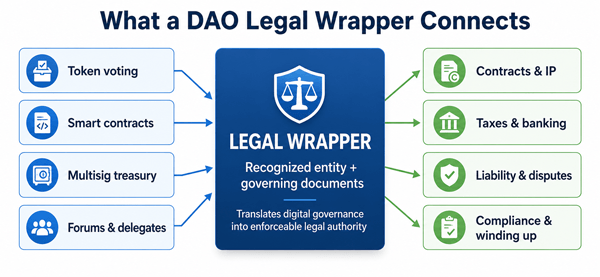
Figure 1. A legal wrapper connects digital governance to conventional legal rights and obligations.
A DAO is a coordination system in which participants use digital tools, often governance tokens, multisignature wallets, discussion forums and smart contracts, to propose, approve and execute decisions. The term describes how the group operates; it does not by itself identify the group’s legal form.
A legal wrapper connects the DAO’s digital governance layer to the conventional legal system. It gives the organization a recognized name and legal identity, defines who can act for it and provides a framework for property ownership, contracts, taxes, litigation and winding up.
1.1 What a wrapper can accomplish
- Create a separate legal person that can own intellectual property, domain names, bank accounts and off-chain assets.
- Allow the DAO to contract with developers, service providers, exchanges, custodians and employees.
- Limit member liability when statutory requirements and corporate formalities are respected.
- Establish governing law, voting rules, fiduciary standards, dispute procedures and emergency powers.
- Provide a route to obtain an EIN, open financial accounts, keep books and file tax returns.
- Make it easier for counterparties to conduct due diligence and determine who has authority to sign.
1.2 What a wrapper cannot accomplish
- Turn an investment contract into a non-security merely by calling it a governance token.
- Eliminate Commodity Exchange Act obligations, money-transmission licensing, AML duties or sanctions restrictions.
- Guarantee limited liability if members commit fraud, personally guarantee obligations, commingle funds or disregard the entity.
- Erase tax liabilities created before formation or convert a profit-distributing venture into a tax-exempt charity.
- Make defective smart-contract code legally controlling when mandatory law or the governing documents say otherwise.
Key distinction: “Decentralized” is an operational description. “LLC,” “nonprofit corporation,” “unincorporated nonprofit association” and “partnership” are legal classifications. A project needs to analyze both layers.
2. The Risks of Operating Without a Wrapper
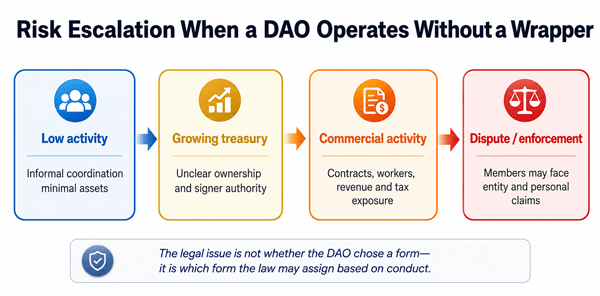
Figure 2. Legal and operational exposure generally rises as an unwrapped DAO accumulates assets, revenue, workers and regulated activity.
An unwrapped DAO is not legally invisible. When people combine resources and act toward a shared objective, courts and agencies may fit the group into an existing category even if the participants never chose one.
2.1 Potential unincorporated-association treatment
The CFTC’s Ooki DAO litigation is the clearest warning. A federal court concluded that the DAO could be sued and served as an unincorporated association and was a “person” under the Commodity Exchange Act. The case does not mean every DAO will be classified identically in every jurisdiction, but it demonstrates that a decentralized voting process does not prevent entity-level enforcement.
2.2 Potential general-partnership exposure
A general partnership can arise by conduct when two or more persons carry on a business for profit as co-owners. No filing may be required. If a DAO’s members share profits, participate in management and operate without a liability shield, plaintiffs may argue that members are partners. General partners can face joint or several liability under applicable state law, depending on the claim and jurisdiction.
2.3 Operational problems
| Problem | Why it matters |
|---|---|
| Asset ownership | A wallet address can control tokens, but it does not answer who legally owns them or who can recover them after a key compromise. |
| Contracts | A vendor may not know whom it is contracting with or who can bind the DAO. |
| Employment and contributors | Informal contributor payments can create worker-classification, withholding, benefits and intellectual-property issues. |
| Banking and exchanges | Financial institutions usually require formation records, beneficial-owner or control information, an EIN and authorized signers. |
| Tax filings | An unwrapped group may still be a partnership or association for tax purposes, creating filing and member-reporting obligations. |
| Litigation | Pseudonymous members may still be identified through discovery, wallet analysis, governance records or service providers. |
| Continuity | Key-person loss, multisig deadlock or governance attacks can freeze assets without a legally enforceable recovery process. |
Warning: Voting against a proposal does not necessarily eliminate all legal exposure. Liability analysis can turn on membership, participation, control, conduct and the law governing the particular claim—not only on one wallet’s vote.
3. Main US Legal Structures for DAOs
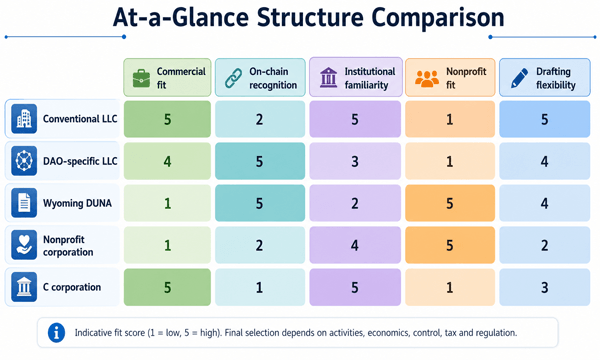
Figure 3. Indicative comparison of commonly used DAO structures; scores are decision aids, not legal conclusions.
| Structure | Best fit | Main strengths | Main limitations |
|---|---|---|---|
| Conventional LLC | Operating businesses, protocol service companies, investment clubs with counsel, contributor collectives | Familiar to banks and vendors; flexible operating agreement; liability shield; broad state choice | Traditional managers and signers still needed; token rights must be carefully mapped; securities and tax issues remain |
| State-specific DAO LLC or decentralized organization | Communities that want statutes expressly recognizing smart contracts and algorithmic governance | Clearer statutory recognition of on-chain governance; tailored formation language | Newer statutes, limited case law, state-specific terminology and technical requirements |
| Wyoming DUNA | Nonprofit-purpose protocol governance, ecosystem stewardship and public-goods coordination | Separate legal capacity; decentralized governance; member liability protections; designed for nonprofit associations | Not suitable for member profit distributions as the central objective; tax-exempt status is separate; evolving framework |
| Nonprofit corporation | Foundations, grantmaking, education, standards and public-benefit initiatives | Strong governance framework; possible path to federal tax exemption; familiar to donors and institutions | Board-centric; private benefit and political-activity restrictions; slower community control |
| Delaware statutory trust or other trust | Asset-holding, investment or protocol arrangements requiring trustee structure | Flexible allocation of legal title and beneficial interests | Complex; securities, investment-company and fiduciary issues; often unsuitable for open participation |
| C corporation | Token or software company raising venture capital, issuing equity and hiring at scale | Investor familiarity; equity compensation; perpetual existence | Double taxation unless special planning; corporate formalities; DAO token governance can conflict with board duties |
| Unincorporated association | Small, low-risk community with no material assets or commercial activity | Low setup burden | Uncertain liability, contracting, tax and governance outcomes; usually poor fit once activity grows |
4. State-Specific DAO Frameworks
Several states have enacted statutes that expressly accommodate decentralized or blockchain-based organizations. The statutes are not interchangeable. Definitions, formation language, governance defaults and dissolution rules differ, and a DAO may still need to register as a foreign entity in states where it actually conducts business.
4.1 Wyoming DAO LLC
Wyoming’s 2021 DAO supplement was the first US statute expressly authorizing a DAO to organize as an LLC. The Wyoming Limited Liability Company Act generally applies unless inconsistent with the DAO supplement. Formation documents must identify the organization as a DAO, and the structure can be member-managed or algorithmically managed under the governing documents and smart contracts.
- Useful for profit-seeking or operational DAOs that want an LLC form with explicit recognition of smart contracts.
- The articles and operating agreement should identify how governing documents and smart contracts relate when they conflict.
- A registered agent and continuing state compliance are required.
- Limited liability depends on maintaining the entity and avoiding personal misconduct or veil-piercing facts.
4.2 Wyoming DUNA
Wyoming enacted the Decentralized Unincorporated Nonprofit Association Act in 2024. A DUNA is intended for decentralized associations pursuing a nonprofit purpose and can use distributed-ledger technology and smart contracts for governance. The statute addresses legal capacity, administrators, membership, liability and governance processes. It has attracted interest from protocol communities seeking a wrapper that is not built around distributing profits to equity owners.
Important: “Nonprofit” under state organizational law is not the same as “tax-exempt” under Internal Revenue Code section 501(c). A DUNA must separately analyze federal and state tax status, private-benefit restrictions and reporting obligations.
4.3 Tennessee decentralized organization
Tennessee’s decentralized-organization supplement applies an LLC framework to entities whose articles state that they are decentralized organizations. The statute permits governing documents and underlying smart contracts to define or modify important member rights, including fiduciary duties, withdrawal, transfer, capital-return and dissolution rights, subject to mandatory law.
4.4 Utah limited liability DAO
Utah’s Decentralized Autonomous Organization Act provides a distinct limited-liability DAO framework. It includes formation, naming, governance, disclosure and reporting provisions. The current code has scheduled renumbering and statutory transition provisions effective in 2026, so a filer should verify the operative chapter and official forms on the filing date rather than rely on an old checklist.
4.5 Vermont blockchain-based LLC
Vermont permits an LLC that materially uses blockchain technology to elect blockchain-based limited liability company status. Its operating agreement must address the mission, governance and blockchain-related procedures. The framework is broader than a pure DAO statute and can fit a business whose operations or records materially rely on blockchain technology.
4.6 Why Delaware remains relevant
Delaware does not need a DAO-specific label to be useful. Its LLC statute is highly contractual, its courts are experienced in business disputes and its entity law is familiar to investors and counterparties. A Delaware LLC can incorporate token-based voting, delegated committees, multisig approvals and smart-contract references in its operating agreement. The tradeoff is that the DAO must draft the blockchain-to-legal interface itself rather than rely on a tailored DAO statute.
| State/form | Profit orientation | On-chain governance recognition | Typical reason to choose |
|---|---|---|---|
| Wyoming DAO LLC | For-profit or other lawful LLC purpose | Express | DAO-specific LLC terminology and algorithmic-management options |
| Wyoming DUNA | Nonprofit purpose | Express | Protocol stewardship, ecosystem governance, grants or public goods without member profit distribution as the core purpose |
| Tennessee decentralized organization | Generally LLC-based | Express | Flexible modification of member rights through governing documents and smart contracts |
| Utah limited liability DAO | Depends on statutory form and purpose | Express | Separate DAO statute with detailed governance and disclosure concepts |
| Vermont BBLLC | Business using blockchain materially | Express | Blockchain-centric business that wants an LLC election |
| Delaware LLC | Usually for-profit or commercial | Contractual rather than DAO-specific | Mature business law, investor familiarity and maximum drafting flexibility |
5. How to Choose the Right Structure
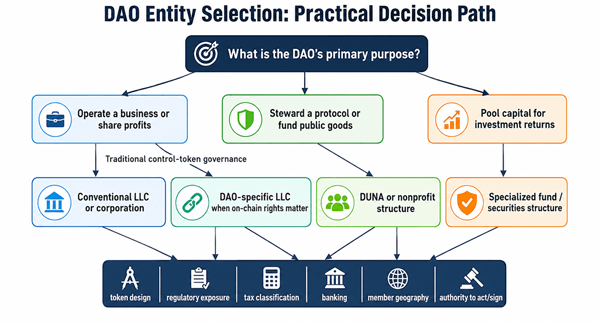
Figure 4. Start with purpose and economics, then test regulation, tax, banking, geography and signing authority.
Start with the activity, not the state. A structure should follow the DAO’s real economics and control system. The following decision framework is more reliable than selecting a jurisdiction because it is popular in crypto communities.
- Define the mission. Is the DAO operating a business, funding public goods, governing a protocol, managing investments, buying assets or supporting a social community?
- Map the money. Identify token sales, protocol fees, grants, subscriptions, treasury yield, contributor compensation and distributions to members.
- Map control. Determine who controls upgrades, treasury keys, websites, front ends, legal contracts and emergency powers.
- Classify participants. Distinguish token holders, legal members, delegates, multisig signers, founders, developers, administrators, employees and vendors.
- Identify regulated activities. Review securities, commodities, derivatives, money transmission, lending, custody, gaming, insurance, privacy and consumer finance.
- Determine tax objectives. Decide whether pass-through taxation, corporate taxation or a genuine tax-exempt path is appropriate.
- Assess counterparties. Consider what banks, exchanges, custodians, grant recipients, institutional investors and auditors will accept.
- Choose the governing law and wrapper. Compare ordinary LLC, DAO-specific LLC, DUNA, nonprofit corporation, corporation, trust or another structure.
- Design the legal-to-code interface. State which rules control when the smart contract, proposal text, forum discussion and legal documents differ.
- Plan for failure. Include key loss, exploit, sanctions event, deadlock, governance attack, insolvency, litigation and dissolution procedures.
| DAO profile | Likely starting point | Why |
|---|---|---|
| Protocol governance with no intended member profit distributions | Wyoming DUNA or nonprofit-oriented structure | Matches stewardship and public-purpose orientation while creating legal capacity |
| Revenue-generating software or service business | Conventional LLC or corporation | Clear commercial ownership, contracts, hiring and tax administration |
| Token-governed operating collective | DAO-specific LLC or carefully drafted conventional LLC | Can connect token voting to legally enforceable member or manager authority |
| Venture-backed development company plus community governance | Dual structure: corporation/LLC + foundation or DAO wrapper | Separates product development, employment and IP from protocol/community governance |
| Investment DAO | Specialized LLC or fund structure with securities counsel | Investment-company, adviser, broker-dealer and offering rules can dominate entity choice |
| Small social club with minimal assets | Unincorporated association may suffice temporarily | Low activity may not justify complexity, but risk should be reassessed before collecting funds |
6. Step-by-Step DAO Formation Process
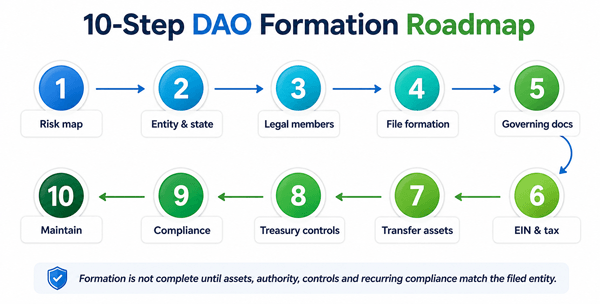
Figure 5. Formation is a sequence: design, file, transfer authority and assets, implement controls, and maintain compliance.
6.1 Create an activity and risk map
Prepare a one-page description of the protocol, users, revenue, treasury, tokens, governance, contributors and jurisdictions. List every party that can move assets or change code. This document helps counsel identify hidden regulatory and liability issues before formation.
6.2 Select the entity and state
Compare liability, governance flexibility, tax treatment, filing requirements, registered-agent rules, annual costs, foreign qualification and the availability of competent local counsel. State of formation is only one factor; the DAO may owe taxes or need registrations elsewhere.
6.3 Decide who the legal members are
Open token ownership and legal membership do not have to be identical. A DAO can define members by a verified registry, token snapshot, signed joinder, delegation relationship or another objective test. The definition should address exchanges, custodians, smart-contract wallets, lost keys and sanctioned addresses.
6.4 File formation documents
File the required articles, certificate or election language with the state and appoint a registered agent. DAO-specific statutes may require special naming, public statements, smart-contract identifiers or disclosures. Use the official current form and statute on the filing date.
6.5 Adopt the operating agreement or governing principles
The core document should translate the DAO’s governance into legally enforceable rules. Boilerplate LLC documents are rarely sufficient for token-based governance.
6.6 Obtain an EIN and determine tax classification
The IRS requires an identifiable responsible party for an EIN application. A domestic multi-member LLC is generally treated as a partnership by default unless it elects corporate treatment; a single-member LLC is generally disregarded unless it elects corporate treatment. A DAO should obtain tax advice before distributing tokens, rewards or treasury assets.
6.7 Transfer assets and contracts properly
Formation alone does not move property. Execute IP assignments, domain transfers, token or wallet-control documentation, contributor agreements, licenses and contract novations. Record the transfer values and tax basis.
6.8 Establish treasury controls
Use documented multisig policies, signer eligibility, transaction limits, independent review, address allowlists, incident response and succession procedures. Keep legal authority aligned with technical access.
6.9 Implement compliance procedures
Build risk-based processes for sanctions screening, securities-law review, AML or money-transmission analysis, privacy, consumer disclosures, tax records, conflicts and vendor diligence. The controls should match the DAO’s actual activities rather than copy a centralized exchange manual.
6.10 Maintain the entity
File annual reports, pay state fees, maintain a registered agent, preserve governance records, update signers and responsible-party information, file tax returns and document material proposals. A dormant shell does not provide reliable protection.
7. Governance Documents and Smart Contracts
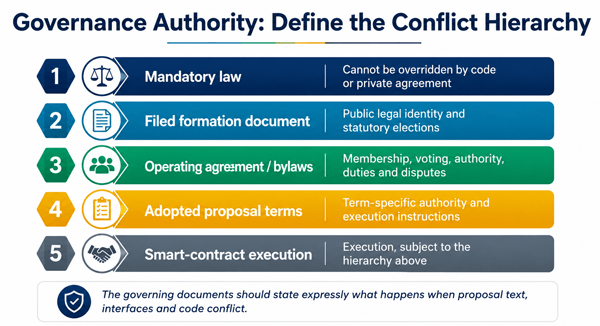
Figure 6. A written conflict hierarchy reduces ambiguity when law, filings, agreements, proposals and code point in different directions.
The most important drafting task is defining which source of authority controls. A DAO may have articles, an operating agreement, governing principles, proposal text, a forum, a governance interface, smart contracts and informal community norms. Ambiguity between them creates litigation and operational risk.
| Clause | Questions to answer |
|---|---|
| Purpose and powers | What may the DAO do? What activities are prohibited without a higher vote threshold or legal review? |
| Membership | Who is a member? Is membership transferable? Do custodians or exchanges count? How are lost or compromised keys handled? |
| Voting | What creates quorum? Are votes token-weighted, one-person-one-vote, delegated or reputation-based? Are abstentions counted? |
| Proposal lifecycle | Who may submit? What notice period applies? Can proposals be amended? When is a vote final? |
| Execution | Does a passed proposal execute automatically, require a multisig or need an administrator’s legal-compliance check? |
| Conflicts hierarchy | Do mandatory law and filed articles override the operating agreement? Does the agreement override smart-contract code or vice versa? |
| Fiduciary duties | Which duties apply to members, delegates, signers, developers and administrators? Which may be modified under state law? |
| Emergency powers | Who may pause contracts, block an exploit, respond to sanctions or migrate assets? How are powers reviewed and terminated? |
| Treasury | What spending limits, diversification rules, custody standards and reporting requirements apply? |
| Compensation | How are grants, salaries, bounties, token awards and delegate payments approved and taxed? |
| Disputes | Which law, forum, arbitration rules and notice methods apply? Can pseudonymous participants enforce rights? |
| Dissolution | What triggers winding up? How are creditors paid and remaining assets distributed? |
Best practice: Treat smart contracts as part of the governance system, not as the entire legal agreement. Code should be audited, versioned, linked to adopted documents and paired with a lawful emergency process.
8. Federal Regulatory Issues
State entity law answers questions about organization and internal liability. Federal law regulates the DAO’s activities, assets, offerings and users. A DAO can comply with its formation statute and still violate federal law.
8.1 Securities law
The SEC’s 2017 DAO Report concluded that tokens offered by The DAO were securities. The analysis focuses on economic reality, including whether purchasers invest money in a common enterprise with a reasonable expectation of profits based on the managerial or entrepreneurial efforts of others. Labels such as “utility,” “governance” or “decentralized” are not determinative.
- Token offerings may require registration or a valid exemption.
- Promoters, issuers, platforms, brokers and intermediaries can have separate obligations.
- Governance rights do not automatically prevent an investment-contract finding, especially when meaningful control remains with a core team.
- Investment DAOs may implicate the Investment Company Act and Investment Advisers Act in addition to offering rules.
8.2 Commodities and derivatives
Digital assets may be commodities, and leveraged retail commodity transactions, futures, options, swaps and certain trading platforms can fall under CFTC jurisdiction. The Ooki DAO judgment illustrates that decentralized governance does not immunize a protocol from the Commodity Exchange Act or registration requirements.
8.3 Money transmission and AML
FinCEN guidance distinguishes users of convertible virtual currency from administrators and exchangers. A DAO or its service entity may be a money services business when it accepts and transmits value or provides certain exchange services, unless an exemption applies. State money-transmitter laws require a separate state-by-state analysis. A protocol that never takes custody may present a different profile from a treasury, front end or operator that controls transactions.
8.4 Sanctions
OFAC states that sanctions obligations apply to virtual-currency transactions just as they apply to fiat transactions. A DAO should assess exposure based on its US nexus, personnel, front-end access, treasury activity and counterparties. Risk-based controls may include wallet screening, geolocation controls, blocked-property procedures, escalation and documentation.
8.5 Corporate Transparency Act
As of August 2, 2026, FinCEN’s published guidance states that entities created in the United States and their beneficial owners are exempt from federal beneficial-ownership information reporting under the Corporate Transparency Act. Certain foreign-formed entities registered to do business in the United States remain within the revised reporting framework. This area changed rapidly in 2024 and 2025 and should be rechecked before relying on the exemption.
8.6 Consumer protection, privacy and other laws
- Federal Trade Commission and state unfair-or-deceptive-practices laws can apply to marketing, disclosures and security claims.
- Privacy laws can apply when front ends, forums, analytics or service providers collect personal information.
- Lending, payments, gaming, insurance, healthcare, energy and real-estate activities can trigger specialized federal and state regimes.
- Export controls may apply to software, services and dealings with restricted parties or regions.
- Employment, independent-contractor and wage laws apply even when contributors are paid in tokens.
9. Tax Treatment and Accounting
There is no single “DAO tax.” Tax treatment depends on the legal entity, elections, activities, members and token transactions. The IRS treats digital assets as property for federal tax purposes, so transfers, swaps, compensation and distributions can create taxable events even when no dollars change hands.
9.1 Default LLC classification
| Entity | Default federal income-tax treatment | Common filing consequence |
|---|---|---|
| Single-member domestic LLC | Disregarded entity unless corporate election | Activity generally reported by owner, though separate employment and excise-tax rules can apply |
| Multi-member domestic LLC | Partnership unless corporate election | Form 1065 and Schedule K-1 reporting; members may owe tax without cash distributions |
| LLC electing C-corporation treatment | Corporation | Entity-level tax and possible shareholder-level tax on distributions |
| Nonprofit corporation or DUNA | Depends on facts and elections/status | State nonprofit status alone does not confer federal exemption; exemption requires qualifying purpose and IRS compliance where applicable |
9.2 DAO-specific tax pressure points
- Token issuance: determine whether tokens are equity-like interests, compensation, property, rewards, prepaid access or another category.
- Treasury diversification: swapping one digital asset for another can create gain or loss.
- Contributor payments: tokens paid for services are generally measured at fair market value and may create payroll or information-reporting duties.
- Staking, mining and protocol rewards: timing and character depend on the arrangement and current tax authority.
- Airdrops and grants: recipients and the DAO may have income, withholding, gift, compensation or business-expense issues.
- International members: partnership withholding, effectively connected income, treaty, FATCA and information-reporting rules may apply.
- Phantom income: pass-through members can owe tax on allocated income even when the DAO retains all cash or tokens.
9.3 Accounting controls
Maintain transaction-level records showing wallet, asset, quantity, timestamp, fair market value in US dollars, purpose, counterparty, approval and supporting proposal. Reconcile on-chain activity to the general ledger and document valuation methods. Assign cost basis by wallet and asset, and preserve records for bridge transactions, wrapped assets, liquidity positions and gas fees.
Tax warning: Do not promise members that a DAO is “tax-free” because it is decentralized, nonprofit-oriented or formed outside their home state. Entity tax, member tax, state nexus and cross-border withholding require separate analysis.
10. Banking, Treasury and Operational Controls
A legally formed DAO can still fail operationally if no one can satisfy bank diligence, explain wallet ownership or demonstrate lawful authority. Financial institutions may request formation documents, an EIN, governing documents, authorized-signer resolutions, source-of-funds information, expected activity and details about controllers or significant participants.
10.1 Minimum treasury-control framework
- Use a multisig or institutional custody arrangement appropriate to asset value and risk.
- Separate proposal approval from transaction execution when practical.
- Require independent verification of destination addresses and contract calls.
- Set transaction limits and enhanced approval thresholds for unusual transfers.
- Maintain signer succession, device security, key backup and compromise procedures.
- Reconcile wallets monthly and publish community reports without exposing sensitive security information.
- Diversify operational liquidity and define who may convert crypto to fiat.
- Carry out sanctions, fraud and counterparty review before material transfers.
- Retain invoices, grant agreements and tax documentation for every off-chain obligation.
10.2 Intellectual property and front ends
The entity should own or license the code, trademarks, domains, documentation and user interfaces it relies on. Open-source licensing does not automatically transfer trademarks, private repositories, contributor copyrights or commercial rights. Contributor agreements should address work-made-for-hire rules, assignments, confidentiality and pre-existing code.
11. Liability, Insurance and Disputes
11.1 When limited liability can fail
- Personal fraud, misrepresentation, theft, hacking or other wrongful conduct.
- Personal guarantees or contracts signed without clearly naming the entity.
- Commingling personal and DAO assets.
- Undercapitalization or using the entity as a sham to avoid existing obligations.
- Failure to maintain the entity, registered agent, records or required filings.
- Acting outside granted authority or knowingly approving unlawful conduct.
11.2 Insurance to consider
| Coverage | Potential use | Key limitation |
|---|---|---|
| Directors and officers / management liability | Claims against managers, administrators, delegates or officers | Policy definitions may not recognize token holders or decentralized roles without endorsements |
| Cyber and crime | Security incidents, social engineering, data breach and theft | Many policies exclude digital assets, smart-contract exploits or insider transfers unless negotiated |
| Errors and omissions | Claims arising from professional or technology services | May exclude financial services, token offerings or protocol failures |
| General liability | Basic bodily injury, property damage and advertising claims | Does not replace cyber, professional or securities coverage |
| Specie or digital-asset custody | Loss of private keys or controlled assets | Requires strict custody procedures and may cover only named wallets or custodians |
11.3 Dispute design
A DAO agreement should state governing law, venue, notice methods, service addresses, arbitration or court procedures and remedies. It should also explain whether on-chain votes are final, when execution can be enjoined and how a court order can be implemented if smart contracts are immutable. Anonymous membership can complicate due process, discovery and enforcement, so high-value rights may require a verified legal-member registry.
12. Examples and Decision Scenarios
12.1 Protocol-governance DAO
A mature open-source protocol has no equity investors at the DAO level. Token holders vote on upgrades, grants and treasury allocations. A separate development company employs engineers. The DAO does not intend to distribute profits to token holders. A nonprofit-purpose wrapper such as a DUNA may be a logical starting point, paired with service agreements and IP licenses between the DAO and development company. Counsel must still review token, sanctions, tax and front-end issues.
12.2 Revenue-generating creator collective
A group sells digital products, hires contributors and shares net revenue with active members. A conventional multi-member LLC may be more suitable than a nonprofit structure because the economic purpose includes member profit. The operating agreement can reference token or reputation voting while reserving tax, payroll and compliance execution to identified managers.
12.3 Investment DAO
Members contribute stablecoins to acquire startup tokens and expect investment returns. This is not merely a formation problem. The offering, pooled vehicle, adviser, broker and investment-company analyses may control the design. The project should use specialized securities and fund counsel before accepting capital, even if membership is limited to accredited investors.
12.4 Grants DAO
A community receives donations and protocol funding to support open-source developers. It does not promise returns to donors. A nonprofit corporation or DUNA could fit, but federal tax exemption is not automatic. Grant agreements, expenditure responsibility, sanctions screening, contributor tax forms and conflicts policies remain necessary.
12.5 Unwrapped social DAO
A private online club collects small dues to host events. At first, an unincorporated association may be adequate. Once it signs a venue contract, stores member data, hires staff or accumulates a meaningful treasury, an LLC or nonprofit entity becomes more compelling.
13. Common Mistakes
| Mistake | Why it is dangerous | Better practice |
|---|---|---|
| Choosing Wyoming before analyzing activity | A friendly statute does not solve securities, tax or licensing exposure | Complete an activity and regulatory map first |
| Copying another DAO’s documents | Different tokens, control rights and economics produce different legal results | Draft from the project’s actual governance and cash flows |
| Assuming token holders automatically equal legal members | Custody, exchanges, lost keys and pseudonymity create ambiguity | Define membership objectively and keep a legally usable record |
| Relying only on smart-contract code | Code may omit mandatory law, disputes, taxes and off-chain authority | Adopt a hierarchy linking code and legal documents |
| Calling the DAO nonprofit while distributing profits | Name and mission statements do not override economic reality | Align distributions and private benefit with the selected form |
| Ignoring tax until year-end | Every swap, reward and contributor payment may need valuation and records | Implement bookkeeping before treasury activity begins |
| Using founders’ wallets after formation | Commingling weakens controls and creates ownership disputes | Transfer assets to documented entity-controlled wallets |
| No emergency process | A bug, exploit or sanctions event can require immediate action | Use narrowly defined pause and recovery powers with review |
| Treating a wrapper as regulatory approval | State filing offices generally do not approve securities or financial activities | Obtain activity-specific legal analysis |
| Failing to update governance after code changes | The entity documents can become disconnected from actual operations | Require legal review and version control for material upgrades |
14. Best-Practice Checklist
- Written description of mission, products, users and revenue model.
- Current diagram of founders, developers, delegates, signers, service entities and token holders.
- Legal analysis of token issuance and secondary trading.
- Commodity, derivatives, money-transmission, lending and other licensing review.
- Entity selected based on economics and control, not branding.
- Filed formation documents and active registered agent.
- Operating agreement or governing principles tailored to on-chain governance.
- Clear hierarchy among law, articles, agreement, proposals and smart contracts.
- Defined legal membership and authority to bind the entity.
- EIN, tax classification decision and responsible party.
- Accounting policy for digital assets and monthly wallet reconciliation.
- IP assignments, open-source licenses and contributor agreements.
- Multisig, custody, signer succession and incident-response policy.
- Sanctions and counterparty screening proportionate to risk.
- Privacy, consumer disclosures and terms of use for front ends.
- Insurance review for management, cyber, crime and professional risks.
- Annual compliance calendar for state filings, taxes and governance reviews.
- Dissolution, migration and asset-recovery plan.
15. Frequently Asked Questions
15.1 Is a DAO legal in the United States?
A DAO is not illegal merely because it is decentralized. Its legal status and obligations depend on its entity form and activities. A DAO may be an LLC, nonprofit association, corporation, trust, unincorporated association or partnership, and it must comply with applicable federal and state laws.
15.2 What is a DAO LLC?
A DAO LLC is a limited liability company whose governance incorporates decentralized decision-making, often through tokens and smart contracts. Some states expressly recognize DAO LLCs; ordinary LLC statutes can also support customized DAO governance.
15.3 Which state is best for a DAO?
There is no universally best state. Wyoming offers DAO-specific LLC and DUNA statutes; Tennessee, Utah and Vermont have specialized frameworks; Delaware offers mature and flexible entity law. The best choice depends on purpose, tax, control, investors, banking and regulatory exposure.
15.4 Do DAO members have limited liability?
Members of a properly formed and maintained limited-liability entity generally receive a statutory liability shield, but the scope varies. The shield does not protect personal misconduct, guarantees or all regulatory claims.
15.5 Can a DAO be sued?
Yes. A wrapped DAO can be sued in its entity name. An unwrapped DAO may also be sued as an unincorporated association or under another legal theory, as shown by the Ooki DAO case.
15.6 Can a DAO open a bank account?
Potentially, but the bank will usually require formation records, an EIN, governing documents, authorized signers, source-of-funds information and a clear explanation of ownership and control.
15.7 Does a DAO need an EIN?
Most US DAO entities that open accounts, hire workers, file returns or conduct business will need an EIN. The IRS application requires a responsible party, generally an identifiable individual.
15.8 How is a DAO taxed?
Tax depends on classification. A multi-member LLC is generally a partnership by default, while a single-member LLC is generally disregarded. Corporate elections are possible. State nonprofit status does not automatically create federal tax exemption.
15.9 Are governance tokens securities?
Some are and some may not be, depending on facts. The economic reality, fundraising, profit expectations, managerial efforts, decentralization and marketing matter. The SEC’s DAO Report confirms that a token called a governance token can still be a security.
15.10 Can a DAO be a nonprofit?
Yes, when its purpose and operations genuinely fit nonprofit law. Options include nonprofit corporations, unincorporated nonprofit associations and Wyoming DUNAs. Member profit distributions and private benefit must be carefully controlled.
15.11 What is the difference between a DUNA and a DAO LLC?
A DAO LLC is an LLC and can generally support commercial or profit-seeking activity. A DUNA is a decentralized unincorporated nonprofit association designed around a nonprofit purpose. Tax treatment and member economics require separate analysis.
15.12 Do all token holders need to be legal members?
No. The governing documents can distinguish token holders from legal members, voters, delegates and service providers, subject to the statute and token design. Clear definitions are essential.
15.13 Can smart contracts replace an operating agreement?
Usually not safely. Smart contracts can implement voting and execution, but they rarely address every legal issue. A written agreement should define the relationship between code and legal rights.
15.14 Does forming a DAO entity eliminate securities risk?
No. Entity formation and securities compliance are separate. A state filing does not approve a token offering or trading platform.
15.15 Does the Corporate Transparency Act apply to a US DAO LLC?
As of August 2, 2026, FinCEN states that US-created entities are exempt from federal BOI reporting under the current interim rule. The rule has changed before and should be verified at formation and annually.
15.16 Can anonymous people participate in a DAO?
Technically yes, but anonymity can conflict with tax, sanctions, banking, contractual and legal-member requirements. A DAO may permit broad token participation while requiring verification for signers, administrators, employees or legal members.
15.17 Does a DAO need a registered agent?
A filed US entity generally needs a registered agent in its formation state. The agent receives lawsuits and official notices; it does not manage the DAO.
15.18 Can a DAO hire employees?
Yes, through its entity or a service company. It must address payroll, withholding, worker classification, benefits, immigration and employment law. Paying in tokens does not avoid these rules.
15.19 Can a DAO own intellectual property?
A recognized entity can own or license IP. The DAO should obtain written assignments from developers and creators and document open-source licenses.
15.20 When should an existing DAO form a wrapper?
Before or as soon as it begins holding significant assets, earning revenue, issuing tokens, hiring contributors, signing contracts, operating a front end or exposing active participants to material liability.
16. Conclusion
The most effective DAO legal structure is one that accurately reflects the organization’s purpose, economics and real control. A wrapper should make governance more enforceable, protect participants from avoidable liability, create reliable treasury and tax administration, and give counterparties a clear legal person to deal with.
For a commercial DAO, a conventional or DAO-specific LLC may offer the best balance of flexibility and familiarity. For protocol stewardship and public-purpose coordination without member profit distributions, a DUNA or nonprofit structure may be more appropriate. Complex token offerings, investment pools, financial protocols and cross-border communities require specialized regulatory and tax analysis before launch—not after enforcement or a treasury crisis.
Actionable takeaway: Before filing anything, prepare an activity map, control map, token map and cash-flow map. Those four documents will reveal whether the project needs an LLC, DUNA, nonprofit corporation, operating company, dual structure or a more specialized regulated vehicle.
16.1 Sources Consulted and Checked
The following sources were consulted and checked while preparing this article and reviewing its accuracy:
- Wyoming Legislature, Senate File 0038 (2021), Decentralized Autonomous Organizations; Wyoming Statutes, DAO Supplement.
- Wyoming Legislature, Senate File 0050 (2024), Wyoming Decentralized Unincorporated Nonprofit Association Act.
- Utah Code, Title 48, Chapter 5, Decentralized Autonomous Organization Act, including 2026 transition and renumbering provisions.
- Tennessee General Assembly, HB 2645 / Tennessee Decentralized Organization Supplement.
- Vermont Statutes, 11 V.S.A. §§ 4171–4176, Blockchain-Based Limited Liability Companies.
- US Securities and Exchange Commission, Report of Investigation Pursuant to Section 21(a) of the Exchange Act: The DAO, Release No. 81207 (July 25, 2017).
- US Commodity Futures Trading Commission, CFTC v. Ooki DAO, Default Judgment Order (N.D. Cal. June 8, 2023), and CFTC enforcement materials.
- Financial Crimes Enforcement Network, Application of FinCEN’s Regulations to Certain Business Models Involving Convertible Virtual Currencies (May 9, 2019).
- Financial Crimes Enforcement Network, Beneficial Ownership Information Reporting guidance and March 2025 interim final rule.
- US Department of the Treasury, Office of Foreign Assets Control, Sanctions Compliance Guidance for the Virtual Currency Industry.
- Internal Revenue Service, Digital Assets; Limited Liability Company (LLC); LLC Filing as a Corporation or Partnership; EIN and Responsible Party guidance.
16.2 Reader Advice
This article is provided for educational and informational purposes only. It is not personalized legal, tax, financial, investment, regulatory, or business advice, and it should not be treated as a recommendation to select any particular DAO structure, jurisdiction, token model, or compliance approach.
DAO, digital-asset, securities, commodities, tax, sanctions, money-transmission, privacy, employment, and entity-formation rules can change over time and may vary by state, country, activity, and individual circumstances. Statistics, filing procedures, official forms, agency guidance, and regulatory interpretations may also be updated. Before acting, verify current requirements through official government and regulatory sources and seek advice from appropriately qualified legal, tax, financial, or compliance professionals.
DAO formation and participation can involve substantial legal, regulatory, operational, cybersecurity, governance, tax, and financial risks, including loss of assets and potential personal liability. Consider the project’s actual activities, control arrangements, member locations, risk tolerance, and financial position before making a decision.