Student Loan Debt Management Guide: Repayment Strategies and Mistakes to Avoid
Best for: borrowers who want a clear, beginner-friendly plan to manage federal loans, private loans, repayment relief, faster payoff, or forgiveness-focused repayment.
Student loan debt can feel confusing because it mixes several moving parts: loan types, interest rates, grace periods, repayment plans, forgiveness programs, credit impact, and life changes such as job loss or marriage. The good news is that student loan debt management is not about finding one perfect trick. It is about building a clear repayment plan that keeps you current, lowers avoidable interest, and fits your real budget.
This guide explains how student loan repayment works, how to choose a strategy, when to pay faster, when to use income-based relief, and which mistakes can make student debt more expensive.
1. Quick answer: What is student loan debt management?
Student loan debt management means organizing your loans, choosing the right repayment plan, making payments on time, reducing interest where possible, and using relief or forgiveness options when you qualify. A good plan answers five questions:
- What type of student loans do I have: federal, private, or both?
- What are my balances, interest rates, payment due dates, and loan servicers?
- Can I afford the required monthly payment without falling behind on essentials?
- Is my goal to pay the loans off faster, lower monthly payments, qualify for forgiveness, or avoid default?
- What actions should I avoid because they could increase total cost or remove borrower protections?
2. How student loans work: the beginner basics
A student loan is borrowed money used to pay education costs. You usually repay the amount borrowed, called principal, plus interest. Interest is the cost of borrowing. Some loans also have fees or capitalization rules that can make the balance grow if interest is not paid.
The most important first step is to separate federal student loans from private student loans because the repayment options are very different.
| Feature | Federal student loans | Private student loans |
|---|---|---|
| Who provides or backs them | U.S. Department of Education | Banks, credit unions, online lenders, schools, or state agencies |
| Repayment flexibility | Often includes multiple repayment plans, deferment, forbearance, consolidation, and possible forgiveness | Depends on lender contract; usually fewer hardship options |
| Income-based payments | May be available through federal income-driven repayment plans | Usually not available unless lender offers hardship modification |
| Forgiveness options | May qualify for programs such as PSLF if requirements are met | Rare; usually no government forgiveness |
| Refinancing impact | Refinancing into a private loan usually gives up federal protections | Can sometimes reduce rate if credit and income qualify |
3. Key student loan terms you should know
| Term | Simple meaning | Why it matters |
|---|---|---|
| Principal | The original amount borrowed, minus principal already paid | Interest is often calculated on this balance |
| Interest rate | The percentage cost of borrowing | Higher rates make debt grow faster |
| Servicer | The company that handles billing and customer service | You contact the servicer to change plans or ask for help |
| Capitalization | Unpaid interest gets added to principal | Future interest may be charged on a larger balance |
| Delinquency | A payment is late | Can lead to fees, credit damage, and default if unresolved |
| Default | Long-term failure to repay under loan rules | Can trigger collections, wage garnishment, tax refund offset, and loss of options |
| Income-driven repayment | A federal plan that bases payments on income and family size | Can lower payments but may increase total interest over time |
Step 1: Make a complete student loan inventory
Before choosing a repayment strategy, list every loan. Many borrowers make poor decisions because they only look at the monthly payment and ignore the interest rate, loan type, or forgiveness eligibility.
Create a student loan inventory with these details:
For federal loans, start with your StudentAid.gov account and compare it with your servicer account so balances, loan types, and payment status match.
- Loan type: federal Direct, FFEL, Perkins, Parent PLUS, Grad PLUS, or private loan.
- Current balance and original balance.
- Interest rate and whether it is fixed or variable.
- Loan servicer or lender.
- Monthly payment and due date.
- Repayment plan name.
- Whether the loan is subsidized, unsubsidized, in deferment, in forbearance, delinquent, or current.
- Whether the loan may qualify for forgiveness programs.
Practical example: Maya has five loans: three federal Direct loans at 4.99%, one Grad PLUS loan at 7.54%, and one private loan at 10.25% variable interest. If Maya only pays the minimum on everything, the private loan may grow expensive quickly. Her best first move is likely to keep all loans current and target extra payments toward the 10.25% private loan, unless she needs short-term payment relief.
Step 2: Choose your main repayment goal
Student loan strategies work best when they match your goal. A plan designed to pay debt off quickly may be wrong for someone pursuing Public Service Loan Forgiveness, and a plan that lowers the monthly payment may be costly for someone who can afford faster repayment.
| Your situation | Likely goal | Strategy to consider |
|---|---|---|
| Stable income and manageable bills | Pay less interest and finish faster | Standard plan plus extra payments, debt avalanche, or refinancing private loans only |
| Payment is unaffordable | Avoid delinquency/default | Federal IDR, hardship plan, deferment, or forbearance as a temporary bridge |
| Government/nonprofit career | Maximize forgiveness eligibility | Track PSLF requirements; avoid extra payments on loans expected to be forgiven |
| High-rate private loans | Reduce interest/payment risk | Compare refinancing or lender hardship options |
| Uncertain income | Protect cash flow | Use flexibility while building emergency savings |
■ Student loan repayment strategies that actually work
1. Pay at least the minimum on every loan
The foundation of student loan debt management is staying current. Even if you want to attack one loan aggressively, keep minimum payments going on all other loans. Missing payments can damage your credit and may reduce access to better repayment options.
2. Use the debt avalanche method for faster payoff
The debt avalanche method means paying the minimum on every loan and putting extra money toward the loan with the highest interest rate first. Once that loan is paid off, roll the extra amount to the next highest-rate loan.
Why it works: It usually saves the most interest because it attacks the most expensive debt first.
Example: If you have a $4,000 private loan at 11%, a $6,000 federal loan at 5%, and a $3,000 federal loan at 3.5%, extra payments should usually go to the 11% loan first, unless there is a forgiveness or hardship reason not to.
3. Use the debt snowball method if motivation is the problem
The debt snowball method means paying off the smallest balance first, regardless of interest rate, while making minimum payments on the rest. It may cost more interest than avalanche, but it can help borrowers who need quick wins to stay consistent.
| Method | How it works | Best for | Main drawback |
|---|---|---|---|
| Debt avalanche | Extra money goes to the highest interest rate first | Borrowers focused on saving the most interest | Progress may feel slow if the highest-rate balance is large |
| Debt snowball | Extra money goes to the smallest balance first | Borrowers who need motivation and simple wins | May cost more interest |
| Hybrid approach | Pay off one small loan for motivation, then switch to avalanche | Borrowers who want both momentum and efficiency | Requires more tracking |
4. Consider income-driven repayment for federal loans if payments are too high
Income-driven repayment, often called IDR, is designed for eligible federal student loans. Monthly payments are generally based on income and family size rather than only the amount owed. IDR can be useful when the standard payment is unaffordable, but it is not always the cheapest long-term option.
Current federal IDR options have been changing. As of July 2026, Federal Student Aid describes IDR as repayment based on income and family size, while recent court actions and policy updates have affected plan availability. The SAVE plan has ended, and borrowers should review current options such as Income-Based Repayment (IBR), Income-Contingent Repayment (ICR), Pay As You Earn (PAYE), or RAP/transition options that may apply to their loan date and status. IDR applications are free through StudentAid.gov, and payments may need to be updated when income or family size changes.
| Federal repayment option | Basic idea | Good fit | Watch out for |
|---|---|---|---|
| Standard repayment | Fixed payment, usually up to 10 years for most non-consolidation loans | Borrowers who can afford the payment and want to finish faster | Higher monthly payment than extended or income-based options |
| Graduated repayment | Payments start lower and rise over time | Borrowers expecting income to increase | Can cost more interest than standard repayment |
| Extended repayment | Longer repayment period and lower monthly payment if eligible | Borrowers needing lower payments without IDR | More total interest over time |
| Income-driven repayment | Payment tied to income and family size | Borrowers with low income, high debt-to-income ratio, or forgiveness goals | Annual updates may be required; lower payments can increase total interest |
| Consolidation | Combines eligible federal loans into one Direct Consolidation Loan | Simplifying loans or accessing certain plans/programs | May extend repayment, add unpaid interest to principal, or affect forgiveness progress |
5. Use Public Service Loan Forgiveness carefully if you qualify
Public Service Loan Forgiveness, or PSLF, can forgive the remaining balance on eligible Direct Loans after the borrower makes 120 qualifying monthly payments while working full-time for a qualifying government or nonprofit employer. PSLF is powerful, but it requires careful tracking.
Best practices for PSLF:
- Confirm your employer qualifies before relying on PSLF.
- Submit employment certification regularly, especially when changing jobs.
- Track qualifying payment counts in your StudentAid.gov account.
- Avoid paying extra on loans expected to be forgiven, unless you have a specific reason.
- Be careful before consolidating because consolidation rules can affect payment counts.
6. Refinance private student loans only after comparing the trade-offs
Student loan refinancing means replacing one or more existing loans with a new private loan, ideally at a lower interest rate or better term. Refinancing can be useful for high-rate private loans, but refinancing federal loans into a private loan usually removes federal protections such as IDR access, many deferment options, and federal forgiveness eligibility.
| Refinancing may make sense when | Refinancing may be risky when |
|---|---|
| You have private loans with high interest rates | You have federal loans and may need IDR, PSLF, or other federal protections |
| You have stable income and strong credit | Your income is unstable or you may need hardship relief |
| You can get a fixed rate lower than your current rate | You are close to forgiveness or using a qualifying repayment path |
| The new term lowers total cost, not just the monthly payment | A lower payment comes only from stretching the loan much longer |
7. Set up autopay, but still monitor your account
Autopay can reduce the risk of missed payments and may offer an interest-rate discount, depending on the loan program or lender. However, autopay is not a substitute for monitoring. Review statements monthly to catch payment errors, due-date changes, servicer transfers, and interest capitalization events.
8. Make extra payments the right way
Extra payments can reduce interest and shorten repayment, but only if they are applied correctly. Tell your servicer or lender that extra money should go toward principal on the loan you choose, usually the highest-rate loan. Also confirm that the extra payment does not simply advance your next due date while leaving the principal strategy unclear.
A simple extra-payment instruction can say: “Please apply this extra payment to the principal balance of Loan X after satisfying any outstanding interest and fees. Do not advance my due date unless required.” Keep confirmation records.
9. Build a small emergency fund before extreme payoff
Paying student loans faster is good, but not if it leaves you with no cash buffer. Without emergency savings, a car repair, medical bill, or job gap can push you into credit card debt or missed payments. Many borrowers should build at least a starter emergency fund before sending every spare dollar to loans.
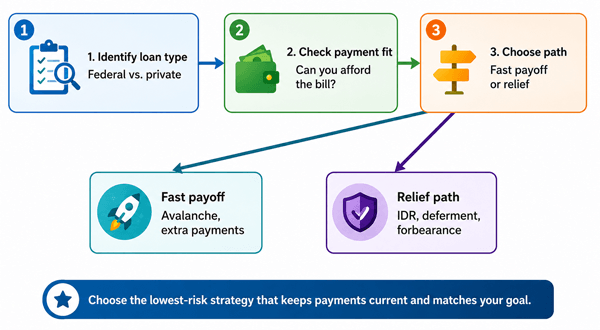
■ Diagram: A practical student loan decision flow
Use this simple flow to decide whether your next move should be faster payoff or payment relief.
■ How to manage federal student loans if you cannot afford payments
If you cannot afford your federal student loan payment, act before you miss payments. The worst strategy is silence. Federal borrowers may have options, but those options are easier to use before default.
- Log in and verify your loan status. Check your servicer, current plan, due date, balance, and whether any loans are delinquent.
- Compare repayment plans. Use the official Loan Simulator or servicer tools to estimate monthly payments, forgiveness fit, and long-term costs before choosing a lower payment.
- Apply for IDR if appropriate. IDR can lower payments based on income and family size, though it may extend repayment and increase total interest.
- Ask about deferment or forbearance only as a temporary bridge. These can pause or reduce payments, but interest may continue to accrue.
- If already in default, ask about official ways to return to good standing. Options may include rehabilitation or consolidation, depending on current rules and loan type.
■ How to manage private student loans if you cannot afford payments
Private student loans usually have fewer protections than federal loans, so early communication matters. Contact the lender before the due date and ask what hardship options exist.
- Temporary interest-only payments.
- Short-term forbearance or payment pause.
- Modified payment plan.
- Co-signer release requirements, if applicable.
- Refinancing options if your income and credit qualify.
Be careful with private loan refinancing during hardship. A new loan may lower the payment but increase total interest if the term is much longer. Compare the full repayment cost, not only the monthly bill.
■ Student loan mistakes to avoid
| Mistake | Why it hurts | Better move |
|---|---|---|
| Ignoring servicer emails or letters | You may miss due dates, plan changes, or required paperwork | Open every notice and save important records |
| Choosing the lowest payment without checking total cost | Longer repayment can mean much more interest | Compare monthly payment and lifetime cost |
| Refinancing federal loans into private loans too quickly | You may permanently lose federal protections | Refinance federal loans only after understanding the trade-offs |
| Using forbearance repeatedly without a plan | Interest may grow and balance may increase | Use as a short-term bridge while fixing cash flow |
| Missing IDR recertification or update requirements | Payment may rise or plan status may change | Set calendar reminders and update income/family size when needed |
| Paying extra on loans expected to be forgiven | You may reduce the amount forgiven without improving your situation | For PSLF, focus on qualifying payments and documentation |
| Not targeting extra payments | Extra money may not hit the highest-rate loan | Give written payment allocation instructions |
| Consolidating without checking consequences | Can extend repayment, capitalize interest, or affect forgiveness progress | Compare pros and cons before consolidating |
| Waiting until default | Default can cause credit damage and forced collection tools | Contact servicer early and ask for official options |
■ Real-world repayment scenarios
Scenario 1: New graduate with low income
A new graduate owes $32,000 in federal loans and earns $36,000 per year. The standard payment feels too high after rent and basic expenses. A practical plan is to compare federal repayment plans, consider IDR if eligible, keep payments current, and increase payments later as income rises.
Scenario 2: High earner with private loans
A borrower earns $95,000 and has $45,000 in private loans at 9.5%. They have steady income and good credit. A practical plan is to compare refinancing offers for a lower fixed rate, avoid stretching the term unnecessarily, and use the avalanche method for extra payments.
Scenario 3: Public school teacher pursuing PSLF
A teacher has eligible Direct Loans and works full-time for a public school. The best strategy may not be aggressive payoff. Instead, the teacher should confirm employer eligibility, use a qualifying repayment plan, submit PSLF forms regularly, and track payment counts.
Scenario 4: Borrower with both federal and private loans
A borrower has $20,000 in federal loans at 4.8% and $12,000 in private loans at 11%. They can afford minimums plus $250 extra. A practical strategy is to keep federal loans current, preserve federal protections, and send extra payments toward the 11% private loan first.
■ A simple monthly student loan management checklist
- Confirm all payments were received and applied correctly.
- Check whether any interest capitalized or fees appeared.
- Update your loan inventory if balances, rates, or servicers changed.
- Review whether extra payments are going to the target loan.
- Save statements, confirmations, and important servicer messages.
- If your income changed, compare repayment options before missing a payment.
- If pursuing PSLF, track employment certification and qualifying payment counts.
■ When should you pay student loans faster?
Paying faster usually makes sense when you have stable income, an emergency fund, no higher-interest debt, and you are not pursuing forgiveness. It is especially useful for private loans and high-interest loans.
However, faster payoff may not be the best move if you have credit card debt, no emergency savings, unstable income, or strong forgiveness eligibility. For example, paying extra on federal loans while carrying 24% credit card debt is usually less efficient than attacking the credit card balance first.
■ When should you lower your student loan payment?
Lowering your payment can be smart when the current payment threatens your ability to pay rent, food, utilities, insurance, or other essential bills. A lower payment can prevent delinquency and protect your credit. But it may increase total interest, so treat payment relief as part of a plan, not a permanent autopilot decision.
■ Pros and cons of student loan debt management strategies
| Strategy | Pros | Cons |
|---|---|---|
| Standard repayment | Clear payoff timeline; less interest than longer plans | Higher monthly payment |
| Income-driven repayment | Can lower payments; may support forgiveness goals | May increase total interest; paperwork and rule changes matter |
| Avalanche method | Usually saves the most interest | Requires discipline; fewer quick wins |
| Snowball method | Builds motivation | May cost more interest |
| Consolidation | Simplifies federal loans; may open access to some options | Can extend repayment or affect forgiveness progress |
| Private refinancing | May lower interest rate for qualified borrowers | Can remove federal protections if federal loans are refinanced |
■ Student loan debt management best practices
- Know your loan type before acting. Federal and private loans are managed differently.
- Compare total cost, not only monthly payment. A lower payment can cost more if it stretches repayment for many years.
- Keep federal protections unless you are sure you do not need them. Refinancing federal loans into private loans is often irreversible.
- Use written records. Save payment instructions, hardship approvals, PSLF forms, and servicer messages.
- Review your plan once or twice a year. Income, family size, interest rates, and rules can change.
- Ask for help early. Nonprofit credit counselors, financial aid offices, servicers, official government resources, and qualified financial or legal professionals can help you understand options.
■ Frequently asked questions
1. What is the best way to pay off student loans?
The best method depends on your goal. If you want to save the most interest and can afford payments, use the debt avalanche method. If you need motivation, use the snowball method. If you cannot afford payments, compare federal IDR or hardship options before missing payments.
2. Should I pay off student loans early?
Early payoff can save interest, especially on high-rate private loans. But it may not be best if you have credit card debt, no emergency fund, unstable income, or strong forgiveness eligibility.
3. Is income-driven repayment a good idea?
IDR can be helpful if your federal student loan payment is unaffordable or you are working toward forgiveness. The trade-off is that lower payments may extend repayment and increase total interest.
4. Can student loans be forgiven?
Some federal student loans may qualify for forgiveness programs such as PSLF or IDR forgiveness if all requirements are met. Private student loans generally do not have the same federal forgiveness options.
5. Should I consolidate my federal student loans?
Consolidation can simplify payments and may provide access to certain repayment options, but it can also extend repayment, add unpaid interest to principal, and affect forgiveness progress. Review the impact before consolidating.
6. Should I refinance my student loans?
Refinancing can help with private loans if you qualify for a lower rate. Be cautious about refinancing federal loans into private loans because you may lose federal repayment and forgiveness protections.
7. What happens if I miss student loan payments?
A missed payment can lead to delinquency, credit damage, late fees, and eventually default. Federal student loan default can trigger serious collection actions. Contact your servicer before missing payments.
8. Can I negotiate student loan debt?
Federal student loan settlement options are limited and usually apply only in default. Private lenders may negotiate in some hardship or default situations, but terms vary. Get any agreement in writing.
9. How often should I review my repayment plan?
Review your plan at least once a year and whenever your income, family size, job, loan servicer, or financial goals change.
10. What is the biggest student loan mistake?
The biggest mistake is ignoring the loans until they become delinquent or defaulted. Early action gives you more choices and usually costs less.
■ Final takeaway
Student loan debt management is not about panic or perfection. It is about knowing your loans, staying current, choosing the right repayment path, and avoiding decisions that remove useful protections or increase costs unnecessarily. Start with a loan inventory, decide whether your priority is affordability, faster payoff, or forgiveness, and review your plan regularly. Small, consistent decisions can make student debt much easier to manage over time. For the safest decision, match your strategy to your loan type, income stability, interest rate, and eligibility for official repayment or forgiveness programs.
Sources consulted
- Federal Student Aid, “Income-Driven Repayment (IDR) Plans,” including income and family-size based payments and current plan information.
- Federal Student Aid, “IDR Plan Court Actions: Impact on Borrowers,” including updates affecting SAVE and other IDR plan availability.
- Federal Student Aid, “Federal Student Loan Repayment Plans,” including standard, graduated, extended, and income-driven repayment options.
- Federal Student Aid, “Public Service Loan Forgiveness,” including Direct Loan, qualifying employer, and 120 qualifying monthly payment requirements.
- Federal Student Aid, “5 Things to Know Before Consolidating Federal Student Loans,” including consolidation pros, cons, and forgiveness/payment-count considerations.
- Consumer Financial Protection Bureau, student loan default resources, including credit impact and forced collection consequences.
Reader Advice: This article is for educational and informational purposes only and should not be taken as legal, tax, financial, or personalized repayment advice. Please check the latest details from official sources because rules, information, and policies can change over time.
This article focuses mainly on U.S. federal and private student loans. Always verify your options with StudentAid.gov, your loan servicer, or a qualified advisor before making major repayment decision