Debt Snowball vs Debt Avalanche: Which Debt Payoff Method Is Better?
Paying off debt is easier when you use a clear system. Two of the most popular debt payoff strategies are the debt snowball and the debt avalanche. Both methods can work. The difference is the order in which you attack your debts.
The debt snowball method focuses on quick wins by paying off the smallest balances first. The debt avalanche method focuses on saving the most money by paying off the highest-interest debts first. The better method depends on your numbers, your motivation, and how likely you are to stay consistent.
This guide explains how each method works, shows a real-world example, compares the pros and cons, and helps you choose the best debt repayment plan for your situation.
Best Answer: The debt avalanche is usually better mathematically because it pays off high-interest debt first and can reduce total interest. The debt snowball is often better behaviorally because small early wins can help you stay motivated. The best method is the one you can follow until every debt is paid off.
1. What Are the Debt Snowball and Debt Avalanche Methods?
Debt snowball and debt avalanche are structured repayment strategies for people who owe money on multiple debts, such as credit cards, personal loans, medical bills, auto loans, or student loans. With both methods, you make at least the minimum payment on every debt so you avoid late fees, penalties, and damage from missed payments. Then you put any extra money toward one target debt at a time.
The key difference is priority:
- Debt snowball: Pay extra toward the smallest balance first, regardless of interest rate.
- Debt avalanche: Pay extra toward the highest interest rate first, regardless of balance size.
Quick decision rule: choose avalanche when interest savings matter most; choose snowball when momentum and consistency matter most.
2. Debt Snowball Method Explained
The debt snowball method is a debt repayment strategy where you pay off debts from smallest balance to largest balance. The goal is to build momentum. Each paid-off balance gives you a visible win, and the payment you used on that debt is rolled into the next debt.
How the Debt Snowball Works
- List all debts from smallest balance to largest balance.
- Keep making the minimum payment on every debt.
- Put all extra payoff money toward the smallest balance.
- When the smallest debt is paid off, move that payment to the next smallest debt.
- Repeat until all debts are gone.
Debt Snowball Example
| Debt | Balance | Interest Rate | Minimum Payment | Snowball Priority |
|---|---|---|---|---|
| Store card | $500 | 28% | $25 | 1 |
| Medical bill | $900 | 0% | $50 | 2 |
| Personal loan | $2,500 | 11% | $100 | 3 |
| Credit card | $6,000 | 22% | $180 | 4 |
In this example, the store card is paid first because it has the smallest balance, even though the $6,000 credit card has a high interest rate. Once the store card is gone, the freed-up payment is added to the medical bill payment, then the personal loan, then the larger credit card.
Pros of the Debt Snowball Method
- It creates quick wins, which can make debt payoff feel less overwhelming.
- It is simple to understand and easy to start.
- It can help people who have tried and failed to stick with debt payoff before.
- It reduces the number of open accounts faster in many situations, which can make your finances feel more manageable.
Cons of the Debt Snowball Method
- It may cost more interest than the avalanche method.
- High-interest debt can keep growing while you focus on smaller balances.
- It may not be ideal if your largest debts have very high APRs.
- It can encourage emotional decision-making if you ignore expensive debt for too long.
3. Debt Avalanche Method Explained
The debt avalanche method is a debt repayment strategy where you pay off debts from highest interest rate to lowest interest rate. The goal is to reduce interest costs as much as possible. This method is usually the most efficient option if you can stay motivated without quick small-balance wins.
How the Debt Avalanche Works
- List all debts from highest APR to lowest APR.
- Make the minimum payment on every debt.
- Put all extra payoff money toward the debt with the highest APR.
- After that debt is paid off, move the freed-up payment to the next-highest APR debt.
- Repeat until every balance is paid off.
Debt Avalanche Example
| Debt | Balance | Interest Rate | Minimum Payment | Avalanche Priority |
|---|---|---|---|---|
| Store card | $500 | 28% | $25 | 1 |
| Credit card | $6,000 | 22% | $180 | 2 |
| Personal loan | $2,500 | 11% | $100 | 3 |
| Medical bill | $900 | 0% | $50 | 4 |
In this example, the avalanche method attacks the store card first because it has the highest APR. After that, it moves to the credit card because 22% interest is more expensive than the 11% personal loan and the 0% medical bill.
Pros of the Debt Avalanche Method
- It usually saves the most money on interest.
- It is the most mathematically efficient payoff strategy.
- It is especially useful for credit card debt and other high-interest balances.
- It can shorten payoff time when high interest is causing balances to grow quickly.
Cons of the Debt Avalanche Method
- It can feel slow if your highest-interest debt has a large balance.
- You may not see a debt disappear for a while, which can hurt motivation.
- It requires discipline and patience.
- It may be harder for beginners who need emotional momentum.
4. Debt Snowball vs Debt Avalanche: Quick Comparison
| Feature | Debt Snowball | Debt Avalanche |
|---|---|---|
| Main focus | Smallest balance first | Highest interest rate first |
| Best for | Motivation and quick wins | Saving money on interest |
| Emotional benefit | High, because debts disappear sooner | Lower at first, especially with large balances |
| Mathematical benefit | Not always the cheapest | Usually the cheapest |
| Complexity | Very simple | Simple, but requires APR awareness |
| Risk | May pay more interest | May lose motivation before seeing progress |
| Better choice when | You need momentum to stay consistent | You are disciplined and have high-interest debt |
5. Practical Example: Which Method Saves More?
Here is a simplified example using four debts and a fixed monthly payoff budget of $800. The numbers are estimates for education only; real results depend on minimum payments, APR changes, fees, grace periods, due dates, and how interest is calculated.
| Debt | Balance | APR | Minimum Payment |
|---|---|---|---|
| Store card | $900 | 24.99% | $30 |
| Medical bill | $1,200 | 0% | $50 |
| Personal loan | $3,500 | 12% | $110 |
| Credit card | $5,000 | 19.99% | $150 |
| Total | $10,600 | Mixed | $340 minimums |
| Method | Payoff Order | Estimated Months | Estimated Interest Paid | Main Lesson |
|---|---|---|---|---|
| Debt snowball | Store card -> Medical bill -> Personal loan -> Credit card | 15 months | $1,217 | Fast early wins, but more interest |
| Debt avalanche | Store card -> Credit card -> Personal loan -> Medical bill | 15 months | $948 | Same payoff time here, but about $269 less interest |
In this example, the avalanche method saves about $269 because it attacks the expensive 19.99% credit card before the 0% medical bill. However, the snowball method pays off the medical bill much earlier, which may feel more encouraging for someone who needs quick progress.
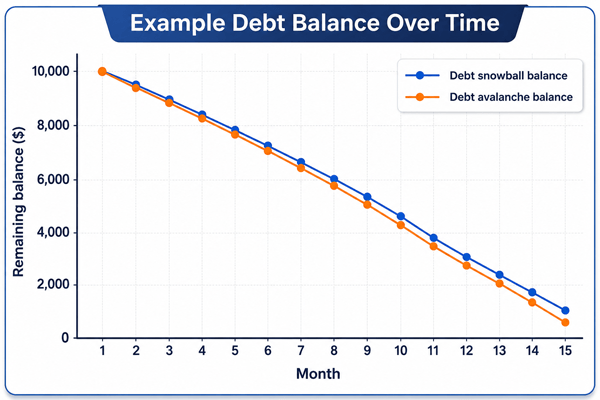
Chart: Example remaining debt balance over time under the snowball and avalanche methods. The avalanche line may reduce interest faster when high-APR balances are targeted earlier.
6. Simple Diagram: How Both Methods Work
| Step | Debt Snowball | Debt Avalanche |
|---|---|---|
| 1 | List debts by balance | List debts by interest rate |
| 2 | Pay minimums on all debts | Pay minimums on all debts |
| 3 | Send extra money to smallest balance | Send extra money to highest APR |
| 4 | Roll old payment into next smallest debt | Roll old payment into next highest APR debt |
| 5 | Repeat until debt-free | Repeat until debt-free |
7. Which Debt Payoff Method Is Better?
The debt avalanche is better if your main goal is to pay the least interest and you can stay consistent. The debt snowball is better if your main goal is to build confidence, reduce the number of debts quickly, and stay motivated. From a purely financial standpoint, avalanche usually wins. From a behavioral standpoint, snowball can be more realistic for many people.
Choose Debt Snowball If...
- You feel overwhelmed by too many small debts.
- You have struggled to stay motivated in the past.
- Your debts have similar interest rates.
- You want to reduce the number of monthly bills quickly.
- A quick win would help you build confidence.
Choose Debt Avalanche If...
- You have credit cards or loans with very high APRs.
- You are comfortable waiting longer for the first payoff win.
- You want to minimize total interest.
- You like making decisions based on numbers.
- Your highest-interest debt is growing quickly.
Use a Hybrid Method If...
A hybrid debt payoff method combines motivation and math. For example, you might pay off one or two very small balances first to create momentum, then switch to avalanche and attack the highest-interest debts. This can be a good compromise for beginners who need encouragement but still want to control interest costs.
Step-by-Step Debt Payoff Plan for Beginners
- Write down every debt. Include the lender, balance, APR, minimum payment, due date, and whether the rate is fixed or variable.
- Get current before accelerating payoff. If any account is past due, focus first on avoiding late fees, collections, or default.
- Build a small emergency cushion. Even $500 to $1,000 can help prevent new debt when an unexpected bill appears.
- Choose your method. Pick snowball, avalanche, or a hybrid approach based on your motivation and interest costs.
- Set a fixed monthly payoff amount. Treat it like a bill. If your minimums are $340 and your budget allows $800, keep paying $800 even as individual debts disappear.
- Automate minimum payments. This reduces the risk of missed due dates while you manually direct extra money to your target debt.
- Track progress monthly. Update balances, interest paid, and payoff dates so you can see the plan working.
- Avoid adding new debt. A payoff strategy only works if balances are going down, not being replaced by new purchases.
8. Best Practices That Make Either Method Work Better
- Pay more than the minimum whenever possible. Minimum payments are designed to keep accounts current, not to eliminate debt quickly.
- Use windfalls wisely. Tax refunds, bonuses, cash gifts, and side income can speed up payoff if applied immediately.
- Ask for a lower interest rate. A lower APR can make both snowball and avalanche more effective.
- Consider balance transfer or debt consolidation carefully. These tools can help only if fees are reasonable, the new rate is lower, and you do not create new debt.
- Keep minimum payments on autopay. Missing a payment can trigger late fees, penalty APRs, or credit damage.
- Review your budget before choosing a payoff amount. A plan that is too aggressive can fail if it leaves no room for real life.
9. Common Mistakes to Avoid
| Mistake | Why It Hurts | Better Approach |
|---|---|---|
| Ignoring minimum payments | Can lead to late fees and credit damage | Always pay minimums first |
| Choosing a method you hate | You are less likely to finish | Pick the plan you can repeat monthly |
| Not knowing your APRs | You may underestimate expensive debt | Check statements or online accounts |
| Using extra money inconsistently | Debt payoff slows down | Set a monthly payoff target |
| Closing every account immediately | May affect credit utilization and credit history | Consider credit score effects before closing accounts |
| No emergency fund | Unexpected bills may create new debt | Build a small cushion while paying debt |
| Falling for debt relief promises | Some programs have high fees or serious credit consequences | Verify nonprofit counseling and read terms carefully |
10. Important Limitations and Risks
Debt snowball and debt avalanche are payoff methods, not magic fixes. They work best when your income can cover minimum payments plus some extra amount. If you cannot afford minimum payments, or if you are facing collections, lawsuits, repossession, foreclosure, or utility shutoff, you may need professional help from a reputable nonprofit credit counseling agency, legal aid office, or qualified financial professional.
Also, be careful with debt settlement companies that promise fast results or tell you to stop paying creditors. Debt settlement can involve fees, tax consequences, collection activity, lawsuits, and credit score damage. A debt management plan through a reputable credit counseling agency may be an option for some unsecured debts, but it is not right for everyone and should be reviewed carefully before enrolling.
For housing, student loans, taxes, lawsuits, secured loans, or collection notices, review the official program rules and speak with a qualified adviser before changing payments.
11. Debt Snowball vs Debt Avalanche for Different Types of Debt
| Debt Type | Useful Method | Notes |
|---|---|---|
| Credit card debt | Usually avalanche | High APRs make interest savings important. Snowball can help if there are several small cards. |
| Medical debt | Often snowball or negotiated plan | Many medical bills have low or no interest; ask about payment plans or financial assistance. |
| Personal loans | Depends on APR | Use avalanche if rate is high; use snowball if balance is small and payoff will motivate you. |
| Student loans | Depends on loan type and benefits | Check federal loan protections, forgiveness options, and repayment plans before accelerating payoff. |
| Auto loans | Usually avalanche if high rate | Do not ignore risk of repossession; stay current. |
| Mortgage | Usually separate from consumer debt payoff | High-priority debt, but often lower rate and tied to housing stability. |
Frequently Asked Questions
1. Is the debt avalanche always better?
No. The avalanche method is usually better mathematically because it targets the highest interest first. But it is not always better in real life if the slow early progress causes you to quit. The better method is the one you can finish.
2. Is the debt snowball bad because it can cost more interest?
No. The snowball method is not bad. It may cost more interest than avalanche, but it can be very effective for people who need motivation and quick wins. Paying off debt consistently is more important than choosing the perfect method and then abandoning it.
3. Should I pay off the smallest debt or highest interest debt first?
Pay the smallest debt first if motivation is your biggest challenge. Pay the highest-interest debt first if saving money is your top priority and you can stay disciplined.
4. Do I still make minimum payments on all debts?
Yes. With both methods, make at least the minimum payment on every debt. The extra payoff money goes to one target debt at a time.
5. Can I switch from snowball to avalanche?
Yes. Many people start with snowball to remove a few small debts, then switch to avalanche to reduce interest costs. Switching is fine as long as you keep paying consistently.
6. Which method improves credit score faster?
There is no guaranteed answer. Credit scores depend on payment history, credit utilization, account age, credit mix, and other factors. Paying on time and reducing credit card balances can help, but results vary.
7. Should I save money or pay off debt first?
Start with a small emergency cushion so one surprise expense does not push you back into debt. After that, high-interest debt payoff often becomes a priority. The right balance depends on job stability, interest rates, and risk.
8. What if I cannot afford the minimum payments?
Do not rely only on snowball or avalanche if minimum payments are unaffordable. Contact creditors early, review your budget, and consider a reputable nonprofit credit counselor or qualified adviser.
9. Can these methods work with debt consolidation?
Yes, but consolidation changes the numbers. If you combine debts into one lower-rate loan, you may no longer need a snowball or avalanche order. The key is to avoid running up the old accounts again.
10. How often should I update my payoff plan?
Review your plan at least once a month or whenever your income, expenses, APRs, or balances change. A payoff plan should be structured but flexible enough for real life.
Final Verdict: Which Method Should You Choose?
Choose the debt avalanche method if you want the lowest total interest cost and can stay committed without fast emotional wins. Choose the debt snowball method if you need momentum, confidence, and visible progress to keep going. Choose a hybrid method if you want quick early wins but do not want to ignore high-interest debt for too long.
The most important decision is not snowball versus avalanche. It is deciding to stop drifting, make a written plan, pay at least the minimums on time, send extra money to one debt at a time, and repeat the process until you are debt-free.
Sources Consulted
- Consumer Financial Protection Bureau: How to reduce your debt.
- Federal Trade Commission Consumer Advice: How to get out of debt and how to choose a credit counselor.
- National Foundation for Credit Counseling: Debt avalanche vs. debt snowball overview.
- Navy Federal Credit Union and Fidelity educational overviews on snowball and avalanche payoff strategies.
Reader Advice: This article is for educational and informational purposes only and should not be taken as personal financial, legal, tax, credit, or professional advice. Rules, programs, rates, and policies can change over time, so please check the latest official sources or speak with a qualified professional for guidance about your situation.