Personal Loan Debt Management Guide: How to Repay Personal Loans Faster
For most readers, the search intent is simple: understand the loan, lower interest where possible, avoid late-payment damage, and build a repayment plan that is realistic enough to follow every month.
Personal loan debt management is the process of organizing, prioritizing, and paying down a personal loan in a way that protects your budget and reduces unnecessary interest. A personal loan is usually an installment loan: you borrow a lump sum of money and repay it in fixed payments over a set period. The Consumer Financial Protection Bureau describes a personal installment loan as money borrowed and paid back in fixed amounts called installments.
Many personal loans are unsecured, meaning you do not pledge collateral such as a car or house. Some are secured, which means the lender can claim the collateral if you default. Personal loans are commonly used for debt consolidation, medical bills, home repairs, moving costs, emergency expenses, or large purchases. Because they usually have fixed monthly payments, they can be easier to plan for than revolving credit cards. However, they still require discipline: missing payments can lead to late fees, credit damage, collection activity, and extra stress.
Quick answer: The fastest safe way to repay a personal loan is to understand your loan terms, make every payment on time, pay extra toward principal when allowed, avoid new debt, and refinance only if the new loan clearly lowers your total cost. Faster repayment is useful, but it should not leave you without emergency savings or cause you to miss higher-priority bills.
1. How Personal Loan Repayment Works
A personal loan payment usually has two parts: interest and principal. Interest is the cost of borrowing. Principal is the original amount borrowed, minus what you have already repaid. At the beginning of the loan, a larger share of each payment often goes toward interest. As the balance falls, more of each payment goes toward principal.
Important note: APR is usually the better comparison number than the interest rate alone because APR can include certain lender fees. Always compare total repayment cost, not just the monthly payment.
| Term | Simple meaning | Why it matters |
|---|---|---|
| Principal | The amount you borrowed and still owe. | Extra payments should usually be applied to principal because that reduces future interest. |
| APR | Annual percentage rate, including interest and certain fees. | APR helps you compare the true cost of loans, not just the monthly payment. |
| Loan term | How long you have to repay the loan. | A longer term may lower the payment but usually increases total interest. |
| Monthly installment | The fixed payment due each month. | This must fit your budget reliably. |
| Origination fee | A fee some lenders subtract from the loan or add to cost. | It can make refinancing or new borrowing more expensive. |
| Prepayment penalty | A fee for paying off early, if your contract has one. | Check this before making large extra payments or refinancing. |
2. Why Paying Off a Personal Loan Faster Can Help
Repaying a personal loan faster can be valuable because interest is charged while the balance remains outstanding. Lowering the balance sooner can reduce total interest and free up monthly cash flow earlier. It can also improve your debt-to-income picture, which may help when applying for a mortgage, auto loan, or other credit later.
The main benefit is not simply “being debt-free faster.” It is paying less for the same borrowed money. For example, imagine you borrowed $10,000 at 15% APR for 36 months. Your scheduled payment would be about $347 per month. If you paid an extra $100 per month and your lender applied it to principal with no prepayment penalty, you could shorten the payoff period and save interest.
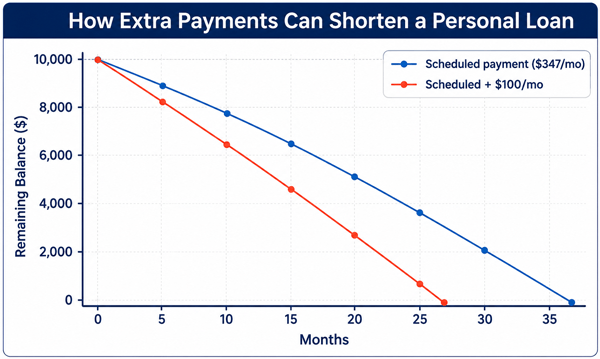
Chart example: A $10,000 loan at 15% APR over 36 months. Paying an extra $100 monthly can reduce the balance faster and lower total interest, assuming no prepayment penalty and extra payments are applied to principal.
3. Before You Try to Repay Faster: Check These Loan Details
Before sending extra money, read your loan agreement or online account details. The goal is to make extra payments safely and correctly.
- Ask whether there is a prepayment penalty or payoff fee.
- Confirm whether extra payments automatically reduce principal or are treated as early future payments.
- Find the exact payoff amount if you want to close the loan completely.
- Check whether interest accrues daily or monthly.
- Review late fees, grace periods, autopay discounts, and payment processing rules.
- Make sure your emergency fund and essential bills are protected before paying aggressively.
If your budget is unstable, choose a smaller extra payment first and increase it later. A steady plan protects your credit better than an aggressive plan that leads to missed payments.
4. Step-by-Step Personal Loan Debt Management Plan
Step 1: List the loan facts in one place
Start with a simple loan snapshot. This prevents guessing and helps you choose the right payoff strategy.
| Loan detail | Example |
|---|---|
| Current balance | $8,400 |
| APR | 16.5% fixed |
| Minimum monthly payment | $310 |
| Remaining term | 31 months |
| Due date | 15th of each month |
| Prepayment penalty | None |
| Extra payment rule | Must select “principal only” online |
| Payoff goal | 18 months |
Step 2: Build a realistic monthly budget
A faster payoff plan only works if the payment is repeatable. Review your income, essential expenses, debt payments, savings needs, and irregular costs such as car repairs or annual insurance. Do not build a plan that only works in a perfect month.
A practical budget order is: essentials first, minimum debt payments second, emergency savings third, then extra debt payments. If your loan payment is already difficult, focus first on preventing late payments. A perfect aggressive plan that fails after two months is worse than a modest plan you can keep for a year.
Step 3: Choose a payoff strategy
If you only have one personal loan, the strategy is simple: pay the required monthly amount on time and send extra principal whenever possible. If you have multiple debts, choose a method that fits your numbers and personality.
| Strategy | Best for | How it works | Watch out for |
|---|---|---|---|
| Extra principal payments | One personal loan or a clear target debt. | Pay more than required and ask the lender to apply extra money to principal. | Some systems apply extra payments to future installments unless you choose principal only. |
| Debt avalanche | People who want to save the most interest. | Pay minimums on all debts, then put extra money toward the highest APR debt first. | It may take longer to feel progress if the highest-rate balance is large. |
| Debt snowball | People who need motivation and quick wins. | Pay minimums on all debts, then attack the smallest balance first. | It may cost more interest if small balances have low rates. |
| Refinancing | Borrowers who can qualify for a lower APR or better term. | Replace the current loan with a new loan that has better total cost. | Fees or a longer term can erase savings. |
| Debt consolidation | People juggling several high-interest debts. | Use one loan to combine debts into one payment. | It helps only if you avoid running up the old balances again. |
Step 4: Automate the required payment
Late payments are expensive and can damage your credit. Set up automatic payments for at least the required amount if your income timing is stable. Keep a small buffer in the account so autopay does not cause overdrafts. If your income is irregular, set calendar reminders several days before the due date and pay manually when cash is available.
Step 5: Add one extra-payment habit
You do not need a dramatic lifestyle change to make progress. Choose one repeatable extra-payment habit, such as adding $25 every payday, rounding the payment up to the next $50, sending half of bonuses or tax refunds to the loan, or using savings from canceled subscriptions. The habit matters because small extra principal payments compound over time by reducing the balance that earns interest.
Step 6: Review progress monthly
Once a month, check your current balance, payment history, interest charged, and remaining payoff date. This helps you catch errors and stay motivated. If you receive a raise or reduce another expense, increase your extra payment. If your budget gets tight, temporarily return to the required payment rather than missing a payment.
■ Best Ways to Repay Personal Loans Faster
1. Pay more than the minimum whenever possible
The most direct way to repay a personal loan faster is to pay extra toward principal. Even a small extra amount can help. For example, if your required payment is $286, rounding it up to $325 adds $39 per month toward faster repayment. The key is to confirm how your lender applies the extra amount.
2. Make biweekly payments
Instead of making one monthly payment, you may split the payment in half and pay every two weeks. Over a full year, this can create the equivalent of one extra monthly payment because there are 26 biweekly periods. This method works best when your lender accepts partial payments without fees and applies them correctly. If your lender does not process partial payments until the full amount is received, simply save the extra and make one additional principal payment during the year.
3. Use windfalls wisely
A windfall is money outside your normal paycheck, such as a bonus, refund, gift, side-job income, commission, or cash from selling unused items. A balanced approach is to use part of the windfall for savings or necessary expenses and part for extra loan repayment. For example, you might put 50% toward the loan, 30% toward emergency savings, and 20% toward planned needs.
4. Cut one expense and redirect the savings
A useful repayment plan names the specific source of extra money. Instead of saying “spend less,” choose a category: dining out, subscriptions, unused memberships, convenience delivery, impulse shopping, or expensive phone plans. If you cut $75 per month and immediately schedule that $75 as an extra loan payment, the savings has a job.
5. Increase income temporarily
For some people, cutting expenses is not enough. Temporary income can speed up repayment without permanently reducing quality of life. Options may include overtime, freelancing, tutoring, seasonal work, renting out unused equipment, or selling items you no longer need. Use temporary income carefully; do not burn out or take on risky work just to repay debt slightly faster.
6. Refinance if the numbers clearly work
Refinancing means replacing your current personal loan with a new loan. It can help if your credit score has improved, market rates are lower, or your current loan has an unusually high APR. But refinancing is not automatically good. Compare the APR, fees, remaining term, total interest, and payoff timeline. A lower monthly payment can still cost more overall if the new term is much longer. Also check whether the application involves a hard credit inquiry and whether closing the old loan changes any autopay or payment due-date arrangements.
| Refinance question | Good sign | Warning sign |
|---|---|---|
| Is the APR lower? | New APR is meaningfully lower after fees. | APR is similar or higher. |
| Are there fees? | Fees are low and included in total-cost comparison. | Origination fees make savings disappear. |
| What happens to the term? | Same or shorter term with affordable payment. | Lower payment comes from stretching debt for years. |
| Will you borrow more? | New loan only pays off current debt. | You add cash-out borrowing and increase total debt. |
| Can you keep old accounts controlled? | You have a plan not to create new debt. | You consolidate debt but continue overspending. |
■ Personal Loan Repayment Example
Here is a simple example showing why extra principal payments matter.
| Scenario | Payment plan | Estimated result |
|---|---|---|
| Standard payoff | $10,000 loan, 15% APR, 36 months, about $347 per month. | Paid off in 36 months with about $2,480 in interest. |
| Faster payoff | Same loan, but add $100 per month toward principal. | Paid off in about 27 months with about $1,810 in interest. |
| Estimated benefit | Extra payment requires $100 more monthly cash flow. | About 9 months faster and roughly $670 less interest. |
These are estimates for education only. Your exact savings depend on your APR, balance, payment date, fees, lender rules, and how interest is calculated.
5. Should You Pay Off a Personal Loan Early?
Paying off a personal loan early can be a smart move, but it is not always the best first priority. Compare the loan against your whole financial life.
| Pay early when... | Slow down when... |
|---|---|
| The loan has a high APR and no prepayment penalty. | You have no emergency savings at all. |
| You can pay extra without missing bills. | You are behind on rent, utilities, insurance, or taxes. |
| You already contribute enough for important employer retirement matches. | The loan APR is low and you have higher-interest debt elsewhere. |
| Early payoff reduces stress and improves cash flow. | Extra payments would force you to use credit cards for basic expenses. |
| You have a stable income and a clear monthly surplus. | Your income is unstable and you need cash reserves. |
6. Common Mistakes to Avoid
- Paying extra without checking for prepayment penalties or payment-allocation rules.
- Refinancing only because the monthly payment is lower, without comparing total cost.
- Using every spare dollar for debt while keeping no emergency fund.
- Missing payments because the payoff plan is too aggressive.
- Taking a new personal loan to pay old debt without fixing the spending pattern that caused the debt.
- Ignoring small fees, returned-payment fees, or late fees.
- Assuming debt consolidation solves debt by itself. It only changes the structure of repayment.
- Not asking for help early when payments become unaffordable.
7. What If You Cannot Afford Your Personal Loan Payment?
If you are struggling, act early. Lenders often have more options before an account is seriously past due. Call the lender, explain your situation clearly, and ask what hardship options are available. Possible options may include a temporary payment reduction, due-date change, short deferment, modified repayment plan, or fee waiver. Get any agreement in writing before relying on it.
You may also consider speaking with a reputable nonprofit credit counselor or a qualified financial professional. Avoid companies that promise instant debt forgiveness, demand large upfront fees, or pressure you to stop paying without explaining the risks.
If a loan is already in collections, you still have rights. The Consumer Financial Protection Bureau provides resources explaining debt collection, and the Federal Trade Commission explains that debt collectors may not use abusive, unfair, or deceptive practices when collecting debts. Keep records of calls, letters, payment agreements, and receipts. Do not ignore legal notices.
■ Practical 30-Day Action Plan
- Day 1: Log in to your loan account and write down balance, APR, payment, due date, term, fees, and payoff amount.
- Day 2: Read the prepayment rules and confirm how to make principal-only payments.
- Days 3-5: Review your budget and find one realistic extra-payment amount.
- Day 6: Set autopay or calendar reminders for the required payment.
- Day 7: Make a small principal-only test payment if your lender allows it, then verify it was applied correctly.
- Week 2: Choose your payoff method: extra principal, avalanche, snowball, or refinancing review.
- Week 3: Cut or reduce one expense and redirect the savings to the loan.
- Week 4: Update your payoff tracker and decide whether to increase, maintain, or pause extra payments next month.
■ Simple Personal Loan Payoff Tracker
| Month | Starting balance | Required payment | Extra principal | Interest charged | Ending balance | Notes |
|---|---|---|---|---|---|---|
| 1 | ||||||
| 2 | ||||||
| 3 | ||||||
| 4 | ||||||
| 5 | ||||||
| 6 |
■ Personal Loan Debt Management Checklist
- I know my exact balance, APR, payment, term, and due date.
- I have checked whether my loan has a prepayment penalty.
- I know how to make extra payments toward principal.
- My required payment is automated or protected by reminders.
- My extra-payment plan does not put essential bills at risk.
- I have at least a small emergency buffer.
- I compare refinancing based on total cost, not just monthly payment.
- I review progress once a month.
■ FAQs About Personal Loan Debt Management
1. What is the best way to pay off a personal loan faster?
The best way is to make every required payment on time and add extra principal payments when your lender allows it without penalty. A realistic budget, autopay, and monthly progress checks make the plan easier to maintain.
2. Do extra payments always reduce interest?
Extra payments usually reduce interest if they are applied to principal. If the lender applies extra money to future payments instead, the interest savings may be smaller. Always confirm the payment-allocation rule.
3. Is it better to pay off a personal loan or credit card debt first?
Usually, you should prioritize the debt with the highest APR if your goal is to save the most interest. Many credit cards have higher APRs than personal loans, but compare your actual rates before deciding.
4. Will paying off a personal loan early hurt my credit score?
It can affect your credit mix or account history, so a small temporary score change is possible. However, being debt-free and avoiding interest can be more important than trying to manage a few credit-score points. The impact depends on your full credit profile.
5. Should I refinance my personal loan?
Consider refinancing if you can get a lower APR, lower total cost, or better terms after fees. Do not refinance only for a lower monthly payment if it stretches the debt much longer and increases total interest.
6. What should I do if I miss a personal loan payment?
Contact the lender as soon as possible, pay what you can, ask about hardship options, and get any agreement in writing. Avoid ignoring the problem because late fees, credit reporting, and collection activity can make it worse.
7. Can I negotiate a personal loan payoff?
If the loan is current, lenders may be less likely to settle for less than the balance. If it is seriously delinquent or in collections, settlement may be possible, but it can affect credit and may have tax consequences. Get written terms before paying.
8. Is debt consolidation a good idea for personal loans?
It can be useful if it lowers your APR, simplifies payments, and helps you avoid new debt. It is risky if you use consolidation to create room for more borrowing without changing the underlying habits.
9. How much emergency savings should I keep while paying debt?
A beginner goal is at least a small starter emergency fund, such as one month of essential expenses or a manageable cash buffer. The right amount depends on income stability, family needs, and risk level.
10. What is the difference between loan balance and payoff amount?
The balance is what you owe at a point in time. The payoff amount may include interest accrued through a specific payoff date and any applicable fees, so it can be slightly different.
11. Can paying extra on a personal loan save money?
Yes, it can save money when the extra amount is applied to principal and there is no prepayment penalty. The savings depend on your APR, balance, payment timing, and lender rules.
■ Final Thoughts
Personal loan debt management is not about extreme sacrifice. It is about knowing your numbers, making payments on time, reducing principal faster when possible, and avoiding decisions that make the debt more expensive. A good plan protects your essentials, keeps some emergency cash available, and uses extra money intentionally. Start with one clear action today: check your loan terms and confirm how to make principal-only extra payments. That single step can turn a vague debt goal into a practical payoff plan.
Sources and Notes
This article is educational and does not replace advice from a qualified financial professional who understands your full situation. Loan rules, rates, and hardship options vary by lender, country, and borrower profile.
- Consumer Financial Protection Bureau, “What is a personal installment loan?” updated January 29, 2025.
- Consumer Financial Protection Bureau, Debt Collection consumer resources, updated October 30, 2025.
- Federal Reserve Board, Consumer Credit - G.19, current release, June 5, 2026, reporting April 2026 consumer credit trends.
- Federal Trade Commission, Debt Collection FAQs, explaining consumer rights under the Fair Debt Collection Practices Act.
Reader Advice: This article is for educational and informational purposes only and should not be taken as personal financial, legal, or tax advice. Please review your loan agreement and check the latest information from official sources, because rules, policies, rates, and lender options can change over time.