Debt Consolidation Explained: Meaning, Benefits, Risks and Examples
Quick answer: Debt consolidation combines multiple debts into one new payment. It can be helpful when it lowers your APR, reduces confusion, and creates a realistic payoff plan. It can be risky when it increases total cost, uses your home as collateral, or leaves spending habits unchanged.
1. What Is Debt Consolidation?
Debt consolidation means combining several debts into one new payment. Instead of paying multiple credit cards, personal loans, medical bills, or other unsecured debts separately, you use a new product or repayment plan to simplify the debt into one main monthly payment.
The goal is usually to make debt easier to manage, reduce the interest rate, lower the monthly payment, or create a clear payoff date. However, debt consolidation does not erase debt. It changes how the debt is organized and repaid.
| In simple terms | What it means |
|---|---|
| Before consolidation | You may have several debts with different due dates, rates, minimum payments, and lenders. |
| After consolidation | You make one main payment under a new loan, transfer offer, home-equity product, or debt management plan. |
| Main purpose | Simplify repayment and, when possible, reduce total interest or speed up payoff. |
| Big caution | It only works if the new terms are truly better and you avoid building new debt. |
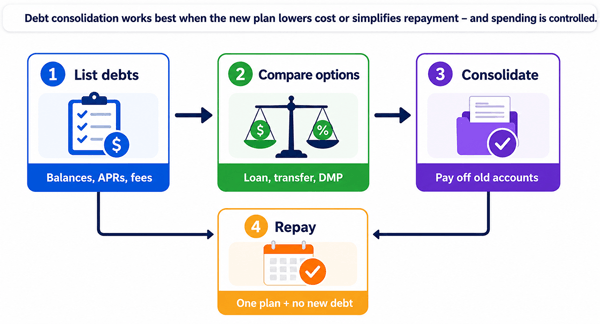
Simple Debt Consolidation Flow
2. How Debt Consolidation Works
Debt consolidation usually follows a clear process. First, you list your debts, balances, interest rates, fees, minimum payments, and payoff terms. Then you compare consolidation options. If you qualify for a better option, you use it to pay off the old debts or roll the balances into a managed repayment plan. After that, you repay the new consolidated balance according to the new schedule.
- List every debt you want to consolidate, including balance, APR, monthly payment, fees, and due date.
- Check your credit score, income, budget, and how much monthly payment you can afford.
- Compare realistic options such as a personal loan, balance transfer card, home equity loan, HELOC, or nonprofit debt management plan.
- Calculate the total cost, not just the monthly payment. Include origination fees, balance transfer fees, closing costs, annual fees, and the repayment term.
- Use the new loan or program to pay off the old debts.
- Stick to the repayment plan and avoid charging new balances on the accounts you just paid off.
3. Common Types of Debt Consolidation
| Option | Best for | Main benefit | Key risk |
|---|---|---|---|
| Personal debt consolidation loan | Borrowers with steady income and decent credit who want fixed payments. | Fixed rate, fixed payoff date, one monthly payment. | May include origination fees; poor credit can mean a high APR. |
| Balance transfer credit card | Credit card debt that can be paid off during a promotional 0% APR period. | Can save interest during the promo window. | Transfer fees apply; rate can jump after promo period; missed payments may end promo terms. |
| Home equity loan | Homeowners with equity who need a larger fixed loan. | Often lower rates than unsecured debt; predictable payments. | Your home is collateral; missed payments can put the home at risk. |
| HELOC | Homeowners who need flexible borrowing and can handle variable rates. | Draw what you need, often interest-only during draw period. | Variable rates and home collateral risk; payments may rise. |
| Cash-out refinance | Homeowners replacing a mortgage and taking cash to pay debts. | May offer a lower rate than credit cards if mortgage terms make sense. | Resets or changes mortgage; closing costs; home is at risk. |
| Debt management plan (DMP) | People struggling with unsecured debt who need help from a nonprofit credit counseling agency. | One monthly payment to the agency; possible creditor concessions. | Usually requires closing or restricting credit cards; not the same as debt settlement. |
| 401(k) loan or retirement account loan | Rare cases where the borrower understands retirement and job-loss risks. | No credit check and interest is paid back to your account. | Can hurt retirement savings; job loss may trigger quick repayment or tax consequences. |
4. Debt Consolidation Example: Before and After
The easiest way to understand debt consolidation is to compare the old debts with a possible new loan. The numbers below are illustrative, not a quote or guarantee.
| Debt | Balance | APR | Monthly payment |
|---|---|---|---|
| Credit card A | $4,000 | 24% | $160 |
| Credit card B | $3,000 | 22% | $120 |
| Store card | $2,000 | 29% | $90 |
| Medical bill payment plan | $1,000 | 0% | $80 |
| Total before consolidation | $10,000 | Mixed rates | $450 |
Suppose the borrower qualifies for a $10,000 personal loan at 12% APR with a 36-month term and no origination fee. The monthly payment would be about $332. The borrower may reduce monthly payment pressure and create a clear three-year payoff plan. But if the same borrower stretches repayment to 60 months, the payment may be lower, yet the total interest could be higher. This is why the repayment term matters.
| Scenario | Approx. monthly payment | Approx. total repayment | Main lesson |
|---|---|---|---|
| No consolidation; pays $450/month toward mixed debts | $450 | Depends on rates and payoff method | Fast payoff is possible if extra payments are consistent. |
| Consolidation loan: $10,000 at 12% for 36 months | $332 | $11,957 | Lower payment and fixed payoff date may help. |
| Consolidation loan: $10,000 at 12% for 60 months | $222 | $13,347 | Lower payment can cost more because the debt lasts longer. |
■ Main Benefits of Debt Consolidation
1. One Monthly Payment Is Easier to Manage
Many people fall behind not because they refuse to pay, but because they are juggling too many due dates, minimum payments, and interest rates. Consolidation can simplify repayment by turning several bills into one scheduled payment.
2. You May Get a Lower Interest Rate
If your current debts are high-interest credit cards and you qualify for a lower-rate loan or promotional balance transfer, consolidation may reduce the amount of interest you pay. This is usually the strongest financial reason to consolidate.
3. You Can Create a Clear Payoff Date
Credit card minimum payments can keep borrowers in debt for a long time. A fixed-rate installment loan can give you a specific end date, such as 24, 36, 48, or 60 months. This can make progress easier to see and plan around.
4. It May Reduce Monthly Stress
A lower or more predictable payment can help protect your budget from missed payments. This matters because missed payments can lead to fees, penalty APRs, collection activity, and credit score damage.
5. It Can Support a Bigger Debt Payoff Plan
Debt consolidation works best when it is part of a broader plan: a budget, emergency fund, spending controls, and a payoff strategy. It is not a magic fix, but it can be a useful tool.
■ Risks and Downsides of Debt Consolidation
| Risk | Why it matters | How to reduce the risk |
|---|---|---|
| You may pay more over time | A longer term can lower the monthly payment but increase total interest. | Compare total repayment cost, not only the monthly payment. |
| Fees can erase the savings | Origination fees, balance transfer fees, closing costs, and annual fees can make the deal less attractive. | Add all fees before deciding. |
| You might not qualify for a low rate | A damaged credit score or high debt-to-income ratio can lead to expensive offers. | Check prequalification options and compare multiple lenders. |
| You could run up new debt | If old credit cards stay open and spending habits do not change, debt can double. | Stop using paid-off cards or set strict rules before consolidating. |
| Secured options can put assets at risk | Home equity loans, HELOCs, and cash-out refinancing use your home as collateral. | Avoid risking your home for unsecured debt unless the math and budget are very strong. |
| Scams and misleading promises exist | Some debt relief companies charge upfront fees or promise results they cannot guarantee. | Use reputable lenders or nonprofit credit counselors; avoid upfront-fee debt relief promises. |
5. Debt Consolidation vs Debt Settlement vs Debt Management
These terms are often confused, but they are not the same.
| Term | What it means | Credit impact | Best use case |
|---|---|---|---|
| Debt consolidation | Combining multiple debts into one new loan, transfer, or repayment structure. | May cause a hard inquiry; can help over time if payments are on time. | You can repay the full debt but want simpler or cheaper repayment. |
| Debt management plan | A nonprofit credit counseling agency helps arrange one payment plan for unsecured debts. | Accounts may be closed or noted; on-time payments can still help stabilize finances. | You need structured help but want to repay debts without settlement. |
| Debt settlement | A company or borrower tries to negotiate paying less than the full balance. | Often harmful if you stop paying; forgiven debt may have tax consequences. | Usually a last-resort option for serious hardship, not a simple consolidation method. |
6. When Debt Consolidation Is a Good Idea
Debt consolidation may make sense when most of the following are true:
- You can qualify for a lower interest rate than your current debts.
- The new payment fits comfortably in your monthly budget.
- The total cost, including fees, is lower or worth the simplification.
- You have stable income and can make every payment on time.
- You are not planning to use the newly paid-off credit cards for more spending.
- You understand whether the new debt is unsecured or secured by an asset such as your home.
7. When Debt Consolidation May Be a Bad Idea
- The new loan has a higher APR than your current debts.
- The payment is lower only because the term is much longer.
- Fees are high enough to cancel out the savings.
- You are using home equity to pay unsecured debt without a strong repayment plan.
- Your income is unstable and you may miss payments.
- You have not addressed the spending pattern that created the debt.
- A company promises to “erase” debt, asks for upfront fees, or pressures you to act immediately.
■ How to Decide If Debt Consolidation Is Right for You
- Write down all balances, APRs, minimum payments, and fees.
- Calculate your current total monthly payment and estimated payoff timeline.
- Check your credit and compare prequalified offers when available.
- Compare APR, loan term, monthly payment, fees, total repayment, and whether collateral is required.
- Ask whether the new plan solves a cost problem, a cash-flow problem, or an organization problem.
- Create a rule for old credit cards before consolidation, such as freezing them, removing them from shopping apps, or closing some accounts after considering credit score effects.
- Choose the option that improves your finances without adding unnecessary risk.
■ Debt Consolidation Calculator: What to Compare
Before accepting a consolidation offer, compare these numbers side by side:
| Number to compare | Why it matters |
|---|---|
| Current total balance | Shows how much debt you are actually refinancing or restructuring. |
| Current weighted average APR | Helps you judge whether the new APR is meaningfully lower. |
| New APR | The advertised rate is not enough; look at the actual APR you qualify for. |
| Fees | Include origination fees, transfer fees, closing costs, and annual fees. |
| Loan term | Longer terms can reduce payments but increase total interest. |
| Monthly payment | Must fit your budget without relying on new borrowing. |
| Total repayment cost | The best comparison is often total dollars paid over the full term. |
| Collateral | Know whether your home, car, or retirement savings is at risk. |
8. Practical Examples
Example 1: Good Use of Debt Consolidation
A borrower has $12,000 in credit card debt at an average APR of 23%. They qualify for a 36-month personal loan at 11% APR with a manageable payment and no major fees. They stop using the credit cards, build a small emergency fund, and automate the loan payment. This can be a strong use of consolidation because the rate is lower, the payoff date is clear, and the behavior problem is addressed.
Example 2: Risky Use of Debt Consolidation
A borrower transfers $8,000 to a 0% balance transfer card but has no plan to pay it off before the promotional period ends. They keep using the old card and add another $3,000 in new purchases. This can make the situation worse because consolidation created temporary breathing room without changing the spending pattern.
Example 3: Dangerous Use of Home Equity
A homeowner uses a home equity loan to pay off credit cards but continues using the cards. Now the borrower has new card balances and a loan secured by the home. This is dangerous because unsecured consumer debt has effectively been converted into debt that can threaten the house if payments are missed.
9. Common Mistakes to Avoid
- Choosing the lowest monthly payment without checking the total cost.
- Ignoring origination fees, transfer fees, closing costs, or annual fees.
- Using home equity for credit card debt without a strong budget and emergency fund.
- Assuming consolidation fixes overspending by itself.
- Missing a payment during the transfer or payoff process.
- Closing all old credit cards immediately without understanding possible credit score effects.
- Trusting companies that guarantee debt elimination or demand upfront fees for debt relief.
10. Best Practices for Successful Debt Consolidation
- Automate the new payment so you do not miss due dates.
- Keep a small emergency fund to avoid new credit card debt.
- Use a written budget that includes debt payment, essentials, savings, and occasional irregular expenses.
- Pay more than the required payment when possible, especially if there is no prepayment penalty.
- Remove paid-off cards from online stores and digital wallets.
- Track your balance monthly so you can see progress.
- Compare at least three offers before choosing a loan or transfer product.
- Use nonprofit credit counseling if you are overwhelmed or already missing payments.
Featured Snippet: Is Debt Consolidation Worth It?
Debt consolidation is worth it when it lowers your interest cost, simplifies repayment, gives you an affordable payment, and helps you become debt-free without creating new debt. It is not worth it if the new loan is expensive, the term is too long, fees are high, or you continue using credit cards after consolidating.
■ Frequently Asked Questions
1. Does debt consolidation hurt your credit score?
It can cause a temporary dip because applying for credit may create a hard inquiry and opening a new account can affect account age. Over time, it may help if you make payments on time and reduce credit card balances.
2. Can I consolidate debt with bad credit?
Yes, but your options may be more limited and expensive. Some borrowers with bad credit receive high-rate offers that do not save money. A nonprofit credit counseling agency may be a better first step if loan offers are too costly.
3. Is debt consolidation the same as a debt consolidation loan?
Not exactly. A debt consolidation loan is one method. Other methods include balance transfers, home equity products, cash-out refinancing, and debt management plans.
4. What debts can be consolidated?
Common debts include credit cards, personal loans, medical bills, payday loans, and some private student loans. Federal student loans have their own consolidation rules and should be evaluated separately before refinancing or combining them with private debt.
5. Should I close my credit cards after consolidating?
Not always. Closing cards may reduce available credit and affect credit history. However, if open cards tempt you to spend, closing or freezing access may be worth considering. The right choice depends on behavior, fees, and credit goals.
6. What is the biggest risk of debt consolidation?
The biggest risk is replacing old debt with new debt while continuing to borrow. This can leave you with both the consolidation payment and new balances.
7. Is a 0% balance transfer better than a personal loan?
A 0% balance transfer can be cheaper if you can pay the balance before the promotional period ends and the transfer fee is reasonable. A personal loan may be better if you need a fixed payment and more time.
8. Can debt consolidation reduce my monthly payment?
Yes, but check why the payment is lower. A lower payment from a lower APR is helpful. A lower payment from a much longer term may cost more over time.
9. Are debt consolidation companies safe?
Some are legitimate, but scams exist. Be cautious with companies that contact you unexpectedly, promise guaranteed debt elimination, pressure you to stop paying creditors, or charge upfront fees for debt relief.
10. What should I do before consolidating?
List your debts, compare APRs and fees, check your budget, calculate total repayment cost, and decide how you will avoid adding new debt.
■ Final Takeaway
Debt consolidation can be a smart financial tool when it lowers your interest rate, simplifies payments, and gives you a realistic path out of debt. But it is not a cure for overspending, unstable income, or unaffordable payments. The best consolidation plan is one you can afford, understand, and finish. Before you sign, compare the total cost, check the risks, and make sure your new payment plan moves you closer to being debt-free.
Reader Advice: This article is for educational and informational purposes only and should not be taken as personal financial, legal, tax, or credit advice. Please check the latest information from official sources or a qualified professional, as rules, rates, fees, and policies can change over time.
Sources Consulted: Consumer Financial Protection Bureau (CFPB), Federal Trade Commission (FTC), Federal Reserve/FRED Consumer Credit data, MyCreditUnion.gov/NCUA, Canada Financial Consumer Agency debt consolidation guidance, and lender educational resources from U.S. Bank and Capital One. These sources were used for general consumer guidance, risks, scam warnings, and debt consolidation definitions.
Official reference URLs: consumerfinance.gov; ftc.gov; mycreditunion.gov; canada.ca; fred.stlouisfed.org.