Signs You Have Too Much Debt and What to Do Next
Debt is not automatically bad. A mortgage, student loan, car loan, or business loan can sometimes help you reach an important goal. The problem starts when debt payments become larger than your income, savings, and peace of mind can handle.
Too much debt usually does not appear overnight. It builds slowly: one credit card balance, one emergency expense, one missed payment, one new loan to cover an old loan. By the time many people realize there is a problem, they are already stressed, behind, or relying on more borrowing to stay afloat.
This guide explains the most common signs you have too much debt, how to check your situation with simple numbers, and what to do next. It is educational information, not personalized financial, legal, or tax advice. If you are facing lawsuits, foreclosure, repossession, or bankruptcy decisions, speak with a qualified professional in your area. It is designed for readers searching for clear debt warning signs, debt-to-income ratio guidance, and practical debt help options.
Quick answer: How do you know if you have too much debt?
You may have too much debt if you are missing payments, using credit cards for basic living costs, paying only minimums, carrying high-interest balances month after month, borrowing to pay other debt, receiving collection calls, losing sleep over bills, or spending more than about one-third to two-fifths of your gross monthly income on debt payments. The next step is to list every debt, calculate your debt-to-income ratio, protect essential bills, stop adding new debt, and choose a realistic payoff or help plan.
1. What “Too Much Debt” Really Means
Too much debt means your debt payments are no longer comfortably supported by your income, savings, and normal living expenses. It is not only about the total amount you owe. A $5,000 balance can be dangerous for someone with unstable income and no emergency fund, while a $200,000 mortgage may be manageable for a household with strong income, low other debt, and savings.
The real question is: can you pay your debts on time, cover basic needs, save a little for emergencies, and still make progress toward financial goals? If the answer is no, your debt may already be too heavy.
| Healthy debt use | Debt danger zone |
|---|---|
| Payments fit within your budget after essentials. | Payments force you to skip essentials or savings. |
| You know what you owe and have a payoff plan. | You avoid checking balances or opening bills. |
| Debt was used for a clear purpose you can afford. | Debt is used to cover normal monthly shortfalls. |
| Balances are falling over time. | Balances stay the same or grow despite payments. |
| You have some savings for emergencies. | Any surprise expense requires more borrowing. |
■ The Most Common Signs You Have Too Much Debt
1. You Can Only Afford Minimum Payments
Minimum payments keep your account current, but they often make debt last for years. If most of your payment goes toward interest and very little reduces the balance, you may feel like you are paying forever without making progress. This is especially common with credit cards and high-interest personal loans.
2. Your Credit Card Balances Keep Growing
A balance that rises every month is a serious warning sign. It usually means your spending, interest charges, or emergency expenses are larger than your available cash. Even if you are making payments, the debt can still grow if you keep using the card or interest is high.
3. You Use Credit Cards or Loans for Basic Living Costs
Using credit for groceries, fuel, rent, utilities, school fees, or medical expenses is not always irresponsible. Sometimes it happens during a temporary crisis. But if it becomes your normal monthly system, debt is filling an income gap instead of solving a one-time problem.
4. You Miss Payments or Pay Late
Late payments are one of the clearest signs that debt has become hard to manage. They can trigger late fees, penalty rates, collection activity, and credit score damage. One missed payment may be fixable. Repeated missed payments need immediate attention.
5. You Borrow From One Source to Pay Another
Using a cash advance, payday loan, overdraft, personal loan, or new credit card to pay an old debt can create a debt spiral. It may buy time, but it usually adds fees, interest, and pressure unless you also fix the underlying budget gap.
6. Your Debt Payments Take Up Too Much of Your Income
When debt payments consume a large share of income, there is less room for food, housing, transport, healthcare, insurance, children, savings, and emergencies. This is where a debt-to-income ratio can help you see the problem clearly.
A useful extra check is whether debt is crowding out essentials after taxes, not just whether a lender might approve you. Lender rules vary by country, loan type, and credit profile, so treat any ratio as a warning light rather than a guarantee.
7. You Have No Emergency Savings Because Debt Takes Everything
If every spare dollar goes to debt payments, even a small surprise can push you back into borrowing. This creates a frustrating cycle: you pay down debt, an emergency happens, and the balance rises again.
8. You Are Avoiding Bills, Calls, or Account Statements
Avoidance is common when money feels overwhelming. But unopened bills do not disappear. Avoidance often allows fees, interest, and legal deadlines to grow. If you feel afraid to check accounts, that fear itself is a warning sign.
9. You Feel Constant Stress, Shame, or Conflict About Money
Debt is not only a math issue. It can affect sleep, relationships, work focus, and health. If debt conversations cause arguments or you feel trapped, it is time to create a plan and get support.
10. You Are Denied Credit or Offered Only High Interest Rates
Lenders may see high balances, missed payments, or a high debt-to-income ratio as risk. If you are declined for credit or approved only at expensive rates, it may be a sign that your current debt level is already too high.
11. You Depend on Balance Transfers Without Paying Down the Principal
A balance transfer can help when it lowers interest and you have a repayment plan. It becomes risky when you move the same debt from card to card without reducing the balance or when new transfer fees keep adding to the total.
12. Your Debt Is Growing Faster Than Your Income
Even manageable debt can become dangerous if income is flat and balances are rising. Inflation, job instability, family needs, or medical costs can make yesterday’s affordable payment unaffordable today.
■ How to Measure Whether Your Debt Is Too High
Warning signs matter, but numbers help you decide what to do. Start with four simple checks: your debt-to-income ratio, minimum payment pressure, credit utilization, and cash-flow gap.
1. Calculate Your Debt-to-Income Ratio
Debt-to-income ratio, or DTI, compares your monthly debt payments with your gross monthly income. The Consumer Financial Protection Bureau explains DTI as monthly debt payments divided by gross monthly income. Lenders may use it as one measure of your ability to manage payments, but standards differ by lender, product, and location.
| DTI formula |
|---|
| Monthly debt payments ÷ Gross monthly income × 100 = Debt-to-income ratio |
Example: You pay $400 on a car loan, $250 on credit cards, $150 on a personal loan, and $1,200 on rent or mortgage. Your total monthly debt and housing-related payments are $2,000. If your gross monthly income is $5,000, the calculation shown below is 40%. Note that some lenders count housing costs differently, so use this as an educational example, not a lending rule.
| Monthly debt payments | Gross monthly income | DTI calculation | Result |
|---|---|---|---|
| $2,000 | $5,000 | $2,000 ÷ $5,000 × 100 | 40% |
| DTI range | What it may mean | Practical action |
|---|---|---|
| Below 20% | Usually manageable if you also have savings and stable income. | Keep debt low, build savings, and avoid unnecessary borrowing. |
| 20% to 35% | Often workable, but depends on rent, family size, and income stability. | Watch spending, pay high-interest debt faster, and avoid adding new debt. |
| 36% to 43% | Debt may be putting pressure on your budget. Many lenders become more cautious in this range. | Create a payoff plan, reduce balances, and consider professional guidance if payments feel tight. |
| Above 43% to 50% | High risk for many households, especially with high-interest debt or no emergency savings. | Pause new borrowing, contact lenders, explore credit counseling or restructuring options. |
| Above 50% | Debt payments may be crowding out essentials and increasing default risk. | Act quickly. Prioritize essentials, seek nonprofit counseling, and consider legal advice if collections or lawsuits are involved. |
Important: DTI is a guideline, not a perfect rule. It does not show your grocery costs, childcare, medical costs, taxes, savings, or whether your income is stable. A lower DTI can still feel stressful if your income is irregular or your living costs are high.
2. Check Your Minimum Payment Pressure
Add up the minimum payments on all credit cards and loans. Then compare that number with your take-home pay. If minimums alone consume a large part of your take-home income, your budget may be fragile even before you include rent, food, transport, and utilities.
| Example | Amount |
|---|---|
| Monthly take-home pay | $3,200 |
| Credit card minimums | $420 |
| Personal loan payment | $310 |
| Car loan payment | $480 |
| Total non-mortgage debt payments | $1,210 |
| Share of take-home pay | 37.8% |
3. Look at Credit Utilization
Credit utilization is how much of your available revolving credit you are using. For example, a $4,500 balance on a card with a $5,000 limit is 90% utilization. High utilization can signal financial strain and can affect credit scores. From a practical budgeting perspective, it also means you have little room left for emergencies. As a practical target, lower utilization is generally healthier than maxed-out cards; if one card is near its limit, treat it as a sign to pause new charges and focus on reducing the balance.
4. Find Your Monthly Cash-Flow Gap
Your cash-flow gap is the difference between money coming in and money going out. If your regular expenses plus debt payments are larger than your income, the debt problem will continue even if you consolidate or refinance.
| Monthly budget check | Amount |
|---|---|
| Take-home income | $3,500 |
| Essential living costs | $2,450 |
| Minimum debt payments | $900 |
| Total outgoing | $3,350 |
| Money left before savings | $150 |
| Emergency buffer | Very small |
■ Debt Warning Signs by Severity
| Level | Signs | What to do |
|---|---|---|
| Early warning | Balances are rising, savings are shrinking, minimum payments feel annoying but still affordable. | Track spending, stop adding new debt, build a starter emergency fund, and choose a payoff method. |
| Moderate stress | You pay late sometimes, use credit for basics, or your DTI is high. | Call lenders before missing payments, reduce expenses, increase income where possible, and consider nonprofit credit counseling. |
| Serious debt problem | You are behind on multiple accounts, receiving collection calls, or borrowing to pay debt. | Prioritize essentials, stop unsecured debt autopay if it threatens food or housing, speak with a reputable counselor, and learn your legal rights. |
| Crisis stage | Lawsuit, wage garnishment threat, repossession, foreclosure, eviction risk, or no ability to meet essentials. | Seek qualified legal help immediately. Ask about hardship programs, bankruptcy options, and local consumer protections. |
■ What to Do Next If You Have Too Much Debt
The best next step depends on how serious the situation is. The goal is to stabilize first, then reduce the debt in a way that is realistic and sustainable.
Step 1: Stop the Bleeding
- Pause new borrowing unless it is necessary for basic safety or survival.
- Remove saved credit cards from shopping apps and browsers.
- Use cash, debit, or a separate spending account for daily purchases.
- Cancel subscriptions, upgrades, and nonessential recurring charges you do not truly need.
- Avoid payday loans, high-fee cash advances, and “quick fix” debt products unless you fully understand the cost and have no safer option.
Step 2: List Every Debt in One Place
You cannot fix what you cannot see. Create a debt inventory with the lender, balance, interest rate, minimum payment, due date, and account status.
| Debt | Balance | Interest rate | Minimum payment | Status |
|---|---|---|---|---|
| Credit Card A | $3,800 | 24% | $115 | Current |
| Credit Card B | $1,200 | 29% | $45 | One payment late |
| Personal loan | $6,000 | 16% | $240 | Current |
| Car loan | $9,500 | 8% | $390 | Current |
Step 3: Protect Essential Expenses First
When money is tight, pay for survival and stability before unsecured debt. This usually means housing, utilities, food, essential transport, insurance, childcare, and necessary medical care. Credit cards and personal loans matter, but losing housing, transportation, or essential services can make everything worse.
Step 4: Contact Lenders Before You Fall Further Behind
Many lenders have hardship options, but you usually need to ask. Be honest, calm, and specific. You can ask about temporary payment reductions, due-date changes, fee waivers, lower interest, forbearance, or a repayment plan. Get any agreement in writing before relying on it.
| What to say | Why it helps |
|---|---|
| “I am having temporary financial hardship and want to avoid default.” | Shows you are trying to solve the problem, not ignore it. |
| “What hardship options are available on this account?” | Opens the door to programs you may not know about. |
| “Can you confirm the new terms in writing?” | Protects you from misunderstandings. |
| “Will this affect my credit reporting?” | Helps you understand the consequences before agreeing. |
Step 5: Choose a Debt Payoff Strategy
If you can afford minimum payments and have some extra money, a structured payoff method can help you stay focused.
| Method | How it works | Best for | Main drawback |
|---|---|---|---|
| Debt avalanche | Pay minimums on all debts, then put extra money toward the highest interest rate first. | Saving the most interest over time. | May feel slow if the highest-rate debt has a large balance. |
| Debt snowball | Pay minimums on all debts, then put extra money toward the smallest balance first. | Building motivation with quick wins. | May cost more interest than avalanche. |
| Debt consolidation | Combine multiple debts into one new loan or balance transfer, ideally at a lower rate. | Simplifying payments and lowering interest. | Can backfire if you keep using the old accounts or accept high fees. |
| Debt management plan | A credit counseling agency works with creditors to create one monthly payment plan. | People who need structure and interest concessions. | May require closing cards and staying on the plan for several years. |
Step 6: Build a Small Emergency Buffer
It may feel strange to save money while in debt, but a small emergency fund can prevent new borrowing. Start with a modest target such as $250, $500, or one month of essential expenses. The right amount depends on your income stability and risk level.
Step 7: Increase Income or Free Up Cash
- Ask for overtime, extra shifts, or a raise if realistic.
- Sell unused items and apply the money directly to a target debt.
- Temporarily reduce discretionary spending, not basic needs.
- Review insurance, phone, internet, and utility plans for lower-cost options.
- Use windfalls, refunds, bonuses, or gifts to reduce high-interest balances before upgrading lifestyle.
Step 8: Get Reputable Help When the Problem Is Bigger Than Your Budget
Getting help is not failure. It is often the fastest way to understand your options. Reputable nonprofit credit counseling agencies can review your budget, explain options, and sometimes offer a debt management plan. Be careful with companies that promise fast debt elimination, demand upfront fees before results, or pressure you to stop paying creditors without explaining the risks.
Red flags include guarantees to erase debt quickly, pressure to sign immediately, requests for large upfront fees, or instructions to stop paying all creditors without a clear written explanation of the risks.
Before choosing any option, check the total cost, possible credit-reporting impact, tax consequences, and whether the provider is licensed or reputable in your area. Never rely on verbal promises alone.
■ Options for Dealing With Too Much Debt
| Option | What it can help with | Pros | Risks or limits |
|---|---|---|---|
| Budget and DIY payoff | Debt is stressful but you can still pay minimums. | Low cost, full control, builds strong habits. | Requires discipline and enough cash flow. |
| Hardship plan with lender | Temporary income loss or short-term payment trouble. | May reduce payments or fees temporarily. | May affect credit or increase total interest. |
| Balance transfer | Credit card debt with high interest. | Can reduce interest during promotional period. | Fees, expiration dates, and new purchases can create more debt. |
| Debt consolidation loan | Multiple debts with high rates and confusing due dates. | One payment, possibly lower rate. | Needs credit approval; does not fix overspending by itself. |
| Debt management plan | Unsecured debts like credit cards that need structure. | May lower interest and simplify payments. | Usually takes years and may restrict card use. |
| Debt settlement | Severe hardship where full repayment may not be realistic. | May settle for less than owed. | Can damage credit, create tax issues, and trigger lawsuits or fees. |
| Bankruptcy consultation | Overwhelming debt, lawsuits, garnishment, or no realistic repayment path. | Can provide legal protection and a fresh start in some cases. | Serious legal and credit consequences; must get qualified advice. |
■ Mistakes to Avoid When You Have Too Much Debt
- Ignoring the problem because you feel embarrassed. Debt problems get easier to solve when handled early.
- Taking a new loan without fixing the monthly budget gap. Consolidation is not a cure if spending still exceeds income.
- Paying the loudest collector before essentials. Food, housing, utilities, and essential transport usually come first.
- Draining retirement savings without understanding taxes, penalties, and long-term consequences.
- Co-signing or borrowing from family without a written repayment agreement and honest discussion.
- Trusting companies that guarantee results, ask for large upfront fees, or pressure you to act immediately.
- Closing every account without understanding credit score and available-credit effects. Sometimes it is wise; sometimes it is not.
- Assuming bankruptcy is always bad or always easy. It is a legal tool, but it needs professional advice.
■ Real-World Scenarios
Scenario 1: The Minimum Payment Trap
Aisha has $8,000 in credit card debt and pays $240 per month. Her balances barely move because interest is high and she keeps using the card for groceries near the end of the month. Her first step is not a new card. It is a cash-flow fix: reduce spending, create a basic grocery and bills plan, stop using the card, and pay extra toward the highest-rate balance.
Scenario 2: The Debt Consolidation Temptation
Omar has three credit cards and wants one loan to combine them. Consolidation may help if the rate is lower and the payment fits. But if he keeps the old cards open and uses them again, he could end up with the consolidation loan plus new credit card debt. His plan should include closing or freezing cards, automatic payments, and a written payoff schedule.
Scenario 3: The Crisis Stage
Maria is three months behind, receiving collection letters, and worried about a lawsuit. Her priority is stability: pay rent, utilities, food, and transport first; document all debt collector contacts; avoid making promises she cannot keep; and speak with a nonprofit counselor or consumer attorney about her rights and options.
■ Simple Debt Action Plan You Can Start Today
- Write down every debt, balance, interest rate, minimum payment, and due date.
- Calculate your debt-to-income ratio and your monthly cash-flow gap.
- Pay essential living costs first: housing, food, utilities, transport, insurance, and medical needs.
- Stop using credit for nonessential purchases while you stabilize.
- Call lenders and ask about hardship options before accounts become further past due.
- Choose one payoff method: avalanche for interest savings or snowball for motivation.
- Build a small emergency buffer to avoid new borrowing.
- Get reputable help if you are behind, overwhelmed, sued, or unable to pay essentials.
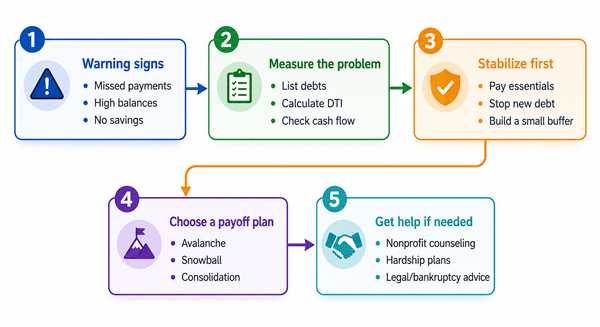
■ Debt Warning Signs Diagram
Use this simple flow to decide what to do when debt starts feeling unmanageable.
■ Printable Debt Self-Check Checklist
Check any statement that is true for you. The more boxes you check, the more urgent it is to act.
| Debt self-check item | Yes/No |
|---|---|
| I can only afford minimum payments on one or more debts. | |
| My balances are staying the same or increasing. | |
| I use credit cards or loans for regular living costs. | |
| I have missed or late payments in the last six months. | |
| I borrow from one account to pay another. | |
| I do not have even a small emergency fund. | |
| I avoid looking at bills or account balances. | |
| Debt causes stress, sleep problems, or relationship conflict. | |
| Collectors are calling or sending letters. | |
| I cannot see a realistic way to repay everything under current terms. |
Tip: If you are outside the United States, use the same debt checks but verify local credit-reporting rules, debt collection laws, court timelines, and bankruptcy or insolvency options from official local sources.
■ Frequently Asked Questions
1. How much debt is too much?
Debt may be too much when payments prevent you from covering essentials, saving for emergencies, or paying on time. A high DTI, rising balances, and missed payments are stronger warning signs than the total balance alone.
2. Is credit card debt worse than other debt?
Credit card debt is often riskier because rates can be high, payments can stretch for years, and available credit can tempt more spending. Mortgage or student loan debt may have lower rates, but any debt can become a problem if payments are unaffordable.
3. Should I pay off debt or save money first?
Do both in a balanced way if possible. Pay at least the minimums to avoid fees and credit damage, while building a small emergency fund so every surprise does not become new debt. After that, focus extra money on high-interest debt.
4. Should I use debt consolidation?
Debt consolidation can help if it lowers your interest rate, simplifies payments, and fits your budget. It is risky if you use it to make debt feel smaller while continuing to borrow.
5. What should I do if I cannot pay all my bills this month?
Prioritize essentials first: housing, food, utilities, transportation, insurance, and required medical care. Then contact lenders before due dates, explain the hardship, and ask for options. Avoid promising payments you cannot make.
6. Can too much debt hurt my credit score?
Yes. Late payments, high credit utilization, collections, charge-offs, and judgments can damage credit. Paying on time and reducing balances over time can help rebuild credit.
7. When should I talk to a credit counselor?
Talk to a reputable nonprofit credit counselor if you are behind, overwhelmed, paying only minimums, considering debt settlement, or unsure whether your budget can support your debts.
8. When should I consider bankruptcy advice?
Consider legal advice if you face lawsuits, wage garnishment, foreclosure, repossession, overwhelming medical debt, or no realistic way to repay debts under current terms. Bankruptcy is a legal decision and should be reviewed with a qualified professional.
9. Is it bad to negotiate with creditors?
No. Negotiating can be helpful, especially before default. Ask about hardship plans, interest reductions, due-date changes, or payment arrangements. Always get terms in writing.
10. What is the fastest way to get out of debt?
The fastest realistic way is to stop adding new debt, free up cash, pay more than minimums, and target debts strategically. The avalanche method usually saves the most interest, while the snowball method may help motivation.
■ Key Takeaways
- Too much debt is about affordability, cash flow, stress, and risk—not only the total amount owed.
- Major warning signs include missed payments, rising balances, minimum-payment dependence, borrowing to pay debt, and using credit for basic living costs.
- Calculate your DTI, review your minimum payments, and check whether your budget has a cash-flow gap.
- Stabilize first by protecting essentials and stopping new debt, then choose a payoff or assistance plan.
- Get reputable help early if you are behind, overwhelmed, or facing collections or legal action.
Sources and Notes
This article follows a people-first approach, adds practical self-checks, cites reputable consumer education sources, avoids unrealistic promises, and treats debt decisions as personal financial matters that may require qualified professional advice.
This article was written for general financial education and reviewed for beginner clarity, practical usefulness, and consumer-protection awareness. It draws on established consumer finance concepts and guidance from reputable consumer education sources, including:
- Consumer Financial Protection Bureau: explanation of debt-to-income ratio and how lenders use it. https://www.consumerfinance.gov/ask-cfpb/what-is-a-debt-to-income-ratio-en-1791/
- Federal Trade Commission Consumer Advice: guidance on getting out of debt, legitimate help, debt settlement, debt consolidation, bankruptcy, credit repair, and avoiding scams. https://consumer.ftc.gov/articles/how-get-out-debt
- Federal Trade Commission debt collection education: consumer rights and safe handling of debt collector contact. https://consumer.ftc.gov/credit-loans-debt/debt-collection
- Cornell Legal Information Institute Wex: general definition and context for debt-to-income ratio. https://www.law.cornell.edu/wex/debt-to-income_ratio
Reader Advice: This article is for educational and informational purposes only and should not be taken as financial, legal, tax, credit, or professional advice. Please check the latest information from official sources or a qualified professional, as rules, policies, lender practices, and local laws can change over time. Readers should verify local laws, lender rules, tax consequences, and credit-reporting effects before making major debt decisions.