Common Debt Management Mistakes and How to Avoid Them
Debt can feel confusing when you are trying to handle multiple bills, different interest rates, late fees, collection calls, and everyday expenses at the same time. Many people make debt management mistakes not because they are careless, but because the system is hard to understand and stressful to navigate.
The good news is that most debt mistakes are avoidable. Once you understand how debt management works, you can create a plan that is realistic, organized, and easier to stick with. This guide explains the most common debt management mistakes, why they are harmful, and what to do instead.
This article is written for beginners. It focuses mainly on consumer debts such as credit cards, personal loans, medical bills, student loans, auto loans, and accounts in collections. Rules and options vary by country, lender, and debt type, so use this as general education and seek qualified help for legal, tax, or complex financial issues.
Before choosing any debt option, separate urgent priority bills from unsecured consumer debts. Housing, utilities, taxes, court deadlines, child support, and vehicle payments may carry faster consequences than ordinary credit card balances. This is why a safe debt plan protects essential living costs first and then uses extra money for a focused payoff strategy.
1. What Is Debt Management?
Debt management is the process of organizing, prioritizing, and repaying debt in a way that fits your income and protects your long-term financial health. It includes knowing what you owe, making on-time payments, reducing interest where possible, avoiding new unnecessary debt, and getting help before the situation becomes unmanageable.
A debt management plan can be informal, such as your own spreadsheet and payoff strategy, or formal, such as a plan arranged through a nonprofit credit counseling agency. A formal Debt Management Plan, often called a DMP, usually involves one monthly payment to the counseling agency, which then pays participating creditors on your behalf. The National Foundation for Credit Counseling explains that a counselor reviews your finances first and then helps determine whether a DMP is appropriate for your situation.
2. Why Debt Management Mistakes Are So Costly
Small debt decisions can become expensive because of interest, fees, credit score effects, and stress. For example, paying only the minimum on a high-interest credit card may keep the account current, but it can also stretch repayment over many years. Missing payments can add late fees, penalty rates, and credit damage. Ignoring collection notices can cause you to miss dispute deadlines or settlement opportunities.
| Mistake Type | Immediate Effect | Long-Term Risk |
|---|---|---|
| Paying only minimums | Balance falls slowly | More interest paid over time |
| Missing due dates | Late fees and possible credit reporting | Higher borrowing costs later |
| Using new debt to pay old debt | Temporary relief | Debt cycle gets larger |
| Ignoring collectors | Less stress today | Possible lawsuits, added fees, or missed rights |
| Choosing the wrong help | May pay fees without results | Credit damage, scams, or wasted money |
3. Common Debt Management Mistakes and How to Avoid Them
Mistake 1: Not knowing exactly how much you owe
Why it hurts: Many people estimate their debt instead of listing it clearly. This makes it hard to choose a payoff strategy or know whether progress is happening.
How to avoid it:
- Create a debt inventory with the creditor name, balance, interest rate, minimum payment, due date, loan term, and account status.
- Check statements and credit reports for accounts you may have forgotten.
- Update the list at least once a month.
Example: Sara thinks she owes about $8,000, but after listing every account she finds $11,400, including a store card and a medical bill in collections. Her real plan must be based on $11,400, not the estimate.
Mistake 2: Paying only the minimum without a payoff plan
Why it hurts: Minimum payments are designed to keep an account current, not necessarily to get you out of debt quickly. On high-interest credit cards, most of the minimum payment may go toward interest instead of reducing the balance.
How to avoid it:
- Pay more than the minimum on at least one target debt while staying current on all others.
- Use a debt payoff calculator to estimate time and interest.
- Apply bonuses, tax refunds, or extra income to principal when possible.
Best practice: Treat the minimum as the floor, not the goal.
Mistake 3: Attacking every debt equally
Why it hurts: Splitting extra money evenly across all debts can feel fair, but it often slows progress. A focused method gives your extra dollars a clear job.
How to avoid it:
- Use the debt avalanche method if you want to minimize interest by paying extra toward the highest-rate debt first.
- Use the debt snowball method if motivation matters more and you want quick wins by paying extra toward the smallest balance first.
- Keep making minimum payments on every account to avoid late fees.
Example: If you have a 24% credit card, a 12% personal loan, and a 5% student loan, the avalanche method usually targets the 24% card first.
Mistake 4: Ignoring your budget while focusing on debt
Why it hurts: A debt plan that does not match real life usually fails. If you send too much money to creditors and leave nothing for groceries, transport, medicine, or emergencies, you may end up borrowing again.
How to avoid it:
- Build a simple monthly budget before choosing extra debt payments.
- Separate needs, debt minimums, savings, and flexible spending.
- Leave a small buffer for irregular expenses.
A realistic plan you can maintain for 12 months is better than an aggressive plan that collapses in three weeks.
Practical rule: if a proposed payment leaves you short on essentials, it is not a stable debt plan. Reduce discretionary spending first, but keep enough cash flow to avoid replacing paid-off debt with new borrowing.
Mistake 5: Continuing to use credit cards while trying to pay them off
Why it hurts: Using the same card you are trying to repay can make progress invisible. You pay $200, then charge $180, and the balance barely changes.
How to avoid it:
- Pause nonessential card use while paying down balances.
- Use debit or cash for categories where you tend to overspend.
- Remove saved card details from shopping apps if impulse spending is a problem.
Important: Do not close old credit accounts automatically. Closing accounts can affect credit utilization and credit history. Consider pausing use first.
Mistake 6: Skipping an emergency fund
Why it hurts: Some people put every extra dollar toward debt and keep no emergency savings. Then a car repair or medical bill forces them back into credit card debt.
How to avoid it:
- Start with a small starter emergency fund, such as $500 to $1,000 if that is realistic in your currency and cost of living.
- After high-interest debt is under control, gradually build a larger cushion.
- Keep emergency money separate from everyday spending.
Emergency savings are not a distraction from debt payoff. They help protect the payoff plan.
Mistake 7: Missing payments because the system is disorganized
Why it hurts: Missed payments often happen because of forgotten due dates, not because someone refused to pay. Unfortunately, lenders and credit reports usually do not care why the payment was late.
How to avoid it:
- Set calendar reminders several days before each due date.
- Use autopay for minimum payments if your cash flow is stable.
- Align due dates with paydays when creditors allow it.
Tip: If you use autopay, still review statements. Autopay prevents forgetting; it does not prevent billing errors or overspending.
Also review your credit reports periodically. A payment calendar helps prevent late payments, while credit report checks help you spot duplicate collection accounts, wrong balances, or accounts that do not belong to you.
Mistake 8: Taking a consolidation loan without changing spending habits
Why it hurts: Debt consolidation can simplify payments and reduce interest, but it does not erase debt. If you consolidate credit cards and then run the cards back up, you now have the consolidation loan plus new card balances.
How to avoid it:
- Compare the total cost, not only the monthly payment.
- Stop using the paid-off cards for new purchases unless you can pay in full monthly.
- Avoid stretching repayment so long that you pay more interest overall.
Consolidation is a tool, not a cure. It works best when paired with a budget and behavior changes.
Mistake 9: Confusing debt management with debt settlement
Why it hurts: Debt management and debt settlement are often confused. They are very different. Debt management usually aims to repay debts through an organized plan. Debt settlement tries to negotiate paying less than the full balance, often after accounts become delinquent.
How to avoid it:
- Understand the difference before signing anything.
- Ask whether the company is a nonprofit credit counseling agency, a lender, or a for-profit settlement company.
- Be cautious with any company that promises fast results or tells you to stop paying creditors without explaining the risks.
The U.S. Federal Trade Commission states that certain debt relief providers generally cannot collect fees before settling or otherwise resolving debts. This is a major red flag check when evaluating help.
Mistake 10: Ignoring debt collectors instead of verifying the debt
Why it hurts: Avoiding collection calls may reduce stress briefly, but it can also cause you to miss important deadlines. In the United States, debt collectors generally must provide validation information, including the creditor name, amount owed, and how to dispute the debt.
How to avoid it:
- Ask for written validation information before paying a collector.
- Do not give bank details to an unknown collector until you confirm the debt is legitimate.
- Keep records of letters, emails, calls, payment agreements, and receipts.
Never assume every collection notice is accurate. Debts can be sold, duplicated, outdated, or reported with errors.
In the United States, CFPB guidance says consumers generally have 30 days after receiving validation information to dispute a debt in writing. Other countries have different rules, so check the official consumer-protection source in your location.
Mistake 11: Not negotiating when you are struggling
Why it hurts: Many borrowers wait until they are months behind before contacting creditors. Earlier communication can sometimes lead to hardship programs, lower temporary payments, due-date changes, fee waivers, or alternative repayment options.
How to avoid it:
- Contact creditors before missing payments if possible.
- Explain the problem briefly and ask what hardship options exist.
- Get any agreement in writing before relying on it.
Example script: “I want to stay current, but my income dropped. Are there hardship options, reduced payments, or a temporary interest-rate reduction available?”
Mistake 12: Borrowing from retirement savings too quickly
Why it hurts: Using retirement savings to pay debt may seem attractive, but it can create taxes, penalties, lost investment growth, and future insecurity. It may also fail to fix the spending or income issue that caused the debt.
How to avoid it:
- Treat retirement withdrawals as a last resort, not a first option.
- Compare alternatives such as budgeting changes, creditor hardship programs, nonprofit counseling, or a lower-cost consolidation loan.
- Speak with a qualified financial or tax professional before withdrawing retirement money.
A debt problem should not automatically become a retirement problem.
Mistake 13: Falling for quick-fix promises and debt scams
Why it hurts: Debt stress makes people vulnerable to companies promising to remove debt, repair credit instantly, or guarantee settlement. Real debt solutions usually take time and require trade-offs.
How to avoid it:
- Avoid companies that demand large upfront fees, guarantee results, or pressure you to act immediately.
- Check nonprofit status, licensing, reviews, complaints, and written fee disclosures.
- Never sign a blank form or give remote access to your bank account.
Trustworthy help explains risks clearly. A scam hides the risks and sells certainty.
Mistake 14: Forgetting about taxes, fees, and credit effects
Why it hurts: Some debt options have side effects. Settlement may affect credit and may have tax consequences in some places. Consolidation loans may include origination fees. Balance transfers may include transfer fees and a promotional rate that expires.
How to avoid it:
- Ask about all fees before accepting any offer.
- Calculate what happens after promotional rates end.
- Understand possible tax or legal consequences before settling debt.
Look beyond the monthly payment. The cheapest-looking option is not always the safest.
For tax-sensitive or legal situations, confirm the rules before acting. In some places, forgiven or canceled debt may be treated as taxable income, and court judgments can create additional collection powers.
Mistake 15: Trying to handle serious debt alone for too long
Why it hurts: Debt can become too complex for a do-it-yourself plan, especially if you face lawsuits, wage garnishment, repossession, foreclosure, or repeated missed payments.
How to avoid it:
- Talk to a nonprofit credit counselor for a budget review and options.
- Consult a consumer law attorney if you are sued or threatened with legal action.
- Consider bankruptcy advice if debt is truly unmanageable; bankruptcy rules vary widely by country and situation.
Getting help early is not failure. It is often the most responsible step.
4. Debt Payoff Methods: Which One Helps Avoid Mistakes?
| Method | How It Works | Best For | Main Limitation |
|---|---|---|---|
| Debt Avalanche | Pay extra toward the debt with the highest interest rate first. | People who want to save the most interest mathematically. | The first debt may take longer to pay off, which can reduce motivation. |
| Debt Snowball | Pay extra toward the smallest balance first. | People who need quick wins and motivation. | May cost more interest if high-rate debts are not paid first. |
| Debt Consolidation | Combine multiple debts into one new loan or balance transfer. | People with good enough credit to qualify for a lower rate and a stable budget. | Can backfire if old cards are used again or repayment is stretched too long. |
| Debt Management Plan | A credit counseling agency helps arrange one monthly payment to creditors. | People with unsecured debts who need structure and possible interest concessions. | May require closing or pausing credit accounts and fees may apply. |
| Hardship Program | Temporary creditor arrangement such as lower payment or reduced interest. | People facing short-term income loss or emergency expenses. | Terms vary and may not be available for every borrower. |
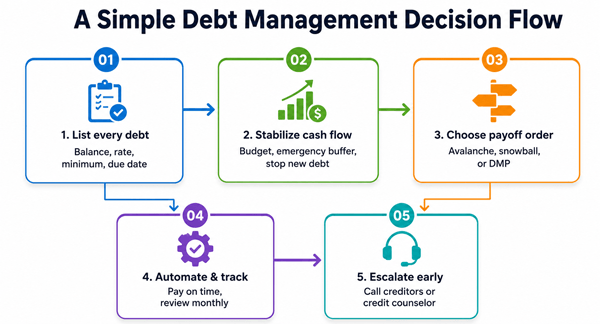
5. Simple Debt Management Flowchart
Use this flowchart as a beginner-friendly starting point. It shows the order that usually prevents the biggest mistakes: organize first, stabilize cash flow, choose a strategy, track progress, and ask for help early when needed.
6. A Practical 30-Day Plan to Avoid Debt Management Mistakes
| Time Frame | Action | Why It Matters |
|---|---|---|
| Day 1-3 | List every debt, minimum payment, interest rate, and due date. | You cannot manage what you have not measured. |
| Day 4-7 | Build a basic budget using real income and expenses. | Prevents an unrealistic payoff plan. |
| Day 8-10 | Set up reminders or autopay for minimum payments. | Reduces late-payment risk. |
| Day 11-14 | Choose avalanche, snowball, consolidation, hardship request, or counseling. | Gives your extra money a clear strategy. |
| Day 15-21 | Call creditors if you are behind or likely to fall behind. | Earlier contact may preserve more options. |
| Day 22-30 | Make the first focused extra payment and record progress. | Builds momentum and creates a measurable baseline. |
7. Debt Management Checklist
- ☐ I know my total debt balance.
- ☐ I know the interest rate on each debt.
- ☐ I know every due date and minimum payment.
- ☐ I have a monthly budget based on real spending.
- ☐ I am current on minimum payments or have contacted creditors for help.
- ☐ I have chosen one main payoff strategy.
- ☐ I have stopped adding unnecessary new debt.
- ☐ I have a small emergency buffer or a plan to build one.
- ☐ I have verified any collection account before paying.
- ☐ I have checked fees, credit effects, and risks before using consolidation or settlement.
8. Warning Signs You Need Help With Debt
- You regularly use credit cards for basic expenses because income is not enough.
- You can only make minimum payments and balances are not falling.
- You are behind on rent, mortgage, utilities, auto payments, or taxes.
- You receive collection notices, legal letters, or court papers.
- You are considering payday loans or high-cost borrowing to cover existing debt.
- Debt stress is affecting sleep, work, health, or relationships.
If several of these apply, consider speaking with a nonprofit credit counselor or a qualified professional. If you receive court papers, get legal advice quickly because deadlines can be short.
Quick safety check before choosing debt help:
| Ask this question | Why it matters |
|---|---|
| Is the provider nonprofit, for-profit, a lender, or a settlement company? | Different providers have different incentives, fees, and risks. |
| Are all fees, credit effects, and risks explained in writing? | Clear written terms support trust and protect against pressure tactics. |
| Will I stay current on essential bills while following this plan? | Debt help should not endanger housing, utilities, food, medicine, or transport. |
9. Common Misconceptions About Debt Management
| Misconception | Reality |
|---|---|
| “All debt is bad.” | Some debt can support long-term goals, such as education, housing, or business growth, if it is affordable and well managed. |
| “A lower monthly payment is always better.” | A lower payment can help cash flow, but a longer term may increase total interest. |
| “Debt consolidation fixes the problem.” | It only reorganizes debt. Spending and budgeting habits still matter. |
| “Collectors are always right.” | Collection accounts can contain errors. Verify the debt before paying. |
| “Asking for help means I failed.” | Getting guidance early can prevent bigger damage and may save money. |
■ Useful Scripts and Examples
Script for Calling a Creditor
“Hello, I am trying to keep my account in good standing, but I am having financial difficulty. Can you tell me whether I qualify for a hardship program, reduced interest rate, payment extension, fee waiver, or modified payment plan? Please send any approved terms in writing.”
Script for a Debt Collector
“Please send written validation information for this debt, including the creditor name, amount owed, and how I can dispute the debt. I do not agree to any payment until I have reviewed the written information.”
Simple Debt Inventory Template
| Creditor | Balance | Interest Rate | Minimum Payment | Due Date | Status |
|---|---|---|---|---|---|
| Credit Card A | $2,400 | 24.99% | $80 | 5th | Current |
| Personal Loan | $6,000 | 11.50% | $210 | 15th | Current |
| Medical Bill | $750 | 0% or unknown | $50 | 20th | Needs verification |
■ Frequently Asked Questions
1. What is the biggest debt management mistake?
The biggest mistake is trying to repay debt without a complete plan. A good plan includes a debt list, budget, payment calendar, payoff strategy, and emergency buffer.
2. Should I pay off the smallest debt or highest-interest debt first?
Mathematically, the highest-interest debt first usually saves more money. Emotionally, the smallest debt first can help motivation. The best method is the one you can follow consistently while staying current on all required payments.
3. Is debt consolidation a good idea?
Debt consolidation can be helpful if it lowers your interest rate, simplifies payments, and does not tempt you to take on new debt. It can be harmful if it only lowers the monthly payment by extending the term or if you keep using the old accounts.
4. Should I stop paying creditors if a debt settlement company tells me to?
Be very cautious. Stopping payments can lead to fees, credit damage, collection activity, and possible lawsuits. Get the risks in writing and consider nonprofit credit counseling or legal advice before taking this step.
5. How do I know if a debt collector is legitimate?
Ask for written validation information. Confirm the company, creditor, amount, and your dispute rights. Do not give sensitive payment information until you are confident the debt is real and belongs to you.
6. Can I manage debt without hurting my credit?
Often, yes. Paying on time, reducing balances, and avoiding new unnecessary debt can help protect credit. Some options, such as settlement, delinquency, or bankruptcy, may have more serious credit effects.
7. How often should I review my debt plan?
Review it monthly. Update balances, confirm payments posted correctly, check your budget, and decide where extra money should go next.
8. When should I contact a credit counselor?
Consider contacting a nonprofit credit counselor if you cannot make progress, are falling behind, feel overwhelmed, or need help comparing options. A counselor can review your budget and explain whether a DMP or another strategy may fit.
■ Final Thoughts: The Best Debt Plan Is Clear, Realistic, and Repeatable
Debt management mistakes are common, but they are not permanent. The most important step is to move from reaction to organization. Know what you owe, protect your cash flow, pay on time, choose one strategy, and ask for help before missed payments become a crisis.
A strong debt plan does not need to be complicated. It needs to be honest, practical, and consistent. Even small extra payments can matter when they are focused and repeated over time.
Notes and Sources Consulted
This article is for general financial education only. It is not personalized financial, legal, tax, or credit advice. Debt laws, credit reporting rules, hardship programs, and tax consequences vary by country and individual situation. For serious debt, collection lawsuits, tax questions, or bankruptcy decisions, consult a qualified professional.
- Consumer Financial Protection Bureau (CFPB) – Debt collection resources, debt validation information, and debt-to-income (DTI) ratio guidance.
- Federal Trade Commission (FTC) – Guidance on debt relief services and the Telemarketing Sales Rule, including upfront fee regulations.
- National Foundation for Credit Counseling (NFCC) – Information on Debt Management Plans (DMPs) and nonprofit credit counseling.
- Money Management International (MMI) – Educational resources explaining debt management plans and repayment strategies.
Reader Advice: This article is for educational and informational purposes only and should not be taken as personalized financial, legal, tax, or credit advice. Rules, programs, fees, and policies can change over time, so please check the latest official sources or speak with a qualified professional before making important debt decisions.