How to Get Out of Debt Faster: Practical Debt Payoff Strategies
Debt can feel heavy, especially when several bills arrive every month and the balances barely seem to move. The good news is that getting out of debt faster is not about finding a magic trick. It is about using a clear plan, paying more than the minimum when possible, reducing interest where it makes sense, and avoiding new debt while you make progress.
This guide explains practical debt payoff strategies in simple language. You will learn how debt repayment works, how to choose between the debt snowball and debt avalanche methods, when consolidation may help, how to free up extra money, and what to do if your debt feels unmanageable.
It is especially useful for readers who want to pay off credit card debt, personal loans, student loans, medical bills, or other consumer debt with a realistic monthly plan. Because debt decisions can affect your financial stability, compare options carefully and confirm details with your lender before making major changes.
In this article, you will learn:
- What it means to get out of debt faster
- The first steps before choosing a payoff strategy
- Debt snowball vs debt avalanche
- How to lower interest and payments without making debt worse
- Practical ways to find extra payoff money
- What to avoid while paying off debt
- When to get professional help
- A beginner debt payoff checklist and FAQs
1. What Does It Mean to Get Out of Debt Faster?
Getting out of debt faster means reducing your balances more quickly than you would by making only the required minimum payments. Minimum payments are designed to keep your account current, but they often leave you paying interest for a long time, especially on credit cards and high-interest loans.
A faster debt payoff plan usually includes three parts: a clear list of what you owe, a repayment strategy, and extra money directed toward principal. Principal is the original amount you borrowed. Interest is the cost of borrowing. The more money that goes toward principal, the faster your balance falls.
2. Why Paying Off Debt Faster Matters
Paying off debt faster can improve your financial life in several ways. It can reduce total interest, lower monthly stress, free up cash flow, and help you qualify for future financial goals such as saving for a home, building an emergency fund, or investing for retirement.
However, faster payoff should still be realistic. A plan that is too strict may fail after a few weeks. The best debt payoff strategy is one you can follow consistently while still covering essentials such as housing, food, utilities, transportation, insurance, and basic savings.
Step 1: Know Exactly What You Owe
Before choosing a strategy, create a complete debt inventory. This removes guesswork and helps you make decisions based on facts rather than anxiety.
- Creditor or lender name
- Type of debt
- Current balance
- Interest rate or APR
- Minimum payment
- Due date
- Whether the rate is fixed or variable
- Any fees or penalties
Example debt inventory:
| Debt | Balance | APR | Minimum Payment | Due Date | Notes |
|---|---|---|---|---|---|
| Credit card A | $3,200 | 24.99% | $105 | 5th | Highest interest |
| Personal loan | $6,500 | 11.50% | $220 | 12th | Fixed payment |
| Credit card B | $1,100 | 19.99% | $45 | 19th | Smallest balance |
| Student loan | $8,000 | 6.80% | $95 | 28th | Lower interest |
Step 2: Stop the Debt From Growing
A payoff plan works only if your balances stop increasing. This does not mean you are a bad person if you have used credit to survive. It means the plan needs breathing room.
- Pause nonessential credit card spending while you repay balances.
- Remove saved cards from shopping apps and websites.
- Use a basic weekly spending limit for groceries, eating out, transport, and personal spending.
- Build a small starter emergency fund if possible, even $500 to $1,000, so one surprise bill does not push you back into debt.
- Contact lenders early if you are already behind, because options are usually better before accounts go to collections.
- Keep secured debts, taxes, child support, rent, utilities, and other essential obligations current whenever possible, because missed payments may create serious consequences beyond normal interest charges.
Step 3: Choose a Debt Payoff Strategy
Most successful payoff plans use one of two popular methods: the debt snowball or the debt avalanche. Both require you to keep making minimum payments on every debt. The difference is which debt gets your extra payment first.
Debt Snowball Method
With the debt snowball method, you pay off the smallest balance first, regardless of interest rate. After that debt is gone, you roll its payment into the next smallest balance. This creates quick wins and can keep you motivated.
Debt Avalanche Method
With the debt avalanche method, you pay off the debt with the highest interest rate first. This usually saves the most money mathematically because expensive debt is eliminated sooner.
Debt snowball vs debt avalanche:
| Method | How it works | Best for | Main advantage | Main limitation |
|---|---|---|---|---|
| Debt snowball | Pay smallest balance first | People who need motivation | Quick wins build confidence | May cost more interest |
| Debt avalanche | Pay highest interest first | People focused on math savings | Usually saves the most interest | First win may take longer |
| Hybrid method | Start with a small quick win, then switch to high interest | Beginners who need momentum and savings | Balances motivation and efficiency | Requires more tracking |
Example: How the Two Methods Work
Imagine you have $300 extra each month after making all minimum payments:
| Debt | Balance | APR | Minimum Payment |
|---|---|---|---|
| Credit card B | $1,100 | 19.99% | $45 |
| Credit card A | $3,200 | 24.99% | $105 |
| Personal loan | $6,500 | 11.50% | $220 |
Using the snowball method, you would put the extra $300 toward Credit card B because it has the smallest balance. Using the avalanche method, you would put the extra $300 toward Credit card A because it has the highest APR. Neither method is wrong. The right choice is the one you will actually follow.
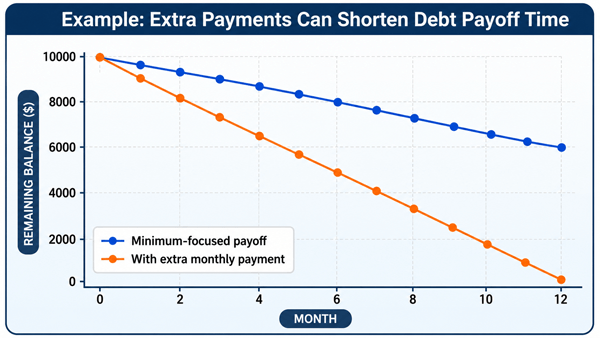
Chart: A simplified example showing how extra payments can reduce a balance faster than a minimum-focused approach. Actual results depend on interest rates, fees, and payment timing.
Strategy 1: Pay More Than the Minimum
The most direct way to get out of debt faster is to pay more than the minimum. Even a small extra payment can help because it reduces principal sooner.
Practical tip: Treat your extra debt payment like a bill. Schedule it right after payday before the money disappears into everyday spending.
Also check how your lender applies extra payments. When possible, ask that extra money be applied to principal rather than future scheduled payments, because principal reduction is what shortens the payoff timeline.
Strategy 2: Use the Debt Snowflake Method
The debt snowflake method means sending small extra amounts to debt whenever you find them. Examples include a $20 refund, $15 saved from a coupon, or $50 from selling an unused item.
Small payments may not feel powerful, but they add up. The key is to send the money to debt immediately instead of letting it blend into your checking account.
Strategy 3: Lower Your Interest Rate
Lowering interest can speed up payoff because more of each payment goes toward principal. Options may include asking your credit card issuer for a lower APR, using a balance transfer card, refinancing a loan, or consolidating debt with a lower-rate personal loan.
Be careful: lower interest helps only if you avoid adding new debt and understand all fees, promotional periods, and repayment terms.
For balance transfers, compare the transfer fee, promotional APR period, regular APR after the promotion, and the monthly payment needed to clear the balance before the higher rate begins.
Strategy 4: Consider Debt Consolidation Carefully
Debt consolidation combines multiple debts into one payment, often through a personal loan, balance transfer, or home equity product. It can simplify repayment and possibly reduce interest.
Consolidation is not the same as debt elimination. You still owe the money. It can backfire if you consolidate credit card balances and then run the cards up again.
Before consolidating, compare the total repayment cost, loan term, monthly payment, fees, and whether the new payment fits your budget. A lower monthly payment can still cost more overall if the repayment period becomes much longer.
Strategy 5: Use Windfalls Wisely
Tax refunds, bonuses, gifts, overtime checks, and side income can create major progress. A balanced approach is to use part of a windfall for urgent needs and send the rest to your target debt.
For example, if you receive a $1,200 bonus, you might keep $300 for essential expenses, add $200 to emergency savings, and send $700 to your highest-priority debt.
Strategy 6: Increase Income Temporarily
Cutting expenses helps, but there is a limit. Increasing income can accelerate debt payoff without making your budget feel impossible.
Beginner-friendly ideas include overtime, freelance work, weekend gigs, tutoring, selling unused items, renting out equipment, or taking short-term seasonal work. Choose options that do not risk your health, safety, or main job.
Strategy 7: Reduce Expenses Without Making Life Miserable
The best spending cuts are specific and repeatable. Instead of saying “spend less,” choose clear actions such as cooking dinner four nights a week, canceling unused subscriptions, negotiating insurance, or setting a weekly fun-money limit.
Avoid cutting every enjoyable expense. A small planned treat can help you stick with the plan longer.
■ Debt Consolidation Options Compared
| Option | How it may help | Watch out for | Good fit when | Poor fit when |
|---|---|---|---|---|
| Balance transfer card | May offer a low or 0% promotional APR | Transfer fees, high rate after promo ends | You can repay before promo expires | You may keep spending on cards |
| Personal loan | Fixed payment and payoff date | Origination fees, rate depends on credit | Rate is lower than current debt | Payment is unaffordable |
| Credit counseling debt management plan | May reduce rates and organize payments | May require closing cards and monthly fees | You need structure and creditor support | You want new credit immediately |
| Home equity loan or HELOC | May have lower rate | Your home may be at risk if you cannot pay | Debt is large and repayment is stable | You are converting unsecured debt into home-secured debt |
■ Build a Simple Debt Payoff Budget
A debt payoff budget tells your money where to go before the month begins. It does not have to be complicated. Start with these categories:
- Income: wages, business income, benefits, side income, and reliable support.
- Essentials: rent or mortgage, utilities, groceries, transport, insurance, childcare, and basic medical costs.
- Minimum debt payments: every required debt payment.
- Starter savings: a small emergency fund contribution if possible.
- Extra debt payment: the amount assigned to your target debt.
- Flexible spending: personal money, eating out, entertainment, clothing, and gifts.
Simple formula: Income - essentials - minimum payments - savings - flexible spending = extra debt payoff money.
If the result is negative, focus first on stabilizing essentials and contacting creditors rather than forcing an aggressive payoff plan that cannot be maintained.
■ A Practical 30-Day Debt Payoff Action Plan
| Time frame | Action |
|---|---|
| Days 1-3 | List all debts, balances, APRs, minimums, and due dates. |
| Days 4-7 | Review spending from the last 30-60 days and identify three realistic cuts. |
| Days 8-10 | Choose snowball, avalanche, or hybrid method. |
| Days 11-15 | Set up automatic minimum payments to avoid late fees. |
| Days 16-20 | Make your first extra payment to the target debt. |
| Days 21-25 | Look for interest reduction options, such as a lower APR request or safer consolidation. |
| Days 26-30 | Review progress, adjust the budget, and plan next month’s extra payment. |
■ Common Debt Payoff Mistakes to Avoid
- Paying extra on one debt while missing minimum payments on another. This can trigger fees and credit damage.
- Ignoring interest rates completely if your high-interest debt is growing quickly.
- Using consolidation as a reason to start spending on credit cards again.
- Draining every dollar of savings and then using debt for the next emergency.
- Choosing a payoff plan that is too strict to maintain.
- Not reading the terms on balance transfers, refinancing, or hardship programs.
- Waiting too long to ask for help when payments are already unaffordable.
■ What If You Cannot Afford Your Minimum Payments?
If you cannot afford minimum payments, a standard snowball or avalanche plan may not be enough. Focus first on safety, housing, food, utilities, transportation, and essential insurance. Then contact creditors and ask about hardship options before accounts become seriously delinquent.
You may also consider speaking with a reputable nonprofit credit counseling agency. A counselor can review your budget, explain options, and help you decide whether a debt management plan, hardship program, settlement, or legal advice may be appropriate. Avoid companies that promise guaranteed results, tell you to stop paying creditors without explaining risks, or charge large upfront fees.
■ Pros and Cons of Paying Off Debt Faster
| Benefits | Possible trade-offs |
|---|---|
| Less interest over time | Less money available for wants in the short term |
| More monthly cash flow after debts are gone | May require lifestyle changes |
| Lower financial stress | Can feel slow at the beginning |
| More room for saving and investing | Overpaying debt before building any emergency fund can create setbacks |
■ Debt Payoff Checklist for Beginners
- List every debt with balance, APR, minimum payment, and due date.
- Make all minimum payments on time.
- Choose one target debt using snowball, avalanche, or hybrid method.
- Send extra money to the target debt every month.
- Pause new nonessential debt.
- Build a small emergency buffer.
- Review interest-lowering options carefully.
- Track balances monthly to stay motivated.
- Celebrate milestones without creating new debt.
- Ask for help early if payments become unaffordable.
■ Frequently Asked Questions
1. What is the fastest way to get out of debt?
The fastest realistic way is to make all minimum payments, avoid new debt, put every extra dollar toward one target debt, and reduce interest where possible. The debt avalanche method often saves the most interest, while the debt snowball method may be easier to stick with.
2. Should I pay off debt or save money first?
For many beginners, a small starter emergency fund comes first, then aggressive debt payoff. This helps avoid using credit for every surprise expense. After high-interest debt is under control, larger savings goals can become a bigger priority.
3. Is the debt snowball or avalanche better?
The avalanche method is usually better mathematically because it targets the highest interest rate first. The snowball method may be better emotionally because it creates quick wins. The best method is the one you can follow consistently.
4. Can debt consolidation help me get out of debt faster?
Yes, if it lowers your interest rate, creates a clear repayment schedule, and you stop adding new debt. It can hurt if it adds fees, extends repayment too long, or frees up credit cards that you use again.
5. Should I close credit cards after paying them off?
Not always. Closing a card can affect your available credit and credit history. But if keeping a card open leads to more spending, closing or freezing it may be the healthier choice. Consider your behavior, fees, and credit goals.
6. How do I stay motivated while paying off debt?
Track progress monthly, celebrate small milestones, use visual charts, focus on one debt at a time, and remind yourself what the payment will be used for after the debt is gone.
7. What debts should I pay first?
If you want maximum interest savings, pay the highest APR debt first. If you need motivation, pay the smallest balance first. Always stay current on secured debts, taxes, child support, and any debt with serious legal or essential-service consequences.
8. When should I get professional help?
Get help if you cannot afford minimum payments, are using debt for basic living costs, are facing collections or lawsuits, or feel overwhelmed by creditor calls. A reputable nonprofit credit counselor or qualified legal professional can explain options.
Yes, but timing matters. Extra payments can reduce interest, but you should still keep a small emergency buffer and avoid missing required payments. Some loans may have prepayment rules, so review the terms first.
9. Is it smart to use all extra money for debt payoff?
■ Final Thoughts: Start Small, Stay Consistent
Getting out of debt faster is not about being perfect. It is about making a plan, following it more often than not, and adjusting when real life happens. Start by listing what you owe, choose a payoff method, make every minimum payment on time, and send extra money to one target debt. Each paid-off balance gives you more cash flow, more confidence, and more control over your financial future.
Reader Advice: This article is for educational and informational purposes only and should not be taken as personalized financial, credit, tax, or legal advice. Please check the latest information from official sources or qualified professionals, as rules, fees, rates, and policies can change over time.