Credit Card Debt Management Guide: How to Pay Off Credit Card Debt
Credit card debt is one of the most common and expensive forms of consumer debt. It usually starts small: a few emergency purchases, a balance carried for one month, or a minimum payment that feels manageable. Over time, interest charges, fees, and new spending can turn that balance into a serious financial burden.
The good news is that credit card debt is not a life sentence. With a clear plan, disciplined payments, and the right strategy, many people can reduce their balances, save money on interest, and rebuild financial confidence. This guide explains how credit card debt works, why it grows so quickly, and how to pay it off step by step.
In the United States, official Federal Reserve G.19 data for April 2026 show that revolving credit, the category that includes most credit card balances, increased at a 10.4% seasonally adjusted annual rate. Federal Reserve data also show average credit card interest rates can be high compared with many other forms of borrowing, which is why paying down balances matters.
For readers, the practical takeaway is simple: before choosing any payoff strategy, check your latest statement for the exact balance, APR, minimum payment, fees, due date, and any promotional-rate deadline. Those details determine which method saves the most money and which plan is realistic.
1. What Is Credit Card Debt?
Credit card debt is money you owe to a credit card issuer after using your card and not paying the full statement balance by the due date. If you pay your full statement balance on time, you usually avoid interest on purchases. But if you carry a balance from one billing cycle to the next, the card issuer typically charges interest based on your annual percentage rate, or APR.
Credit card debt is usually revolving debt. That means you can borrow, repay, and borrow again up to your credit limit. This flexibility is useful, but it can also make debt easy to build and hard to escape if you rely on the card for regular expenses.
2. How Credit Card Debt Works
A credit card has several moving parts. Understanding them helps you make smarter decisions and avoid expensive surprises.
| Term | Meaning | Why it matters |
|---|---|---|
| Balance | The amount you currently owe. | This is the number you need to reduce. |
| Statement balance | The balance shown on your monthly statement. | Pay this in full by the due date to usually avoid purchase interest. |
| Minimum payment | The smallest payment required to keep the account current. | Paying only this can keep you in debt for years. |
| APR | Annual percentage rate, or the yearly cost of borrowing. | Higher APR means more interest if you carry a balance. |
| Credit limit | The maximum amount you can charge. | Using too much of it can hurt your credit score. |
| Credit utilization | Your card balances compared with credit limits. | Lower utilization generally helps credit scores. |
Credit card interest is often calculated daily. That means interest can build quickly when you carry a balance. Even if the APR is stated as an annual rate, the issuer usually breaks it into a daily rate and applies it to your average daily balance.
Tip: If your statement includes a minimum-payment warning or payoff estimate, read it carefully. It can show how long payoff may take if you pay only the minimum and why even a small extra monthly payment can make a meaningful difference.
3. Why Credit Card Debt Grows So Fast
Credit card debt can grow faster than people expect for five main reasons:
- High interest rates increase the cost of carrying a balance.
- Minimum payments are often too small to reduce the balance quickly.
- New purchases add to the balance while interest is still being charged.
- Late fees and penalty APRs can make the debt more expensive.
- Emotional stress can lead to avoidance, which delays action.
The most important lesson is simple: the longer you carry a high-interest credit card balance, the more of your money goes to interest instead of reducing the debt.
4. A Simple Example of Credit Card Debt
Imagine you owe $5,000 on a credit card with a 22% APR. If you only make small payments and keep using the card, much of your payment may go toward interest. But if you stop adding new charges and pay extra every month, the balance can fall much faster.
| Monthly strategy | What happens | Result |
|---|---|---|
| Minimum payment only | You stay current, but progress is slow. | More interest and a longer payoff timeline. |
| $200 monthly payment | You pay more principal each month. | Faster payoff and less interest. |
| $300 monthly payment plus no new charges | You attack the balance directly. | Much faster progress and stronger control. |
The exact numbers depend on your APR, balance, fees, and payment schedule, but the principle is always the same: higher payments and no new charges shorten the payoff timeline.
5. Step-by-Step Credit Card Debt Management Plan
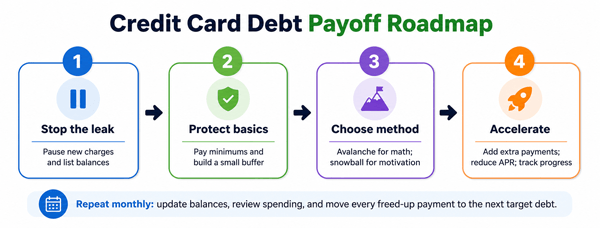
Figure: A practical monthly roadmap for paying off credit card debt.
Step 1: Stop Adding New Credit Card Debt
Before you choose a payoff strategy, stop the balance from growing. This does not mean you can never use credit cards again. It means you need a temporary rule: no new charges unless you can pay them off immediately.
Practical ways to pause new debt include removing saved cards from shopping apps, switching recurring bills to a debit card or bank account, leaving cards at home, and using a written spending plan for the next 30 days.
Step 2: List Every Credit Card Balance
Create a debt inventory. Include each card name, balance, APR, minimum payment, due date, credit limit, and whether the APR is promotional or regular. This gives you a complete picture and helps you choose the best payoff method.
| Card | Balance | APR | Minimum payment | Due date | Credit limit |
|---|---|---|---|---|---|
| Card A | $2,400 | 24.99% | $75 | 5th | $4,000 |
| Card B | $900 | 19.99% | $35 | 12th | $2,000 |
| Card C | $5,200 | 27.99% | $160 | 20th | $7,000 |
Step 3: Build a Bare-Bones Debt Payoff Budget
A debt payoff budget is not about punishment. It is about finding money that can be redirected toward the balance. Start with essentials: housing, food, utilities, transportation, insurance, minimum debt payments, and basic savings. Then look for temporary reductions in subscriptions, dining out, impulse purchases, unused memberships, and nonessential upgrades.
Your goal is to create a monthly debt payoff amount. For example, if your minimum payments total $270 and you can free up $230, your total monthly debt payment becomes $500. That extra $230 is what creates real momentum.
Simple formula: total monthly debt payoff amount = all minimum payments + safe extra payment from your budget. Keep this amount realistic so you do not miss essentials or create new credit card debt.
Step 4: Always Pay at Least the Minimum on Every Card
Minimum payments are not ideal as a long-term strategy, but missing them is worse. Late payments can lead to fees, penalty rates, collection activity, and credit score damage. Set automatic payments for at least the minimum if possible. Then make extra payments manually toward your target card.
Step 5: Choose a Payoff Method
Two popular credit card payoff methods are the debt avalanche and debt snowball. Both work, but they serve different needs.
| Method | How it works | Best for | Main advantage | Main drawback |
|---|---|---|---|---|
| Debt avalanche | Pay minimums on all cards, then put extra money toward the highest APR debt first. | People who want to save the most interest. | Usually the mathematically cheapest method. | May feel slow if the highest-rate balance is large. |
| Debt snowball | Pay minimums on all cards, then put extra money toward the smallest balance first. | People who need quick wins and motivation. | Builds confidence by eliminating small debts first. | May cost more interest if high-rate debts wait. |
| Hybrid method | Start with one small balance for motivation, then switch to highest APR. | People who want both momentum and interest savings. | Balanced and realistic. | Requires more tracking. |
Step 6: Consider Ways to Lower the Interest Rate
Lowering your APR can help more of each payment go toward principal. Options may include asking your card issuer for a lower rate, using a balance transfer card, taking a debt consolidation loan, or entering a nonprofit credit counseling debt management plan. Each option has risks, so compare costs before deciding.
Before applying for a balance transfer or consolidation loan, compare the total cost, including transfer fees, origination fees, promotional deadlines, regular APR after the offer ends, and whether the new payment fits your monthly budget.
| Option | Potential benefit | Key risk or limitation |
|---|---|---|
| Ask for a lower APR | Simple and free to try. | Issuer may say no or offer only a small reduction. |
| Balance transfer card | Promotional 0% APR can reduce interest temporarily. | Transfer fees, limited promo period, and possible high APR later. |
| Debt consolidation loan | One fixed payment may be easier to manage. | May not help if you keep using credit cards. |
| Nonprofit credit counseling | Can provide budgeting help and structured repayment. | Some plans may require closing cards or limiting card use. |
| Debt settlement | May reduce the amount paid in some cases. | Can damage credit, trigger taxes, include fees, and attract scams. |
Step 7: Make Extra Payments Strategically
Once minimums are covered, put every extra dollar toward one target debt. This is more effective than spreading extra payments thinly across all cards. When one card is paid off, roll its old payment into the next card. This is sometimes called a debt snowball payment roll-up, and it works with either the snowball or avalanche method.
Step 8: Track Progress Monthly
Credit card debt payoff can take months or years, so tracking matters. At the end of each month, record your new balances, interest charged, payments made, and total debt reduction. Seeing the balance fall can keep you motivated.
■ Best Ways to Pay Off Credit Card Debt
1. Debt Avalanche Method
The avalanche method is usually best if your main goal is to save money on interest. You attack the card with the highest APR first while paying minimums on the rest. Once the highest-rate debt is gone, you move to the next highest rate.
Example: You have three cards: $5,200 at 27.99%, $2,400 at 24.99%, and $900 at 19.99%. With the avalanche method, your extra payment goes to the 27.99% card first.
2. Debt Snowball Method
The snowball method is best if motivation is your biggest challenge. You pay off the smallest balance first, regardless of APR. The quick win can make the plan feel achievable.
Example: With the same three cards, your extra payment goes to the $900 balance first. After that is paid off, you move its payment to the next smallest balance.
3. Balance Transfer Strategy
A balance transfer can move credit card debt from a high-interest card to a card with a temporary low or 0% promotional APR. This can be useful if you qualify and can pay the balance during the promotional period. Always check the transfer fee, the length of the promotional rate, the regular APR after the promotion, and whether new purchases lose the grace period.
4. Debt Consolidation Loan
A debt consolidation loan combines multiple credit card balances into one installment loan. It can simplify payments and may lower the interest rate. However, consolidation is not a cure by itself. If you pay off cards with a loan and then run the cards back up, you can end up with both loan debt and new credit card debt.
5. Credit Counseling and Debt Management Plan
A nonprofit credit counseling agency may help you create a budget and, if appropriate, set up a debt management plan. In a debt management plan, you usually make one monthly payment to the agency, and the agency pays your creditors. Some creditors may reduce rates or waive certain fees. This is different from debt settlement, which often asks you to stop paying creditors and can seriously damage credit.
■ What Not to Do When Paying Off Credit Card Debt
- Do not ignore statements or collection notices.
- Do not use one credit card to make payments on another unless you fully understand fees and risks.
- Do not rely on payday loans or high-cost cash advances to make credit card payments.
- Do not drain your entire emergency fund unless the situation is urgent and planned.
- Do not pay upfront fees to a debt relief company that promises guaranteed results.
Use extra caution with any company that guarantees debt elimination, pressures you to stop communicating with creditors, or asks for fees before doing the promised work.
- Do not close every paid-off card immediately without understanding credit utilization and credit history effects.
6. How Credit Card Debt Affects Your Credit Score
Credit card debt can affect credit scores mainly through payment history and credit utilization. Payment history looks at whether you pay on time. Credit utilization compares your balances with your credit limits. For example, if you owe $4,000 across cards with $10,000 in total limits, your utilization is 40%.
Paying down credit card balances can often help your credit profile because it lowers utilization. However, results vary based on your full credit report. The best long-term habits are paying on time, lowering balances, avoiding unnecessary applications, and keeping accounts in good standing.
7. When Credit Card Debt Is an Emergency
Credit card debt becomes urgent when you cannot make minimum payments, are using cards for basic living expenses every month, are receiving collection notices, are considering payday loans to stay current, or feel unable to manage the stress. In that situation, focus first on essentials: food, housing, utilities, transportation to work, insurance, and minimum payments where possible. Then contact your creditors, explore hardship programs, and consider reputable nonprofit credit counseling.
■ Practical Monthly Credit Card Debt Payoff Checklist
- Update all balances and APRs.
- Pay every minimum payment before the due date.
- Choose one target card for extra payments.
- Make at least one extra payment as soon as money is available.
- Review spending categories that caused new debt.
- Move any windfalls, refunds, bonuses, or side income toward the target card.
- Celebrate progress without adding new debt.
■ Common Myths About Credit Card Debt
| Myth | Reality |
|---|---|
| Carrying a balance helps your credit score. | You do not need to carry interest-bearing debt to build credit. Paying on time and using credit responsibly matter more. |
| Minimum payments are enough. | They keep you current, but they can make debt last much longer and cost more interest. |
| Consolidation automatically fixes debt. | It only helps if the new payment is affordable and you stop creating new card balances. |
| Debt settlement has no downside. | Settlement can damage credit, include fees, have tax consequences, and attract scams. |
| I need a perfect plan before starting. | A simple plan followed consistently beats a perfect plan that never starts. |
8. Example Payoff Plan for a Beginner
Assume Maya has three credit cards totaling $8,500. Her minimum payments are $270 per month. After reviewing her budget, she can afford $500 per month toward debt.
| Card | Balance | APR | Minimum | Plan |
|---|---|---|---|---|
| Card A | $5,200 | 27.99% | $160 | Target first using avalanche. |
| Card B | $2,400 | 24.99% | $75 | Pay minimum until Card A is paid off. |
| Card C | $900 | 19.99% | $35 | Pay minimum unless choosing snowball for motivation. |
Using the avalanche method, Maya pays the minimums on Cards B and C, then sends the remaining debt payoff money to Card A. When Card A is paid off, she rolls that payment into Card B, then Card C. She also removes saved cards from online stores and builds a $500 starter emergency fund so small surprises do not go back on the cards.
9. How to Stay Out of Credit Card Debt After Paying It Off
Paying off credit card debt is a major achievement. Staying out of debt requires a new system. Keep a small emergency fund, use a monthly budget, pay the full statement balance when possible, set spending alerts, avoid using credit cards for emotional purchases, and review statements weekly. If a card helped you overspend, consider using it only for one predictable bill that you pay off automatically.
■ Frequently Asked Questions
1. What is the fastest way to pay off credit card debt?
The fastest practical way is to stop new charges, pay every minimum on time, put extra money toward one target card, and use either the avalanche or snowball method. Lowering your interest rate can also speed up progress.
2. Should I pay off the highest interest card first or the smallest balance?
Paying the highest interest card first usually saves the most money. Paying the smallest balance first may be better if quick wins help you stay motivated.
3. Is credit card consolidation a good idea?
It can be helpful if it lowers your rate, creates an affordable payment, and you stop adding new card debt. It can be harmful if it simply frees up cards for more spending.
4. Should I close a credit card after paying it off?
Not always. Closing a card can reduce available credit and increase utilization. However, closing may make sense if the card has high fees or creates a strong temptation to overspend.
5. Can I negotiate credit card debt myself?
You can contact your card issuer to ask about lower rates, hardship programs, payment plans, or fee waivers. Results vary, but it is often worth asking before missing payments.
6. Is debt settlement the same as debt management?
No. Debt management usually focuses on structured repayment, often through nonprofit credit counseling. Debt settlement usually tries to settle debts for less than owed and can involve missed payments, credit damage, fees, and tax issues.
7. How much should I pay toward credit card debt each month?
Pay at least the minimum on every card. Then pay as much extra as your budget safely allows without missing essentials or creating new debt.
8. What if I cannot afford the minimum payments?
Prioritize basic needs, contact creditors quickly, ask about hardship options, and consider speaking with a reputable nonprofit credit counselor. Avoid companies that demand upfront fees or promise guaranteed debt elimination.
■ Final Thoughts: The Best Credit Card Debt Plan Is the One You Can Follow
Credit card debt management is not about shame. It is about creating a realistic plan and repeating it consistently. Start by stopping new debt, listing every balance, protecting your minimum payments, choosing a payoff method, and sending extra money to one target card at a time. As balances fall, your confidence grows and more of your income becomes available for savings, investing, and long-term financial goals.
Editorial note: Because credit card debt is a personal finance topic, readers should verify rates, fees, program terms, and legal requirements with official sources, their card issuer, or a qualified professional before making decisions.
Sources and References
- Consumer Financial Protection Bureau, Credit Cards consumer resources, January 2026.
- Federal Reserve Board, Consumer Credit - G.19 release, June 5, 2026.
- Federal Trade Commission, How To Get Out of Debt.
- Federal Trade Commission, Debt Relief and Credit Repair Scams.
- Consumer Financial Protection Bureau, Regulation Z repayment disclosure appendix for minimum payment estimates.
- Federal Reserve Board, Consumer Credit - G.19, current release: https://www.federalreserve.gov/releases/g19/current/default.htm
- Consumer Financial Protection Bureau, Credit Cards consumer resources: https://www.consumerfinance.gov/consumer-tools/credit-cards/
- Consumer Financial Protection Bureau, understanding minimum payments: https://www.consumerfinance.gov/consumer-tools/educator-tools/youth-financial-education/teach/activities/understanding-minimum-payments/
- Federal Trade Commission, Debt Relief and Credit Repair Scams: https://www.ftc.gov/news-events/topics/consumer-finance/debt-relief-credit-repair-scams
- Google Search Central, creating helpful, reliable, people-first content: https://developers.google.com/search/docs/fundamentals/creating-helpful-content
Reader Advice: This article is for educational and informational purposes only and should not be taken as personal financial, legal, tax, or credit advice. Please check the latest information from official sources or qualified professionals, as rules, fees, rates, and policies can change over time.