Debt-to-Income Ratio Explained: Meaning, Formula and Good Ratio
Your debt-to-income ratio, often called DTI, is one of the simplest ways to measure how much of your monthly income is already committed to debt payments. Lenders use it to judge whether you can comfortably handle another loan. You can also use it for your own financial planning, even if you are not applying for credit right now.
A low DTI usually means you have more room in your budget for savings, emergencies, and everyday living costs. A high DTI may mean you are stretched, even if your credit score looks good. This guide explains what DTI means, how to calculate it, what counts as debt, what a good ratio is, and how to lower it step by step.
Quick Answer: What Is Debt-to-Income Ratio?
Debt-to-income ratio is the percentage of your gross monthly income that goes toward required monthly debt payments. Gross income means income before taxes and deductions. The Consumer Financial Protection Bureau explains the basic calculation as adding monthly debt payments and dividing them by gross monthly income. In simple terms, DTI answers one question: how much of your income is already promised to debt before you take on anything new?
Simple formula: DTI = Total monthly debt payments ÷ Gross monthly income × 100.
Example: If your required monthly debt payments are $1,800 and your gross monthly income is $5,000, your DTI is 36% because $1,800 ÷ $5,000 × 100 = 36%.
| DTI Level | General Meaning | Practical Interpretation |
|---|---|---|
| Under 20% | Very strong | You likely have plenty of income left after debt payments. |
| 20% to 35% | Good | Often considered a healthy range for many borrowers. |
| 36% to 43% | Moderate | May still be workable, but your budget has less flexibility. |
| 44% to 50% | High | Loan approval may be harder and monthly pressure may increase. |
| Above 50% | Very high risk | A large share of income is already committed to debt. Focus on reducing debt before borrowing more. |
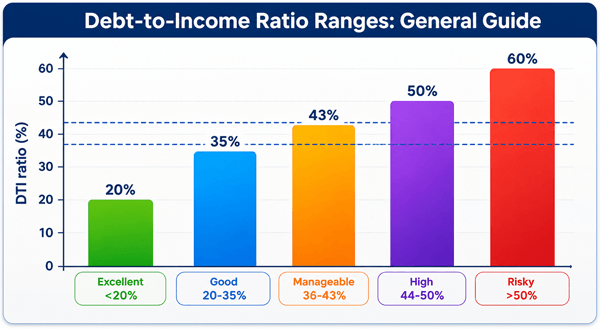
Figure: General DTI ranges. These ranges are educational guidelines, not universal approval rules. Different lenders and loan programs use different standards.
1. Why Debt-to-Income Ratio Matters
DTI matters because it connects your income to your debt obligations. A person earning $10,000 per month with $1,000 in required debt payments is in a very different position from a person earning $3,000 per month with the same $1,000 in payments.
Lenders care about DTI because it helps estimate repayment capacity. A high credit score shows how you have handled credit in the past. DTI shows whether your current income can support your current and proposed payments.
DTI can affect:
- Mortgage approval and loan size
- Auto loan and personal loan approval
- Credit card underwriting
- Interest rate offers in some cases
- How much financial breathing room you have each month
For personal planning, DTI is also useful before you apply for credit because it helps you compare the payment a lender may approve with the payment you can comfortably afford.
2. Debt-to-Income Ratio Formula
Use this formula for the standard back-end DTI ratio:
Debt-to-income ratio = (Total monthly debt payments ÷ Gross monthly income) × 100
Gross monthly income is income before taxes, health insurance, retirement contributions, and other deductions. Monthly debt payments are required recurring debt payments, not every expense in your budget.
Step-by-step DTI calculation
- List your required monthly debt payments.
- Add them together.
- Find your gross monthly income.
- Divide total monthly debt payments by gross monthly income.
- Multiply by 100 to convert the answer into a percentage.
| Item | Monthly Amount |
|---|---|
| Rent or mortgage payment | $1,200 |
| Car loan | $350 |
| Student loan | $250 |
| Credit card minimum payments | $150 |
| Personal loan | $200 |
| Total monthly debt payments | $2,150 |
| Gross monthly income | $6,000 |
| DTI calculation | $2,150 ÷ $6,000 × 100 = 35.8% |
In this example, the person has a DTI of about 36%. That means roughly 36 cents of every pre-tax dollar are already committed to required debt payments.
3. What Counts as Debt in Your DTI?
A common beginner mistake is including every bill. DTI is not the same as a full budget. It usually focuses on required debt payments, although mortgage underwriting may also include full housing costs such as taxes, insurance, mortgage insurance, and homeowners association dues.
| Usually Included in DTI | Usually Not Included in DTI |
|---|---|
| Mortgage or rent payment | Groceries |
| Home equity loan or line payment | Utilities such as electricity or water |
| Auto loan or lease payment | Phone and internet bills |
| Student loan payment | Insurance premiums not tied to a mortgage payment |
| Credit card minimum payments | Gas, transportation, and parking costs |
| Personal loan payments | Streaming subscriptions and memberships |
| Child support or alimony obligations when required | Income taxes and payroll deductions |
Important note: Mortgage lenders may calculate housing costs differently from other lenders. A mortgage DTI may include principal, interest, property taxes, homeowners insurance, mortgage insurance, and homeowners association dues. Some obligations, such as child support, alimony, co-signed debts, or deferred student loans, may also be treated differently depending on the loan program. Always ask the lender how it calculates your ratio.
4. Front-End DTI vs Back-End DTI
There are two common types of DTI: front-end and back-end. Understanding the difference is especially important for mortgages.
| Type of DTI | What It Measures | Formula | Common Use |
|---|---|---|---|
| Front-end DTI | Housing costs only | Monthly housing payment ÷ gross monthly income × 100 | Mortgage affordability |
| Back-end DTI | All required monthly debt payments, including housing | Total monthly debt payments ÷ gross monthly income × 100 | Mortgage, auto, personal loan, and overall credit review |
Example: If your gross monthly income is $6,000 and your proposed housing payment is $1,500, your front-end DTI is 25%. If your total debt payments including housing are $2,300, your back-end DTI is 38.3%.
5. What Is a Good Debt-to-Income Ratio?
There is no single perfect DTI ratio for every person or every lender. However, as a practical rule, lower is better because it gives you more room for savings, emergencies, and everyday living costs.
A DTI below 36% is commonly viewed as a strong target for many borrowers. A ratio between 36% and 43% may still be acceptable, especially if your credit, income stability, savings, and down payment are strong. Above 43%, approval can become more difficult for many loan types, and the monthly budget risk rises. The most useful DTI target is the one that leaves enough money for taxes, food, utilities, insurance, savings, and emergencies after debt payments.
| DTI Range | How to Think About It | Possible Action |
|---|---|---|
| 0% to 20% | Excellent debt flexibility | Keep saving and avoid unnecessary new debt. |
| 21% to 35% | Generally healthy | Good range for many goals; monitor new borrowing. |
| 36% to 43% | Caution zone | Review your budget before adding debt; pay down balances where possible. |
| 44% to 50% | High | Consider delaying major borrowing or increasing income before applying. |
| Over 50% | Very high | Make debt reduction a priority; avoid taking on new debt unless necessary. |
6. Debt-to-Income Ratio and Mortgage Approval
Mortgage lenders often pay close attention to DTI because a home loan is usually a large, long-term obligation. Standards vary by loan program, underwriting system, lender overlays, credit score, cash reserves, and property type.
As current reference points: CFPB materials describe DTI as monthly debt payments divided by gross monthly income. Fannie Mae states that manually underwritten loans generally have a maximum total DTI of 36%, with the possibility of going up to 45% when credit score and reserve requirements are met; Desktop Underwriter loan casefiles may allow up to 50%. The CFPB has explained that the General Qualified Mortgage rule historically used a 43% DTI limit, but the current General QM definition is based mainly on loan pricing and other rule requirements rather than a single universal DTI cap. These are not personal approval guarantees; lender rules can differ.
| Mortgage Context | Common DTI Reference Point | What It Means for Borrowers |
|---|---|---|
| General affordability guideline | 28/36 rule | Housing costs under 28% and total debts under 36% is a conservative benchmark. |
| General QM historical benchmark | 43% total DTI (historical) | A useful historical risk reference; current General QM rules are not based only on one universal DTI cap. |
| Fannie Mae manual underwriting | 36%, sometimes up to 45% | Higher DTI may require stronger credit and reserves. |
| Fannie Mae DU automated underwriting | Up to 50% | Possible in some automated approvals, but not guaranteed. |
Practical takeaway: Do not assume that one published DTI number guarantees approval. A lender also reviews credit history, assets, income reliability, down payment, loan type, property details, and recent debt behavior.
7. Does Debt-to-Income Ratio Affect Your Credit Score?
Your DTI ratio does not directly appear as a credit score factor in the same way payment history or credit utilization does. Credit scoring models generally do not know your full income unless it is separately provided to a lender. However, DTI can still strongly affect loan approval because lenders ask for income and debt information during underwriting.
DTI and credit utilization are related but different. Credit utilization compares your credit card balances to your credit limits. DTI compares required debt payments to gross monthly income.
| Metric | Compares | Used For | Can You Improve It? |
|---|---|---|---|
| DTI ratio | Monthly debt payments vs. gross income | Loan affordability and underwriting | Yes: reduce payments or increase income. |
| Credit utilization | Credit card balances vs. credit limits | Credit scoring and revolving credit risk | Yes: lower card balances or increase limits responsibly. |
■ How to Improve a High Debt-to-Income Ratio
There are only two basic ways to lower DTI: reduce monthly debt payments or increase gross monthly income. The best plan often uses both.
1. Pay down or pay off debt strategically
Focus first on debts that create large required monthly payments or high interest costs. Paying off a small loan completely can sometimes lower DTI more than making a small extra payment on a large long-term loan, because the required monthly payment disappears.
2. Avoid new debt before applying for a loan
New credit cards, auto loans, personal loans, and buy now pay later plans may raise your monthly obligations or change how a lender views your file. If you plan to apply for a mortgage, avoid adding debt unless it is necessary.
3. Refinance or consolidate carefully
Refinancing or consolidating can lower your required monthly payment, which may improve DTI. But it may also extend your repayment period, add fees, or increase total interest. Compare the total cost, not just the lower monthly payment.
4. Increase documented income
A raise, second job, overtime, business income, rental income, or consistent freelance income may help if the lender accepts and documents it. Lenders usually require proof and may average variable income over time.
5. Choose a less expensive loan amount
For a mortgage or car loan, borrowing less can reduce the new monthly payment and keep DTI within a safer range. A larger down payment can also help, if it does not drain your emergency savings.
| Action | How It Helps DTI | Watch Out For |
|---|---|---|
| Pay off a loan completely | Removes a monthly payment | May use cash that you need for emergencies. |
| Pay down credit cards | Can reduce minimum payments and improve utilization | Minimum payments may not fall immediately. |
| Refinance debt | May lower required monthly payment | Can extend the loan and increase total interest. |
| Increase income | Raises the denominator in the DTI formula | Income must often be stable and documentable. |
| Borrow less | Reduces the new proposed payment | May require changing the purchase budget. |
■ Common Debt-to-Income Ratio Mistakes to Avoid
- Using take-home pay instead of gross income when calculating standard DTI.
- Counting every monthly bill as debt instead of focusing on required debt payments.
- Forgetting small obligations such as minimum credit card payments, student loans, or child support.
- Assuming a high income automatically means a safe DTI. High earners can still be overextended.
- Applying for new credit shortly before a mortgage application.
- Ignoring the difference between what a lender may approve and what you can comfortably afford.
- Only lowering the monthly payment without checking the total cost of refinancing or consolidation.
8. Practical Examples
Example 1: Good DTI but weak savings
Maya earns $5,500 per month before taxes and has $1,400 in monthly debt payments. Her DTI is 25.5%, which looks good. But she has almost no emergency savings. Her DTI is healthy, but she should still build cash reserves before taking on a larger loan.
Example 2: High DTI despite good credit
Daniel has a 760 credit score and earns $6,000 per month. His monthly debts total $3,000, so his DTI is 50%. Even with strong credit, he may struggle to qualify for additional debt because half of his gross income is already committed to payments.
Example 3: Lowering DTI before a mortgage
Aisha earns $7,000 per month and has $2,900 in debt payments, a DTI of 41.4%. She pays off a personal loan with a $300 monthly payment. Her new debt total is $2,600, and her DTI falls to 37.1%. That improvement may make her application stronger and her budget safer.
9. DTI Ratio Calculator Worksheet
Use this simple worksheet before applying for a loan.
| Debt or Income Item | Your Monthly Amount |
|---|---|
| Mortgage or rent | |
| Auto loan or lease | |
| Student loan | |
| Credit card minimum payments | |
| Personal loans | |
| Child support or alimony | |
| Other required debt payments | |
| Total monthly debt payments | |
| Gross monthly income | |
| DTI = total debt ÷ gross income × 100 |
10. Pros and Limits of Using DTI
DTI is useful, but it is not a complete picture of financial health.
| Benefits of DTI | Limitations of DTI |
|---|---|
| Easy to calculate and understand | Uses gross income, not take-home pay. |
| Helps lenders assess repayment capacity | Does not show savings, emergency funds, or spending habits. |
| Useful for comparing borrowing options | Does not directly measure credit history. |
| Can reveal debt stress early | May vary depending on lender rules and loan type. |
11. Best Practices for a Healthy DTI
- Check your DTI before applying for a major loan.
- Keep total debt payments comfortably below what a lender says you can technically borrow.
- Build an emergency fund so a low DTI is supported by real cash flexibility.
- Pay more than the minimum on high-interest debt when possible.
- Review your debts at least twice a year and before major financial decisions.
- Avoid using DTI alone. Also consider credit score, savings rate, job stability, and long-term goals.
■ Frequently Asked Questions
1. What is the debt-to-income ratio in simple words?
It is the share of your monthly income that goes toward debt payments. If your DTI is 35%, about 35% of your gross monthly income is already committed to required debt payments.
2. What is the formula for DTI?
DTI = total monthly debt payments ÷ gross monthly income × 100.
3. Is rent included in debt-to-income ratio?
For many mortgage affordability calculations, housing costs are included. For some non-mortgage credit decisions, a lender may treat rent differently. When calculating your own financial stress, include rent because it is a major fixed obligation.
4. Are credit card balances included in DTI?
Usually the required minimum monthly payment is included, not the full card balance. However, the full balance matters for credit utilization and interest costs.
5. Is a 30% DTI good?
Yes, a 30% DTI is generally considered a healthy range for many borrowers, assuming your income is stable and you also have enough savings for emergencies.
6. Is a 45% DTI bad?
A 45% DTI is high. Some lenders may still approve certain borrowers, but the budget may be tight. Before borrowing more, test whether the payment is comfortable after taxes, savings, insurance, food, transportation, and emergencies.
7. Can I get a mortgage with a high DTI?
Possibly. Some programs and automated underwriting systems may allow higher DTI if other factors are strong, such as credit history, reserves, down payment, income stability, and loan type. But approval is not guaranteed, and a higher DTI can increase financial stress.
8. How fast can I lower my DTI?
You can lower DTI quickly if you pay off a debt that has a required monthly payment or if your documented income increases. Paying down credit card balances may help too, but minimum payments may update on the next statement cycle.
9. Does DTI include taxes?
The standard formula uses gross income before taxes. However, smart personal budgeting should also look at take-home pay because that is the money you actually spend.
■ Final Takeaway
Debt-to-income ratio is a practical financial health measure that shows how much of your gross monthly income is already committed to required debt payments. The formula is simple: total monthly debt payments divided by gross monthly income, multiplied by 100. A lower DTI usually improves your borrowing profile and gives you more financial flexibility.
For many people, a DTI below 36% is a strong target. Between 36% and 43% can still be workable, but it deserves caution. Above 43%, you should review your budget carefully and consider reducing debt before taking on more obligations. The best DTI is not just the one a lender will accept; it is the one that lets you pay bills, save, handle emergencies, and sleep well at night.
Source Notes
This article has been prepared using general financial education principles and current public guidance from the Consumer Financial Protection Bureau on DTI calculation; CFPB information on qualified mortgages; and Fannie Mae Selling Guide information on debt-to-income ratios. Readers should confirm current requirements with their lender because underwriting standards vary and can change.
Key references: Consumer Financial Protection Bureau, “What is a debt-to-income ratio?”; Consumer Financial Protection Bureau, “Qualified Mortgage Definition under the Truth in Lending Act”; Consumer Financial Protection Bureau, General QM Final Rule updates; Fannie Mae Selling Guide B3-6-02, “Debt-to-Income Ratios.”
Reader Advice: This article is for educational and informational purposes only and should not be taken as personalized financial, legal, tax, or lending advice. Please check the latest information from official sources or your lender, as rules, policies, and requirements can change over time.