Debt Management: Guide to Debt Management Plans & Payoff Strategies
Quick answer: Debt management helps you organize all debts, protect essential bills, choose a repayment strategy, and decide whether a nonprofit credit counseling debt management plan is suitable. It is best for people who can make steady payments but need structure, lower rates, or professional guidance.
Debt management is the process of organizing what you owe, creating a realistic repayment plan, reducing financial stress, and making steady progress toward becoming debt-free. It is not a magic trick, and it does not erase debt overnight. Done well, it gives you control, structure, and a clear next step.
This guide explains debt management in plain English. You will learn what debt management means, how debt management plans work, which debts usually qualify, how to compare payoff strategies, when to get professional help, and how to avoid common traps.
- Debt management means creating a structured plan to repay debt while protecting your essential living needs.
- A debt management plan, often called a DMP, is usually arranged through a nonprofit credit counseling agency and is not a new loan.
- A DMP can simplify payments and may reduce interest rates or fees, but it usually requires consistent monthly payments and may limit new credit use.
- Debt management is different from debt settlement, debt consolidation, credit repair, and bankruptcy.
- The best approach depends on your debt type, interest rates, income stability, credit score, and how far behind you are.
1. What Is Debt Management?
Debt management is a practical system for handling debt in a way that is organized, affordable, and sustainable. It usually includes listing all debts, understanding interest rates and minimum payments, building a budget, choosing a payoff strategy, communicating with creditors when needed, and tracking progress each month.
At its simplest, debt management answers four questions:
- How much do I owe in total?
- Which debts are most urgent or expensive?
- How much can I realistically pay every month?
- What plan will help me pay the debt down without falling further behind?
Important: Do not treat all debts equally. Priority debts such as housing, utilities, secured loans, tax obligations, and court-ordered payments may require faster action than unsecured credit card debt because the consequences can be more immediate.
2. What Is a Debt Management Plan?
A debt management plan, or DMP, is a structured repayment arrangement usually administered by a nonprofit credit counseling agency. You make one monthly payment to the agency, and the agency distributes payments to your creditors. The goal is usually to repay your enrolled debts in full under more manageable terms.
A DMP is not a loan. It does not replace your debt with new borrowing. It also does not guarantee that debt will be forgiven. Credit counselors can often ask creditors for lower interest rates, waived fees, or more manageable payment terms, but creditor participation is not always guaranteed.
Figure 1. Typical debt management workflow
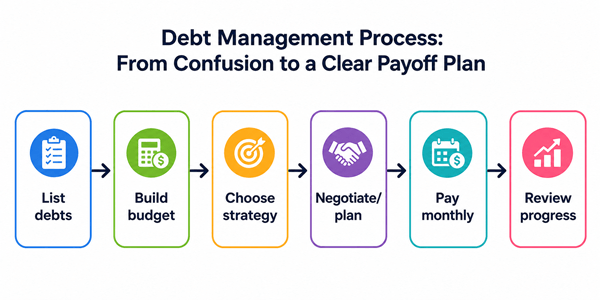
Source note: The Consumer Financial Protection Bureau explains that credit counselors may help create debt management plans and that, under a DMP, you typically make one payment to the counseling organization, which then pays creditors. The Federal Trade Commission warns that legitimate counselors should review your finances before recommending a plan and that DMPs do not help everyone.
3. How Debt Management Works Step by Step
Step 1: List every debt
Write down each balance, interest rate, minimum payment, due date, creditor, and whether the account is current, late, in collections, or charged off.
Step 2: Separate priority debts from non-priority debts
Priority debts are debts that can quickly affect housing, transportation, utilities, legal status, or essential services. Examples may include rent, mortgage, car loan, taxes, child support, and utility arrears. Non-priority debts often include credit cards, medical bills, unsecured personal loans, and many collections accounts.
Step 3: Build a survival budget first
Before choosing a payoff method, make sure basic needs are covered: housing, food, utilities, transportation, insurance, minimum debt payments, and essential medical costs.
Step 4: Choose a payoff method
Common methods include the debt snowball, debt avalanche, debt consolidation, creditor hardship plans, or a formal debt management plan.
Step 5: Automate and track payments
Use automatic payments where safe, calendar reminders, and a monthly debt tracker. Tracking matters because debt payoff is usually a months-or-years process.
Step 6: Review the plan monthly
If income changes, expenses rise, or a creditor changes terms, update the plan instead of ignoring the problem.
4. Types of Debt: Which Debts Can Debt Management Help With?
| Debt type | Can debt management help? | What to know |
|---|---|---|
| Credit cards | Often yes | Credit cards are commonly included in DMPs. A counselor may request lower rates or fee concessions. |
| Medical bills | Sometimes | Hospitals or providers may offer payment plans, financial assistance, or negotiated balances. |
| Unsecured personal loans | Often possible | Some lenders may participate in a DMP or hardship arrangement. |
| Collection accounts | Sometimes | You may need to validate the debt, negotiate carefully, or request written terms before paying. |
| Student loans | Usually separate | Federal student loans have their own repayment, deferment, forbearance, and forgiveness rules. |
| Mortgage or rent | Priority debt | Do not ignore. Seek housing counseling or legal/local assistance if at risk of eviction or foreclosure. |
| Auto loans | Priority debt | Falling behind can risk repossession. Contact the lender early if payment is unaffordable. |
| Tax debt | Special rules | Tax agencies may offer installment agreements or hardship status. Consider qualified tax help. |
5. Debt Management vs. Debt Consolidation vs. Debt Settlement
| Option | What it means | Best for | Main risks |
|---|---|---|---|
| Debt management plan | A credit counseling agency helps organize repayment, often with one monthly payment to the agency. | People with mostly unsecured debt who can afford a monthly payment but need structure or lower rates. | May require closing or pausing credit cards; fees may apply; success requires consistent payments. |
| Debt consolidation loan | You borrow one new loan to pay off multiple debts. | People with good enough credit to qualify for a lower interest rate and disciplined repayment. | You can end up deeper in debt if you keep using paid-off credit cards. |
| Balance transfer card | You move credit card debt to a card with a promotional rate. | People who can repay quickly before the promo rate ends. | Fees, short promotional periods, and high rates after the offer ends. |
| Debt settlement | A company or you negotiate to pay less than the full balance. | People already seriously delinquent who cannot repay in full and understand the credit/legal risks. | Can damage credit, trigger collection activity, involve fees, and forgiven debt may have tax consequences. |
| Bankruptcy | A legal process that may discharge or reorganize debt. | People with overwhelming debt and no realistic repayment path. | Credit impact, legal costs, eligibility rules, and long-term financial consequences. |
6. When a Debt Management Plan May Make Sense
- You have multiple high-interest credit cards or unsecured debts.
- You can afford one stable monthly payment if interest rates or fees become more manageable.
- You want to repay debts in full but need a structured plan.
- You are not trying to take on a new loan.
- You are willing to stop using enrolled credit cards while the plan is active.
- You prefer guidance from a certified nonprofit credit counselor.
7. When a Debt Management Plan May Not Be the Best Fit
- Your main problem is secured debt, such as a mortgage or auto loan.
- You cannot afford the proposed monthly payment even after concessions.
- You need legal protection from lawsuits, wage garnishment, foreclosure, or repossession.
- Most of your debt is federal student loans, taxes, child support, or other debts with special rules.
- You are current and can pay debt off faster on your own using the avalanche or snowball method.
8. Debt Payoff Strategies You Can Use Yourself
| Strategy | How it works | Pros | Cons |
|---|---|---|---|
| Debt snowball | Pay minimums on all debts, then put extra money toward the smallest balance first. | Fast emotional wins; easy for beginners to stick with. | May cost more interest than avalanche. |
| Debt avalanche | Pay minimums on all debts, then put extra money toward the highest interest rate first. | Usually saves the most interest mathematically. | First win may take longer if the highest-rate debt has a large balance. |
| Hybrid method | Pay off one small debt first for motivation, then switch to highest interest. | Balances motivation and interest savings. | Requires more tracking. |
| Hardship plan | Ask creditors directly for temporary lower payments, lower rates, or fee waivers. | Can help during short-term income loss. | Terms vary and may affect account status. |
| Spending reset | Temporarily reduce optional spending and direct cash to debt. | Works without new loans or programs. | Can fail if the budget is too strict to maintain. |
9. Practical Example: Choosing a Strategy
Imagine Maria has three credit cards:
| Debt | Balance | Interest rate | Minimum payment |
|---|---|---|---|
| Card A | $450 | 24% | $25 |
| Card B | $3,200 | 19% | $95 |
| Card C | $7,000 | 29% | $210 |
If Maria uses the snowball method, she attacks Card A first because it has the smallest balance. This may help her build confidence quickly. If she uses the avalanche method, she attacks Card C first because it has the highest interest rate. This is likely to save more money, but progress may feel slower at first.
The best plan is the one Maria can actually follow. A mathematically perfect plan that fails after two months is less useful than a slightly less efficient plan she can maintain for a year.
■ How to Build a Beginner Debt Management Plan
1. Create a debt inventory
Use a spreadsheet, notebook, budgeting app, or printed worksheet. Include the creditor name, account number ending, balance, interest rate, minimum payment, due date, and status.
2. Calculate your monthly debt payoff amount
Start with take-home income. Subtract essential expenses and minimum payments. The amount left is your extra debt payoff amount. If the number is negative, the first goal is not aggressive payoff; it is stabilizing the budget.
3. Cut expenses carefully
Focus on changes that free up meaningful cash without making life unmanageable. Examples include pausing subscriptions, negotiating phone or internet bills, meal planning, selling unused items, or setting a temporary entertainment limit.
4. Increase income where realistic
Debt payoff becomes easier when the gap between income and expenses grows. Consider overtime, freelancing, part-time work, selling unused items, or asking for a raise. Avoid risky “quick money” schemes or expensive training programs that add more debt.
5. Protect your emergency fund
A small emergency fund helps prevent new debt. Even $500 to $1,000, or a practical local-currency equivalent, can keep a car repair or medical bill from going back on a credit card. After high-interest debt is under control, you can build a larger fund.
■ How Credit Counseling Works
Credit counseling is professional guidance from an organization that reviews your income, expenses, debts, and goals. A counselor may help you make a budget, understand options, and decide whether a DMP is appropriate. Reputable counselors do not push one solution before reviewing your full financial picture.
Before working with an agency, ask:
- Are you a nonprofit organization?
- Are your counselors certified or accredited?
- What fees do you charge, and can fees be reduced or waived if I cannot afford them?
- Will you provide a written action plan?
- Which creditors may participate, and what happens if one does not?
- How will the plan affect my credit cards and credit report?
- Can I cancel the plan, and what happens if I miss a payment?
Verification tip: Check whether the agency is accredited, whether counselors are certified, and whether complaints or licensing information can be reviewed through official consumer-protection or state/regional regulator websites.
10. Costs, Credit Impact, and Timeline
| Question | Beginner-friendly answer |
|---|---|
| How long does debt management take? | Many formal DMPs take several years. The FTC notes that successful plans can take 48 months or more, depending on your situation. |
| Does a DMP hurt credit? | A DMP itself is not the same as bankruptcy, but creditors may close accounts or report account changes. Missing payments before or during the plan can hurt credit. Over time, lower balances and on-time payments may help. |
| Are there fees? | Credit counseling agencies may charge fees. Ask for all setup and monthly fees in writing. |
| Can I use credit cards? | Many plans require you not to use or apply for new credit while enrolled. |
| Can creditors still contact me? | A DMP is not the same as legal protection. Ask the agency how creditor communications are handled. |
11. Warning Signs of Debt Relief Scams
Be cautious if a company:
- Guarantees it can erase debt or raise your credit score quickly.
- Charges large upfront fees before doing any work.
- Tells you to stop communicating with creditors without explaining the consequences.
- Pressures you to sign immediately.
- Claims a special government program will eliminate your credit card debt.
- Refuses to provide fees, risks, and terms in writing.
- Promises results before reviewing your finances.
A trustworthy debt management provider should explain both benefits and risks. If the sales pitch sounds too easy, slow down and verify the organization before sharing personal information.
12. Common Debt Management Mistakes to Avoid
- Only paying minimums without a payoff plan.
- Using a consolidation loan while continuing to run up credit cards.
- Ignoring priority debts such as rent, mortgage, car payments, taxes, or child support.
- Choosing debt settlement without understanding credit, collection, legal, and tax risks.
- Failing to build even a small emergency cushion.
- Not reading the written agreement before enrolling in any program.
- Assuming one strategy works for every type of debt.
13. Debt Management Checklist for Beginners
- List all debts and balances.
- Mark debts as priority or non-priority.
- Check interest rates and minimum payments.
- Build a realistic monthly budget.
- Choose snowball, avalanche, hardship plans, consolidation, or credit counseling based on your situation.
- Contact creditors before missing payments if you are struggling.
- Get all program terms in writing.
- Track balances monthly.
- Avoid taking on new debt while paying off old debt.
- Review your plan every 30 days.
14. Pros and Cons of Debt Management Plans
| Pros | Cons |
|---|---|
| One monthly payment can be easier to manage. | It may take years to complete. |
| May reduce interest rates or waive certain fees. | Not all creditors or debt types qualify. |
| Provides structure and professional guidance. | You may need to stop using enrolled credit accounts. |
| Can help you avoid more expensive or risky options. | Fees may apply. |
| Focuses on repaying debt rather than borrowing more. | Missing payments can disrupt the plan. |
■ Frequently Asked Questions
1. Is debt management the same as debt consolidation?
No. Debt management is a repayment system or program. Debt consolidation usually means taking a new loan or balance transfer to combine debts. A DMP does not require a new loan.
2. Is a debt management plan the same as debt settlement?
No. A DMP usually aims to repay enrolled debts in full under better terms. Debt settlement tries to negotiate payment for less than the full balance and often involves serious delinquency risks.
3. Can I do debt management myself?
Yes. Many people manage debt on their own using a budget, the snowball method, the avalanche method, and direct creditor negotiations. Professional credit counseling can help when you need structure or are overwhelmed.
4. What debts should I pay first?
Protect priority debts first: housing, utilities, transportation, taxes, child support, and debts tied to essential needs. After that, choose a strategy for unsecured debts, such as highest interest first or smallest balance first.
5. Should I close credit cards while paying off debt?
Not always. Closing cards can affect available credit and credit history. However, some DMPs require enrolled cards to be closed or paused. The right choice depends on your plan and spending habits.
6. What if I cannot afford even the minimum payments?
Contact creditors early, consider nonprofit credit counseling, review hardship options, and prioritize essentials. If there is no realistic repayment path, legal advice or bankruptcy counseling may be appropriate.
7. How do I know if a credit counseling agency is legitimate?
Look for nonprofit status, trained or certified counselors, transparent fees, written terms, a complete budget review, and no unrealistic promises. Avoid high-pressure sales tactics.
8. Will debt management fix my credit score?
Debt management is mainly about repayment and stability, not instant credit repair. On-time payments and lower balances can help over time, but missed payments, closed accounts, and past delinquencies may still affect your credit report.
■ Final Thoughts: The Best Debt Management Plan Is Realistic
Debt management works best when it is honest, specific, and repeatable. Start by understanding exactly what you owe. Protect your essential needs. Choose a payoff method that fits your personality and budget. Ask for help before the situation becomes a crisis. Most importantly, measure progress monthly instead of expecting perfection.
The goal is not just to get out of debt. The goal is to build a money system that keeps you from going back into the same cycle.
Sources Consulted:
Official-source reminder: For the latest rules and consumer alerts, check official sources such as consumerfinance.gov, consumer.ftc.gov, studentaid.gov, irs.gov, your state or national consumer-protection office, and your creditor’s written terms.
- Consumer Financial Protection Bureau: Difference between credit counseling, debt settlement, debt consolidation, and credit repair.
- Consumer Financial Protection Bureau: What is credit counseling?
- Federal Trade Commission: How to get out of debt.
- Federal Trade Commission: Debt relief and credit repair scams.
- National Foundation for Credit Counseling: Debt Management Plan overview.
Additional source URLs for editorial verification: CFPB credit counseling and debt relief resources (consumerfinance.gov); FTC debt and debt relief scam guidance (consumer.ftc.gov); NFCC Debt Management Plan overview (nfcc.org); Federal Student Aid repayment information (studentaid.gov); IRS payment plans and tax debt information (irs.gov).
Reader Advice: This article is for educational and informational purposes only and should not be taken as financial, legal, tax, or credit advice. Please check the latest information from official sources or a qualified professional, as rules, fees, programs, and policies can change over time.
Because debt rules, creditor policies, fees, and relief options can change, readers should verify important decisions with official consumer-protection sources, their creditor, a qualified nonprofit credit counselor, or a licensed professional where appropriate.