How to Avoid Debt and Stay Financially Stable
1. Introduction: Debt Avoidance Is About Control, Not Fear
Avoiding debt does not mean you must never borrow money. It means you understand when debt is risky, when it may be useful, and how to protect your income from being swallowed by payments. Financial stability means your basic needs are covered, your bills are paid on time, you have some savings for surprises, and you are making steady progress toward your goals.
For beginners, the most important idea is simple: debt usually becomes dangerous when spending decisions are made before the repayment plan is clear. This guide explains how to avoid debt, stay financially stable, and build habits that make your money easier to manage over time.
Use this article as a practical starting point, then adjust each step to your income, country, family needs, and the financial rules that apply where you live.
2. Quick Answer: How Do You Avoid Debt?
To avoid debt, spend less than you earn, keep a written budget, build an emergency fund, use credit cards only when you can pay the full balance, avoid lifestyle inflation, compare costs before borrowing, and plan ahead for irregular expenses such as car repairs, school fees, insurance, medical bills, and holidays.
In simple terms, the debt prevention formula is: clear income + realistic budget + emergency savings + careful borrowing decisions + regular review.
- Track where your money goes every month.
- Separate needs, wants, savings, and debt payments.
- Save a small emergency fund before upgrading your lifestyle.
- Avoid using credit for everyday gaps in income.
- Think in monthly payments and total cost, not just affordability today.
- Review your finances regularly so small problems do not become crises.
3. What Does It Mean to Avoid Debt?
Avoiding debt means reducing your need to borrow for normal living expenses and avoiding high-cost debt that weakens your finances. It does not always mean avoiding every mortgage, education loan, or business loan. Some borrowing may support long-term goals, but only if the payment is affordable, the purpose is clear, and the total cost is understood.
| Type of debt decision | What it looks like | Risk level |
|---|---|---|
| Avoidable debt | Using a credit card for clothes, dining out, or gadgets because cash is short | High if unpaid monthly |
| Emergency debt | Borrowing after a medical bill or urgent repair because there is no emergency fund | Medium to high |
| Planned debt | Taking a carefully compared loan for education, home purchase, or business equipment | Depends on cost and repayment plan |
| Toxic debt | Payday loans, very high-interest credit, repeated cash advances, or borrowing to pay other debts | Very high |
4. What Is Financial Stability?
Financial stability means your money situation is strong enough to handle normal life without constant stress. It does not mean you are rich. A financially stable person may still have a modest income, but they manage it carefully, avoid unnecessary debt, and prepare for predictable and unexpected costs.
Signs of financial stability include:
- You can pay essential bills on time.
- You know how much money comes in and goes out.
- You have some emergency savings.
- You are not relying on credit cards or loans for groceries, rent, or utilities.
- Your debt payments, if any, are manageable.
- You can make financial decisions without panic.
5. Why People Fall Into Debt Even When They Try to Be Careful
Most debt problems do not begin with one big mistake. They often begin with small gaps that repeat: spending a little more than income, not planning for irregular bills, using credit cards as backup income, or underestimating how quickly interest grows.
| Common cause | Example | How to prevent it |
|---|---|---|
| No budget | You think you have extra money, but bills are still unpaid | Use a monthly spending plan before spending starts |
| Lifestyle inflation | Income rises, but spending rises just as fast | Save part of every raise before upgrading expenses |
| No emergency fund | A car repair goes on a credit card | Build a starter emergency fund first |
| Minimum-payment habit | Credit card balance stays for months or years | Pay in full or make a fixed payoff plan |
| Buy now, pay later overuse | Several small payments hit at the same time | Track all future payments before buying |
| Social pressure | Spending to match friends, family, or online lifestyles | Set personal limits and use cash-based goals |
Step 1: Know Your Real Income and Expenses
You cannot avoid debt if you do not know whether your spending is higher than your income. Start with your take-home income, not your gross salary. Take-home income is the money you actually receive after taxes, deductions, or business expenses.
Then list your expenses in four groups:
- Fixed essentials: rent or mortgage, utilities, transport, insurance, school fees, minimum debt payments.
- Variable essentials: groceries, fuel, medicine, basic clothing, home supplies.
- Wants: eating out, subscriptions, entertainment, travel, upgrades, hobbies.
- Future costs: emergency savings, annual bills, repairs, gifts, taxes, and long-term goals.
Beginner tip: Look at your last 30 to 90 days of bank statements, wallet spending, and mobile payments. Your memory may underestimate small purchases.
Step 2: Build a Realistic Budget That Prevents Debt
A budget is not a punishment. It is a plan for your income before the month controls you. The best budget is one you can actually follow.
| Budget method | How it works | Best for |
|---|---|---|
| 50/30/20 rule | About 50% needs, 30% wants, 20% savings and debt payoff | Beginners who want a simple starting point |
| Zero-based budget | Every unit of income is assigned a job before the month begins | People who want detailed control |
| Envelope method | Separate money into spending categories, physically or digitally | People who overspend in specific areas |
| Pay-yourself-first | Save first, then spend what remains | People who struggle to save consistently |
Do not force your budget to look perfect on paper. If groceries usually cost $500, budgeting $300 will only push the difference onto a credit card. A useful budget is honest before it is ambitious.
Step 3: Create an Emergency Fund Before You Need One
An emergency fund is money set aside for unexpected but necessary expenses. It is one of the strongest tools for avoiding debt because it gives you cash options when life happens.
A good beginner goal is to save a small starter fund first, such as one month of basic expenses or a realistic amount that covers common emergencies in your life. After that, work toward three to six months of essential expenses if possible. The right number depends on income stability, family responsibilities, health needs, and job security.
| Emergency fund stage | Goal | Use it for | Do not use it for |
|---|---|---|---|
| Starter fund | Small cushion you can build quickly | Minor repairs, urgent medicine, essential travel | Shopping, vacations, gifts |
| Basic stability fund | About one month of essentials | Income delays, larger repairs, temporary gaps | Lifestyle upgrades |
| Stronger safety fund | Three to six months of essentials | Job loss, illness, major disruption | Investing risks or optional spending |
Step 4: Use Credit Cards Carefully
Credit cards are convenient, but they can create debt quickly when they are treated as extra income. The safest habit is to use a credit card only for purchases you could already pay for in cash, then pay the full balance by the due date.
Credit card rules that help you avoid debt:
- Do not carry a balance for wants or everyday expenses.
- Avoid cash advances unless there is a serious emergency and no safer option.
- Set payment reminders or automatic payments.
- Keep credit utilization low by not spending near your limit.
- Ignore rewards if they tempt you to spend more than planned.
- Review statements weekly to catch overspending early.
Step 5: Understand Needs vs Wants Before Spending
Many people get into debt because wants are disguised as needs. A need supports basic living, health, work, or safety. A want may improve comfort or enjoyment, but life can continue without it.
| Expense | Need or want? | Better decision question |
|---|---|---|
| Basic groceries | Need | Can I buy nutritious food within my budget? |
| Daily restaurant lunch | Want or convenience | Can I reduce this to a planned weekly treat? |
| Phone for work and communication | Need | Do I need the latest model or a reliable affordable one? |
| Designer clothing | Want | Am I buying this for value or status? |
| Car repair for commuting | Need | Can I pay from a sinking fund instead of borrowing? |
| Vacation | Want or goal | Have I saved for it before booking? |
This does not mean wants are bad. A stable budget includes some enjoyable spending. The key is to plan wants after essentials and savings, not before them.
Step 6: Plan for Irregular Expenses With Sinking Funds
A sinking fund is savings for a known future expense. It prevents predictable costs from becoming emergencies. For example, if your annual insurance bill is $600, saving $50 per month makes it manageable. Without a sinking fund, the same bill may become credit card debt.
| Future expense | Estimated cost | Monthly sinking fund if due in 12 months |
|---|---|---|
| Car maintenance | $720 | $60 |
| Annual insurance | $600 | $50 |
| Holiday gifts | $480 | $40 |
| School supplies | $360 | $30 |
| Home repairs | $1,200 | $100 |
Step 7: Avoid Lifestyle Inflation
Lifestyle inflation happens when your spending increases every time your income increases. A raise, bonus, or new job can improve your life, but if every extra dollar is spent, financial stability does not improve.
A simple rule is to divide extra income before you get used to spending it. For example, you might save 50%, use 30% for debt payoff or goals, and enjoy 20%. The exact split can change, but the habit matters: upgrade your future before upgrading your lifestyle.
Step 8: Make Borrowing a Last Resort, Not a Habit
Before taking a loan, ask whether the borrowing solves a real problem or only delays a spending decision. Debt can feel like relief at first because it gives immediate cash or a purchase today. The cost appears later through monthly payments, interest, fees, and reduced flexibility.
Ask these questions before borrowing:
- Is this purchase necessary, or can it wait?
- What is the total cost after interest and fees?
- Can I afford the payment if income drops or expenses rise?
- What will I give up each month to make this payment?
- Is there a cheaper alternative?
- Am I borrowing because of pressure, emotion, or comparison?
Step 9: Protect Yourself From High-Risk Debt Products
Some debt products are especially dangerous because they have high fees, short repayment periods, or confusing terms. Even small loans can become expensive if repayment is not clear.
| Debt product or habit | Why it can be risky | Safer alternative |
|---|---|---|
| Payday or salary advance loans | Very short repayment period and high cost | Emergency fund, employer hardship program, family plan, expense reduction |
| Credit card cash advance | Fees and interest often start immediately | Use savings, negotiate bill, seek lower-cost loan only if necessary |
| Buy now, pay later stacking | Multiple small payments become hard to track | Save first or limit to one planned payment at a time |
| Rent-to-own purchases | Total cost can be much higher than cash price | Buy used, save monthly, or choose a cheaper model |
| Borrowing to invest or gamble | Losses can leave you with debt and no asset | Invest only money you can afford to risk after essentials |
Step 10: Build Stable Money Habits
Financial stability is built through repeated habits, not one perfect decision. The goal is to create systems that reduce mistakes.
- Review your budget once a week for 10 to 15 minutes.
- Set automatic transfers to savings on payday.
- Use separate accounts or envelopes for bills, savings, and spending money.
- Wait 24 hours before buying non-essential items.
- Unsubscribe from marketing emails that trigger impulse purchases.
- Keep a small buffer in your checking account to avoid overdrafts.
- Discuss money expectations with family or partners before problems arise.
■ Practical Example: How One Budget Prevents Debt
Suppose a beginner earns $3,000 per month after tax. Without a plan, they spend freely in the first half of the month and use a credit card in the last week. A simple budget can change that.
The dollar amounts below are examples only. Replace them with your local currency, actual prices, and real monthly income before using the budget.
| Category | Monthly amount | Purpose |
|---|---|---|
| Rent and utilities | $1,050 | Essential fixed costs |
| Groceries and household basics | $450 | Essential variable costs |
| Transport | $250 | Work and daily travel |
| Insurance/medical | $200 | Protection and health |
| Emergency fund | $250 | Debt prevention |
| Sinking funds | $200 | Annual and irregular bills |
| Savings or investing | $200 | Future goals |
| Wants and entertainment | $250 | Planned enjoyment |
| Buffer | $150 | Small surprises |
This budget is not perfect for everyone, but it shows the principle: savings and irregular expenses are planned before extra spending. That makes debt less likely.
6. Simple Financial Stability Framework
Use this framework as a visual checklist. Move from the bottom upward; each layer supports the next.
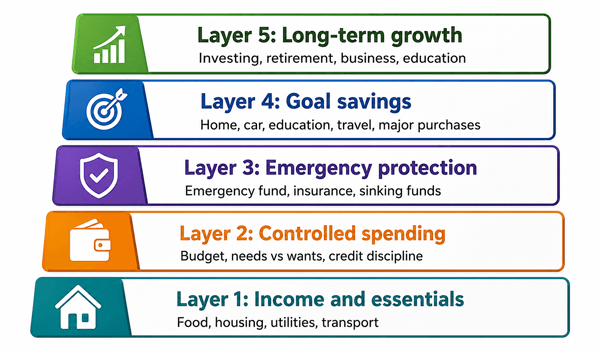
Figure: Simple financial stability framework - build from essential income protection toward long-term growth.
| Stability layer | What to focus on | Result |
|---|---|---|
| Layer 5: Long-term growth | Investing, retirement, business, property, education | Future wealth building |
| Layer 4: Goal savings | Home, car, education, travel, major purchases | Less need for future borrowing |
| Layer 3: Emergency protection | Emergency fund, insurance, sinking funds | Fewer financial shocks |
| Layer 2: Controlled spending | Budget, needs vs wants, credit card discipline | Monthly cash flow control |
| Layer 1: Income and essentials | Reliable income, food, housing, utilities, transport | Basic financial safety |
7. Debt Avoidance Checklist
- I know my monthly take-home income.
- I track fixed, variable, and irregular expenses.
- I have a realistic budget before the month starts.
- I save something toward emergencies every payday.
- I do not use credit cards for purchases I cannot pay off in full.
- I plan for annual bills and repairs with sinking funds.
- I compare total cost before taking any loan.
- I pause before emotional or impulse purchases.
- I review my finances weekly or monthly.
- I ask for help early if bills become difficult.
8. Common Mistakes to Avoid
| Mistake | Why it hurts | Better approach |
|---|---|---|
| Budgeting only fixed bills | Variable spending quietly creates debt | Track groceries, transport, subscriptions, and small purchases |
| Using savings only after spending | Nothing is left at the end of the month | Save first on payday |
| Thinking minimum payments are enough | Debt may last much longer and cost more | Pay more than minimum when possible |
| Ignoring small subscriptions | Small leaks add up over time | Review subscriptions quarterly |
| Buying based on monthly payment only | Low payment may hide high total cost | Compare total interest, fees, and term |
| Waiting too long to ask for help | Late fees and stress increase | Contact lenders, creditors, or a nonprofit counselor early |
9. When Debt May Be Reasonable
Not all debt is automatically bad. Debt may be reasonable when it helps fund a necessary or productive asset, the total cost is affordable, and repayment fits comfortably within your budget. Examples may include a modest mortgage, a carefully chosen education loan, or equipment that helps a business earn income.
However, even potentially useful debt can become harmful if the payment is too large, the interest rate is high, the income benefit is uncertain, or the borrower has no emergency fund. The key is not the label of the debt, but whether it improves or weakens long-term stability.
10. What to Do If You Are Already Close to Debt
If you are already using credit to cover normal expenses, act early. Small changes are easier than crisis repairs.
- Stop adding new non-essential debt immediately.
- List all balances, payment due dates, interest rates, and minimum payments.
- Cut or pause optional expenses for 30 to 90 days.
- Build a small emergency buffer so you do not keep re-borrowing.
- Call lenders or service providers before missing payments to ask about hardship options.
- Consider a structured payoff method such as debt avalanche or debt snowball.
- Seek help from a qualified nonprofit credit counselor, licensed financial adviser, or trusted local consumer-protection organization if payments are becoming unmanageable.
11. How to Stay Financially Stable on a Low Income
Avoiding debt is harder when income is limited, but the same principles still help. The focus should be on protecting essentials, reducing avoidable leaks, increasing income where possible, and building even a small cushion.
If your income is irregular, build the budget around your lowest realistic monthly income and treat extra income as money for essentials, savings, and overdue priorities first.
- Start with a tiny emergency fund goal if a large goal feels impossible.
- Prioritize food, housing, utilities, transport, and medicine before unsecured debt.
- Use community resources when available rather than borrowing for basic needs.
- Negotiate bills, compare service providers, and cancel unused subscriptions.
- Look for income improvements such as overtime, freelance work, skill training, or a better job opportunity.
- Avoid shame-based decisions. Financial stability is built step by step.
12. Pros and Cons of a Debt-Free Lifestyle
| Pros | Cons or trade-offs |
|---|---|
| Lower financial stress and fewer monthly obligations | May require delaying purchases |
| More flexibility if income changes | May feel slower than using credit |
| Less money lost to interest and fees | Requires planning for big expenses |
| Better ability to save and invest | May require saying no to social pressure |
| Stronger sense of control | Some strategic borrowing may still be useful in certain cases |
13. Beginner-Friendly Monthly Money Routine
A simple routine can keep your finances stable without making money management feel overwhelming.
| When | Action | Time needed |
|---|---|---|
| Payday | Move money to bills, savings, emergency fund, and spending categories | 15 minutes |
| Weekly | Check balances and compare spending to budget | 10 minutes |
| Mid-month | Adjust categories before overspending happens | 10 minutes |
| End of month | Review what worked, what failed, and what is due next month | 20 minutes |
| Quarterly | Review subscriptions, insurance, goals, and debt progress | 30 minutes |
■ Frequently Asked Questions
1. What is the best way to avoid debt?
The best way to avoid debt is to spend less than you earn, plan expenses before the month starts, save for emergencies, and avoid using credit for purchases you cannot pay in full.
2. How much emergency savings should I have?
Start with a small amount that covers common emergencies. Then aim for one month of essential expenses, and eventually three to six months if possible. The right amount depends on your job stability, family needs, and monthly expenses.
3. Is all debt bad?
No. Some debt can be useful if it supports a long-term goal and is affordable. However, high-interest consumer debt, repeated borrowing for daily expenses, and loans without a repayment plan can damage financial stability.
4. Should I use a credit card if I want to avoid debt?
You can use a credit card safely if you spend only what you already have and pay the full balance by the due date. If a card encourages overspending, use debit, cash, or prepaid spending categories instead.
5. How can I avoid debt when prices keep rising?
Update your budget often, prioritize essentials, cut low-value expenses, compare providers, increase income where possible, and build even a small emergency fund. The goal is to reduce the gap between income and expenses before credit fills it.
6. What is the difference between saving and avoiding debt?
Saving gives you money for future needs, while avoiding debt reduces your dependence on borrowed money. They work together because savings helps prevent new debt when unexpected costs appear.
7. What should I do first: save money or pay off debt?
If you have no emergency savings, build a small starter fund first while paying minimums. Then focus on high-interest debt. After that, increase emergency savings and long-term savings.
8. How do I stop impulse buying?
Use a 24-hour rule, remove saved cards from shopping apps, unsubscribe from sales emails, shop with a list, and set a fixed monthly amount for wants. Impulse buying decreases when money has a clear plan.
9. Can budgeting really help me stay out of debt?
Yes. A budget helps you see problems before they become debt. It turns vague money stress into clear choices about income, bills, savings, and spending.
10. When should I ask for financial help?
Ask for help as soon as you cannot pay bills on time, rely on credit for basics, or feel unsure how to manage debt. Early help usually gives you more options.
■ Final Thoughts: Stability Comes From Small Decisions Repeated Often
Avoiding debt and staying financially stable is not about being perfect. It is about building a system that protects you from predictable problems and gives you options when unexpected problems happen. Start with the basics: know your income, make a realistic budget, save for emergencies, use credit carefully, and review your money regularly.
Even small steps matter. A small emergency fund can stop a small crisis from becoming a loan. A weekly budget review can catch overspending before it becomes a credit card balance. A delayed purchase can protect your future choices. Financial stability grows when your money decisions match your real income, values, and goals.
Reader Advice: This article is for educational and informational purposes only and should not be taken as personalized financial, legal, or tax advice. Rules, costs, products, and policies can change over time, so please check the latest information from official sources or a qualified professional before making important decisions.