How to Read a Crypto Whitepaper: Step-by-Step Guide, Tips, Fees, Risks and Best Practices
A crypto whitepaper is often the first serious document a project publishes. It explains what the project is trying to build, why it matters, how the technology works, how the token is used, and what the team plans to do next. For beginners, whitepapers can feel intimidating because they mix finance, software, economics, and marketing language in one document.
The good news is that you do not need to be a developer or professional investor to read a whitepaper intelligently. You need a structured process. Your goal is not to understand every mathematical detail on the first pass. Your goal is to separate clear, useful, verifiable information from vague promises, hype, and missing details.
This guide walks you through how to read a crypto whitepaper step by step, what sections to focus on, how to evaluate tokenomics and fees, what risks to watch for, and which best practices can help you avoid common beginner mistakes.
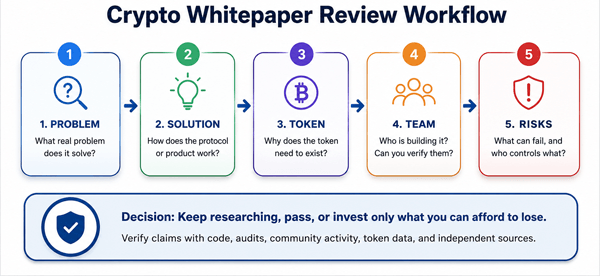
Crypto Whitepaper Review Workflow
1. What Is a Crypto Whitepaper?
A crypto whitepaper is a document that explains the idea, design, token model, and roadmap of a blockchain or crypto project. It is similar to a business plan, technical overview, and investor explainer combined into one document. Some whitepapers are highly technical, such as the original Bitcoin paper, while others are more like product documents for apps, exchanges, games, wallets, or decentralized finance protocols.
A good whitepaper should answer basic questions clearly: What problem is being solved? Why is blockchain needed? How does the system work? What role does the token play? Who controls the project? What are the risks? How will users, validators, developers, investors, and the broader community benefit?
A weak whitepaper may look professional but still avoid the hard questions. It may use buzzwords such as AI, Web3, metaverse, DeFi, zero-knowledge, or real-world assets without explaining the actual mechanism. Your job is to read beyond the branding and find the evidence.
2. Why Reading a Whitepaper Matters
Many beginners buy tokens because of social media hype, influencer posts, price charts, or fear of missing out. A whitepaper slows you down and forces you to ask better questions. It helps you understand what you are actually buying and whether the project has a realistic reason to exist.
- It shows whether the project has a clear problem and solution.
- It helps you identify how the token is created, distributed, used, and potentially diluted.
- It reveals fees, incentives, governance powers, and possible conflicts of interest.
- It gives you a checklist for independent research beyond the project website.
- It helps you spot red flags before you risk money.
A whitepaper is not proof that a project is legitimate. Anyone can write a convincing document. Treat it as a starting point, not a guarantee.
3. Whitepaper vs Litepaper vs One-Pager
| Document type | Best for | What to watch out for |
|---|---|---|
| Whitepaper | Detailed explanation of the project, token model, architecture, governance, roadmap, and risks. | Can still be biased because it is usually written by the project team. |
| Litepaper | A shorter, easier summary for non-technical readers. | May skip important details such as vesting, fees, security assumptions, or governance control. |
| One-pager | Quick overview for early interest or marketing. | Too short for serious due diligence. Use it only as a starting point. |
| Technical paper | Deep protocol design, math, cryptography, consensus, or system architecture. | May be difficult for beginners; verify whether claims are implemented in real code. |
4. Before You Start: Prepare Like a Researcher
Before reading, gather the official whitepaper from the project website, GitHub, documentation site, or verified announcement channel. Avoid random PDFs shared in Telegram, Discord, or unofficial mirrors because scammers can alter wallet addresses, token sale details, or links.
- Download the whitepaper from an official source.
- Open the project website, documentation, GitHub or code repository, block explorer, and social channels in separate tabs.
- Create a simple notes document with headings: problem, solution, token, team, fees, risks, red flags, questions.
- Write down anything you cannot verify. Unanswered questions matter.
- Do not connect your wallet, sign transactions, or send funds just because a whitepaper looks professional.
5. Step-by-Step Guide: How to Read a Crypto Whitepaper
Step 1: Read the Abstract and Summary First
The abstract or executive summary should explain the project in plain language. After reading it, you should be able to describe the project in one or two sentences. If you cannot, the document may be unclear, overly technical, or intentionally vague.
Ask: What is the project? Who is it for? What problem does it solve? Why is this better than existing options?
Step 2: Identify the Problem
A strong crypto project usually starts with a real problem. For example, Bitcoin addressed peer-to-peer digital cash without relying on a central intermediary. A decentralized storage network may address censorship-resistant file storage. A DeFi lending protocol may address borrowing and lending without a traditional bank.
Be cautious when the problem is vague, exaggerated, or already solved well by non-blockchain tools. Blockchain can be powerful, but it also adds complexity, fees, security risks, and user-experience friction. The whitepaper should explain why those trade-offs are worth it.
Step 3: Understand the Proposed Solution
Next, look for the mechanism. A whitepaper should not simply say the project will be fast, secure, decentralized, scalable, or revolutionary. It should explain how. For a beginner, the key is to understand the basic flow: who participates, what they do, how transactions or data move, and how the system prevents abuse.
A useful trick is to draw the system in three boxes: users, network/protocol, and token. Then write what each part does. If the whitepaper cannot support this simple diagram, it may not be clear enough.
Step 4: Check Whether Blockchain Is Actually Needed
Not every digital product needs a token or blockchain. Ask whether the project needs decentralization, censorship resistance, transparent settlement, programmable ownership, open participation, or trust-minimized coordination. If the main benefits could be achieved with a normal database, the token may exist mainly for fundraising or speculation.
| Claim in whitepaper | Beginner question to ask |
|---|---|
| “Decentralized” | Which parts are decentralized today, and which parts are controlled by the team? |
| “Scalable” | What transaction throughput is claimed, and has it been tested publicly? |
| “Secure” | Has the code been audited, battle-tested, or formally verified? |
| “Community-owned” | How much token supply is held by insiders, treasury, investors, or the foundation? |
| “Low fees” | Low compared with what, under what network conditions, and who pays the fees? |
Step 5: Study the Tokenomics
Tokenomics means the economic design of the token: supply, distribution, utility, incentives, emissions, burns, vesting, and governance rights. This is one of the most important sections for beginners because a project can have good technology but poor token economics.
Look for total supply, circulating supply, inflation schedule, vesting periods, unlock dates, insider allocation, staking rewards, treasury control, token burns, and the exact reason the token must exist. A token that has no clear utility may depend mostly on speculation.
| Tokenomics item | Why it matters | Red flag |
|---|---|---|
| Total supply | Shows the maximum or planned number of tokens. | No clear supply cap or emission schedule. |
| Circulating supply | Shows how many tokens are currently tradable. | Tiny circulating supply with large future unlocks. |
| Allocation | Shows who receives tokens. | Large insider share without long vesting. |
| Vesting/unlocks | Shows when team or investor tokens can enter the market. | Major unlocks soon after public sale. |
| Utility | Explains why users need the token. | Token exists but could be replaced by ETH, BTC, USDC, or a normal payment method. |
| Governance | Shows voting or control rights. | Small group can change fees, mint supply, or freeze funds. |
Step 6: Review Fees and Costs
Crypto fees can be confusing because a project may have several layers of cost. The whitepaper should explain which fees exist, who pays them, who receives them, and whether they can change. Beginners often focus only on the token price and ignore the cost of using the system.
| Fee or cost | What it means | Example question |
|---|---|---|
| Network gas fee | Cost paid to process transactions on a blockchain. | Will users pay gas in ETH, the project token, or another coin? |
| Protocol fee | Fee charged by the app or protocol for swaps, loans, mints, withdrawals, or transactions. | Does the fee go to liquidity providers, token holders, treasury, or the team? |
| Validator/miner fee | Reward paid to network participants that secure or process transactions. | Are incentives sustainable if token rewards decline? |
| Bridge fee | Cost of moving assets between blockchains. | What happens if the bridge is hacked or paused? |
| Exchange fee | Fee charged when buying or selling the token. | Is there enough liquidity to exit without large slippage? |
| Hidden cost | Indirect cost such as slippage, failed transactions, taxes, withdrawal limits, or lockups. | Can funds be withdrawn at any time? |
A whitepaper that says fees will be “minimal” without numbers, formulas, examples, or governance limits is incomplete. It should explain how fees behave when the network is busy and whether administrators can change them.
Step 7: Examine the Technology and Architecture
You do not need to read code to ask useful technology questions. Look for clear explanations of consensus, smart contracts, oracles, bridges, data availability, validator requirements, custody, and upgrade controls. If the project depends on another blockchain, understand that dependency.
For example, a DeFi lending protocol may rely on price oracles. If the oracle fails or is manipulated, loans can be liquidated incorrectly. A cross-chain bridge may hold large pools of funds and can become a high-value attack target. A layer-2 network may depend on sequencers, fraud proofs, validity proofs, or data availability assumptions.
Step 8: Check Security, Audits, and Code Availability
Security claims should be verifiable. Look for audit reports, bug bounty programs, open-source repositories, testnet results, mainnet history, and incident disclosures. An audit reduces risk but does not eliminate it. Many hacked projects had audits, and audits may cover only a specific version of the code.
- Check whether the code repository is public and active.
- Look for named audit firms and direct links to reports.
- Confirm whether audit issues were fixed, acknowledged, or ignored.
- Look for admin keys, upgradeable contracts, emergency pause powers, minting rights, and multisig controls.
- Check whether the project has a bug bounty and a clear disclosure process.
Step 9: Research the Team, Advisors, and Backers
A credible team is not a guarantee of success, but anonymous or unverifiable teams require extra caution. Check whether founders have relevant experience, whether advisors are real and publicly connected to the project, and whether investors or partners are confirmed by independent sources.
Be careful with fake partnerships. A whitepaper might list major brands, exchanges, universities, or investors without proof. Verify claims through the partner’s official website, press release, or public statement.
Step 10: Analyze the Roadmap
A roadmap should be specific enough to judge progress. “Launch ecosystem,” “build partnerships,” and “expand community” are weak milestones. Better milestones include testnet release, audit completion, mainnet launch, governance launch, mobile app release, exchange integration, or specific protocol upgrades.
Compare the roadmap with the current date and actual delivery. If the whitepaper is old, check whether deadlines were met. Repeated missed milestones without explanation are a warning sign.
Step 11: Look for Governance and Control Risks
Governance determines who can change the system. Some projects are controlled by token votes, some by a foundation, some by a multisig wallet, and some by a private company. Beginners often assume “decentralized” means no one is in charge, but many projects keep powerful admin controls during early stages.
Ask who can upgrade contracts, pause the protocol, change fees, mint tokens, blacklist addresses, control treasury funds, or alter voting rules. These powers may be necessary early on, but they should be disclosed clearly.
Step 12: Read the Risk Disclosures
Do not skip the risk section. A serious project should discuss technical, market, regulatory, liquidity, governance, oracle, smart contract, bridge, custody, and operational risks. If a whitepaper has no risk section, treat that as a major weakness.
Risk disclosures should be specific, not generic. “Crypto is risky” is not enough. The document should explain what can go wrong in this project and how the team tries to reduce those risks.
Step 13: Verify Claims Outside the Whitepaper
After reading the whitepaper, verify the important claims. Check the website, documentation, GitHub, smart contracts, token explorer, audit reports, community discussions, exchange listings, governance forum, and independent analysis. If a claim matters to your decision, do not rely on the whitepaper alone.
6. A Simple Beginner Example
Imagine a project called “PayFastChain” claims it will make global payments instant and cheap. The whitepaper says the token will be used for transaction fees, validator rewards, and governance.
A beginner might think this sounds promising. A careful reader asks: Are payments really faster than existing options? Who validates transactions? How many validators exist today? What happens if token price falls and validators stop participating? Are fees predictable? Is the token necessary, or could users pay in stablecoins? How much supply is held by the team? When do investor tokens unlock? Is there working code?
This is the mindset you want. You are not trying to be negative. You are testing whether the project survives practical questions.
7. Common Red Flags in Crypto Whitepapers
| Red flag | Why it matters | What to do |
|---|---|---|
| Guaranteed returns or fixed profit promises | Legitimate investments cannot guarantee crypto profits. | Treat as a serious warning and investigate further. |
| No clear token utility | The token may depend mainly on hype. | Ask why the token must exist. |
| Anonymous team with no track record | Accountability is lower. | Require stronger evidence from code, audits, and community history. |
| Copied or plagiarized text | Suggests low effort or deception. | Search unique phrases online and compare documents. |
| Unclear supply or unlock schedule | Future dilution may harm buyers. | Avoid until token data is transparent. |
| Fake partnerships or vague “strategic alliances” | Used to create false credibility. | Verify with partner sources. |
| No security details | Smart contract or custody risks may be hidden. | Look for audits, code, bug bounties, and admin controls. |
| Overuse of buzzwords | May hide lack of substance. | Translate every claim into plain language. |
| Pressure to buy immediately | Creates fear of missing out. | Slow down. Legitimate research does not require panic. |
8. Benefits of Reading a Crypto Whitepaper
- You understand the project before risking money.
- You can compare projects more fairly instead of relying on hype.
- You spot weak tokenomics, hidden fees, and governance risks earlier.
- You ask better questions in communities, forums, and research groups.
- You build long-term research skills that apply across crypto sectors.
9. Limitations: What a Whitepaper Cannot Tell You
A whitepaper cannot prove future success. It cannot guarantee adoption, liquidity, price appreciation, security, honest leadership, regulatory approval, or product-market fit. It may also become outdated as the project changes. Some projects launch with one design and later move to a different model.
That is why a whitepaper should be part of a broader due diligence process. Combine it with technical checks, market research, community quality, legal context, and your own risk tolerance.
10. Practical Best Practices for Beginners
- Read the whitepaper twice: once for the big picture, once for details.
- Write a one-sentence summary. If you cannot explain it simply, keep researching.
- Focus on tokenomics, fees, governance, and security before marketing claims.
- Compare the project with two or three competitors.
- Check whether the roadmap matches actual progress.
- Verify team, partnerships, audits, and code through independent sources.
- Never invest based only on a whitepaper, social media thread, or influencer recommendation.
- Avoid connecting your wallet to unknown sites while researching.
- Use position sizing: never risk money you cannot afford to lose.
- Keep a written checklist so emotions do not drive the decision.
11. Whitepaper Review Checklist
| Question | Good sign | Warning sign |
|---|---|---|
| Can I explain the project in one sentence? | Clear problem and solution. | Vague mission or confusing language. |
| Is blockchain necessary? | Clear reason for decentralization or trust minimization. | A normal database would work just as well. |
| Does the token have real utility? | Token is needed for security, fees, governance, or access. | Token feels added mainly for fundraising. |
| Is supply transparent? | Total supply, emissions, vesting, and unlocks are clear. | Missing or confusing supply information. |
| Are fees explained? | Fee formulas and recipients are disclosed. | Only says fees are low or flexible. |
| Is the team verifiable? | Public, relevant experience and confirmed links. | Fake, anonymous, or unverifiable team claims. |
| Is security addressed? | Audits, code, bug bounty, and admin powers disclosed. | No audit, no code, no risk section. |
| Are risks specific? | Clear discussion of technical, market, and regulatory risks. | Risk section is missing or generic. |
| Can claims be verified? | Evidence exists outside the whitepaper. | Important claims rely only on the project’s own words. |
12. Pros and Cons of Using Whitepapers for Crypto Research
| Pros | Cons |
|---|---|
| Shows the project’s intended design and goals. | Usually written by the project team, so it may be biased. |
| Helps evaluate tokenomics, roadmap, and governance. | Can be outdated or changed after launch. |
| Gives beginners a structured research starting point. | May use technical language that hides weak ideas. |
| Makes it easier to compare projects. | A polished document can still be attached to a scam or failed project. |
| Encourages slower, more rational decisions. | Does not replace code review, audits, market data, or legal research. |
13. Fees, Risks, and Investor Protection: Useful Facts
Regulators and investor education bodies consistently warn that crypto assets can involve high volatility, cyber risks, platform risks, fraud, manipulation, and unclear protections. For example, the U.S. CFTC notes that virtual currency cash markets may lack the same supervision and safeguards as regulated markets, and the SEC’s investor education resources emphasize investor protection and disclosure principles. These warnings do not mean every crypto project is bad, but they do mean beginners should be cautious and verify claims carefully.
The original Bitcoin whitepaper is only nine pages, but it clearly defines the problem of double spending and proposes a peer-to-peer timestamp system. That is a useful lesson: strong whitepapers are not always long. They are clear, specific, and internally coherent.
14. Frequently Asked Questions
14.1 What is the main purpose of a crypto whitepaper?
The main purpose is to explain the project’s problem, solution, technology, token model, roadmap, governance, and risks. It helps readers understand what the project claims to build and how it is supposed to work.
14.2 Do I need technical knowledge to read a whitepaper?
No. Technical knowledge helps, but beginners can still evaluate clarity, tokenomics, fees, team credibility, roadmap realism, risk disclosures, and whether claims are verifiable.
14.3 Is a long whitepaper better than a short one?
Not necessarily. A short whitepaper can be excellent if it is clear and specific. A long whitepaper can still be weak if it hides behind jargon or avoids important details.
14.4 Can a project be legitimate without a whitepaper?
Sometimes, especially if it has strong documentation, open-source code, active development, and transparent governance. However, for a new token sale or protocol, the absence of a serious explanatory document is a reason to be cautious.
14.5 What is the most important section for investors?
Tokenomics is usually one of the most important sections because it affects supply, dilution, incentives, governance, and potential market pressure. Security, fees, and governance are also critical.
14.6 How do I spot a fake or low-quality whitepaper?
Look for copied text, unrealistic promises, fake partnerships, no technical mechanism, no token supply details, no team verification, no security discussion, and pressure to buy quickly.
14.7 Should I invest if the whitepaper looks good?
Not based on the whitepaper alone. Use it as one part of your research. Check code, audits, token data, liquidity, governance, community quality, legal risks, and independent sources before making any decision.
14.8 What fees should I look for?
Look for network gas fees, protocol fees, validator or miner fees, bridge fees, exchange fees, withdrawal fees, slippage, failed transaction costs, and lockup or unstaking costs.
14.9 What does “decentralized” mean in a whitepaper?
It should mean that control, validation, or governance is distributed rather than held by one party. But the word is often used loosely. Check who can upgrade contracts, pause the system, change fees, mint tokens, or control treasury funds.
15. Final Thoughts
Learning how to read a crypto whitepaper is one of the most useful habits a beginner can build. It helps you slow down, ask practical questions, and avoid relying only on hype. The best whitepapers explain a real problem, a realistic solution, a necessary token model, transparent fees, credible security practices, and specific risks.
The most important rule is simple: do not treat a whitepaper as proof. Treat it as a claim that needs evidence. If the claims are clear, testable, and supported by independent facts, the project may deserve deeper research. If the claims are vague, unverifiable, or built around guaranteed profits, walking away is often the smartest decision.
Sources Consulted and Checked
These sources were consulted when preparing and checking this document for accuracy.
- Bitcoin: A Peer-to-Peer Electronic Cash System, Satoshi Nakamoto
- CFTC Customer Advisory: Understand the Risks of Virtual Currency Trading
- CFTC Customer Advisory on Digital Tokens
- SEC Investor.gov: The Role of the SEC
- FINRA Investor Education resources
Reader Advice
This article is educational only and is not financial, legal, or tax advice. Crypto assets are volatile and can involve fraud, technical failure, regulatory uncertainty, and permanent loss of funds. Rules, policies, laws, fees, market conditions, and statistics can change over time and may vary by country or region, so verify important information through official and current sources before making a decision. Consider your circumstances and risk tolerance, protect your wallet and private keys, and seek advice from an appropriately qualified professional when personalized financial, legal, or tax guidance is needed. Never risk funds you cannot afford to lose.