Crypto Passive Income: Complete Guide, Examples, Risks and Best Practices
1. What Is Crypto Passive Income?
Crypto passive income means earning rewards, fees, interest, or token distributions from crypto assets or blockchain-related activity without actively trading every day. The word passive can be misleading. In most cases, you still need to research the asset, choose a platform or protocol, understand the risks, monitor performance, track taxes, and protect your wallet.
A simple example is staking. On some proof-of-stake blockchains, token holders can help secure the network by locking or delegating tokens. In return, they may receive staking rewards. Another example is lending crypto through a platform, where borrowers pay interest. A third is providing liquidity to a decentralized exchange, where traders pay fees that are shared with liquidity providers.
The key point: crypto passive income is not the same as a bank savings account. Rewards are usually paid in crypto, the value of those rewards can rise or fall, and the risks can be much higher.
2. How Crypto Passive Income Works in Simple Terms
Most crypto income methods follow the same basic pattern:
- You commit something of value, such as tokens, liquidity, computing power, or attention.
- A blockchain network, DeFi protocol, exchange, or project uses that contribution.
- You receive a reward, such as staking rewards, trading fees, lending interest, newly minted tokens, points, or airdropped tokens.
- Your real result depends on token price changes, fees, taxes, lockup periods, platform safety, and whether you can exit when needed.
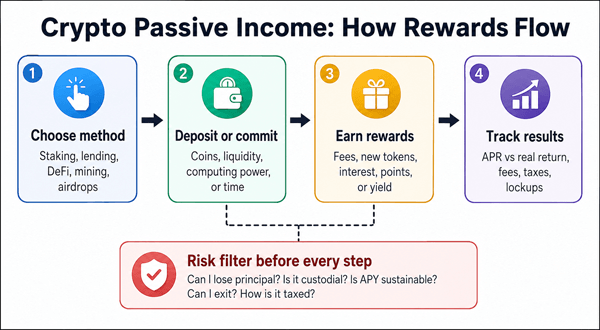
Diagram: The basic flow of crypto passive income, with risk checks built into the process.
3. The Main Types of Crypto Passive Income
There is no single best method for everyone. The right choice depends on your risk tolerance, technical skill, location, tax situation, and whether you are comfortable using centralized platforms, self-custody wallets, or decentralized finance protocols.
| Method | How it works | Beginner difficulty | Main risk |
|---|---|---|---|
| Staking | Delegating or locking proof-of-stake tokens to support network validation | Low to medium | Slashing, lockups, token price drops, validator risk |
| Liquid staking | Staking through a provider and receiving a receipt token that can often be used elsewhere | Medium | Smart contract risk, depeg risk, provider risk, added complexity |
| Crypto lending | Depositing crypto so borrowers can use it and pay interest | Medium to high | Platform insolvency, borrower default, withdrawal freezes, unclear protections |
| DeFi yield farming | Moving funds across DeFi protocols to earn tokens, fees, or incentives | High | Smart contract hacks, impermanent loss, token collapse, complexity |
| Liquidity providing | Supplying token pairs to decentralized exchanges and earning trading fees | Medium to high | Impermanent loss, low volume, pool imbalance, smart contract risk |
| Mining | Using hardware and electricity to validate proof-of-work networks | Medium to high | Hardware cost, electricity cost, competition, regulatory issues |
| Airdrops and points | Qualifying for possible future token distributions by using projects | Medium | No guarantee, scam links, time cost, privacy risk |
| Crypto rewards cards | Earning small crypto rewards from spending through a card | Low to medium | Fees, reward changes, tax tracking, issuer risk |
4. Crypto Staking
Staking is one of the most common forms of crypto passive income. It applies to proof-of-stake networks, where validators help confirm transactions and maintain the blockchain. Token holders can often stake directly, delegate to a validator, or use a staking service.
4.1 Example: staking a proof-of-stake token
Suppose a beginner owns 10 units of a proof-of-stake crypto asset. The network offers staking rewards that vary depending on network participation and validator performance. The user delegates tokens to a reputable validator. Over time, the wallet receives rewards. If the token price falls 40%, however, the user may still lose money in dollar terms even if the number of tokens increases.
4.2 Pros of staking
- Often easier to understand than advanced DeFi strategies.
- Can support the security and decentralization of a blockchain network.
- Rewards are usually transparent at the protocol level, although actual returns vary.
4.3 Cons and risks of staking
- Tokens may be locked or subject to an unbonding period before you can sell.
- Some networks can reduce staked balances through slashing if a validator misbehaves or fails.
- Rewards are paid in a volatile asset, so token price changes may outweigh yield.
- Custodial staking means another company may control or hold your assets.
5. Liquid Staking
Liquid staking is a version of staking where you deposit a token with a protocol or service provider and receive a receipt token in return. That receipt token usually represents your claim on the staked assets and rewards. The benefit is liquidity: instead of waiting for unstaking, you may be able to sell, transfer, or use the receipt token in other DeFi applications.
The extra flexibility comes with extra complexity. A liquid staking receipt token may trade below the value of the underlying asset, the provider or smart contract may fail, and using the receipt token in other DeFi strategies can stack risks on top of each other.
6. Crypto Lending
Crypto lending means depositing crypto with a platform or protocol so others can borrow it. In return, you may earn interest. Lending can happen through centralized companies or decentralized money markets.
6.1 Centralized lending vs DeFi lending
| Feature | Centralized lending platform | DeFi lending protocol |
|---|---|---|
| Control of assets | Often custodial: the platform may hold assets | Usually wallet-based, but smart contracts control funds |
| Transparency | Depends on company disclosures | Protocol data may be visible on-chain, but still complex |
| Main risk | Platform insolvency, frozen withdrawals, weak risk controls | Smart contract bugs, oracle failures, governance attacks |
| User experience | Usually easier for beginners | Requires wallet, gas fees, and DeFi knowledge |
| Regulatory position | Can vary widely by country and product | Often uncertain and jurisdiction-dependent |
A beginner should be very careful with any lending product that advertises unusually high, stable returns. In finance, high yield usually means high risk, hidden leverage, poor transparency, or temporary incentives.
7. DeFi Yield Farming
Yield farming means using decentralized finance protocols to earn rewards from lending, borrowing, liquidity providing, staking receipt tokens, or participating in incentive programs. It can be profitable for experienced users, but it is one of the easiest areas for beginners to misunderstand.
A yield farm may show a high annual percentage yield because rewards are paid in a new token. If that token quickly loses value, the displayed yield can disappear. Fees, slippage, impermanent loss, and smart contract risk can also reduce or erase returns.
8. Liquidity Providing
Liquidity providers deposit tokens into a trading pool on a decentralized exchange. Traders use the pool to swap between tokens, and liquidity providers receive a share of trading fees. The classic example is depositing two assets, such as Token A and Token B, into a pool.
8.1 What is impermanent loss?
Impermanent loss happens when the price relationship between the two tokens changes after you deposit them into a liquidity pool. Compared with simply holding the two tokens, your pool position may be worth less. Trading fees can offset this loss, but they do not always do so.
9. Mining
Mining applies to proof-of-work networks. Miners use specialized hardware and electricity to compete to add blocks to the blockchain. In return, successful miners receive block rewards and transaction fees. For beginners, mining is rarely passive in the simple sense because it involves hardware purchases, electricity planning, heat management, maintenance, and profitability calculations.
Before buying mining equipment, calculate electricity cost, hardware cost, expected network difficulty, pool fees, taxes, noise, heat, and resale value. A mining setup that looks profitable at one coin price can become unprofitable if the market falls or competition rises.
10. Airdrops, Points, and Learn-to-Earn Programs
Airdrops are token distributions from crypto projects. Some are given to early users, community members, testnet participants, or holders of certain assets. Points programs are similar but may or may not turn into tokens later.
Airdrops can be appealing because they may not require a large investment. But they are not guaranteed income. They can require time, transaction fees, and exposure to scam links. Never connect your wallet to a random website or sign a transaction you do not understand.
11. Examples of Real-World Crypto Passive Income Scenarios
| Scenario | What the beginner does | Possible good outcome | What could go wrong |
|---|---|---|---|
| Conservative staker | Delegates a small amount of a major proof-of-stake asset from a self-custody wallet | Earns modest token rewards while learning wallet security | Token price falls; validator underperforms; unstaking delay prevents quick exit |
| High-yield chaser | Moves funds into a new DeFi farm offering triple-digit APY | Early rewards look large | Reward token collapses; contract is exploited; gas fees eat profit |
| Crypto lender | Deposits stablecoins on a lending platform for advertised yield | Earns interest for several months | Platform freezes withdrawals or changes terms; stablecoin loses peg |
| Liquidity provider | Supplies two tokens to a DEX pool | Earns trading fees if volume is high | Impermanent loss exceeds fees; one token loses value sharply |
| Airdrop farmer | Uses new protocols with a small wallet to qualify for potential rewards | Receives an airdrop later | No airdrop happens; phishing link drains wallet; transaction costs exceed reward |
12. Benefits of Crypto Passive Income
- It can put idle crypto assets to work instead of simply holding them.
- Staking can help secure proof-of-stake networks.
- Some methods teach useful skills such as wallet security, on-chain research, and risk management.
- Rewards may compound if reinvested carefully, although compounding also increases exposure.
- Certain methods can be started with small amounts, making them useful for learning.
13. Limitations and Misconceptions
- Passive does not mean risk-free. Most methods require monitoring and risk decisions.
- APY is not the same as profit. Token price changes, fees, taxes, and losses matter.
- Stablecoin yield is not the same as bank interest. Stablecoins, platforms, and protocols can fail.
- High yield is often temporary. Incentive rewards can fall quickly as more users join.
- More complexity does not automatically mean better returns. It often means more ways to lose money.
14. The Biggest Risks Beginners Must Understand
14.1 Market risk
Crypto prices can move sharply. A 5% staking reward does not help if the asset falls 50%. Always think in total return, not just token count.
14.2 Platform and custody risk
If you deposit assets with a centralized platform, you may become dependent on its solvency, controls, legal compliance, and withdrawal policies. In a failure, customers may not have the same protections they expect from regulated bank or brokerage accounts.
14.3 Smart contract risk
DeFi protocols run on code. Bugs, exploits, oracle failures, bridge hacks, and governance attacks can cause losses even when the strategy looks simple.
14.4 Liquidity and lockup risk
Some staking and lending products limit withdrawals. If the market drops or you need cash, you may not be able to exit quickly.
14.5 Slashing and validator risk
On some proof-of-stake networks, validator mistakes or malicious behavior can lead to penalties. Delegators may share in those penalties depending on the network rules.
14.6 Stablecoin and depeg risk
Stablecoins aim to track another asset, often the U.S. dollar, but the peg can fail. Yield on a stablecoin is not useful if the stablecoin itself loses value or becomes hard to redeem.
14.7 Tax and recordkeeping risk
Rewards, staking income, airdrops, trades, swaps, and sales can create tax reporting obligations. Rules vary by country, and poor records can create problems later.
14.8 Scam risk
Crypto income opportunities attract scams. Warning signs include guaranteed returns, pressure to act fast, fake support messages, secret arbitrage systems, romance-investment pitches, and requests for seed phrases or private keys.
15. How to Evaluate a Crypto Passive Income Opportunity
Before depositing money, use this checklist:
- What exactly generates the yield? Is it staking rewards, borrower interest, trading fees, token inflation, leverage, subsidies, or something unclear?
- Who controls the assets? You, a smart contract, a validator, a centralized company, or multiple parties?
- Can you withdraw? Check lockups, unbonding periods, withdrawal queues, and emergency pause powers.
- What is the worst realistic loss? Include token price decline, smart contract failure, platform insolvency, depeg, slashing, and tax costs.
- Is the advertised APY sustainable? Very high yields usually fall or hide risk.
- Has the protocol or platform been audited? Audits help but do not guarantee safety.
- How long has it operated through stressed markets? New platforms often have less battle-tested risk management.
- What fees apply? Include platform fees, validator commissions, gas fees, trading fees, withdrawal fees, and spread.
- How will you track taxes? Know the fair market value of rewards when received and the cost basis for future sales where applicable.
- What is your exit plan? Decide in advance when you would reduce exposure or leave.
16. Best Practices for Beginners
- Start small. Treat early activity as education, not a major investment strategy.
- Prefer simple, transparent methods before complex DeFi stacking.
- Use reputable wallets and enable strong account security, including hardware wallets for larger amounts.
- Never share your seed phrase, private key, or wallet recovery words.
- Separate wallets by purpose: long-term holdings, DeFi experimentation, and airdrop activity.
- Avoid yields you cannot explain in one or two sentences.
- Keep screenshots, transaction hashes, dates, token amounts, and fair market values for tax records.
- Understand whether you are using self-custody or trusting a custodian.
- Diversify risk, but do not over-diversify into projects you cannot monitor.
- Review terms of service, withdrawal rules, fees, and risk disclosures before depositing.
17. Common Mistakes to Avoid
| Mistake | Why it is dangerous | Better approach |
|---|---|---|
| Chasing the highest APY | High advertised yield can come from risky tokens, leverage, or temporary incentives | Ask what creates the yield and how it can fail |
| Ignoring token price | Rewards may be outweighed by market decline | Measure total return in your local currency |
| Using one wallet for everything | A bad signature or malicious site can expose all assets | Use separate wallets and revoke old permissions |
| Assuming stablecoins are risk-free | Peg, issuer, reserve, and platform risks remain | Use only what you understand and diversify carefully |
| Not tracking taxes | Rewards and swaps may be taxable events | Record transactions as they happen |
| Believing guaranteed returns | Crypto returns are uncertain and volatile | Treat guarantees as a major red flag |
18. Tax, Legal, and Regulatory Basics
Tax treatment depends on your country. In the United States, the IRS treats digital assets as property for federal tax purposes and reminds taxpayers that digital asset income must be reported. Staking rewards, airdrops, mining income, and sales may have different reporting consequences depending on facts and timing. Beginners should use crypto tax software or consult a qualified tax professional if the amounts are meaningful.
Regulation also changes. In the United States, SEC staff issued statements in 2025 addressing certain proof-of-work mining, protocol staking, and liquid staking activities, while investor alerts from regulators continue to warn that crypto assets can be volatile, speculative, and may lack traditional investor protections. Your local rules may be different, so do not assume a product available online is legal, regulated, or protected where you live.
19. Beginner Action Plan: A Safer Way to Start
- Learn the basics of wallets, private keys, seed phrases, gas fees, and blockchain transactions.
- Choose one simple method, such as small-scale staking of a well-known proof-of-stake asset, before exploring lending or DeFi.
- Use a small amount you can afford to lose while learning.
- Write down the reason you expect rewards, the risks, fees, lockup period, and exit plan.
- Track every transaction from day one.
- Review performance monthly using total return, not only APY.
- Increase exposure only after you understand custody, taxes, platform risk, and worst-case scenarios.
20. Is Crypto Passive Income Worth It?
Crypto passive income can be useful for people who already understand crypto risks and want to put idle assets to work. It can also be a practical learning path. But it is not a shortcut to guaranteed wealth. For beginners, the best mindset is defensive: protect your principal, understand the source of yield, avoid unnecessary complexity, and never risk money because a platform displays an attractive APY.
A good crypto income strategy is boring, documented, and understandable. A bad one relies on hype, urgency, screenshots of huge returns, or trust in strangers. When in doubt, choose safety, simplicity, and patience over yield.
21. Quick Comparison: Safer vs Riskier Crypto Income Habits
| Safer habit | Riskier habit |
|---|---|
| Starting with small test amounts | Depositing a large amount immediately |
| Understanding where yield comes from | Choosing only by APY |
| Using reputable wallets and 2FA | Keeping assets on unknown platforms |
| Reading withdrawal and lockup rules | Assuming you can exit anytime |
| Keeping tax records | Trying to reconstruct records months later |
| Avoiding seed phrase requests | Typing recovery words into websites or chats |
22. FAQs About Crypto Passive Income
22.1 Can you really earn passive income with crypto?
Yes, but it is not guaranteed and it is not risk-free. You can earn rewards through staking, lending, liquidity providing, mining, airdrops, and other methods. Your actual profit depends on market prices, fees, taxes, and losses.
22.2 What is the easiest crypto passive income method for beginners?
Staking is often the easiest to understand, especially when done with a small amount and a reputable validator or wallet. Beginners should still learn about lockups, slashing, custody, and tax reporting.
22.3 Is crypto staking safe?
Staking can be lower risk than advanced DeFi, but it is not completely safe. Risks include token price decline, lockup periods, validator problems, slashing, platform custody risk, and regulatory changes.
22.4 Can I lose my crypto while earning yield?
Yes. Losses can happen through price declines, hacks, smart contract bugs, platform failures, stablecoin depegs, validator penalties, phishing, or bad wallet approvals.
22.5 What APY is realistic?
There is no universal realistic APY. Sustainable staking yields are usually tied to network rules and participation. Very high yields often come from temporary incentives, risky tokens, leverage, or unsustainable emissions.
22.6 Is crypto lending the same as earning bank interest?
No. Crypto lending usually does not have the same protections as a bank account. You may face platform insolvency, frozen withdrawals, borrower default, collateral failure, and regulatory uncertainty.
22.7 What is the difference between APR and APY?
APR is the simple annual rate before compounding. APY includes compounding. In crypto, both can be misleading if token prices change or rewards are paid in volatile tokens.
22.8 Do I have to pay taxes on crypto passive income?
In many countries, yes. Tax rules vary. In the U.S., digital asset income generally must be reported, and digital assets are treated as property for federal tax purposes. Consult a qualified tax professional for your situation.
22.9 Are airdrops passive income?
Sometimes, but they are unpredictable. Airdrops may require using a protocol, paying transaction fees, or meeting eligibility rules. Many airdrop links are scams, so wallet safety is critical.
22.10 What is the best rule for avoiding scams?
Never share your seed phrase or private key, never trust guaranteed returns, and never rush because someone says an opportunity will disappear. Verify websites, use bookmarks, and test with small amounts.
Sources Consulted and Checked
The following sources were consulted and checked while preparing this document and reviewing its accuracy
- SEC Investor.gov, Exercise Caution with Crypto Asset Securities: Investor Alert
- FINRA, Crypto Assets investor education page
- SEC Division of Corporation Finance, Statement on Certain Protocol Staking Activities, May 29, 2025
- SEC Division of Corporation Finance, Statement on Certain Liquid Staking Activities, Aug. 5, 2025
- SEC Division of Corporation Finance, Statement on Certain Proof-of-Work Mining Activities, Mar. 20, 2025
- IRS, Digital assets
- IRS, Frequently asked questions on virtual currency transactions
- FBI, 2025 IC3 Annual Report and crypto/investment scam warnings
Reader Advice
This article is provided for educational and informational purposes only and is not personalized financial, investment, tax, or legal advice or a recommendation to use any crypto asset, platform, protocol, or strategy. Crypto passive-income activities can involve substantial risks, including market losses, loss of the original capital, scams, hacking, smart-contract failures, custody or platform failure, lockups, slashing, stablecoin depegging, fees, and tax consequences. Laws, regulations, platform policies, network rules, reward rates, and statistics can change over time and differ by country or region. Before acting, verify current information through official sources, review the applicable terms and risks, and consider advice from appropriately qualified financial, tax, or legal professionals. Never invest or commit funds you cannot afford to lose.