Crypto Taxes Basics: Beginner Guide, Key Concepts, Examples and Common Mistakes
Crypto taxes can feel confusing at first because cryptocurrency works differently from a bank account or a normal brokerage account. You can buy Bitcoin, trade Ethereum for a token, receive staking rewards, move coins between wallets, use a stablecoin, buy an NFT, or pay someone in crypto. Each action may have a different tax result.
The beginner-friendly way to understand crypto taxes is this: tax authorities usually care about two things. First, did you dispose of an asset and create a capital gain or loss? Second, did you receive something that counts as income? Once you separate those two categories, most crypto tax questions become easier to answer.
For U.S. federal tax purposes, the IRS treats digital assets as property, not as foreign currency. That means general property tax rules apply when you sell, exchange, or otherwise dispose of crypto. The IRS also says a sale for U.S. dollars or similar currency creates a recognized capital gain or loss, subject to the normal limits on capital losses.
Quick answer: Crypto taxes are the taxes owed when cryptocurrency transactions create income, capital gains, or capital losses. Buying and holding crypto is usually not taxable by itself. Selling, swapping, spending, or receiving crypto as payment, rewards, mining, staking, or an airdrop can be taxable and should be tracked carefully.
Quick Summary for Beginners
- Buying crypto with cash and holding it is usually not a taxable event, but you still need good records.
- Selling crypto, trading one coin for another, using crypto to buy goods or services, and many NFT transactions are usually taxable disposals.
- Receiving crypto from mining, staking, airdrops, salaries, freelance work, promotions, or referral bonuses can create ordinary income.
- Your gain or loss is generally: proceeds minus cost basis.
- In the U.S., capital crypto transactions are commonly reported on Form 8949 and summarized on Schedule D; crypto income may be reported elsewhere depending on the facts.
- Tax software and exchange reports help, but they can be incomplete when you use multiple wallets, DeFi protocols, bridges, or self-custody.
1. What Are Crypto Taxes?
Crypto taxes are the tax consequences of owning, selling, trading, spending, earning, or otherwise using digital assets. Digital assets can include cryptocurrencies, stablecoins, NFTs, and certain tokenized assets. The tax result depends on what happened, when it happened, the value of the asset at that time, and whether you held the asset as an investment, business asset, or personal-use asset.
A common beginner mistake is thinking crypto is only taxable when money returns to a bank account. That is not how the rules generally work. A crypto-to-crypto trade can be taxable even if you never converted anything into dollars. Spending crypto can also be taxable because you are disposing of an asset.
| Action | Usually taxable? | Why it matters |
|---|---|---|
| Buy crypto with cash and hold | Usually no | No sale or income event has happened yet, but save the purchase date, amount, price, and fees. |
| Sell crypto for cash | Yes | You disposed of property and must calculate gain or loss. |
| Trade BTC for ETH | Yes | You disposed of BTC and received ETH; calculate gain or loss on the BTC. |
| Use crypto to buy a laptop | Yes | You disposed of crypto. The USD value of the purchase is treated like proceeds. |
| Transfer between your own wallets | Usually no | No sale or income event if ownership does not change, but network fees may need tracking. |
| Receive crypto as payment | Yes | The fair market value when received is generally income. |
| Receive staking or mining rewards | Often yes | Rewards can create income when received or otherwise controlled, depending on the facts and jurisdiction. |
| Donate crypto to a qualified charity | Maybe special rules | May avoid capital gain and may allow a deduction if requirements are met; documentation matters. |
Diagram: Beginner Crypto Tax Decision Flow
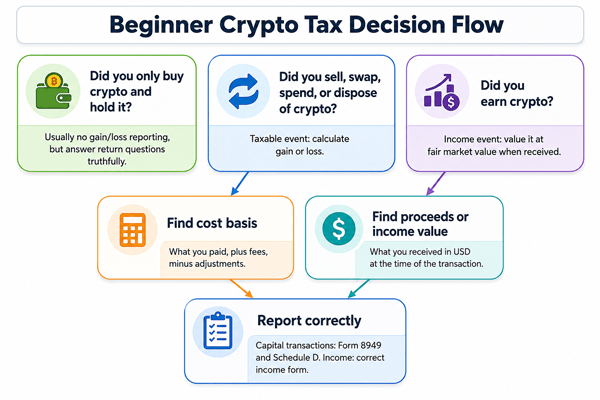
2. How Crypto Taxes Work: The Two Big Buckets
2.1 Capital gains and capital losses
This is the investment side. If you bought crypto and later sold, swapped, spent, or otherwise disposed of it, compare what you received with your cost basis. If proceeds are higher than basis, you have a gain. If proceeds are lower, you have a loss.
2.2 Ordinary income
This is the earning side. If you receive crypto for work, services, rewards, mining, staking, an airdrop, or certain promotions, the fair market value at the time you receive it may be income. That value can also become your basis for later gain or loss calculations.
| Concept | Plain-English meaning | Beginner example |
|---|---|---|
| Cost basis | Your tax starting point in the asset, usually purchase price plus certain fees. | You buy 0.1 BTC for $6,000 and pay $20 in fees. Basis is about $6,020. |
| Proceeds | What you receive when you dispose of crypto, measured in USD or your local currency. | You sell that 0.1 BTC for $7,500. Proceeds are $7,500, possibly reduced by selling fees depending on reporting method. |
| Capital gain | Profit from disposing of a capital asset. | $7,500 proceeds minus $6,020 basis = $1,480 gain. |
| Capital loss | Loss from disposing of a capital asset. | You bought SOL for $1,000 and sold it for $650. Loss is $350. |
| Fair market value | The market value of the crypto at the time of a transaction. | You receive 100 tokens worth $2 each. Income value is $200. |
| Holding period | How long you held the asset before disposal. | Buying on March 1 and selling the next February is short-term; holding more than one year is generally long-term in U.S. federal tax rules. |
3. Taxable vs. Non-Taxable Crypto Events
Beginners should focus first on whether a transaction is a taxable event. A taxable event is an action that may create income, a capital gain, or a capital loss. A non-taxable event may still require recordkeeping, but it usually does not create immediate tax.
3.1 Common taxable crypto events
- Selling crypto for dollars or another government-issued currency.
- Trading one cryptocurrency for another, such as BTC for ETH.
- Using crypto to buy goods or services.
- Receiving crypto as payment for work, freelancing, business activity, or employment.
- Receiving mining rewards, staking rewards, airdrops, referral bonuses, or incentive rewards when you have control over them.
- Selling or trading NFTs or using crypto to mint, buy, or sell NFTs.
- Liquidations, margin activity, or certain derivatives transactions, which may have more complex rules.
3.2 Common non-taxable or usually non-taxable events
- Buying crypto with cash and holding it.
- Moving crypto between wallets or exchange accounts you own, assuming ownership does not change.
- Giving someone access to your wallet software without transferring ownership is not a tax event by itself.
- Placing an order that does not execute is not a taxable event.
- Viewing a token balance or receiving a scam token you cannot control or sell may require caution, but it is not the same as a clear income event.
Beginner tip: A wallet transfer can look like a sale in software if the receiving wallet is not connected. Label transfers carefully so you do not accidentally report a taxable disposal that never happened.
4. Step-by-Step Crypto Tax Examples
The following simplified examples show how the math works. They ignore state taxes, special deductions, wash-sale debates, business expenses, and other complications so beginners can see the basic structure.
4.1 Example 1: Selling crypto for a profit
Maya buys 1 ETH for $2,000 and pays a $20 fee. Her basis is $2,020. Six months later, she sells the ETH for $2,700 and pays a $10 selling fee. If she treats proceeds as $2,690 after the selling fee, her gain is $670. Because she held it for one year or less, the gain is short-term under U.S. federal rules and is generally taxed at ordinary income rates.
4.2 Example 2: Selling crypto at a loss
Omar buys ADA for $1,200. Later, he sells the position for $800. His capital loss is $400. Capital losses can offset capital gains. If losses exceed gains, U.S. federal rules generally allow limited deduction against ordinary income, with unused losses carried forward, subject to detailed limits.
4.3 Example 3: Trading one coin for another
Sara bought BTC for $10,000. When that BTC is worth $14,000, she trades it for ETH. Even though she did not cash out to dollars, she disposed of BTC. Her capital gain is $4,000. Her new basis in the ETH is generally the $14,000 fair market value at the time of the trade.
4.4 Example 4: Using crypto to buy something
Leo bought 0.05 BTC for $1,500. Later, he uses that 0.05 BTC to buy a phone when the BTC is worth $2,200. He has a $700 capital gain because spending crypto is treated like disposing of it.
4.5 Example 5: Receiving crypto as income and selling later
Nadia receives 500 tokens for freelance design work. The tokens are worth $1 each when she receives them, so she has $500 of income. Later, she sells them for $900. Her later capital gain is $400 because her basis is generally the $500 already included as income.
5. Which Tax Forms Are Used for Crypto?
The exact forms depend on the country and the nature of the transaction. For U.S. federal returns, many individual investors use Form 8949 to list sales and other dispositions of capital assets and Schedule D to summarize capital gains and losses. Crypto income may appear on forms such as Schedule 1, Schedule C, Form W-2, or Form 1099 information returns depending on how it was earned.
| Form or document | What it is used for | Beginner note |
|---|---|---|
| Form 8949 | Lists capital asset sales and other dispositions transaction by transaction. | Common for crypto sales, swaps, and spending events. |
| Schedule D (Form 1040) | Summarizes capital gains and losses from Form 8949 and other sources. | This is where totals flow on many individual U.S. returns. |
| Form 1099-DA | Digital asset proceeds from broker transactions. | Broker reporting is being phased in; do not assume it captures every wallet, DeFi, or self-custody transaction. |
| Form 1099-MISC / 1099-NEC / W-2 | May report income paid in crypto or rewards, depending on payer and arrangement. | The form can help, but you still need your own records. |
| Schedule C | Business income and expenses for sole proprietors. | May apply to professional mining, validating, creator activity, or crypto service businesses. |
6. How to Calculate Crypto Gains and Losses
A simple formula covers many beginner situations:
Capital gain or loss = proceeds - cost basis
The hard part is not the formula; it is collecting accurate data. You need dates, times, quantities, fees, fair market values, wallet addresses, exchange records, and transaction IDs. Crypto creates many small transactions, and missing one transfer can distort the entire calculation.
6.1 Cost basis methods
If you bought the same asset multiple times at different prices, you need a method to identify which units were sold. Common methods include FIFO (first in, first out), specific identification, and sometimes average cost depending on jurisdiction and asset type. U.S. crypto investors should be careful because rules and broker reporting have evolved, and the IRS has issued guidance related to basis allocation and broker reporting. Consistency and documentation are essential.
| Method | How it works | Pros | Cons |
|---|---|---|---|
| FIFO | The earliest units purchased are treated as sold first. | Simple and commonly supported by software. | May create higher gains in rising markets. |
| Specific identification | You identify the exact units disposed of, with records supporting date, time, basis, and value. | Can be tax-efficient when properly documented. | Requires strong records and careful execution. |
| Average cost | Uses an average basis per unit. | Easy conceptually. | May not be allowed for all crypto situations in every jurisdiction; confirm before using. |
7. Crypto Income: Mining, Staking, Airdrops, Rewards and Payments
Not every crypto tax issue is a capital gain. If you receive crypto because you performed work, validated transactions, mined coins, participated in staking, received an airdrop, or earned a platform reward, the value may be ordinary income. The general beginner approach is to record the fair market value when you receive the asset and can control it. That value may become your basis if you later sell or trade the asset.
| Income type | Possible tax treatment | Record to save |
|---|---|---|
| Freelance payment in crypto | Usually ordinary business or self-employment income. | Invoice, payer, date/time received, token amount, USD value, wallet address. |
| Employee wages in crypto | May be wages through payroll rules. | Paystub, W-2 or equivalent, token value, withholding details. |
| Mining rewards | Often income; business vs hobby facts matter. | Reward date/time, fair market value, mining expenses, equipment records. |
| Staking rewards | Often income when received or controlled, but details can be complex. | Reward records, protocol, date/time, value, lockup restrictions. |
| Airdrops | May be income when you have dominion and control. | Eligibility, date received, ability to transfer/sell, value at receipt. |
8. Special Beginner Areas: Stablecoins, NFTs and DeFi
8.1 Stablecoins
A stablecoin is designed to track another asset, often the U.S. dollar. Beginners sometimes assume stablecoin trades do not matter because the price is close to $1. But a stablecoin sale, swap, or spend can still be a reportable disposal. The gain or loss may be tiny, but the transaction can still need tracking.
8.2 NFTs
NFT tax treatment depends on what you did. Buying an NFT with crypto may trigger a gain or loss on the crypto you spent. Selling an NFT may create a capital gain or loss if held as an investment, but creator royalties or business activity can be ordinary income. Some NFTs may have special classification issues, so large NFT transactions deserve professional review.
8.3 DeFi
DeFi adds complexity because lending, liquidity pools, wrapping, bridging, governance rewards, rebasing tokens, and derivatives can blur the line between a transfer, a swap, income, and a loan. Do not assume every DeFi action is tax-free. For meaningful amounts, keep detailed records and consult a qualified tax professional.
9. A Practical Crypto Tax Workflow for Beginners
- Export complete transaction histories from every exchange you used during the year.
- List every wallet you control, including hardware wallets, mobile wallets, DeFi wallets, and old wallets.
- Connect wallets or import CSV files into reputable crypto tax software, but review the results manually.
- Mark transfers between your own wallets as transfers, not sales.
- Add missing cost basis for deposits that came from another wallet or exchange.
- Classify income transactions such as staking, mining, airdrops, referral rewards, and payments.
- Reconcile totals against exchange statements and tax forms such as Form 1099-DA or other reports.
- Review short-term vs long-term gains, losses, fees, and suspicious outliers.
- Save a PDF or CSV backup of reports, transaction exports, and assumptions used.
- Give the final report to your tax preparer or use it carefully when preparing your own return.
10. Common Crypto Tax Mistakes Beginners Should Avoid
| Mistake | Why it is a problem | Better practice |
|---|---|---|
| Thinking “I did not cash out, so I owe nothing” | Crypto-to-crypto trades can be taxable disposals. | Track swaps and calculate gain or loss in USD or your local currency. |
| Ignoring small trades | Many small gains, losses, and stablecoin trades can add up or create reporting gaps. | Import all transactions, not only large ones. |
| Treating wallet transfers as sales | This can overstate taxable gains. | Label self-transfers and connect both sides of the transfer. |
| Relying only on one exchange report | The exchange may not know your basis if crypto came from another wallet. | Combine all wallets and exchanges. |
| Forgetting fees | Fees can affect basis, proceeds, or expenses depending on transaction type. | Save fee data and classify it consistently. |
| Ignoring income events | Staking, mining, airdrops, and work payments may be income before any later sale. | Record fair market value when received or controlled. |
| Using screenshots as the only record | Screenshots are better than nothing but not complete. | Export CSV files and save transaction IDs. |
| Changing basis methods without support | Inconsistent methods can distort gains and invite questions. | Use a consistent method and keep documentation. |
| Assuming tax software is always correct | Software can misclassify bridges, transfers, liquidity pool activity, and missing deposits. | Review warnings, unmatched transfers, and missing basis. |
| Waiting until filing week | Crypto reconciliation can take time, especially with DeFi. | Update records quarterly or after major activity. |
11. DIY Crypto Taxes vs. Hiring a Professional
| Option | Best for | Pros | Limitations |
|---|---|---|---|
| DIY with tax software | Simple buy/sell activity on one or two exchanges. | Lower cost, faster, educational. | Risky if many wallets, DeFi, NFTs, business activity, or missing basis. |
| Crypto tax software plus regular tax preparer | Moderate activity with good records. | Good balance of automation and review. | Preparer must understand crypto reports and limitations. |
| Crypto-focused CPA or tax attorney | Large amounts, prior-year mistakes, audits, DeFi, mining business, international issues. | Expert review and risk management. | Higher cost; still requires complete records from you. |
12. Best Practices for Crypto Tax Recordkeeping
- Keep a master list of all exchanges, wallets, and blockchain addresses you used each tax year.
- Export transaction records regularly; do not rely on exchanges existing forever.
- Record fair market value at the time of income events.
- Keep notes for unusual transactions, such as hacks, scams, lost keys, bridge failures, or protocol migrations.
- Separate personal investing from business activity where possible.
- Do not mix your own wallet transfers with third-party payments.
- Back up CSVs, tax software reports, exchange statements, and final tax forms.
- Review local rules. U.S. federal treatment is only one layer; states and other countries may differ.
13. Crypto Tax Misconceptions
| Misconception | Reality |
|---|---|
| Crypto is anonymous, so taxes do not apply. | Tax rules apply whether or not a transaction feels private. Blockchain records are often traceable, and exchanges may report information. |
| Only Bitcoin is taxable. | Tax rules can apply to many digital assets, including tokens, stablecoins, and NFTs. |
| A loss means I do not need to report anything. | Losses may still need reporting and can be valuable because they may offset gains. |
| Moving crypto to a hardware wallet is taxable. | A transfer between wallets you own is usually not taxable, but it must be documented. |
| A Form 1099 means the IRS already has the full story. | A 1099 may show proceeds but may not include full basis, transfers, DeFi, or wallets outside that broker. |
14. Risks, Limitations and When to Get Help
Crypto tax guidance is improving, but gray areas remain. Tax results can differ based on jurisdiction, timing, asset type, whether you are an investor or business, and how a protocol actually works. The more complex your activity, the more dangerous it is to rely on generic internet advice.
- Get professional help if you had large gains or losses, prior-year unreported crypto, DeFi lending or liquidity pools, NFT creator income, mining as a business, international accounts, hacked or stolen assets, or exchange bankruptcy issues.
- Be cautious with aggressive tax positions. A transaction that looks like a loan, wrap, or bridge in crypto language may still have tax consequences depending on facts and law.
- Keep records even for non-taxable transfers because they prove basis and ownership history later.
15. Beginner Crypto Tax Checklist
- I know every exchange and wallet I used during the year.
- I exported complete CSV transaction histories.
- I identified buys, sells, swaps, spending, transfers, income, fees, and rewards.
- I corrected missing basis and unmatched transfers.
- I separated capital gains/losses from ordinary income.
- I reviewed short-term and long-term holding periods.
- I compared tax software totals with exchange forms and statements.
- I saved copies of reports and assumptions.
- I asked a tax professional about complex, high-value, or uncertain transactions.
16. FAQs About Crypto Taxes
16.1 Do I pay tax just for buying crypto?
Usually no. Buying crypto with cash and holding it is generally not a taxable event. You still need to keep records because your purchase price and date become important later.
16.2 Is trading one cryptocurrency for another taxable?
Often yes. A crypto-to-crypto trade is generally treated as disposing of the first asset and acquiring the second. You calculate gain or loss on the asset you gave up.
16.3 Do I owe tax if I lost money in crypto?
You may not owe tax on the loss, but you may still need to report the transaction. Capital losses can sometimes offset capital gains and, within limits, ordinary income.
16.4 Are staking rewards taxable?
They often can be taxable income when received or when you have control, but details vary. Keep records of reward dates, amounts, values, and lockup restrictions.
16.5 Are wallet-to-wallet transfers taxable?
Usually no if both wallets are yours and ownership does not change. But you should label them clearly so software does not treat them as sales.
16.6 What happens if I receive a Form 1099-DA?
Use it as one source of information, not the whole answer. Compare it with your own records. It may not include all wallets, basis history, or DeFi activity.
16.7 What if I forgot to report crypto in a prior year?
Do not ignore it. Depending on facts, you may need to amend a return or seek professional help. Prior-year mistakes are easier to address before tax authorities contact you.
16.8 Can I deduct crypto losses from scams, hacks, or lost keys?
Possibly, but the rules are highly fact-specific and have changed over time. Get professional advice before claiming a deduction.
16.9 Do I need crypto tax software?
Not always. A few simple transactions can be calculated manually. But software becomes useful when you have many trades, multiple exchanges, wallet transfers, or DeFi activity.
16.10 How long should I keep crypto tax records?
Keep records long enough to support your tax return and future basis. Because crypto assets can be held for years, keep purchase and transfer records for as long as you own the asset and after you dispose of it, according to your jurisdiction’s record retention rules.
17. Final Takeaway
Crypto taxes are manageable when you break them into simple questions: Did you dispose of crypto? Did you receive crypto as income? What was the fair market value? What was your cost basis? Which records prove the answer? Beginners who keep complete records, understand taxable events, and review software outputs carefully can avoid many of the most common crypto tax mistakes.
Sources Consulted and Checked
These sources were consulted and checked while preparing this document to support accuracy and clarity.
- IRS: Digital assets overview and FAQs
- IRS: Frequently asked questions on virtual currency transactions
- IRS: Frequently asked questions on digital asset transactions
- IRS: About Form 8949, Sales and Other Dispositions of Capital Assets
- IRS: About Schedule D (Form 1040), Capital Gains and Losses
- IRS: Topic No. 409, Capital Gains and Losses
- IRS: About Form 1099-DA, Digital Asset Proceeds From Broker Transactions
- IRS: Final regulations and related guidance for broker reporting on digital asset sales and exchanges
Reader Advice
This article provides general educational and informational guidance about crypto taxes, with a primary focus on U.S. federal concepts. It is not personalized tax, legal, financial, or investment advice, and it does not replace guidance from a qualified professional who understands your transactions and jurisdiction. Tax rules, reporting policies, forms, thresholds, laws, interpretations, and statistics can change over time and may vary by country, state, and individual circumstances, so verify current requirements through official tax-authority sources before filing or making a decision. Crypto activity can involve reporting errors, penalties, audits, financial loss, and uncertain treatment, especially for DeFi, staking, mining, NFTs, international accounts, hacks, or prior-year omissions, so keep complete records and seek professional advice when amounts are significant or the treatment is unclear.