Risk Management for Crypto Investors: Complete Guide, Examples, Risks and Best Practices
Crypto can offer opportunity, but it also exposes investors to risks that are very different from ordinary stock or fund investing. Prices can move sharply in minutes, tokens can fail, exchanges can be hacked, private keys can be lost, and scams can look professional. Risk management is the set of rules and habits that helps you survive those risks.
This guide is written for beginners. It does not tell you which coin to buy. Instead, it shows you how to think before investing, how much to risk, how to protect your crypto, and how to avoid common mistakes. The goal is not to remove risk completely. That is impossible. The goal is to take risks knowingly, limit damage when you are wrong, and avoid one bad decision that can wipe out your capital.
1. What Is Crypto Risk Management?
Crypto risk management means identifying, measuring, reducing, and monitoring the risks involved in owning or trading digital assets. It answers questions such as: How much can I afford to lose? Which assets are too risky for me? Where should I store my coins? What will I do if the market falls 40%? How will I avoid scams?
A simple definition: Crypto risk management is a written plan that protects your money, your decisions, and your access to your assets before the market tests you.
| Risk-management question | Beginner-friendly answer |
|---|---|
| How much should I invest? | Only an amount that would not damage your life if it fell sharply or went to zero. |
| Which coins should I buy? | Start by understanding Bitcoin, Ethereum, stablecoins, and major risks before considering smaller tokens. |
| Where should I store crypto? | Use reputable platforms for small active balances and consider self-custody hardware wallets for larger long-term holdings. |
| How do I avoid emotional decisions? | Use preset rules for position size, rebalancing, profit-taking, and loss limits. |
2. Why Crypto Risk Management Matters
Crypto markets operate 24/7 and are often more volatile than traditional markets. FINRA warns that crypto assets can be extremely volatile and that investors face a significant risk of losing all of their investment. The SEC’s investor education office has also warned that crypto asset investments can be exceptionally volatile and speculative, and that some platforms may lack important investor protections. The CFTC notes that many digital asset markets are largely unregulated and that fraud is a significant risk.
In practice, this means beginners should not treat crypto like a normal savings account. A bank account is designed for stability and access. Crypto investing is risk capital. Risk management separates investing from gambling because it forces you to decide what can go wrong before you chase what could go right.
3. Main Types of Risk Crypto Investors Face
| Risk type | What it means | Example | How to reduce it |
|---|---|---|---|
| Market risk | The price falls after you buy. | Bitcoin drops 25% in a week after a macro news event. | Limit allocation, diversify, use staged buying, avoid leverage. |
| Liquidity risk | You cannot sell quickly at a fair price. | A small token has low volume and falls 40% when you try to exit. | Prefer liquid assets, check volume and spreads, avoid oversized positions. |
| Security risk | Your wallet, exchange account, or private key is compromised. | A phishing site tricks you into signing a malicious transaction. | Use hardware wallets, 2FA, allowlist addresses, verify URLs. |
| Platform risk | An exchange, lender, bridge, or protocol fails. | A platform freezes withdrawals or is hacked. | Avoid keeping all funds on one platform; research custody and audits. |
| Smart contract risk | Code in DeFi protocols contains bugs or can be exploited. | A yield pool is drained because of a contract flaw. | Use established protocols, limit DeFi exposure, understand permissions. |
| Regulatory risk | Rules change or enforcement affects access, taxes, or token status. | An exchange delists a token in your region. | Use compliant platforms and track tax/reporting obligations. |
| Scam risk | A fraudster convinces you to send funds or reveal seed phrases. | A romance or social media scam promises guaranteed returns. | Never share seed phrases; ignore guaranteed-return pitches. |
4. The Beginner’s Crypto Risk Management Framework
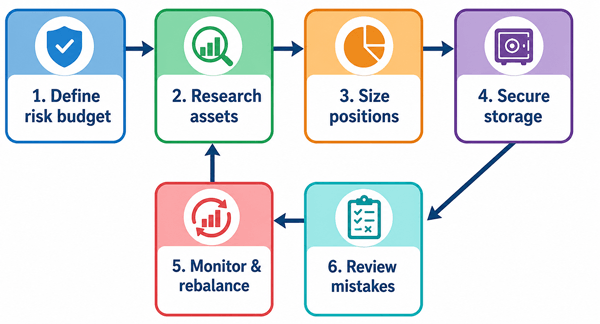
Use the following six-step framework before buying any crypto asset. It is simple enough for beginners but strong enough to prevent many common losses.
4.1 Define your risk budget
Decide the maximum amount of money you are willing to expose to crypto. This should be money you can afford to lose without affecting rent, bills, emergency savings, debt payments, or family obligations.
4.2 Research before buying
Understand what the asset does, who uses it, how tokens are issued, what can make it fail, where it trades, and whether you are buying because of evidence or hype.
4.3 Size each position
Do not put the same amount into every token automatically. A large, liquid asset may justify a larger position than an experimental micro-cap token.
4.4 Secure your holdings
Your investment plan is useless if you lose access or get hacked. Security is part of risk management, not a separate technical hobby.
4.5 Monitor and rebalance
Crypto prices can change portfolio weight quickly. Rebalancing stops one winning asset from becoming an accidental all-in bet.
4.6 Review mistakes
Keep notes about why you bought, what happened, and what you learned. This improves decision-making over time.
5. How Much Should a Beginner Invest in Crypto?
There is no universal number. A beginner should start with a personal risk budget, not a price prediction. The safest rule is to invest only money that you can afford to lose. For many beginners, crypto might be a small portion of an overall portfolio rather than the center of it.
5.1 Example: Setting a crypto allocation
Suppose you have $10,000 available for investing after building an emergency fund and paying high-interest debt. You decide that crypto should be 5% of your investable assets. Your crypto budget is $500. If the market falls 50%, your loss is $250, which is painful but survivable. If you instead put the full $10,000 into a speculative token and it falls 80%, you lose $8,000 and may be forced into emotional decisions.
| Investor profile | Possible crypto allocation approach | Reasoning |
|---|---|---|
| Very cautious beginner | 0% to 2% | Learning first may be wiser than investing immediately. |
| Moderate beginner | 2% to 5% | Meaningful exposure without allowing crypto to dominate finances. |
| Experienced high-risk investor | 5% to 10%+ | Only suitable if the investor understands volatility, taxes, custody, and loss risk. |
6. Position Sizing: The Rule That Prevents One Bad Bet From Ruining You
Position sizing means deciding how much money to put into each asset. It is one of the most important crypto risk-management tools because even good investors are wrong sometimes.
| Asset category | Risk level | Example position idea |
|---|---|---|
| Large, established crypto assets | High but comparatively lower within crypto | Larger share of crypto allocation, such as 40%-70% of the crypto bucket. |
| Major altcoins | Very high | Smaller share, such as 10%-30% depending on research and conviction. |
| DeFi, gaming, meme, or new tokens | Extremely high | Tiny experimental position only; avoid if you do not understand it. |
| Stablecoins | Different risk profile | Useful for liquidity, but still carry issuer, platform, and depeg risk. |
Example: If your total crypto budget is $1,000, you might place $600 in assets you understand well, $300 in a second asset, and keep $100 for learning or cash-like liquidity. A beginner should be very careful with tiny tokens, meme coins, and projects where the main investment case is social media excitement.
7. Diversification in Crypto: Helpful, But Not Magic
Diversification means spreading risk across different assets. In crypto, it can help reduce single-token risk, but it cannot remove market-wide risk. Many tokens fall together when sentiment turns negative. Owning 25 highly correlated altcoins is not the same as true diversification.
| Approach | Pros | Cons |
|---|---|---|
| Concentrated portfolio | Easier to understand; fewer assets to monitor. | Large losses if one asset performs badly. |
| Moderately diversified portfolio | Reduces single-asset risk; more balanced. | Requires more research and tracking. |
| Over-diversified portfolio | Feels safer on the surface. | Can become a collection of low-quality assets you do not understand. |
8. Dollar-Cost Averaging vs Lump-Sum Investing
Dollar-cost averaging means investing a fixed amount at regular intervals, such as $50 every week or $200 each month. Lump-sum investing means investing the full amount at once. For beginners, dollar-cost averaging can reduce the stress of trying to pick the perfect entry price.
| Method | Best for | Main advantage | Main limitation |
|---|---|---|---|
| Dollar-cost averaging | Beginners and cautious investors | Reduces timing pressure and emotional buying. | May underperform if prices rise strongly after the first purchase. |
| Lump sum | Investors with strong conviction and high risk tolerance | Gets full exposure immediately. | Higher regret risk if price falls soon after buying. |
9. Using Stop-Losses, Alerts, and Rebalancing
A stop-loss is an order or rule to exit a position if price falls to a certain level. It can limit losses, but it is not perfect. In fast markets, the sale price can be worse than expected. In thinly traded tokens, stops can trigger during temporary price spikes. Beginners should treat stop-losses as tools, not guarantees.
Price alerts are often safer for long-term beginners because they prompt review without forcing automatic selling. Rebalancing is another useful tool. For example, if crypto grows from 5% to 12% of your overall portfolio, you may sell some or add more to other investments to bring the percentage back to your target.
10. Leverage and Margin: Why Beginners Should Be Extremely Careful
Leverage means borrowing or using derivatives to control a larger position than your cash balance. It can magnify gains, but it also magnifies losses. A small price move can liquidate your position. For beginners, leverage is usually unnecessary and dangerous. If you cannot explain liquidation price, funding rates, slippage, collateral, and exchange risk, you should not use leverage.
11. Crypto Wallet and Custody Risk Management
Custody means who controls the keys that move your crypto. With a centralized exchange, the platform controls custody on your behalf. With self-custody, you control the private keys or seed phrase. Each option has trade-offs.
| Custody method | Pros | Risks | Best practice |
|---|---|---|---|
| Centralized exchange | Convenient, easy to buy and sell, beginner-friendly. | Platform failure, account compromise, withdrawal freezes. | Use reputable platforms, strong 2FA, and avoid storing all funds there. |
| Software wallet | Easy access to DeFi and payments. | Device malware, phishing, bad approvals. | Use for smaller amounts and separate wallets for experiments. |
| Hardware wallet | Private keys kept offline; strong for long-term storage. | Seed phrase loss, fake devices, user error. | Buy from trusted source, back up seed phrase offline, test small transfers. |
| Multi-signature wallet | Requires multiple approvals; useful for larger balances. | More complex setup and recovery. | Use only after learning the process or with expert help. |
11.1 Seed phrase safety rules
- Never type your seed phrase into a website or chat message.
- Never store it only in email, cloud notes, screenshots, or a photo gallery.
- Write it down and store it in at least one secure offline location.
- Consider a fire- and water-resistant backup for larger holdings.
- Test recovery with a small wallet before relying on a setup for meaningful funds.
12. How to Avoid Crypto Scams
Scams are one of the biggest practical risks for beginners. FINRA warns that fraud and scams involving crypto assets are common and advises investors to avoid relying on social media posts, messages, or videos that promote new crypto assets. The CFTC also warns about relationship investment scams, where fraudsters build trust before steering victims into fake crypto opportunities.
| Red flag | Why it is dangerous | Safer response |
|---|---|---|
| Guaranteed returns | Real investments do not guarantee high returns without risk. | Walk away. |
| Urgent pressure | Scammers use deadlines to stop you from thinking. | Pause for 24 hours and verify independently. |
| Someone asks for your seed phrase | A seed phrase gives full control of the wallet. | Never share it. |
| Unknown exchange or app | Fake platforms can show fake profits and block withdrawals. | Use established, regulated, well-reviewed services. |
| Romance or friendship investment tip | Trust is used to lower your guard. | Do not send funds based on online relationships. |
| Airdrop or NFT approval request | Malicious approvals can drain a wallet. | Use a separate wallet and verify contracts carefully. |
13. DeFi Risk Management for Beginners
Decentralized finance, or DeFi, allows users to lend, borrow, trade, and earn yield through smart contracts. It can be useful, but it adds technical and operational risks. A protocol can be hacked, an oracle can fail, liquidity can disappear, or a wallet approval can give a contract too much access.
Beginner best practice: Bo not chase high yields until you understand where the yield comes from. If a protocol offers a return far above normal market rates, ask what risk is paying for that return. The answer may be token inflation, leverage, smart contract risk, or unsustainable incentives.
14. Real-World Risk Management Scenarios
14.1 Scenario 1: The beginner who buys after a social media pump
A new investor sees a token trending online and buys $2,000 without research. The token falls 70% after early holders sell. Better approach: limit speculative positions to a tiny percentage of the crypto budget, check liquidity, read the tokenomics, and avoid buying purely because something is trending.
14.2 Scenario 2: The long-term holder who keeps everything on one exchange
An investor buys Bitcoin and Ethereum and leaves all holdings on one exchange for years. If the account is compromised or the platform freezes withdrawals, access may be lost. Better approach: keep only trading balances on exchanges and move long-term holdings to a properly backed-up hardware wallet.
14.3 Scenario 3: The DeFi yield chaser
A user sees a 60% annual yield and deposits most of their stablecoins into a new protocol. A smart contract exploit drains funds. Better approach: cap DeFi exposure, prefer battle-tested protocols, understand audits are not guarantees, and avoid putting essential capital into experimental yield farms.
15. A Practical Crypto Risk Management Checklist
- Build an emergency fund before investing in crypto.
- Write down your total crypto allocation limit.
- Decide your maximum loss before buying.
- Use position-size limits for each asset.
- Avoid leverage unless you fully understand the mechanics.
- Use strong unique passwords and app-based or hardware two-factor authentication.
- Use a hardware wallet for meaningful long-term holdings.
- Never share your seed phrase or private keys.
- Keep records for taxes, buys, sells, transfers, and fees.
- Review your portfolio at scheduled intervals instead of reacting to every price move.
- Ignore guaranteed-return offers and pressure tactics.
- Rebalance when one asset becomes too large relative to your plan.
16. Common Mistakes Beginners Make
| Mistake | Why it hurts | Better habit |
|---|---|---|
| Investing money needed soon | Crypto can fall sharply right when you need cash. | Use only long-term risk capital. |
| Buying because of FOMO | Late entries often happen near local tops. | Use a plan and staged entries. |
| Ignoring fees and spreads | Small trades can become expensive. | Compare total trading costs. |
| Holding too many tokens | Hard to research and monitor. | Own fewer assets you understand. |
| Believing stablecoins are risk-free | Stablecoins can depeg or face issuer/platform risk. | Diversify cash management and understand reserves. |
| Skipping tax records | Transfers and trades may create reporting obligations. | Track every transaction from the start. |
17. Benefits and Limitations of Crypto Risk Management
| Benefits | Limitations |
|---|---|
| Reduces the chance of catastrophic loss. | Cannot prevent all losses or hacks. |
| Helps control emotions during volatility. | Requires discipline when markets are exciting or frightening. |
| Improves security and custody habits. | Self-custody can create new user-error risks. |
| Makes investing decisions more consistent. | No framework can predict prices reliably. |
18. Sample Beginner Crypto Risk Management Plan
Here is a simple example of how a beginner might write a personal plan. Adjust the numbers to your own situation, risk tolerance, and local rules.
- Total crypto allocation: maximum 5% of investable assets.
- No single speculative token: more than 0.5% to 1% of investable assets.
- No leverage, margin, or futures trading.
- Buy only after writing a short reason for the investment.
- Use dollar-cost averaging rather than one large emotional purchase.
- Keep long-term holdings in a hardware wallet after learning how to use it safely.
- Review monthly; rebalance if crypto exceeds target allocation by more than 25%.
- Sell or reduce a position if the original reason for buying is no longer true.
- Never invest based on private messages, celebrity posts, or guaranteed-return offers.
19. Useful Facts Beginners Should Know
- Blockchain transactions are generally irreversible. If you send funds to the wrong address or a scammer, recovery is unlikely.
- Private keys and seed phrases control access. Whoever has them can usually move the assets.
- Large market capitalization does not eliminate risk. Even major crypto assets can be volatile.
- High yield usually means high risk, hidden risk, or temporary incentives.
- Audits reduce smart contract risk but do not eliminate it.
- Past price performance does not prove future value.
20. FAQs About Risk Management for Crypto Investors
20.1 What is the biggest risk in crypto investing?
For many beginners, the biggest risks are volatility, scams, poor custody practices, and investing too much too soon. The exact biggest risk depends on your behavior. A careful long-term holder may face custody risk, while an active trader may face leverage and emotional decision risk.
20.2 Can crypto risk be eliminated?
No. Risk can be reduced, transferred, or limited, but not eliminated. Even careful investors can face market crashes, hacks, regulatory changes, and user mistakes.
20.3 Is Bitcoin safer than other cryptocurrencies?
Bitcoin is generally more established and liquid than many smaller tokens, but it is still volatile and risky. Safer does not mean safe.
20.4 Should beginners use leverage?
Usually no. Leverage can cause liquidation and rapid losses. Beginners should learn spot investing, custody, taxes, and market behavior before considering advanced products.
20.5 How do I know if a crypto project is too risky?
Warning signs include anonymous teams with no track record, unclear use case, unrealistic returns, low liquidity, heavy insider token allocations, unaudited contracts, aggressive marketing, and pressure to buy quickly.
20.6 Is a stablecoin the same as cash?
No. Stablecoins aim to track a currency such as the U.S. dollar, but they may carry issuer, reserve, platform, regulatory, and depeg risk.
20.7 How often should I check my crypto portfolio?
Beginners often do better with scheduled reviews, such as weekly or monthly, instead of checking prices constantly. Too much monitoring can lead to emotional trading.
20.8 What should I do before my first crypto purchase?
Learn the basics, choose a reputable platform, start small, enable strong security, understand fees, write your reason for buying, and decide your maximum loss in advance.
21. Final Thoughts: The Best Crypto Investors Survive First
Crypto investing rewards patience, skepticism, and preparation more than excitement. A beginner does not need a complicated trading system. The essentials are simple: invest only what you can afford to lose, avoid leverage, diversify carefully, secure your wallets, watch for scams, keep records, and make decisions from a written plan rather than emotion.
Good risk management may feel boring when markets are rising, but it becomes valuable when prices fall, platforms fail, or scams appear. In crypto, survival is a real advantage.
Sources Consulted and Checked
These sources were consulted and checked while preparing this document to support its accuracy and reliability.
- SEC Investor.gov - Exercise Caution with Crypto Asset Securities: Investor Alert: https://www.investor.gov/introduction-investing/general-resources/news-alerts/alerts-bulletins/investor-alerts/crypto-asset-securities
- CFTC - Digital Assets investor education resources: https://www.cftc.gov/LearnandProtect/digitalassets/index.htm
- CFTC - Understand the Risks of Virtual Currency Trading: https://www.cftc.gov/LearnAndProtect/AdvisoriesAndArticles/understand_risks_of_virtual_currency.html
- FINRA - Crypto Assets: https://www.finra.org/investors/investing/investment-products/crypto-assets
- FINRA - Crypto Assets Risks: https://www.finra.org/investors/investing/investment-products/crypto-assets/risks
- Chainalysis - 2025 Crypto Crime Trends: https://www.chainalysis.com/blog/2025-crypto-crime-report-introduction/
- Chainalysis - 2026 Crypto Crime Report Introduction: https://www.chainalysis.com/blog/2026-crypto-crime-report-introduction/
Reader Advice
This article is provided for educational and informational purposes only and is not personalized financial, investment, legal, tax, or security advice or a recommendation to buy, sell, hold, or use any crypto asset, platform, wallet, or protocol. Crypto assets are volatile and speculative, and losses—including the loss of all invested funds or access to assets—are possible through price movements, scams, hacks, platform failures, smart-contract issues, custody mistakes, or regulatory changes. Rules, policies, laws, tax requirements, market conditions, and statistics change over time and vary by country or region, so verify current information with official regulators, tax authorities, and service providers before acting. Consider your circumstances, conduct independent research, use appropriate security measures, and seek advice from a suitably qualified professional where needed.