Dollar-Cost Averaging in Crypto: Complete Guide, Examples, Risks and Best Practices
Dollar-cost averaging, often shortened to DCA, is one of the simplest ways to invest in crypto without making a big bet on one perfect entry price. Instead of trying to guess whether Bitcoin or Ethereum will rise or fall tomorrow, you invest a fixed amount on a fixed schedule.
For example, you might buy $50 of Bitcoin every Friday or $200 of Ethereum on the first day of each month. Some purchases will happen at higher prices and some at lower prices. Over time, your average purchase price becomes the result of many smaller decisions rather than one emotional, all-or-nothing decision.
DCA does not guarantee profit. It does not remove crypto risk. But it can help beginners build discipline, reduce timing stress, and avoid common mistakes such as panic buying near market tops or panic selling during sudden drops.
1. What Is Dollar-Cost Averaging in Crypto?
Dollar-cost averaging in crypto is an investing strategy where you buy a fixed dollar amount of a cryptocurrency at regular intervals, regardless of the current price. The key ingredients are consistency, a fixed amount, and a predetermined schedule.
| Element | What it means |
|---|---|
| Fixed amount | You invest the same dollar amount each time, such as $25, $100, or $500. |
| Regular schedule | You buy on a planned schedule, such as daily, weekly, biweekly, or monthly. |
| Same target asset | You usually apply DCA to one or a small number of assets you are willing to hold long term. |
| No price prediction required | You keep investing through ups and downs instead of waiting for the perfect price. |
In traditional investing, sources such as SEC Investor.gov and FINRA describe dollar-cost averaging as investing equal portions at regular intervals regardless of market conditions. The same idea can be applied to crypto, but crypto has extra risks such as extreme volatility, exchange risk, custody risk, and regulatory uncertainty.
2. How Dollar-Cost Averaging Works Step by Step
- Choose the asset carefully: Most beginners who use DCA start with larger, more established crypto assets rather than highly speculative tokens. The strategy only makes sense if you believe the asset has a reasonable long-term case.
- Choose an amount you can sustain: A good DCA amount should not disturb your rent, bills, emergency fund, or debt payments. If $25 per week feels easy to maintain, that is better than $500 per week that causes stress.
- Choose a schedule: Common schedules include daily, weekly, biweekly, and monthly. Weekly or monthly is often easier for beginners because it reduces transaction frequency and decision fatigue.
- Automate the purchases if possible: Many exchanges and apps allow recurring buys. Automation can reduce emotional decisions, but you should still review fees, spreads, and security settings.
- Review periodically, not constantly: DCA works best with a calm review routine, such as monthly or quarterly. Watching the price every hour often creates anxiety and encourages impulsive changes.
3. A Simple DCA Example With Bitcoin
Imagine a beginner decides to invest $100 per month into Bitcoin for six months. The price changes each month. When the price is lower, the same $100 buys more Bitcoin. When the price is higher, it buys less.
| Month | BTC price | Amount invested | BTC bought | Cumulative BTC |
|---|---|---|---|---|
| Jan | $40,000 | $100 | 0.002500 | 0.002500 |
| Feb | $32,000 | $100 | 0.003125 | 0.005625 |
| Mar | $25,000 | $100 | 0.004000 | 0.009625 |
| Apr | $30,000 | $100 | 0.003333 | 0.012958 |
| May | $45,000 | $100 | 0.002222 | 0.015181 |
| Jun | $38,000 | $100 | 0.002632 | 0.017812 |
Total invested: $600. Total Bitcoin accumulated: about 0.01863 BTC. Average cost per BTC is approximately $32,208, calculated as total dollars invested divided by total BTC bought.
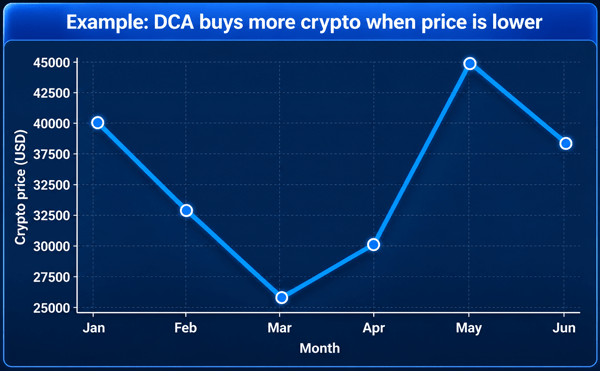
Figure: In a DCA plan, lower prices automatically buy more units, while higher prices buy fewer units.
4. DCA vs Lump-Sum Investing in Crypto
A common beginner question is whether it is better to invest all at once or slowly over time. There is no universal answer. The best choice depends on your cash situation, risk tolerance, time horizon, and emotional discipline.
| Approach | How it works | Best suited for |
|---|---|---|
| Dollar-cost averaging | Invest a fixed amount over time, such as $100 weekly. | Beginners, nervous investors, salary-based investors, and anyone who wants to reduce timing regret. |
| Lump-sum investing | Invest all available money at once. | Investors with a long time horizon, strong conviction, and the ability to handle immediate volatility. |
| Hybrid approach | Invest part now and DCA the rest over weeks or months. | People who want market exposure now but do not want to commit everything at one price. |
Important: DCA may reduce the risk of investing everything right before a sharp drop, but it can also underperform lump-sum investing during a fast rising market because some of your money stays in cash while prices rise.
5. Benefits of Dollar-Cost Averaging in Crypto
- Reduces pressure to time the market: Crypto prices can move sharply in minutes or hours. DCA removes the need to guess the perfect entry point.
- Builds discipline: A fixed plan helps prevent emotional buying after hype and emotional quitting after market drops.
- Makes investing manageable: Many beginners do not have a large lump sum. DCA lets them build exposure gradually from regular income.
- Can lower timing regret: Even if the price falls after one purchase, only that small purchase was made at the higher price.
- Creates a repeatable habit: DCA turns investing into a routine rather than a constant debate.
6. Risks and Limitations of Crypto DCA
- DCA does not guarantee profit: If the asset trends toward zero, regular buying simply increases exposure to a losing investment.
- Crypto can be extremely volatile: A portfolio may fall 30%, 50%, or more even if the DCA plan is executed perfectly.
- Fees and spreads can eat returns: Small frequent buys may be expensive if the platform charges high trading fees or wide spreads.
- Bad asset selection is still bad asset selection: DCA into a weak, illiquid, or scam token is not safer just because the purchases are spread out.
- Over-automation can create neglect: Recurring buys are convenient, but investors still need to review security, taxes, portfolio concentration, and whether the original thesis remains valid.
- Tax recordkeeping can become complex: Frequent purchases create many cost basis lots. Selling later may require careful records, depending on your local tax rules.
7. Best Practices for Dollar-Cost Averaging in Crypto
- Build an emergency fund before investing heavily in crypto.
- Use money that is not needed for short-term bills, debt payments, or essential goals.
- Start with a small amount until you understand the platform, fees, tax records, and custody process.
- Prefer transparent, liquid assets over obscure tokens promoted mainly by hype.
- Set a schedule in advance and avoid changing it because of social media panic or excitement.
- Compare fees, spreads, deposit costs, and withdrawal costs before choosing an exchange.
- Use strong security: unique password, two-factor authentication, withdrawal allowlists if available, and caution with phishing links.
- Decide where assets will be held: on an exchange for convenience or in self-custody for more control and responsibility.
- Rebalance or review allocation periodically so crypto does not grow beyond your risk tolerance.
- Keep records of dates, amounts, assets, fees, and transfers for tax and portfolio tracking.
8. Choosing a DCA Schedule: Daily, Weekly, or Monthly?
| Schedule | Pros | Cons | Beginner verdict |
|---|---|---|---|
| Daily | Smooths entry prices more frequently. | More transactions, more records, and potentially more fees. | Usually unnecessary unless fees are very low and automation is easy. |
| Weekly | Good balance between consistency and simplicity. | Still creates many tax lots over time. | Often a practical choice for beginners. |
| Biweekly | Matches many paychecks. | Fewer buys than weekly, so slightly less smoothing. | Good for salary-based investors. |
| Monthly | Simple and easy to track. | Larger gap between purchases. | Good if you want fewer transactions and simpler records. |
9. Real-World DCA Scenarios
9.1 The cautious beginner
A new investor buys $25 of Bitcoin every week for six months while learning about wallets, exchange security, and tax reporting. This keeps the learning cost small.
9.2 The salary-based investor
Someone sets aside 5% of monthly disposable income for a Bitcoin and Ethereum plan after paying bills and adding to an emergency fund.
9.3 The lump-sum holder who fears bad timing
A person receives $6,000 and invests $1,000 immediately, then $500 every month for ten months. This hybrid approach provides some exposure now and reduces regret if prices fall soon after.
9.4 The investor exiting a position
DCA can also work in reverse. Instead of selling all crypto at once, an investor may sell a fixed amount weekly or monthly to reduce exit timing risk.
10. Common Mistakes to Avoid
- Using DCA as an excuse to buy every dip without a plan.
- DCAing into too many coins and ending up with a scattered portfolio.
- Ignoring fees because each purchase looks small.
- Stopping the plan only because prices are down, even though the original long-term thesis has not changed.
- Increasing contributions aggressively after a big rally because of fear of missing out.
- Keeping all funds on an exchange without understanding custody risk.
- Forgetting that taxes may apply when crypto is sold, swapped, or spent, depending on local law.
11. Misconceptions About DCA in Crypto
| Misconception | Reality |
|---|---|
| DCA guarantees profits. | It does not. It only changes how you enter the market. |
| DCA always beats lump-sum investing. | Not always. In a strong rising market, lump-sum investing can do better. |
| DCA makes risky coins safe. | No strategy can fix a poor-quality or fraudulent asset. |
| You should never change a DCA plan. | You can review and adjust thoughtfully, but not because of short-term emotion. |
| Small buys mean taxes do not matter. | Tax rules vary, but many small buys can still matter when you sell or exchange assets. |
12. A Beginner-Friendly Crypto DCA Checklist
- ☐ I have paid essential bills and high-interest debt first.
- ☐ I have an emergency fund or a plan to build one.
- ☐ I understand that crypto can lose significant value.
- ☐ I have chosen assets based on research, not hype.
- ☐ I know the fees and spreads on my platform.
- ☐ I have enabled strong account security.
- ☐ I have decided on my amount, schedule, and review frequency.
- ☐ I have a plan for recordkeeping and taxes.
- ☐ I know when I would pause, reduce, rebalance, or exit the plan.
13. Example DCA Plan for a Beginner
Here is a simple sample plan. It is not a recommendation, but it shows how a beginner might structure the decision before investing.
| Decision | Example |
|---|---|
| Goal | Build long-term crypto exposure slowly while learning. |
| Asset choice | Bitcoin and/or Ethereum only, at least at the start. |
| Amount | 2% to 5% of monthly disposable income, not total income. |
| Schedule | Monthly on payday or weekly on a fixed day. |
| Review | Quarterly review of allocation, fees, security, and thesis. |
| Risk limit | Crypto remains a small part of the overall investment plan. |
| Exit rule | Consider trimming if crypto grows beyond the target allocation or if personal finances change. |
14. When DCA May Not Be a Good Fit
- You need the money soon for rent, tuition, medical costs, or a home purchase.
- You have high-interest debt that should reasonably be prioritized first.
- You are buying an asset you do not understand.
- You are using leverage, borrowed money, or credit cards to invest.
- You cannot handle large drawdowns emotionally or financially.
- Your plan depends on quick profits rather than long-term discipline.
15. FAQs About Dollar-Cost Averaging in Crypto
15.1 Is DCA good for crypto beginners?
It can be useful because it is simple, disciplined, and less emotionally demanding than trying to time the market. However, it only helps with entry timing. It does not remove the need to choose assets carefully or manage risk.
15.2 How much should I DCA into crypto?
There is no single correct amount. A safer beginner approach is to use a small percentage of disposable income after essential expenses, emergency savings, and debt payments. The amount should be sustainable even during market declines.
15.3 Is weekly or monthly DCA better?
Weekly DCA gives more frequent entries, while monthly DCA is simpler and easier to track. For most beginners, either can work if fees are low and the schedule is consistent.
15.4 Can I DCA into altcoins?
You can, but the risk is usually higher. Many smaller tokens have weaker liquidity, shorter histories, and greater failure risk. Beginners should be especially careful with tokens driven mainly by hype.
15.5 Should I stop DCA when prices fall?
Not automatically. Falling prices are part of the reason DCA exists. However, you should reassess if the asset’s long-term case has changed, your personal finances have changed, or the risk is no longer appropriate.
15.6 Does DCA work during a bear market?
DCA can help investors continue buying gradually during a bear market, which may lower the average purchase price if the asset later recovers. But if the asset never recovers, DCA will not save the investment.
15.7 Can I use DCA to sell crypto?
Yes. Selling a fixed dollar amount on a schedule is sometimes called reverse DCA. It can reduce the pressure of trying to sell at the exact top.
15.8 What is the biggest risk of DCA in crypto?
The biggest risk is consistently buying an asset that performs poorly or fails. DCA is a buying method, not a quality filter.
16. Final Thoughts
Dollar-cost averaging in crypto is popular because it is simple: choose an amount, choose a schedule, and keep buying consistently instead of trying to predict every market move. For beginners, that simplicity can be powerful.
But DCA is not magic. It does not guarantee profit, protect you from bad assets, or remove the need for security and risk management. The best use of DCA is as part of a broader plan: strong personal finances first, careful asset selection, low fees, good recordkeeping, secure custody, and regular reviews.
A thoughtful DCA plan should feel boring, repeatable, and financially comfortable. If it feels exciting, stressful, or urgent, it may be too aggressive.
Sources Consulted and Checked
These sources were consulted and checked while preparing this document to support its accuracy and reliability.
- SEC Investor.gov - Dollar-Cost Averaging
- FINRA - The Benefits and Limitations of Dollar-Cost Averaging
- Charles Schwab - What Is Dollar-Cost Averaging?
- Vanguard - Dollar-cost averaging vs lump-sum investing
- Coinbase Learn - What is Dollar-Cost Averaging (DCA)?
Reader Advice
This article is provided for educational and informational purposes only and is not personalized financial, tax, legal, or investment advice or a recommendation to buy, sell, or hold any crypto asset. Crypto assets can be highly volatile, may lose substantial or all of their value, and may involve platform, custody, cybersecurity, liquidity, fraud, tax, and regulatory risks. Rules, policies, laws, tax treatment, market data, and statistics can change over time and vary by country or region, so readers should verify current information through official sources and consider guidance from appropriately qualified professionals before making important decisions. Only use money you can afford to leave invested or lose, and make choices that fit your own circumstances and risk tolerance.