HODL Strategy Explained: Meaning, How It Works, Examples, Benefits and Risks
1. Quick Answer: What Is HODL?
HODL is a crypto investing term that means holding a cryptocurrency for the long term instead of selling during short-term price swings. It began as a misspelling of “hold” in a 2013 Bitcoin forum post and later became popularly interpreted as “Hold On for Dear Life.”
A HODL strategy is similar to traditional buy-and-hold investing, but it is used mostly in cryptocurrency markets, where prices can rise or fall sharply in a short time. The basic idea is simple: choose assets you believe have long-term value, buy them with money you can afford to risk, store them safely, and avoid emotional selling during market volatility.
2. What Does HODL Mean in Crypto?
In crypto, HODL means staying invested through market ups and downs. It is not the same as ignoring risk or blindly buying any coin. A thoughtful HODL plan starts with research, position sizing, secure storage, and a clear reason for holding.
Many beginners first hear the word during a crypto market crash, when experienced investors say they are “HODLing.” In that context, it usually means they are not selling just because the price is falling. They believe the asset may recover or grow over a longer period.
3. Where Did the Term HODL Come From?
The term became famous after a BitcoinTalk forum user posted “I AM HODLING” in December 2013 while describing why they were not trying to trade short-term price moves. The typo became a meme, then a widely used investing phrase in the crypto community. Today, people use HODL to describe long-term holding of Bitcoin, Ethereum, and other crypto assets.
4. How the HODL Strategy Works
The HODL strategy works by shifting your focus from short-term trading to long-term ownership. Instead of asking, “Can I sell this today for a quick gain?” a HODL investor asks, “Do I still believe this asset has a strong long-term case?”
- Choose a crypto asset after research. Beginners usually start by learning about Bitcoin, Ethereum, or other large, established assets before considering smaller tokens.
- Decide how much you can risk. Crypto can be highly volatile, so the amount should not threaten your rent, emergency savings, debt payments, or basic needs.
- Buy gradually or in one planned purchase. Some investors use dollar-cost averaging, meaning they buy a fixed amount at regular intervals to reduce the stress of timing the market.
- Store the asset securely. Long-term holding requires strong account security, backup phrases, and careful custody decisions.
- Hold through volatility, but review your thesis. HODLing does not mean refusing to change your mind when facts change.
- Rebalance or exit when your plan says so. A mature strategy includes rules for profit-taking, risk reduction, or selling if the original reason for buying is no longer valid.
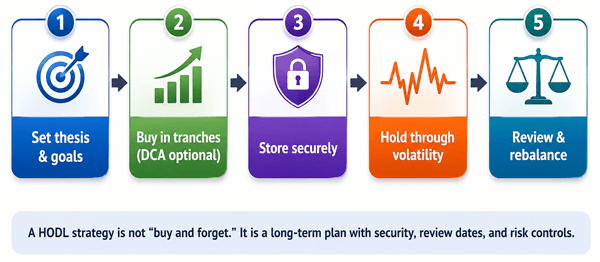
A practical HODL process for beginners.
| Element | What it means | Beginner example |
|---|---|---|
| Time horizon | How long you plan to hold before judging the result. | “I will review this Bitcoin position over 3 to 5 years, not every day.” |
| Asset selection | Choosing what to hold based on research, not hype. | A beginner studies Bitcoin supply, network adoption, Ethereum use cases, and risks before buying. |
| Position size | Limiting how much of your money is exposed to crypto. | Crypto is 5% of an overall portfolio, not the whole savings account. |
| Storage plan | Protecting coins from exchange failures, hacks, lost passwords, and scams. | Use two-factor authentication, withdrawal allowlists, or a hardware wallet for larger amounts. |
| Review rules | Checking whether the original reason to hold still makes sense. | Review quarterly or yearly instead of reacting to every headline. |
5. HODL Strategy Example for Beginners
Imagine Sara has $1,200 she is willing to invest in crypto after building an emergency fund. She believes Bitcoin has a long-term role as a scarce digital asset, but she knows the price can fall sharply. Instead of investing everything in one day, she buys $100 of Bitcoin each month for 12 months. This is a HODL strategy combined with dollar-cost averaging.
After six months, the price drops 35%. Sara does not panic-sell because she expected volatility. However, she does review her plan. She checks whether anything important has changed: network security, regulation, personal finances, and her reason for buying. If her thesis is still intact and her position size is still comfortable, she continues. If the investment has become too large or too stressful, she may reduce it.
6. HODL vs Trading: What Is the Difference?
| Feature | HODL strategy | Active trading |
|---|---|---|
| Main goal | Benefit from long-term growth if the asset succeeds. | Profit from short-term price movements. |
| Time commitment | Lower day-to-day involvement, but still needs periodic review. | High involvement; requires charts, news monitoring, risk management, and discipline. |
| Skill required | Research, patience, security habits, portfolio planning. | Technical analysis, execution speed, position sizing, stop-loss discipline. |
| Common risk | Holding a poor asset too long or ignoring changing facts. | Overtrading, emotional decisions, fees, leverage losses. |
| Best suited for | People who believe in a long-term thesis and do not want to trade daily. | Experienced investors who understand market structure and can manage risk. |
7. HODL vs Dollar-Cost Averaging
HODL and dollar-cost averaging are different ideas, but they are often used together. HODL is about how long you keep the asset. Dollar-cost averaging is about how you buy it.
| Strategy | Simple meaning | Example |
|---|---|---|
| HODL | Buy and hold for the long term. | Buy Ethereum and keep it for several years unless your thesis changes. |
| Dollar-cost averaging | Buy a fixed amount regularly. | Buy $50 of Bitcoin every week for one year. |
| HODL + DCA | Accumulate gradually and hold long term. | Buy monthly, store securely, and review once or twice a year. |
8. Benefits of the HODL Strategy
HODLing can be useful for beginners because it reduces the pressure to predict every short-term move. However, the benefits only matter when the investor chooses assets carefully and controls risk.
- Reduces emotional trading. A plan can help you avoid panic selling after a sudden drop or chasing a coin after a sudden rally.
- Lower time commitment than day trading. You do not need to watch charts all day, although you still need to review your holdings.
- Can reduce transaction costs. Fewer trades usually mean fewer fees, spreads, and taxable events.
- Keeps focus on long-term fundamentals. You can pay attention to adoption, security, developer activity, liquidity, and real use rather than daily noise.
- Pairs well with portfolio discipline. HODLing can fit inside a broader plan that includes cash, stocks, bonds, and other assets.
9. Risks and Limitations of HODLing
HODL is not a guarantee of profit. Crypto assets are speculative, volatile, and sometimes poorly regulated. Some coins never recover after a crash. Others lose relevance because of weak technology, poor security, low demand, fraud, or better competitors.
| Risk | Why it matters | Practical response |
|---|---|---|
| Extreme volatility | A coin can lose 50% or more in a short period. | Use money you can afford to risk and keep crypto as a limited part of your portfolio. |
| Asset selection risk | Not every crypto project has long-term value. | Avoid buying only because of hype, influencers, or short-term gains. |
| Security and custody risk | Long-term holders can lose assets through hacks, phishing, failed exchanges, or lost seed phrases. | Use strong passwords, 2FA, careful backups, and reputable custody methods. |
| Regulatory and tax risk | Rules can change, and selling or swapping crypto may create tax obligations. | Keep records and consult a qualified tax professional for your location. |
| Opportunity cost | Money locked in a weak asset cannot be used elsewhere. | Review your thesis and compare risk-adjusted alternatives. |
| Overconfidence | A meme can turn into blind faith. | Set review dates and define conditions that would make you sell. |
10. When HODLing May Make Sense
- You have researched the asset and understand the main reasons people value it.
- You can tolerate large price swings without needing to sell for living expenses.
- The position is small enough that a major loss would not damage your financial stability.
- You have a secure storage plan and know how to avoid common scams.
- You have a clear time horizon, review schedule, and exit rules.
11. When HODLing May Not Be a Good Idea
- You are using borrowed money, emergency savings, or money needed soon.
- You bought a token only because of social media hype and cannot explain what it does.
- The project has weak liquidity, anonymous leadership, unclear tokenomics, or unrealistic promises.
- You are ignoring major negative developments because you do not want to admit a mistake.
- The position has grown so large that it dominates your financial life.
12. Common HODL Mistakes Beginners Should Avoid
12.1 Confusing HODL with never selling
A good HODL strategy includes conditions for selling. You might sell because your goal was reached, your risk is too high, your thesis changed, or you need to rebalance your portfolio.
12.2 Holding too many low-quality coins
Long-term holding works best when the asset has a credible long-term case. Many small tokens are highly speculative and may never recover from bear markets.
12.3 Ignoring security
Crypto ownership comes with personal responsibility. A strong long-term thesis will not help if your account is hacked or your recovery phrase is lost.
12.4 Investing without an emergency fund
If you may need the money soon, a market crash can force you to sell at the worst time. Build basic financial stability before taking speculative risk.
12.5 Letting slogans replace thinking
“HODL” can be useful as a reminder not to panic, but it should not become an excuse to ignore evidence, risk, or better opportunities.
13. Best Practices for a Smarter HODL Plan
- Write down your investment thesis. Explain in plain language why you are buying, what could prove you wrong, and how long you plan to hold.
- Limit your allocation. Beginners should avoid putting their entire portfolio into crypto. A small, planned allocation is easier to hold through volatility.
- Prefer quality and liquidity. Larger, more established assets usually have better liquidity and more public information than tiny speculative tokens.
- Use secure storage. For exchange accounts, enable app-based two-factor authentication and strong unique passwords. For self-custody, learn seed phrase safety before moving large sums.
- Avoid leverage. Borrowed money can turn normal volatility into forced liquidation.
- Keep records. Track purchase dates, cost basis, fees, transfers, and sales for tax and portfolio review.
- Review on a schedule. Monthly, quarterly, or annual reviews are usually more helpful than checking prices every hour.
- Rebalance after big moves. If crypto grows from 5% to 25% of your portfolio, taking some profit may reduce risk even if you still believe long term.
14. A Simple HODL Checklist
| Question | Why it matters |
|---|---|
| Can I explain what this asset does in one minute? | If not, you may be buying hype rather than understanding value. |
| Can I afford a 50% to 80% drop without panic selling? | Crypto volatility can be severe. |
| Do I know where and how the asset is stored? | Security mistakes can cause permanent loss. |
| Do I have a written exit or review rule? | This prevents emotional decision-making. |
| Have I considered taxes and recordkeeping? | Selling, swapping, or earning crypto can have tax consequences. |
| Is my allocation reasonable compared with my whole financial life? | No single speculative asset should control your future. |
15. Real-World Scenarios
15.1 Scenario 1: The patient beginner
A beginner invests a small amount monthly into Bitcoin and Ethereum after learning the basics. They store assets securely, keep records, and review twice a year. This is a disciplined HODL approach.
15.2 Scenario 2: The hype buyer
Another beginner buys a trending meme coin after watching social media videos. The price falls 70%, but they keep saying “HODL” even though the project has no clear use case. This is not disciplined investing; it is hope without a plan.
15.3 Scenario 3: The overexposed investor
An investor buys a quality asset, but it grows into most of their net worth after a strong bull market. Even if the asset is good, rebalancing may be sensible because personal risk has become too high.
16. HODL Strategy Pros and Cons
| Pros | Cons |
|---|---|
| Simple to understand and easier than active trading. | Can lead to large losses if the asset is poor or the market declines for years. |
| Reduces panic selling and overtrading. | May create false confidence if you ignore new information. |
| Lower fees and fewer taxable events than frequent trading. | Requires patience during painful drawdowns. |
| Fits long-term investors who believe in crypto adoption. | Security, custody, and tax responsibilities remain important. |
| Can be combined with dollar-cost averaging and rebalancing. | Does not remove the need for research or risk management. |
17. Frequently Asked Questions About HODL
17.1 Is HODL a good strategy for beginners?
It can be suitable for beginners who use small position sizes, understand the asset, and have a long-term plan. It is not suitable for people using borrowed money, emergency savings, or money they need soon.
17.2 Does HODL mean I should never sell?
No. HODL means you are not reacting to every short-term price move. A smart plan still includes review dates, rebalancing, profit-taking rules, and reasons to exit.
17.3 Which crypto is best for HODLing?
There is no universally best crypto. Beginners often research larger, more liquid assets first because they have longer histories and more public information. Smaller tokens may offer higher potential upside but usually carry higher risk.
17.4 How long should I HODL?
Your time horizon depends on your goals and risk tolerance. Many HODL investors think in years rather than days or weeks, but you should review your thesis regularly.
17.5 Can I lose money by HODLing?
Yes. You can lose money if the asset price falls and does not recover, if the project fails, if you lose access to your wallet, or if you are scammed.
17.6 Is HODL better than trading?
For many beginners, HODLing is simpler and less stressful than trading. But it is not automatically better. Trading requires skill and discipline, while HODLing requires research, patience, and risk control.
17.7 Should I keep crypto on an exchange while HODLing?
Small amounts may be convenient on a reputable exchange, but larger long-term holdings often require more careful custody planning. Self-custody can reduce exchange risk but introduces responsibility for seed phrases and wallet security.
17.8 Does HODLing avoid taxes?
Not necessarily. In many places, selling, swapping, or spending crypto can trigger taxable gains or losses. Rules vary by country, so keep records and ask a qualified tax professional.
18. Final Takeaway
The HODL strategy is a long-term crypto holding approach built around patience, conviction, and avoiding emotional short-term trading. For beginners, its biggest strength is simplicity. Its biggest weakness is that it can turn into blind faith if you hold poor assets, ignore security, or refuse to reassess your assumptions.
A better way to think about HODL is this: research carefully, buy only what you can afford to risk, protect your assets, hold with a clear long-term plan, and review your decision when facts change. HODLing is not about doing nothing. It is about doing fewer things more deliberately.
Sources Consulted and Checked
The following sources were consulted and checked while preparing this article and supporting its accuracy.
- BitcoinTalk forum: original “I AM HODLING” discussion that popularized the term HODL.
- U.S. SEC Investor.gov: investor alerts on crypto asset volatility, speculation, platform risks, and scams.
- FINRA: crypto asset risk education for investors.
- IRS Digital Assets FAQs: U.S. tax treatment and recordkeeping considerations for digital asset transactions.
- Bitcoin.org and the Satoshi Nakamoto Institute: introductory Bitcoin resources and historical documents.
Reader Advice
This article is provided for educational and informational purposes only and does not constitute personalized financial, investment, tax, or legal advice or a recommendation to buy, sell, or hold any crypto asset. Crypto markets are volatile and may involve substantial or total loss, scams, custody failures, cybersecurity threats, liquidity problems, and changing tax or regulatory obligations. Rules, policies, laws, market conditions, and statistics can change over time and vary by country or region, so readers should verify important information through current official sources and consider advice from appropriately qualified professionals before making decisions. Use only money you can afford to risk and assess whether any strategy suits your own goals, finances, experience, and risk tolerance.