Best Cryptocurrencies to Learn About First: Complete Guide, Examples, Risks and Best Practices
1. Introduction: Which Cryptocurrencies Should Beginners Learn First?
The best cryptocurrencies to learn about first are not always the newest, loudest, or fastest-growing coins. For a beginner, the better starting point is to study the cryptocurrencies that explain the main ideas behind the crypto market: digital scarcity, decentralized networks, smart contracts, stablecoins, wallets, exchanges, fees, security, and risk management.
A practical learning order is Bitcoin first, Ethereum second, stablecoins third, then a few major networks such as Solana, BNB, XRP, Cardano, Polygon, and Chainlink. This does not mean these are automatically good investments. It means they are useful examples for understanding how different parts of the crypto ecosystem work.
2. Beginner Learning Path Diagram
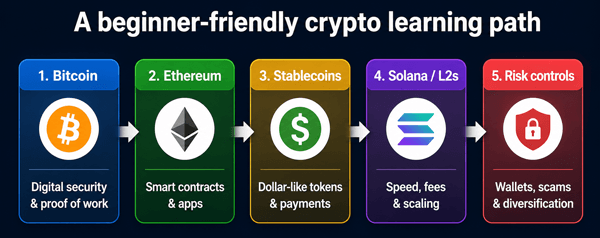
Figure: A simple order for learning crypto concepts without jumping straight into speculation.
3. What Is a Cryptocurrency?
A cryptocurrency is a digital asset that uses cryptography and a shared computer network to record ownership and transactions. Instead of one bank maintaining the ledger, many computers, often called nodes or validators, help maintain the record.
Most cryptocurrencies run on a blockchain. A blockchain is a public or semi-public database that groups transactions into blocks and links those blocks together. Once a transaction is confirmed, changing it is difficult because the network would have to agree to rewrite history.
A simple comparison: a bank account is controlled by a bank and protected by account credentials. A crypto wallet is controlled by private keys. If you hold the keys, you can move the asset. If you lose the keys, there may be no customer support that can restore access.
4. How Cryptocurrencies Work in Plain English
- You create or use a crypto wallet. The wallet has a public address, like an account number, and private keys or a recovery phrase, like the ultimate password.
- You send a transaction. For example, you send ETH from your wallet to another address.
- The network checks the transaction. Validators or miners confirm that the sender has the funds and that the transaction follows the rules.
- The transaction is added to the blockchain. Once confirmed, it becomes part of the shared transaction history.
- You pay a network fee. This fee pays the network participants who process transactions and helps prevent spam.
5. The Main Crypto Categories Beginners Should Understand
| Category | Examples | What it is used for | Beginner risk to notice |
|---|---|---|---|
| Digital money / store of value | Bitcoin | Holding, transferring value, long-term scarcity narrative | Price volatility; mining energy debate; custody mistakes |
| Smart contract platforms | Ethereum, Solana, Cardano, Avalanche | Apps, tokens, DeFi, NFTs, games, payments | Technical complexity; network congestion; smart contract risk |
| Stablecoins | USDT, USDC, DAI | Trading, payments, savings-like DeFi activity, moving value between platforms | Reserve risk, depegging, regulation, issuer risk |
| Exchange and ecosystem tokens | BNB, OKB, CRO | Fee discounts, ecosystem activity, chain fees, incentives | Dependence on a company or exchange ecosystem |
| Payment-focused coins | XRP, Litecoin, Stellar | Fast transfers and settlement narratives | Adoption uncertainty and regulatory risk |
| Oracle and infrastructure tokens | Chainlink, The Graph | Feeds external data or indexing services to blockchain apps | Value capture can be hard for beginners to evaluate |
| Meme coins | Dogecoin, Shiba Inu, PEPE | Community, culture, speculation | High volatility; hype-driven; weak fundamentals |
6. Bitcoin (BTC): The First Cryptocurrency to Study
Bitcoin is usually the best cryptocurrency to learn about first because it introduces the core idea of a decentralized digital asset. Bitcoin was designed as peer-to-peer electronic cash, but many people now also view it as a digital store of value because its supply schedule is limited by protocol rules.
The most important beginner concept is proof of work. Bitcoin miners use computing power to compete to add new blocks. This helps secure the network, but it also means Bitcoin uses significant energy compared with proof-of-stake networks.
Bitcoin is also important because it has become the benchmark for the whole crypto market. In January 2024, the U.S. SEC approved the listing and trading of several spot Bitcoin exchange-traded product shares, which made Bitcoin exposure easier for some traditional investors through brokerage accounts.
6.1 Practical Bitcoin example
Imagine Sarah wants to learn crypto without buying obscure tokens. She studies Bitcoin first. She learns what a wallet is, why a recovery phrase matters, how transaction confirmations work, and why sending funds to the wrong address can be irreversible. Even if she never buys Bitcoin, she now understands the foundation for most crypto discussions.
6.2 Bitcoin pros and cons
| Pros | Cons / limitations |
|---|---|
| Most recognized crypto asset; deep liquidity; clear monetary policy narrative; strong educational value. | Volatile price; transactions can be slower or more expensive during busy periods; no smart contract ecosystem like Ethereum; self-custody mistakes can be permanent. |
7. Ethereum (ETH): The Best Crypto to Learn Smart Contracts
Ethereum is the next major cryptocurrency beginners should study because it expands the idea of blockchain from digital money to programmable applications. Ether, or ETH, is the native asset used to pay transaction fees and secure the network.
Ethereum introduced smart contracts at large scale. A smart contract is code that runs on a blockchain. It can manage tokens, lending apps, NFT marketplaces, decentralized exchanges, games, identity tools, and many other applications.
Ethereum moved from proof of work to proof of stake in September 2022 through an upgrade known as The Merge. Ethereum.org says this change greatly reduced Ethereum energy consumption and enabled the network to use validators instead of miners. Spot Ether ETFs also began trading in the U.S. in July 2024 after regulatory approvals.
7.1 Practical Ethereum example
Ali wants to understand why people talk about DeFi. He studies Ethereum and learns that a decentralized exchange can let users swap tokens through smart contracts instead of a traditional broker. He also learns that using these apps involves gas fees and smart contract risk.
7.2 Ethereum pros and cons
| Pros | Cons / limitations |
|---|---|
| Largest smart contract ecosystem; strong developer community; many educational resources; central to DeFi, NFTs, DAOs, and tokens. | Can be expensive during congestion; user experience can be confusing; smart contract bugs and phishing attacks are serious risks. |
8. Stablecoins: The Most Practical Crypto Category to Understand
Stablecoins are cryptocurrencies designed to keep a relatively stable value, often around one U.S. dollar. The most common types are backed by cash, short-term government securities, other crypto assets, or algorithmic mechanisms. Beginners should learn stablecoins because they are widely used for trading, payments, remittances, and moving value between platforms.
Stablecoins are not risk-free. A stablecoin can lose its peg, its issuer may face legal or banking problems, reserves may be unclear, and redemption rules can differ from what beginners expect. Stablecoins should be studied as payment and liquidity tools, not as magic risk-free dollars.
8.1 Stablecoin comparison
| Stablecoin type | Example | How it tries to stay stable | Main risk |
|---|---|---|---|
| Fiat-backed | USDC, USDT | Issuer holds reserves such as cash or short-term assets. | Issuer, reserve, banking, and regulatory risk |
| Crypto-backed | DAI | Overcollateralized by crypto assets and managed through smart contracts. | Collateral crashes, protocol design, governance risk |
| Algorithmic | Historic examples include TerraUSD | Uses incentives or algorithms instead of simple fully backed reserves. | Can collapse quickly if confidence disappears |
9. Solana (SOL): Learn Speed, Fees, and Scaling Trade-Offs
Solana is a smart contract platform known for fast transactions and low fees. It is useful for beginners because it shows how blockchain networks compete on speed, cost, developer experience, and app design. Solana is often used in consumer crypto apps, NFTs, DeFi, and payments experiments.
The lesson is not that faster is always better. Every blockchain design involves trade-offs around decentralization, reliability, validator requirements, ecosystem maturity, and security. Beginners should compare Solana with Ethereum and Ethereum Layer 2 networks to understand these trade-offs.
10. BNB (BNB): Learn Exchange Ecosystems and Centralization Questions
BNB is associated with the Binance ecosystem and BNB Chain. It is worth learning because exchange-linked tokens show how crypto assets can be tied to trading platforms, fee discounts, chain activity, and ecosystem incentives. The main beginner lesson is that some crypto assets depend heavily on the health, reputation, and regulation of a major company or exchange.
11. XRP (XRP): Learn Payments, Settlement, and Regulatory Risk
XRP is commonly discussed in the context of payments and cross-border settlement. Beginners can use XRP as a case study in how crypto projects try to solve real financial infrastructure problems. It also shows why legal and regulatory questions matter: a token can have technology, users, and market interest while still facing uncertainty about how regulators classify or treat it.
12. Chainlink (LINK): Learn Why Blockchains Need Outside Data
Blockchains are good at verifying what happens on-chain, but many applications need outside information such as asset prices, weather data, sports results, or proof that an event happened. Chainlink is an oracle network that helps smart contracts use external data. For beginners, Chainlink is useful because it explains a hidden but important part of blockchain infrastructure.
13. Polygon and Ethereum Layer 2s: Learn Scaling
Layer 2 networks are designed to make blockchain activity cheaper and faster while relying on a base blockchain such as Ethereum for security or settlement. Polygon and other Ethereum scaling networks help beginners understand why fees matter, why blockchains scale in layers, and why a transaction can happen on one network while still being connected to another.
14. Cryptocurrencies Beginners Should Usually Avoid Learning First
- Very new coins with no clear documentation or track record.
- Anonymous presale tokens promoted mainly on social media.
- Meme coins if the goal is education rather than speculation.
- Highly leveraged DeFi tokens before understanding wallets, fees, liquidation, and smart contract risk.
- Tokens promising guaranteed returns, daily profits, or risk-free yield.
15. Bitcoin vs Ethereum vs Stablecoins: A Simple Comparison
| Feature | Bitcoin | Ethereum | Stablecoins |
|---|---|---|---|
| Primary purpose | Digital money / store-of-value narrative | Programmable blockchain and apps | Stable-value transfer and liquidity |
| Native asset | BTC | ETH | USDT, USDC, DAI, etc. |
| Best beginner lesson | Scarcity, proof of work, self-custody | Smart contracts, gas fees, DeFi | Peg risk, reserves, payments |
| Main risk | Volatility and custody mistakes | Smart contract and fee complexity | Issuer, reserve, depeg, regulation |
| Good first learning activity | Study a Bitcoin wallet and transaction explorer | Study a smart contract app and gas fee estimate | Compare reserve reports and depeg history |
16. How to Evaluate Any Cryptocurrency Before You Buy or Use It
A beginner does not need to become a developer or trader, but you should know how to ask better questions. Use this checklist before taking any project seriously:
- What problem does it claim to solve, and is that problem real?
- Who uses it today besides traders?
- Is the documentation clear, public, and understandable?
- How is the network secured: proof of work, proof of stake, or something else?
- Who controls upgrades, treasury funds, token supply, and governance?
- What is the token actually needed for?
- How many tokens exist now, and how many may be issued later?
- Where is liquidity concentrated, and could one exchange or market maker dominate it?
- Has the project had hacks, outages, lawsuits, or major controversies?
- Can you explain the risk in one paragraph without copying marketing language?
17. Major Risks Beginners Must Understand
17.1 Price volatility
Crypto prices can move sharply in hours. A coin that rises quickly can fall just as quickly. Never assume a large market cap makes an asset safe.
17.2 Scams and phishing
Fake websites, fake support agents, malicious wallet pop-ups, giveaway scams, and impersonation are common. No legitimate support agent needs your recovery phrase.
17.3 Self-custody mistakes
If you send crypto to the wrong address, use the wrong network, lose your seed phrase, or sign a malicious transaction, recovery may be impossible.
17.4 Exchange risk
Keeping assets on an exchange is convenient, but it adds counterparty risk. Exchanges can freeze withdrawals, face hacks, or fail. Learn the difference between exchange custody and a wallet you control.
17.5 Smart contract risk
DeFi apps are software. Bugs, bad design, oracle failures, and governance attacks can cause losses even when the user did not make an obvious mistake.
17.6 Regulatory and tax risk
Crypto rules differ by country and change over time. Buying, selling, staking, swapping, earning yield, or receiving tokens may have tax consequences. Beginners should keep records and consult qualified professionals when needed.
18. Best Practices for Learning Crypto Safely
- Start with education, not urgency. If a project says you must act now, slow down.
- Use small test transactions before sending a larger amount.
- Write down your wallet recovery phrase offline and never share it digitally.
- Enable two-factor authentication on exchanges, preferably with an authenticator app or hardware security key.
- Bookmark official websites instead of clicking ads or random links.
- Do not connect your main wallet to unknown apps. Use a separate test wallet for experiments.
- Avoid leverage until you fully understand liquidation risk.
- Learn how network fees work before moving assets between chains.
- Keep a simple crypto journal: what you bought, why, what risk you accepted, and what would make you change your mind.
- Only risk money you can afford to lose.
19. Real-World Beginner Scenarios
19.1 Scenario 1: Learning without investing
Maya wants to understand crypto but does not want to buy any. She studies Bitcoin transactions on a block explorer, reads Ethereum smart contract examples, compares stablecoin reserve disclosures, and learns common scam patterns. This is a strong starting approach because it separates education from emotional trading.
19.2 Scenario 2: Sending a small test transaction
Omar buys a small amount of ETH on a reputable exchange and sends a tiny test amount to his wallet first. After confirming the address and network are correct, he sends the rest. This habit can prevent expensive mistakes.
19.3 Scenario 3: Stablecoin misunderstanding
A beginner assumes every dollar stablecoin is the same as money in a bank. That is not true. Stablecoins can involve issuer risk, reserve risk, and redemption limits. They can be useful, but they are not identical to insured bank deposits.
20. Common Beginner Misconceptions
| Misconception | Reality |
|---|---|
| “Crypto is anonymous.” | Many blockchains are public. Addresses may be pseudonymous, but transactions can often be traced. |
| “Low price means cheap.” | Market cap, supply, use case, liquidity, and tokenomics matter more than price per coin. |
| “A famous influencer likes it, so it is safe.” | Influencers may be paid, biased, wrong, or speculating. Do your own research. |
| “Stablecoins cannot lose value.” | Some stablecoins have depegged or failed. Stability depends on design, reserves, and confidence. |
| “More transactions per second always means better.” | Speed matters, but security, decentralization, reliability, and adoption also matter. |
| “I need to buy a whole Bitcoin.” | You can buy fractions of many cryptocurrencies, including Bitcoin. |
21. A 30-Day Beginner Learning Roadmap
| Week | What to learn | Practical task |
|---|---|---|
| Week 1 | Bitcoin basics: wallets, keys, mining, confirmations, supply, block explorers. | Look up a Bitcoin transaction on a block explorer and identify sender, receiver, fee, and confirmations. |
| Week 2 | Ethereum basics: smart contracts, gas, tokens, DeFi, NFTs, proof of stake. | Use an Ethereum gas tracker and compare fees at different times. |
| Week 3 | Stablecoins and exchanges: USDT, USDC, DAI, trading pairs, peg risk, reserves. | Compare two stablecoins and write down how each claims to stay stable. |
| Week 4 | Scaling, security, and risk: Solana, Layer 2s, bridges, scams, custody. | Create a personal security checklist before making any transaction. |
22. Benefits and Limitations of Learning Crypto
| Potential benefits | Important limitations |
|---|---|
| Better understanding of digital money, online ownership, open networks, and financial technology. | Learning curve is steep and terminology can be confusing. |
| Ability to evaluate crypto news more critically instead of reacting to hype. | Many projects are speculative and may never gain real adoption. |
| Practical knowledge of wallets, digital security, and online payments. | Security responsibility shifts heavily to the user. |
| Insight into DeFi, tokenization, stablecoins, and blockchain infrastructure. | Regulatory, tax, and legal issues can be complex and location-specific. |
23. Frequently Asked Questions
23.1 What is the best cryptocurrency for beginners to learn first?
Bitcoin is usually the best first cryptocurrency to learn because it teaches the basic concepts of decentralization, wallets, private keys, transactions, miners, and fixed supply. Ethereum is usually the best second step because it teaches smart contracts and decentralized apps.
23.2 Should beginners buy crypto before learning how it works?
No. Beginners should learn the basics first. If someone chooses to buy, a small test amount is safer than making a large emotional purchase.
23.3 Is Bitcoin safer than other cryptocurrencies?
Bitcoin has the longest track record and broad recognition, but it is still risky and volatile. “Safer than many small coins” does not mean safe in the same way as cash or insured bank deposits.
23.4 Why is Ethereum important?
Ethereum is important because it popularized smart contracts. Many tokens, decentralized exchanges, lending apps, NFTs, DAOs, and blockchain experiments are built on Ethereum or Ethereum-compatible networks.
23.5 Are stablecoins risk-free?
No. Stablecoins can have reserve, issuer, banking, smart contract, regulatory, and depegging risks. They may be useful, but they are not automatically the same as insured dollars in a bank account.
23.6 What is the difference between a coin and a token?
A coin usually belongs to its own blockchain, such as BTC on Bitcoin or ETH on Ethereum. A token is usually created on top of another blockchain, such as an ERC-20 token on Ethereum.
23.7 What is a crypto wallet?
A crypto wallet is software or hardware that stores private keys and lets you sign transactions. The assets are recorded on the blockchain; the wallet controls access to them.
23.8 What is a seed phrase?
A seed phrase, also called a recovery phrase, is a group of words that can restore access to a wallet. Anyone with the phrase can control the funds, so it must be protected offline.
23.9 How much money should beginners put into crypto?
This is a personal financial decision. A conservative rule is to risk only what you can afford to lose and avoid borrowing money, using leverage, or chasing hype.
23.10 How do I avoid crypto scams?
Never share your recovery phrase, verify official URLs, ignore guaranteed-profit claims, use two-factor authentication, test with small transactions, and be suspicious of unsolicited messages.
24. Final Thoughts: Learn the Categories, Not Just the Coin Names
The best cryptocurrencies to learn about first are the ones that teach reusable lessons. Bitcoin teaches decentralization and scarcity. Ethereum teaches smart contracts. Stablecoins teach crypto payments and reserve risk. Solana and Layer 2 networks teach scaling. Chainlink teaches blockchain infrastructure. XRP and BNB teach payments, ecosystems, and regulatory considerations.
A beginner who understands these categories will be far better prepared than someone who simply memorizes a list of trending coins. Start slowly, verify information, practice security, and treat crypto as a high-risk learning area rather than a guaranteed path to profit.
Sources Consulted and Checked
The following sources were consulted and checked while preparing this document for accuracy and context.
- U.S. Securities and Exchange Commission, “Statement on the Approval of Spot Bitcoin Exchange-Traded Products,” January 10, 2024.
- SEC Investor.gov, “Exercise Caution with Crypto Asset Securities: Investor Alert,” March 23, 2023.
- Ethereum.org, “The Merge” and “Ethereum Energy Consumption.”
- Reuters, “US SEC approves exchange applications to list spot ether ETFs,” May 2024.
- Troutman Pepper, “SEC Approves Spot Ether ETFs,” July 2024.
- CoinMarketCap, cryptocurrency prices and market capitalization data.
- Solana official website and Coinbase educational overview of Solana.
Reader Advice
This article is provided for educational and informational purposes only and is not personalized financial, investment, tax, legal, or other professional advice or a recommendation to buy, sell, hold, or use any cryptocurrency. Crypto assets, wallets, exchanges, stablecoins, and decentralized applications can involve severe volatility, scams, technical failures, loss of access, regulatory action, tax consequences, and the possible loss of all funds. Rules, policies, laws, market data, and statistics change over time and vary by country or region, so readers should verify current information through official sources and seek advice from appropriately qualified professionals before making decisions. Proceed carefully, use strong security practices, and risk only money you can afford to lose.