Crypto Taxes in the US: Beginner's Guide to Tax Basics, Examples & Common Mistakes
At a glance
The IRS generally treats cryptocurrency and other digital assets as property, not as U.S. currency. Selling, swapping, spending, or otherwise disposing of crypto can create a capital gain or loss. Receiving crypto through work, mining, staking, rewards, or certain airdrops can create ordinary income. You must report taxable activity even when no tax form arrives.
Crypto taxes feel confusing because one wallet can contain investments, payments, rewards, transfers, and business income at the same time. The tax treatment depends less on the name of the token and more on what you did with it, why you received it, and whether you disposed of it.
For most U.S. individuals, the central rule is straightforward: digital assets are generally treated as property for federal income tax purposes. When you dispose of property, you compare what you received with your adjusted cost basis. When you receive property as compensation or a reward, its fair market value may be taxable income when you have dominion and control over it.
Important
This guide focuses on U.S. federal income tax rules for individuals. State tax rules can differ, and business entities, traders, funds, foreign accounts, token issuers, and high-volume DeFi users may face additional rules.
1. What Counts as a Digital Asset?
The IRS uses “digital asset” broadly for a digital representation of value recorded on a cryptographically secured distributed ledger or similar technology. Examples include:
- Cryptocurrencies such as Bitcoin and Ether
- Stablecoins
- Non-fungible tokens (NFTs)
- Certain governance, utility, and platform tokens
- Other tokenized digital property
A token does not stop being taxable merely because it is decentralized, held in a self-custody wallet, traded on a foreign platform, or not reported on an information return.
2. The Core Tax Rule: Crypto Is Generally Property
Because digital assets are generally treated as property, familiar property-tax concepts apply: basis, holding period, capital gain, capital loss, ordinary income, fair market value, and recordkeeping.
| Concept | Plain-English meaning |
|---|---|
| Cost basis | Usually what you paid for the asset, including certain acquisition costs, adjusted for later events. |
| Fair market value | The U.S. dollar value of the asset at the relevant date and time. |
| Amount realized | What you receive when you dispose of the asset, generally reduced by applicable selling or transaction costs. |
| Capital gain or loss | Amount realized minus adjusted basis when a capital asset is sold or exchanged. |
| Holding period | How long you owned the specific units disposed of; generally one year or less is short term, more than one year is long term. |
| Ordinary income | Income taxed under ordinary income rules, such as compensation, mining income, staking rewards, or business receipts in many situations. |
3. Taxable vs. Usually Non-Taxable Crypto Activity
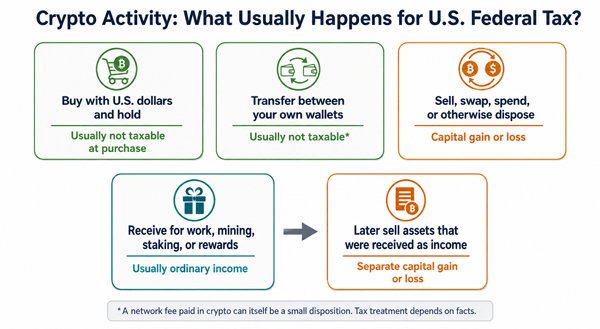
Figure 1. A beginner-friendly map of the most common crypto tax outcomes.
| Activity | Typical federal tax result | Why |
|---|---|---|
| Buy crypto with U.S. dollars and hold it | Usually not taxable at purchase | No disposition has occurred. |
| Transfer crypto between wallets you own | Usually not taxable | Ownership has not changed, although paying a fee in crypto can itself be a disposition. |
| Sell crypto for U.S. dollars | Taxable disposition | You recognize gain or loss. |
| Swap one token for another | Taxable disposition | You disposed of the first asset, even without cashing out. |
| Spend crypto on goods or services | Taxable disposition | Using property to buy something is generally treated as disposing of that property. |
| Receive crypto for work or services | Usually ordinary income | Value received is generally compensation or business income. |
| Receive mining or staking rewards | Usually income when received or controlled | Fair market value is generally included in income; later sale creates a separate gain or loss. |
| Receive a bona fide gift | Usually not income to recipient at receipt | Special basis and holding-period rules apply when the recipient later disposes of it. |
| Donate crypto to a qualified charity | Generally no sale by donor; deduction rules may apply | Deduction amount and appraisal requirements depend on facts, holding period, and value. |
| Crypto drops in value while still held | No deductible capital loss yet | A decline alone is generally unrealized; a closed and completed transaction is usually needed. |
4. The Digital Asset Question on Your Tax Return
Federal income tax returns require a Yes-or-No answer to a digital asset question. For the 2025 Form 1040, the question asks whether, during the tax year, you received a digital asset as a reward, award, or payment for property or services, or sold, exchanged, or otherwise disposed of a digital asset or financial interest in one.
You generally answer “No” when your only activity was buying digital assets with U.S. dollars and holding them, or transferring assets between wallets or accounts you own, provided no digital asset was used to pay a transaction fee. You generally answer “Yes” when you received, sold, exchanged, spent, or otherwise disposed of digital assets.
Do not confuse the checkbox with reporting
Answering “Yes” does not calculate your tax. You must still report the underlying income, gain, or loss on the appropriate forms. You must answer the question even if no Form 1099-DA arrived.
5. How to Calculate a Crypto Capital Gain or Loss
The basic formula is:
Capital gain or loss
Amount realized − adjusted cost basis = capital gain or capital loss
Your amount realized is generally the U.S. dollar value of what you received, less applicable disposition costs. Your adjusted basis is generally what you paid for the specific units, including eligible acquisition costs, adjusted for later events.
5.1 Example 1: Selling crypto for cash
You buy 0.10 BTC for $3,000 and later sell it for net proceeds of $4,200. Your gain is $1,200. If you held it for more than one year, the gain is generally long term; if one year or less, it is generally short term.
5.2 Example 2: Swapping one crypto for another
You bought Token A for $800. Months later, you exchange it for Token B worth $1,100. You have a $300 gain on Token A at the time of the swap. Your initial basis in Token B is generally $1,100, subject to transaction-cost adjustments.
5.3 Example 3: Spending crypto
You use crypto worth $600 to buy a laptop. The units used had a $350 basis. You generally have a $250 capital gain, and the laptop’s cost is generally measured by the value paid.
6. Short-Term vs. Long-Term Capital Gains
A short-term gain generally results when you hold the disposed units for one year or less. It is generally taxed at ordinary income tax rates. A long-term gain generally results when you hold the units for more than one year and may qualify for preferential federal capital-gain rates, depending on taxable income and filing status.
Capital losses first offset capital gains. If net capital losses remain, an individual may generally deduct up to $3,000 per year against other income ($1,500 if married filing separately), with unused losses carried forward, subject to the tax rules and the taxpayer’s circumstances.
Planning insight
Holding-period decisions can materially affect tax, but taxes should not be the only factor. Price risk, liquidity, portfolio concentration, security, and your financial plan also matter.
7. Which Crypto Units Did You Sell?
When you own multiple lots of the same asset at different prices, the units treated as sold can change your gain or loss. Detailed identification and basis-allocation rules apply. A practical record should show the wallet or account, acquisition date and time, quantity, basis, disposition date and time, proceeds, and transaction identifier.
Do not assume an exchange’s default method matches your tax records. Broker reporting is evolving, and assets transferred between platforms can arrive without basis information. Reconcile your own records before filing.
8. How Common Crypto Activities Are Taxed
8.1 Mining
Crypto received from mining is generally included in gross income at fair market value when received. If mining is a trade or business, net earnings may also be subject to self-employment tax, and ordinary and necessary business expenses may be relevant.
8.2 Staking rewards
Rewards are generally taxable income when the taxpayer has dominion and control over them. The included value generally becomes basis; a later sale or exchange creates a separate capital gain or loss.
8.3 Airdrops and hard forks
A hard fork by itself does not necessarily create income if no new units are received. An airdrop of new units following a hard fork can create ordinary income when the taxpayer has dominion and control.
8.4 Payment for employment
Crypto wages are generally taxable compensation, subject to wage reporting and payroll-tax rules. The employee’s basis is generally the value included in income.
8.5 Independent-contractor or business payments
The fair market value received is generally business income. Self-employment tax, estimated tax, and business-expense rules may apply.
8.6 Interest, lending, liquidity rewards, and DeFi incentives
Labels vary, but many receipts can be ordinary income. Deposits, wrappers, liquidity-pool tokens, bridges, and protocol restructurings may also create dispositions depending on the legal and economic facts.
8.7 NFT sales and purchases
Buying an NFT with appreciated crypto can trigger gain or loss on the crypto spent. Selling an NFT can produce capital or ordinary income depending on whether it was an investment, inventory, or creator/business property.
8.8 Stablecoins
Stablecoins are digital assets. Exchanging or spending them can be a reportable disposition even when the economic gain or loss is small.
8.9 Gifts
A genuine gift generally is not income to the recipient when received, but basis rules are special. The recipient may need the donor’s basis, acquisition date, and fair market value at the gift date.
8.10 Charitable donations
Donating appreciated crypto directly to a qualified organization may avoid recognition of gain, while a deduction may be available. Substantiation and qualified-appraisal rules can apply, especially for larger noncash contributions.
8.11 Lost, stolen, frozen, or bankrupt-platform assets
A price decline or inaccessible account does not automatically create a deductible loss. The timing and character of any loss depend on whether a closed and completed transaction or another recognized loss event occurred.
9. Transaction Fees and Network Fees
Fees can affect basis or amount realized, but treatment depends on what the fee relates to. A fee paid to acquire an asset may generally be included in basis; a fee paid to dispose of an asset may generally reduce amount realized. A fee paid in crypto can also be a separate disposition of the crypto used to pay the fee.
Common hidden issue
A wallet-to-wallet transfer is usually non-taxable, but if you pay the network fee with crypto, the fee units may have been disposed of. Record their quantity, basis, and value.
10. Form 1099-DA and Broker Reporting
Form 1099-DA is the IRS information return for digital asset proceeds from broker transactions. Gross-proceeds reporting began for broker transactions on or after January 1, 2025, so many taxpayers received their first statements in early 2026 for 2025 activity.
For 2025 sales, brokers generally were not required to report basis, although voluntary basis reporting was permitted. For sales after 2025, basis reporting is mandatory for certain covered digital assets and generally not required for noncovered assets. Optional rules can also affect reporting for qualifying stablecoins and specified NFTs. A 1099-DA therefore may not show your actual taxable gain or loss, and it may not cover every wallet, protocol, foreign platform, or peer-to-peer transaction.
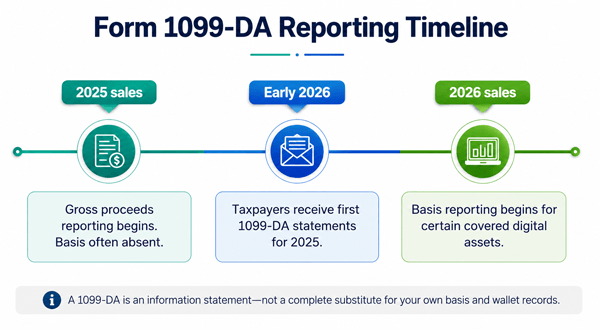
Figure 3. The 1099-DA rollout increases broker reporting, but taxpayers still need independent basis records.
Reconciliation rule
Compare every 1099-DA with your own transaction history. Check for transfers incorrectly treated as sales, missing basis, duplicated transactions, incorrect asset descriptions, and proceeds that do not match your records.
11. Common IRS Forms for Crypto Taxes
| Form or schedule | Common use |
|---|---|
| Form 1040 digital asset question | Mandatory Yes-or-No disclosure question. |
| Form 8949 | Lists sales and other dispositions of capital assets, including many crypto transactions. |
| Schedule D | Summarizes capital gains and losses from Form 8949 and other sources. |
| Schedule 1 | May report certain other income, depending on the type of receipt. |
| Schedule C | May report crypto-related trade or business income and expenses for a sole proprietor. |
| Schedule SE | May calculate self-employment tax when applicable. |
| Form 1099-DA | Broker information statement reporting digital asset proceeds and, in some cases, basis. |
| Form 8283 | May be required for certain noncash charitable contributions. |
| Form 1040-ES | Used for estimated tax payments when withholding is insufficient. |
The correct form depends on the activity. For example, selling an investment is usually different from receiving mining income or selling NFTs created as part of a business.
12. A Step-by-Step Crypto Tax Filing Process
12.1 Collect every source
Download exchange transaction files, wallet histories, Forms 1099-DA and other tax forms, bank records, receipts, and prior-year carryforward information.
12.2 Build a complete transaction ledger
Include buys, sells, swaps, spending, rewards, fees, transfers, gifts, donations, and assets moved between wallets.
Practical check: your ledger should reconcile beginning holdings + acquisitions + income receipts − dispositions − fees with ending holdings for each asset.
12.3 Match transfers
Link outgoing and incoming self-transfers so they are not mistakenly treated as taxable sales.
12.4 Classify each event
Separate non-taxable transfers from capital dispositions and ordinary-income receipts.
12.5 Assign U.S. dollar values
Use a reasonable, consistently applied method based on the date and time of each event.
12.6 Determine basis and holding period
Track the specific units or apply the method permitted under the applicable rules and your records.
12.7 Calculate income, gains, and losses
Do not net everything into one number before preserving transaction-level support.
12.8 Reconcile information returns
Make sure 1099-DA proceeds and other reported amounts are addressed on the return.
12.9 Prepare the relevant forms
Commonly Form 8949 and Schedule D for capital transactions, plus income schedules for rewards or business activity.
12.10 Save your support
Keep the filed return, software reports, raw data, wallet addresses, transaction IDs, valuation method, and supporting documents.
13. Recordkeeping Checklist
- Date and time of acquisition
- Type and quantity of digital asset
- How the asset was acquired
- Fair market value in U.S. dollars at acquisition
- Cost basis and acquisition fees
- Wallet, exchange, or account involved
- Date and time of disposition or receipt
- U.S. dollar value of proceeds or income
- Transaction fees and network fees
- Transaction hash or other identifier
- Counterparty or business purpose when relevant
- Holding period and lot identification
- Copies of Forms 1099-DA and other information returns
- Documentation for gifts, donations, theft, loss, or inaccessible assets
Best practice
Export raw transaction data regularly. Platforms can close, change formats, remove old history, or lose access to transferred-in basis.
14. Detailed Examples
14.1 Multiple purchases and one sale
You buy 1 ETH for $1,500 and another 1 ETH for $2,300. You later sell 1 ETH for net proceeds of $2,000. Your result depends on which unit is treated as sold: a $500 gain using the first lot or a $300 loss using the second lot. Proper identification and records matter.
14.2 Staking reward followed by sale
You receive a reward worth $120 when you gain control of it. You generally report $120 of ordinary income, creating a $120 basis. Later you sell it for $170 and generally recognize a $50 capital gain.
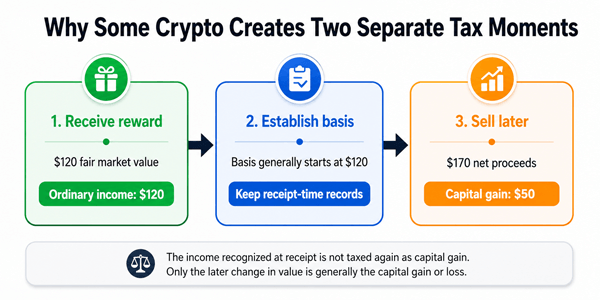
Figure 2. Income at receipt and capital gain or loss at a later sale are separate calculations.
14.3 Self-transfer with a network fee
You move 2 ETH between wallets you own. The transfer itself is generally not taxable. You pay a 0.005 ETH network fee. The fee units may be treated as disposed of, requiring a small gain or loss calculation.
14.4 Payment for freelance work
A client pays you crypto worth $2,000. You generally report $2,000 as business income. If you later sell the crypto for $2,400, you also generally have a $400 capital gain.
14.5 NFT purchased with appreciated crypto
You use crypto worth $1,000 to buy an NFT. The crypto used had a $600 basis. You generally recognize a $400 gain on the crypto. Your initial basis in the NFT is generally $1,000, adjusted for relevant costs.
14.6 Token swap with a loss
You exchange Token X worth $700 for Token Y worth $700. Your basis in Token X was $1,100. You generally recognize a $400 capital loss, subject to applicable limitations, and begin with a basis of approximately $700 in Token Y, adjusted for fees.
15. Common Crypto Tax Mistakes
| Mistake | Why it matters | Better approach |
|---|---|---|
| Reporting only when cash is withdrawn | Crypto-to-crypto swaps and spending can be taxable. | Track every disposition, not only bank withdrawals. |
| Assuming no form means no tax | Taxability does not depend on receiving a 1099. | Report all taxable transactions from your own records. |
| Treating self-transfers as sales | This can create fake proceeds and gains. | Match sending and receiving wallet records. |
| Ignoring fees | Fees can change basis, proceeds, and taxable results. | Record fee amount, asset, value, and purpose. |
| Using one blended cost for all units | Lot selection and holding period can materially change results. | Maintain unit-level or lot-level records. |
| Forgetting ordinary income | Rewards, mining, work payments, and incentives may be income before later sale. | Separate receipt income from later capital gain or loss. |
| Relying blindly on tax software | Imports can duplicate, omit, or misclassify transactions. | Review exception reports and reconcile totals. |
| Assuming wash-sale rules definitely apply or definitely do not | Law and facts can be complex, and related doctrines may matter. | Obtain current professional advice before aggressive loss strategies. |
| Claiming a loss because an asset crashed | A decline in value is generally unrealized. | Identify whether a closed and completed transaction occurred. |
| Losing records after moving assets | A receiving broker may not know original basis. | Preserve records before and after every transfer. |
16. Tax Planning and Risk Management
16.1 Set aside cash for taxes
Rewards and business receipts can create tax without providing U.S. dollars. Consider reserving cash as income is earned.
16.2 Consider estimated payments
If withholding is insufficient, quarterly estimated tax payments may reduce underpayment penalties.
16.3 Review gains and losses before year-end
Realized losses may offset gains, but transactions should have a genuine investment purpose and comply with current law.
16.4 Avoid tax-driven concentration
Do not hold an unsuitable or excessively risky position solely to reach long-term status.
16.5 Document valuation methods
Thinly traded tokens and NFTs may lack a single reliable price. Use a reasonable method consistently and retain evidence.
16.6 Separate personal and business activity
Dedicated wallets and accounts can simplify bookkeeping and support expense classification.
16.7 Get help before complex events
Seek advice before large gifts, donations, migrations, liquidity-pool transactions, protocol failures, offshore activity, or business restructuring—not after records disappear.
17. When to Hire a Crypto Tax Professional
Professional help is especially valuable when you have:
- Thousands of transactions or multiple wallets and exchanges
- DeFi, bridges, liquidity pools, derivatives, wrapped assets, or lending
- Mining, validator, creator, or other business activity
- Foreign exchanges, entities, or accounts
- Large gifts or charitable donations
- Lost, stolen, frozen, hacked, or bankrupt-platform assets
- Missing basis or major differences between software and Forms 1099-DA
- Prior-year omissions or notices from the IRS
Ask whether the professional has direct experience with your activity, which software and valuation methods they use, how they handle missing basis, and what records they expect you to retain.
18. Frequently Asked Questions
18.1 Do I pay tax just for buying Bitcoin?
Usually no. Buying with U.S. dollars and holding is generally not a taxable event, although records of date, quantity, price, and fees are essential.
18.2 Is converting Bitcoin to Ether taxable?
Generally yes. You disposed of Bitcoin and must calculate gain or loss based on the value of what you received.
18.3 Is transferring crypto between my own wallets taxable?
Usually no, because ownership did not change. A fee paid in crypto can still be a separate disposition.
18.4 Do I owe tax if I never received a 1099?
Possibly. You must report taxable income and dispositions whether or not an information form was issued.
18.5 What is Form 1099-DA?
It is a broker information return for digital asset proceeds. For 2025 activity, many statements report proceeds without basis. For sales after 2025, basis may appear for certain covered assets, but you still must reconcile the form with your own records.
18.6 Are staking rewards taxable?
Generally, rewards are income when you have dominion and control. A later sale can create a separate capital gain or loss.
18.7 Are crypto losses deductible?
Realized capital losses can generally offset capital gains, with limited deductions against other income and carryforwards. A mere decline in value is generally not enough.
18.8 Can I deduct gas fees?
Fees may affect basis or proceeds depending on the transaction. Paying a fee in crypto can itself be a disposition.
18.9 Are stablecoin transactions taxable?
Stablecoins are digital assets. Dispositions can be reportable even when gain or loss is small.
18.10 Is receiving a crypto gift taxable?
A bona fide gift is generally not income when received, but the recipient needs donor basis and other information for a future disposition.
18.11 What happens when I donate crypto?
A direct donation to a qualified charity may avoid capital-gain recognition and may support a deduction, but appraisal and substantiation rules can apply.
18.12 Do wash-sale rules apply to crypto?
The conventional securities wash-sale rule has historically been tied to stock or securities, but current law, asset classification, transaction structure, and other tax doctrines must be considered. Obtain current advice before relying on rapid repurchase strategies.
18.13 How long should I keep crypto tax records?
Keep records long enough to support the return and the basis of assets still held. Because basis can carry for many years, retain acquisition records until after the asset is disposed of and the relevant limitations period has passed.
18.14 Can the IRS see crypto transactions?
Brokers increasingly report transactions, and blockchain activity can be traceable. Taxpayers remain responsible for complete reporting regardless of visibility or forms received.
18.15 What should I do if I forgot crypto on a prior return?
Do not ignore it. Reconstruct records, evaluate whether an amended return or other corrective action is appropriate, and consider professional advice for material omissions.
19. Final Filing Checklist
- ☐ Answer the digital asset question
- ☐ Report every taxable disposition
- ☐ Report ordinary income from rewards, work, or business activity
- ☐ Reconcile Forms 1099-DA and other statements
- ☐ Confirm basis and holding periods
- ☐ Review transfer matching and fees
- ☐ Check capital-loss carryforwards
- ☐ Consider estimated-tax obligations
- ☐ Save transaction-level records and valuation support
- ☐ Verify state tax requirements
- ☐ Review unusual transactions with a qualified professional
20. Conclusion
The simplest way to manage crypto taxes is to treat recordkeeping as part of every transaction, not as a project that begins at tax time. Know whether each event is a receipt, a transfer, or a disposition; preserve basis and fair-market-value evidence; reconcile broker forms; and separate ordinary income from capital gain or loss. The rules are manageable for beginners when the transaction history is complete—and difficult even for experts when records are missing.
20.1 Reader Advice
This article is provided for general educational and informational purposes only. It is not personalized tax, legal, accounting, or investment advice or a recommendation for any particular transaction. Digital-asset rules, forms, thresholds, reporting practices, statistics, and interpretations can change over time and may vary by state, country, and individual circumstances. Crypto transactions can involve tax, financial, market, custody, fraud, and recordkeeping risks. Before filing a return or making a tax-sensitive decision, verify the current requirements through official IRS and relevant state or local authority sources, review the facts of your own transactions, and consult a qualified tax or legal professional when appropriate.
20.2 Sources Consulted and Checked
The following sources were consulted and checked while preparing this article and reviewing its accuracy:
- IRS: Digital assets (including broker reporting overview)
- IRS: Frequently asked questions on digital asset transactions
- IRS: Understanding your Form 1099-DA
- IRS: About Form 1099-DA and 2025 instructions
- IRS: 2026 Instructions for Form 1099-DA
- IRS: 2025 Instructions for Form 1040
- IRS: Instructions for Form 8949
- IRS: Publication 544, Sales and Other Dispositions of Assets
- IRS: Publication 551, Basis of Assets
- Taxpayer Advocate Service: Digital Assets
- Google Search Central: Creating helpful, reliable, people-first content