Crypto Investing for Beginners: Complete Guide, Examples, Risks and Best Practices
1. Quick summary
Crypto investing means buying or gaining exposure to digital assets such as bitcoin or ether with the hope that their value increases over time. It can also include regulated exchange-traded products that hold crypto assets. The opportunity is real, but the risks are unusually high: prices can move sharply, platforms can fail, scams are common, transactions can be irreversible, and tax records matter.
For most beginners, the safest way to start is not to chase the newest coin. It is to learn the basics, decide whether crypto fits your financial plan, use a reputable platform, start with a small amount you can afford to lose, secure your account, and keep records from day one.
2. What is cryptocurrency?
Cryptocurrency is a digital asset that uses cryptography and a network of computers to record ownership and transactions. Instead of relying on a single bank ledger, many cryptocurrencies use a shared ledger called a blockchain. A blockchain is a public or semi-public database where transactions are grouped into blocks and linked together in order.
Bitcoin, launched in 2009, is the best-known cryptocurrency. Ether is the native asset of the Ethereum network, which supports decentralized applications and smart contracts. There are thousands of other tokens, but beginners should understand that many are highly speculative and some have little practical use.
2.1 Crypto investing vs. crypto trading
| Approach | Typical time horizon | Beginner-friendly? | Main risk |
|---|---|---|---|
| Investing | Months to years | More beginner-friendly if position size is small and diversified | Long periods of losses, volatility, and uncertainty |
| Trading | Minutes to weeks | Usually not beginner-friendly | Fast losses, leverage, fees, emotional decisions |
| Speculating on new tokens | Days to months | High risk for beginners | Low liquidity, scams, hype cycles, unclear value |
| Buying crypto ETPs/ETFs through a brokerage | Months to years | May be simpler operationally | Still exposed to crypto price swings, product fees, and tracking differences |
3. How crypto investing works
At a basic level, you choose how to get exposure, decide how much to invest, buy through a platform or brokerage, store or hold the asset, and eventually sell, rebalance, or continue holding. Each step has practical decisions that affect your risk.
- Choose your exposure. You can buy crypto directly on an exchange, buy a crypto exchange-traded product through a brokerage, or avoid crypto entirely until you understand it better.
- Fund the account. Most platforms allow bank transfers, debit cards, or other payment methods. Fees can vary significantly.
- Place an order. Beginners usually use simple buy orders, not margin, futures, options, or leverage.
- Store safely. Direct crypto buyers must decide between keeping assets with a platform or moving them to a self-custody wallet.
- Track records. Dates, amounts, fees, cost basis, transfers, staking rewards, and sales can all matter for taxes.
3.1 Direct crypto ownership vs. crypto funds
| Feature | Direct crypto | Spot crypto ETP/ETF-style product |
|---|---|---|
| What you own | The cryptocurrency itself, if held in your wallet | Shares of a product that holds crypto or gets exposure to it |
| Where held | Crypto exchange or personal wallet | Traditional brokerage account |
| Private keys | You may control keys if using self-custody | You do not control crypto keys |
| Operational complexity | Higher: wallets, addresses, transfers, network fees | Lower: similar to buying stocks or funds |
| Risks | Platform failure, wallet loss, wrong address, hacks, market risk | Market risk, fees, product structure, tracking difference |
| Best for | People willing to learn security and custody | People wanting price exposure without handling wallets |
Important note: Investor.gov explains that spot bitcoin and ether exchange-traded products can provide exposure without personally using a wallet or crypto platform, but these products are not registered investment companies under the Investment Company Act of 1940, even when people casually call them ETFs.
4. Core crypto terms beginners should know
| Term | Plain-English meaning | Beginner example |
|---|---|---|
| Blockchain | A shared digital ledger that records transactions | Bitcoin transactions are recorded on the Bitcoin blockchain |
| Wallet | Software or hardware used to access crypto | A mobile wallet or hardware wallet stores your keys, not coins like a physical wallet |
| Private key / seed phrase | Secret information that controls access | Anyone with your seed phrase may be able to move your crypto |
| Exchange | A platform where people buy and sell crypto | A beginner buys bitcoin using a regulated exchange |
| Stablecoin | A token designed to track another asset, often the U.S. dollar | A trader holds a dollar-linked stablecoin between trades |
| Gas / network fee | A fee paid to process blockchain transactions | Sending ether may require a gas fee |
| Market cap | Price multiplied by circulating supply | A large market cap often means a more established asset, not guaranteed safety |
| Staking | Locking or delegating assets to help secure some networks or earn rewards | Staking can involve lockups, platform risk, and tax questions |
5. Why people invest in crypto
- Potential upside: Crypto assets have produced major gains in some periods, though past returns do not predict future returns.
- Portfolio diversification: Some investors want exposure to a technology and asset class that behaves differently from traditional assets, although correlations can change.
- Access to blockchain innovation: Crypto networks can support payments, decentralized applications, tokenized assets, and smart contracts.
- Self-custody: Some users value the ability to hold assets without relying on a bank or broker, but this also shifts responsibility to the user.
The key beginner mistake is seeing only the upside. Crypto can rise fast, but it can also fall fast. A useful rule is: if a 50% drop would force you to sell or lose sleep, the position is probably too large.
6. Major risks of crypto investing
Crypto is not just “a volatile stock.” It has additional risks beginners often underestimate.
| Risk | What it means | Practical protection |
|---|---|---|
| Price volatility | Prices can swing sharply in hours or days | Use a small allocation and avoid money needed soon |
| Scams and fraud | Fake exchanges, romance scams, pump-and-dumps, impersonators | Never send crypto because a stranger promises returns |
| Custody risk | A platform, wallet, or user error can lead to loss | Use strong MFA, reputable providers, and test transfers |
| Regulatory uncertainty | Rules can change by country and asset type | Follow local rules and avoid assets with unclear legal status |
| Liquidity risk | Some tokens are hard to sell without moving the price | Prefer highly liquid assets if you are a beginner |
| Technology risk | Bugs, bridge hacks, chain outages, or smart contract flaws | Avoid complex DeFi until you understand the mechanics |
| Tax complexity | Selling, swapping, spending, mining, staking, or receiving rewards may create tax events | Keep complete records and consult a qualified tax professional |
| Behavioral risk | FOMO, panic selling, overtrading, and leverage magnify losses | Write a plan before buying |
The SEC has warned that crypto asset securities can be exceptionally volatile and speculative and that some platforms may lack important investor protections. The FTC and CFPB also highlight fraud, theft, scams, and transaction problems as major consumer issues in crypto markets.
7. A beginner-friendly way to think about position size
There is no universal right allocation. A beginner should start with financial stability first. Crypto should generally come after essential savings, high-interest debt planning, insurance basics, and retirement contributions appropriate to your situation.
| Investor situation | Crypto allocation idea | Why |
|---|---|---|
| No emergency fund or high-interest debt | 0% until basics improve | A sudden expense or debt interest can be more urgent than speculative investing |
| Stable income, emergency fund, diversified investments | Small test allocation, such as 1%-3% of investable assets | Enough to learn without risking the whole plan |
| High risk tolerance and strong financial base | Possibly higher, but still capped and rebalanced | Large positions can dominate portfolio risk |
| Needs money within 1-3 years | Usually avoid or keep very small | Crypto can be down when you need cash |
Example: If a beginner has $10,000 available for long-term investing and decides on a 2% crypto allocation, the initial crypto amount is $200. If it doubles to $400 while the rest of the portfolio stays near $9,800, crypto becomes about 3.9% of the portfolio. Rebalancing means selling some or adding elsewhere to bring risk back to the target.
8. Beginner crypto investing strategies
8.1 Strategy 1: Learn-first approach
Before buying, spend time learning how wallets, exchanges, fees, taxes, and common scams work. This strategy sounds boring, but it prevents expensive mistakes. A practical learning budget could be as small as $25-$100 if buying direct crypto, enough to understand order placement and transfers without putting meaningful savings at risk.
8.2 Strategy 2: Dollar-cost averaging
Dollar-cost averaging means investing a fixed amount at regular intervals, such as $25 every week or $100 every month. It reduces the pressure to pick the perfect entry price. It does not eliminate risk; it simply spreads purchases over time.
8.3 Strategy 3: Blue-chip-only crypto exposure
Many beginners start with the most established assets, usually bitcoin and sometimes ether, instead of chasing small tokens. This does not make them safe, but they generally have deeper liquidity, more infrastructure, and more public information than tiny speculative coins.
8.4 Strategy 4: Brokerage exposure through crypto ETPs
Some investors prefer gaining exposure through a brokerage account using products that hold bitcoin or ether. This can reduce wallet and private-key mistakes, but it does not remove price risk. It also introduces product fees, tracking differences, and reliance on the product issuer and custodian.
8.5 Strategy 5: Avoidance as a valid strategy
Not investing in crypto is a legitimate decision. Beginners should not feel forced to buy because friends, influencers, or headlines say they are missing out. A good investment fits your goals, time horizon, risk tolerance, and understanding.
9. Practical example: buying your first small crypto position
- Decide why you are buying. Example: “I want a 2% long-term allocation to bitcoin as a speculative part of my portfolio.”
- Choose the method. Example: direct bitcoin purchase on a reputable exchange or a spot bitcoin ETP through a brokerage.
- Set the amount. Example: $200 total, split into four $50 weekly purchases.
- Check fees before buying. A debit card purchase may cost more than a bank transfer.
- Turn on strong security. Use a unique password and multi-factor authentication, preferably an authenticator app or hardware security key rather than SMS when available.
- Decide custody. If using direct crypto, either keep a small amount on the platform while learning or move it to a wallet only after practicing with a small test transfer.
- Record the transaction. Save date, asset, amount, price, fees, and platform confirmation.
- Write exit rules. Example: rebalance if crypto grows above 5% of your portfolio; do not sell in panic just because the price falls 20% in a week.
10. Wallets and custody: how to protect your crypto
Custody means who controls the keys needed to move the crypto. This is one of the most important decisions in direct crypto investing.
| Custody method | Pros | Cons | Beginner notes |
|---|---|---|---|
| Exchange custody | Easy to use; password reset may be possible; simple tax reports | Platform hacks, freezes, insolvency, withdrawal limits | Use reputable platforms and keep position size modest |
| Software wallet | More control; useful for learning on-chain transactions | Device malware, phishing, lost seed phrase | Good for small amounts after learning security |
| Hardware wallet | Keys kept offline; stronger protection for larger holdings | Can be confusing; seed phrase backup is critical | Practice with small test transfers first |
| Crypto ETP/ETF-style product | No wallet management; brokerage statements | You do not own or move the coins directly; product fees | Simpler for investors who only want price exposure |
- Never share your seed phrase, private key, or recovery phrase with anyone.
- Do not type your seed phrase into websites or send it to support staff.
- Use a password manager and unique passwords.
- Enable multi-factor authentication on exchanges and email accounts.
- Make a small test transfer before sending a larger amount.
- Double-check wallet addresses; crypto transactions are usually irreversible.
- Beware of fake wallet apps, fake support accounts, and phishing links.
11. Taxes: what beginners need to know
In the United States, the IRS treats digital assets as property for federal income tax purposes, and general tax principles for property transactions apply. That means selling crypto, trading one crypto for another, spending crypto, or receiving certain rewards can have tax consequences. Other countries have different rules, so check your local tax authority.
| Activity | Possible tax impact in many systems | Record to keep |
|---|---|---|
| Buying crypto with cash | Usually not taxable by itself | Date, amount, fees, cost basis |
| Selling crypto for cash | May create capital gain or loss | Sale price, cost basis, holding period |
| Swapping bitcoin for ether | May be treated like selling bitcoin and buying ether | Fair market value and fees |
| Receiving staking rewards | May be taxable income depending on rules | Date received and value |
| Using crypto to buy goods | May trigger gain or loss on disposed crypto | Purchase value and original cost basis |
| Moving crypto between your own wallets | Usually not a sale by itself, but fees and records matter | Transaction hashes and wallet labels |
Beginner best practice: Export transaction history monthly or quarterly instead of waiting until tax season. If you use several platforms or wallets, tax reporting can become messy quickly.
12. Common beginner mistakes to avoid
- Buying because of FOMO: A rising chart is not a plan.
- Using leverage: Borrowed money can turn normal volatility into a wipeout.
- Putting all money into one token: Concentration increases risk.
- Ignoring fees: Small purchases can become expensive if fees are high.
- Trusting influencers: Paid promotions and hidden conflicts are common.
- Sending crypto to the wrong address: Test transfers matter.
- Skipping tax records: Reconstructing history later can be difficult.
- Believing “guaranteed yield”: High yield with no risk is a classic warning sign.
- Confusing popularity with safety: A trending token can still collapse.
- Keeping too much on one platform: Platform risk is real even when the app looks professional.
13. How to evaluate a cryptocurrency before investing
Beginners do not need to become blockchain engineers, but they should be able to answer basic questions before buying.
| Question | Why it matters | Red flag |
|---|---|---|
| What problem does it solve? | Real demand is stronger than pure hype | No clear use case beyond “price will go up” |
| Who controls supply and upgrades? | Centralized control can affect risk | A small insider group can change rules easily |
| How liquid is it? | Liquidity affects your ability to exit | Tiny volume or only obscure exchanges |
| How are tokens distributed? | Insider allocations can create selling pressure | Large unlocks or unknown wallets |
| Is there credible documentation? | Transparency supports informed decisions | No whitepaper, audits, or public information |
| What are the security risks? | Smart contracts and bridges can fail | Unaudited contracts or frequent exploits |
| What would make you sell? | A thesis needs conditions, not emotions | No exit plan |
14. Pros and cons of crypto investing
| Pros | Cons |
|---|---|
| Potential exposure to a growing digital asset ecosystem | High volatility and possible permanent loss |
| Can be accessed globally and traded around the clock | 24/7 markets can encourage overtrading and stress |
| Self-custody may reduce dependence on intermediaries | Self-custody creates personal responsibility for security |
| Some assets have transparent on-chain supply and transaction data | On-chain transparency does not prevent manipulation or scams |
| Regulated products may make exposure easier through brokerages | Products still carry crypto price risk and fees |
15. Best practices for beginners
- Start with education, not prediction. Understand the asset, custody, taxes, fees, and risks before buying.
- Keep crypto a small part of a broader plan. A diversified financial life is more resilient than a single big bet.
- Avoid leverage and complex products. Futures, options, margin, and high-yield schemes are not beginner tools.
- Use reputable platforms and verify URLs. Bookmark official sites and avoid links from unsolicited messages.
- Secure your email first. If someone controls your email, they may reset exchange passwords.
- Write a simple investment policy. Include target allocation, buying schedule, rebalancing rules, and reasons to sell.
- Keep tax records from day one. Download statements and save transaction hashes.
- Do not chase every new coin. Most beginners are better served by fewer, better-understood decisions.
- Assume anyone promising guaranteed crypto returns is dangerous. Real investing has risk.
- Review quarterly, not hourly. Long-term investors do not need to stare at price charts all day.
16. Beginner checklist before buying crypto
- I have an emergency fund or a plan for essential savings.
- I am not using rent money, debt, or money needed soon.
- I understand that I can lose most or all of the investment.
- I know whether I am buying direct crypto or a brokerage product.
- I checked fees and withdrawal rules.
- I enabled strong security on my exchange, brokerage, and email.
- I know how I will store the asset and back up recovery information.
- I have a target allocation and rebalancing rule.
- I know which records I need for taxes.
- I can explain why I am buying without using the words “everyone says.”
17. Simple diagram: a safer beginner process
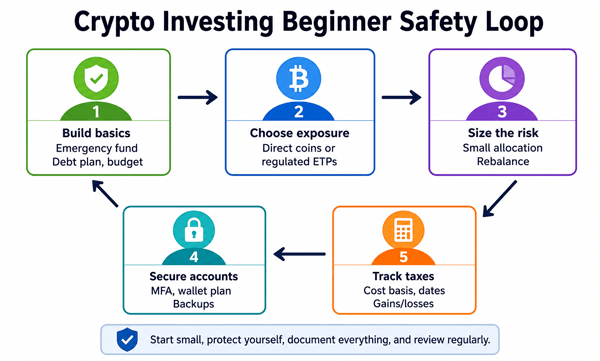
Figure 1: A beginner-friendly safety loop for crypto investing. It emphasizes financial basics, exposure choice, position sizing, security, and recordkeeping before repeating the review cycle.
18. Real-world scenarios
18.1 Scenario 1: The cautious learner
Aisha has never bought crypto. She has an emergency fund and a diversified retirement account. She decides to invest $25 per week for eight weeks into bitcoin through a reputable platform while learning wallet security. She keeps the total small, downloads statements, and writes a rule that crypto should not exceed 3% of her investable assets. This is a controlled learning experiment, not a life-changing bet.
18.2 Scenario 2: The FOMO buyer
Bilal sees a token trending on social media and invests half his savings after a 200% price jump. He does not check liquidity, token supply, or who promoted it. The price falls sharply when early holders sell. This is not investing; it is reactive speculation.
18.3 Scenario 3: The brokerage investor
Sara wants bitcoin exposure but does not want to manage a wallet. She buys a small amount of a spot bitcoin exchange-traded product through her brokerage. This avoids seed-phrase management, but she still accepts bitcoin price risk and reads the product fee and structure before investing.
19. Misconceptions beginners should drop
| Misconception | Reality |
|---|---|
| Crypto always goes up over time | Crypto can experience long drawdowns and some assets never recover |
| A low coin price means it is cheap | Supply matters; a $0.01 token can still be overvalued |
| Stablecoins are risk-free cash | Stablecoins can have issuer, reserve, regulatory, and liquidity risks |
| A famous founder guarantees success | Execution, incentives, security, and market demand matter |
| Hardware wallets remove all risk | They reduce online key exposure, but backups and user behavior still matter |
| Taxes only matter when cashing out to a bank | Crypto-to-crypto trades or spending crypto may also matter in many jurisdictions |
20. When crypto may not be right for you
- You need the money for rent, tuition, medical bills, or a near-term purchase.
- You cannot tolerate large price swings.
- You feel pressured by friends, influencers, or online groups.
- You do not want to track taxes or security responsibilities.
- You are considering borrowing money to buy crypto.
- You cannot explain what you are buying and why.
21. Frequently asked questions
21.1 Is crypto investing safe for beginners?
Crypto can be suitable only as a small, speculative part of a broader plan for some beginners. It is not safe in the way insured bank deposits or diversified bond funds may be considered lower risk. Beginners should assume high volatility and possible loss.
21.2 How much money do I need to start?
Many platforms allow small purchases. The better question is how much you can afford to lose without damaging your financial life. A small learning amount is usually wiser than a large first purchase.
21.3 Should I buy bitcoin or many small coins?
Beginners often start with the most established assets because they have more liquidity and information. Small coins can produce big gains, but they also have higher failure, manipulation, and liquidity risks.
21.4 Do I need a crypto wallet?
If you buy direct crypto and want self-custody, yes. If you buy a crypto ETP through a brokerage, you generally do not use a personal crypto wallet. Direct ownership gives more control but more responsibility.
21.5 Can I lose crypto if I forget my password?
If your crypto is on an exchange, account recovery may be possible. If you self-custody and lose your seed phrase or private keys, recovery may be impossible.
21.6 Is dollar-cost averaging better than buying all at once?
It can reduce timing stress and spread entry prices, but it does not guarantee profit or prevent losses.
21.7 Are stablecoins the same as dollars?
No. Stablecoins are tokens designed to track another asset, often the U.S. dollar. They can still carry issuer, reserve, platform, and regulatory risks.
21.8 Do I pay tax on crypto?
Tax rules depend on your country. In the U.S., the IRS treats digital assets as property for federal income tax purposes, so sales, swaps, and some rewards can matter. Keep records and consult a qualified tax professional.
21.9 What is the biggest beginner security mistake?
Sharing a seed phrase or private key, clicking phishing links, using weak account security, or sending funds to the wrong address.
21.10 What is the best crypto investment?
There is no single best choice for everyone. The best decision may be a small, well-understood allocation - or no crypto at all - depending on your goals, risk tolerance, time horizon, and financial foundation.
22. Final takeaway
Crypto investing for beginners should be approached as a high-risk learning and portfolio decision, not a shortcut to wealth. The practical path is simple: build your financial base, learn the mechanics, start small, avoid leverage, secure your accounts, keep records, and stay skeptical of guaranteed returns. Crypto can be part of a thoughtful investment plan, but it should never replace disciplined saving, diversification, and risk management.
Sources Consulted and Checked
These sources were consulted and checked while preparing this document and reviewing its accuracy:
- SEC Investor.gov, “Crypto Assets” and investor bulletins on crypto custody and crypto asset securities.
- SEC Investor.gov, “Exchange-Traded Products (ETPs) Providing Exposure to Bitcoin and Ether,” September 2024.
- SEC statement on spot bitcoin exchange-traded product approvals, January 10, 2024.
- IRS Digital Assets and Virtual Currency FAQs, including treatment of digital assets as property for U.S. federal tax purposes.
- FTC consumer guidance on cryptocurrency and scams.
- CFPB materials on crypto-asset complaints, including fraud, theft, and transaction issues.
Reader Advice
This article is provided for educational and informational purposes only and is not personalized financial, investment, tax, or legal advice or a recommendation to buy, sell, or hold any crypto asset or product. Crypto investing involves substantial risk, including sharp price changes, scams, platform or custody failures, technology problems, regulatory uncertainty, and the possible loss of some or all invested funds. Rules, policies, laws, tax treatment, product availability, and statistics can change over time and vary by country or region, so verify important details with current official sources and seek advice from appropriately qualified professionals before making decisions. Never invest money you cannot afford to lose.