Crypto Portfolio Allocation: Complete Guide, Examples, Risks and Best Practices
1. Quick Answer: What Is Crypto Portfolio Allocation?
Crypto portfolio allocation is the way you divide your crypto investment across different assets, such as Bitcoin, Ethereum, stablecoins, and smaller tokens. A good allocation plan answers three practical questions: how much of your total money should go into crypto, which crypto assets should you hold, and how will you manage risk over time?
For most beginners, the safest starting point is not to ask, "Which coin can rise the fastest?" but rather, "How much can I afford to lose without damaging my financial life?" Crypto can produce large gains, but it can also fall sharply, suffer platform failures, attract scams, and create tax obligations. A portfolio allocation plan helps you participate with rules instead of emotion.
| Beginner Question | Practical Answer |
|---|---|
| How much crypto should I own? | Only a small portion of your overall investment portfolio. Many cautious beginners start around 1% to 5%, while higher-risk investors may choose more only after understanding the downside. |
| Should I buy many coins? | Not necessarily. Owning too many tokens can increase complexity and risk. A simple portfolio can be more effective than a crowded one. |
| Is Bitcoin enough? | For some investors, yes. Others add Ethereum or a small basket of other assets for broader exposure, but each addition should have a clear reason. |
| Do I need stablecoins? | Stablecoins can help with liquidity and rebalancing, but they are not risk-free. They carry issuer, reserve, regulatory, and platform risks. |
| What is the most important rule? | Set a target allocation, diversify carefully, rebalance on a schedule, and never invest money needed for bills, debt payments, emergency savings, or short-term goals. |
2. What Counts as a Crypto Asset?
A crypto asset is a digital asset issued, stored, or transferred using blockchain or distributed ledger technology. In simple terms, a blockchain is a shared digital record that many computers maintain together. Transactions are verified according to network rules instead of being controlled by one traditional central database.
Crypto assets are not all the same. Bitcoin, Ethereum, stablecoins, governance tokens, meme coins, NFTs, and tokenized assets can have very different purposes and risks. Treating every coin as if it were just "another cryptocurrency" is one of the biggest beginner mistakes.
3. How Crypto Portfolio Allocation Works
Portfolio allocation starts with percentages. Instead of saying, "I will buy $500 of Bitcoin and $200 of other coins," you decide what percentage of your total portfolio belongs in each category. Percentages make your plan easier to manage as prices move.
For example, suppose your total investable assets are $20,000 and you decide crypto should be 5% of your portfolio. Your total crypto allocation would be $1,000. You might then divide that $1,000 into 70% Bitcoin, 20% Ethereum, and 10% cash or stablecoin reserve.
| Crypto Category | What It Means | Typical Role | Key Risks |
|---|---|---|---|
| Bitcoin (BTC) | The first and largest crypto asset by brand recognition and institutional attention. | Core crypto exposure; often treated as the "blue chip" of crypto. | Large price swings, regulatory uncertainty, custody risk, no guaranteed income. |
| Ethereum (ETH) | A blockchain network used for smart contracts, decentralized apps, tokens, and DeFi activity. | Growth and network-use exposure. | Technology risk, competition, smart contract ecosystem risk, volatility. |
| Stablecoins | Tokens designed to track a fiat currency such as the U.S. dollar. | Liquidity, trading, rebalancing, temporary parking place. | Issuer risk, reserve risk, depegging, platform risk, regulatory changes. |
| Large-cap altcoins | Other relatively established crypto networks or tokens. | Diversification beyond BTC and ETH. | Higher uncertainty, weaker adoption, changing narratives. |
| Small-cap/speculative tokens | New, thinly traded, or hype-driven assets. | Very small speculative sleeve, if used at all. | Extreme volatility, scams, low liquidity, project failure. |
| Crypto funds or ETPs | Regulated products that provide exposure through brokerage accounts. | Convenience and custody outsourcing. | Fees, tracking differences, product structure risk; not the same as owning coins directly. |
4. How Much of Your Overall Portfolio Should Be in Crypto?
There is no perfect percentage for everyone. The right crypto allocation depends on your income stability, emergency savings, debt, investment time horizon, risk tolerance, age, goals, and experience. A 25-year-old with a stable job and no dependents may tolerate more volatility than a retiree who needs portfolio income within the next few years.
A useful beginner rule is to decide your maximum total crypto exposure before choosing individual coins. This prevents a common mistake: buying several "small" positions that quietly add up to a large and risky total allocation.
| Investor Type | Possible Crypto Allocation | Why This May Fit | Warning |
|---|---|---|---|
| Very cautious beginner | 0% to 1% | Still learning, wants minimal volatility, or has financial priorities such as debt repayment. | There is no requirement to own crypto. Missing a rally is better than taking risk you do not understand. |
| Cautious long-term investor | 1% to 5% | Wants limited exposure without letting crypto dominate the portfolio. | Even a 5% allocation can be stressful during a sharp crypto bear market. |
| Moderate risk investor | 5% to 10% | Understands volatility and has a diversified stock/bond portfolio outside crypto. | Losses can meaningfully affect total wealth if crypto falls 50% to 80%. |
| Aggressive investor | 10% to 20%+ | Strong conviction, long time horizon, high risk tolerance, and strong financial base. | This is not beginner territory. Concentration risk becomes serious. |
Practical test: Imagine your crypto allocation falls 70% and stays down for two years. If that would force you to sell investments, delay important life goals, take on debt, or lose sleep, your allocation is probably too high.
5. Sample Crypto Portfolio Allocation Examples
The examples below are not recommendations. They are templates that show how allocation logic works. Adjust the percentages based on your risk tolerance, jurisdiction, available products, taxes, and personal goals.
5.1 Example 1: Conservative Beginner Crypto Allocation
Best for: someone new to crypto who wants exposure but prioritizes capital preservation and simplicity.
| Asset Type | Allocation | Reason |
|---|---|---|
| Bitcoin | 60% | Most established crypto asset; often the simplest core holding. |
| Ethereum | 25% | Adds exposure to smart-contract activity and broader blockchain use cases. |
| Cash or stablecoin reserve | 10% | Allows rebalancing after declines and avoids being fully invested at all times. |
| Other crypto assets | 5% | Small learning/speculative allocation with strict limits. |
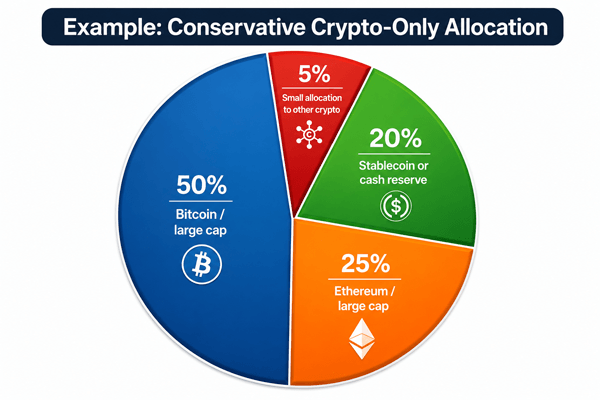
Example: Conservative Crypto-Only Allocation
5.2 Example 2: Balanced Crypto Allocation
| Asset Type | Allocation | Reason |
|---|---|---|
| Bitcoin | 45% | Core store-of-value-style exposure. |
| Ethereum | 30% | Network and smart-contract exposure. |
| Large-cap altcoins | 15% | Diversifies into other established ecosystems, but still limited. |
| Stablecoin or cash reserve | 10% | Dry powder for rebalancing and volatility management. |
5.3 Example 3: Aggressive Crypto Allocation
| Asset Type | Allocation | Reason |
|---|---|---|
| Bitcoin | 35% | Core exposure, but less dominant than in conservative portfolios. |
| Ethereum | 30% | Major growth/network allocation. |
| Large-cap altcoins | 20% | Higher risk diversification. |
| Small-cap/speculative tokens | 10% | High-risk sleeve with a strict cap. |
| Stablecoin or cash reserve | 5% | Liquidity for rebalancing or opportunities. |
Beginner caution: An aggressive crypto allocation is not appropriate simply because someone believes prices may rise. It requires experience, emotional discipline, position limits, security knowledge, and the ability to absorb deep losses.
6. Crypto Allocation Inside Your Total Financial Plan
Crypto should usually sit on top of a solid financial foundation, not replace it. Before increasing crypto exposure, beginners should normally address emergency savings, high-interest debt, insurance, retirement accounts, and a diversified non-crypto portfolio.
| Financial Layer | Purpose | Beginner Action |
|---|---|---|
| Emergency fund | Protects against job loss, medical costs, repairs, and surprise bills. | Keep this outside crypto in cash or cash-like accounts. |
| Debt management | Reduces guaranteed costs from credit cards or high-interest loans. | Paying 20%+ credit card interest often beats speculative investing. |
| Core investing | Builds long-term wealth through diversified assets. | Consider broad stock/bond funds before large crypto exposure. |
| Crypto allocation | Adds high-risk, high-volatility alternative exposure. | Limit size, diversify, rebalance, and secure assets properly. |
7. Three Common Ways to Build a Crypto Portfolio
| Method | How It Works | Pros | Cons |
|---|---|---|---|
| Lump sum | Invest the full planned amount at once. | Simple; full exposure immediately if prices rise. | Bad timing can hurt emotionally and financially. |
| Dollar-cost averaging | Invest a fixed amount on a schedule, such as weekly or monthly. | Reduces timing pressure; beginner-friendly. | May underperform lump sum in a strong rising market. |
| Value averaging or rules-based buying | Buy more when below target and less when above target. | Disciplined and valuation-aware. | More complex; requires tracking and rules. |
For beginners, dollar-cost averaging is often easier to follow because it turns investing into a habit and reduces the urge to guess the perfect entry price. However, it does not remove risk. If the asset keeps falling, scheduled purchases can still lose money.
8. Rebalancing: The Rule That Keeps Your Allocation Honest
Rebalancing means bringing your portfolio back to your target percentages after price changes. Without rebalancing, a winning asset can become too large, or a losing asset can shrink until your portfolio no longer matches your plan.
- Set target percentages, such as 60% BTC, 25% ETH, 10% stablecoin/cash, and 5% other crypto.
- Choose a schedule, such as quarterly, twice a year, or once a year.
- Choose a tolerance band, such as +/- 5 percentage points from target.
- When an asset moves outside the band, sell some of the overweight asset or add to the underweight asset.
- Consider taxes and fees before rebalancing. Sometimes new deposits can rebalance without selling.
| Scenario | Before Rebalancing | Target | Possible Action |
|---|---|---|---|
| Bitcoin rallies sharply | BTC rises from 60% to 75% of crypto portfolio. | 60% | Sell some BTC or direct new contributions to ETH/cash/other assets. |
| Altcoins crash | Altcoins fall from 15% to 5%. | 15% | Decide whether the thesis still holds. Do not automatically buy more if fundamentals weakened. |
| Stablecoin reserve grows too large | Reserve becomes 25% after selling winners. | 10% | Reinvest gradually or keep extra cash if risk outlook changed. |
9. Main Risks of Crypto Portfolio Allocation
Crypto risk is not only price volatility. A crypto portfolio can lose money because of market cycles, hacks, fraud, platform failures, poor custody, taxes, bad liquidity, protocol problems, or investor behavior.
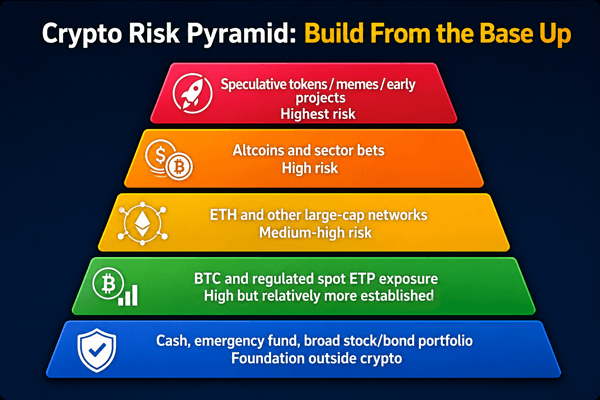
Crypto Risk Pyramid: Build From the Base Up
| Risk | What It Means | How to Reduce It |
|---|---|---|
| Volatility risk | Prices can rise or fall dramatically in short periods. | Keep allocation small, use long time horizons, avoid leverage. |
| Concentration risk | Too much money in one coin, sector, exchange, or narrative. | Set maximum position sizes and diversify cautiously. |
| Custody risk | You can lose funds through exchange failure, hacks, lost keys, or phishing. | Use reputable platforms, hardware wallets for self-custody, strong passwords, 2FA, and backups. |
| Liquidity risk | Small tokens may be hard to sell without pushing the price down. | Favor liquid assets; avoid oversized positions in thin markets. |
| Regulatory risk | Rules can change, affecting exchanges, tokens, taxes, or products. | Use compliant platforms and stay informed in your jurisdiction. |
| Smart contract risk | DeFi protocols and bridges can contain code flaws or be exploited. | Avoid complex DeFi until you understand the technical and counterparty risks. |
| Stablecoin risk | A stablecoin can lose its peg or face reserve/issuer problems. | Diversify reserves and do not treat stablecoins as risk-free bank deposits. |
| Behavioral risk | FOMO, panic selling, overtrading, and chasing influencers can damage returns. | Write rules before investing and use position limits. |
10. Exchange vs Self-Custody vs Crypto ETF/ETP: Which Is Better?
| Option | Best For | Advantages | Drawbacks |
|---|---|---|---|
| Centralized exchange | Beginners who want simple buying and selling. | Easy setup, fiat deposits, simple interface. | Platform risk, withdrawal limits, counterparty exposure. |
| Self-custody wallet | Users who understand private keys and security. | Control over assets; no exchange custody dependence. | Lost seed phrase can mean permanent loss; phishing risk. |
| Hardware wallet | Long-term holders with meaningful balances. | Improves key security when used correctly. | Costs money and still requires careful backup habits. |
| Spot crypto ETP/ETF | Investors who want brokerage-account exposure. | No direct wallet management; easier tax reporting in some accounts. | Fees, tracking differences, no direct on-chain use, product and regulatory limitations. |
In January 2024, the U.S. SEC approved the listing and trading of several spot Bitcoin exchange-traded product shares. That made brokerage-account Bitcoin exposure easier for many investors, but it did not make Bitcoin safe, guaranteed, or endorsed by the SEC. Investors still need to understand volatility, fees, custody arrangements, and product structure.
11. How to Research a Crypto Asset Before Adding It
- Understand the use case. What problem does the network or token actually solve?
- Check token economics. Who owns the supply, when do unlocks happen, and what creates demand?
- Review liquidity. Can you sell without a large price impact?
- Study security history. Has the protocol, bridge, or wallet ecosystem been exploited?
- Look for real adoption. Are users, developers, or businesses actually using it?
- Assess regulatory risk. Could the token be restricted, delisted, or treated differently in your jurisdiction?
- Define why it belongs in your portfolio. If the answer is only "it might pump," keep the allocation tiny or avoid it.
12. Common Beginner Mistakes
| Mistake | Why It Hurts | Better Practice |
|---|---|---|
| Going all-in after a rally | You may buy near a cycle peak because of FOMO. | Set a target allocation and enter gradually. |
| Owning too many tokens | Hard to research, track, secure, and rebalance. | Start with a simple portfolio and add only with a clear reason. |
| Ignoring taxes | Selling, swapping, staking rewards, airdrops, or payments may create taxable events. | Track transactions from day one and consult local tax rules. |
| Leaving large balances on exchanges | Exchange failure, hacks, or account lockouts can affect access. | Use appropriate custody methods and split risk. |
| Using leverage | Borrowed money can cause liquidation during normal crypto volatility. | Avoid leverage as a beginner. |
| Trusting influencers | Promoters may have conflicts of interest or sell while followers buy. | Research independently and avoid hype-driven decisions. |
| Thinking stablecoins are cash | Stablecoins can depeg or face issuer/platform problems. | Treat them as crypto instruments, not insured bank deposits. |
13. Step-by-Step Crypto Portfolio Allocation Plan for Beginners
- Build your financial base first: emergency fund, high-interest debt plan, and core diversified investments.
- Choose your maximum total crypto allocation, such as 1%, 3%, or 5% of investable assets.
- Choose a simple allocation model, such as 70% BTC, 20% ETH, 10% cash/stablecoin reserve.
- Decide how you will buy: lump sum, dollar-cost averaging, or a hybrid approach.
- Select reputable platforms and secure accounts with strong passwords and two-factor authentication.
- Create a custody plan: which assets stay on an exchange, which move to self-custody, and how backups are stored.
- Set rebalancing rules: schedule, tolerance bands, and tax-aware actions.
- Track every transaction for tax and performance reporting.
- Review your plan after major life changes, not after every price move.
- Write down your sell rules before markets become emotional.
14. Real-World Scenarios
14.1 Scenario A: The New Investor With $10,000 Saved
A beginner has $10,000 in investable savings after building an emergency fund. They choose a 3% crypto allocation, or $300 total. A simple version could be $210 Bitcoin, $60 Ethereum, and $30 cash/stablecoin reserve. This may seem small, but the goal is learning without putting the person's financial stability at risk.
14.2 Scenario B: The Investor Who Bought During Hype
Someone bought several tokens during a rally and now holds 40% of their investments in crypto. Instead of panic selling, they can create a target allocation, identify which assets they would still buy today, sell or stop adding to weak positions, and rebalance gradually while considering taxes.
14.3 Scenario C: The Long-Term Investor Using ETFs
An investor wants Bitcoin exposure inside a brokerage account and does not want to manage private keys. A spot Bitcoin ETP/ETF may be convenient, but the investor should compare expense ratios, tracking, tax treatment, liquidity, custody disclosures, and whether the product fits the rest of their portfolio.
15. Benefits and Limitations of Crypto Allocation
| Potential Benefits | Important Limitations |
|---|---|
| Access to a new digital asset class with different drivers from traditional assets. | Crypto may still fall with other risk assets during market stress. |
| High upside potential in successful networks or long-term adoption cycles. | High upside comes with high downside and possible permanent loss. |
| 24/7 global markets and direct asset ownership options. | 24/7 markets can encourage overchecking and emotional trading. |
| Ability to build rules-based exposure instead of random token picking. | Allocation rules cannot eliminate technology, regulatory, or custody risk. |
| ETP/ETF products may simplify access for some investors. | Funds charge fees and do not offer the same control as direct ownership. |
16. FAQs About Crypto Portfolio Allocation
16.1 What is a good crypto portfolio allocation for beginners?
A cautious beginner may start with 1% to 5% of their overall investable portfolio in crypto, then divide that crypto allocation mostly among Bitcoin, Ethereum, and a small cash or stablecoin reserve. The right number depends on risk tolerance and financial stability.
16.2 Should my crypto portfolio be 100% Bitcoin?
It can be, especially for beginners who want simplicity. Bitcoin is the most established crypto asset, but it is still volatile. Adding Ethereum or other assets can diversify exposure but also adds complexity and risk.
16.3 How many coins should I hold?
Many beginners are better served by holding a small number of assets they understand. Five carefully chosen positions are often easier to manage than twenty speculative tokens.
16.4 Are stablecoins safe?
Stablecoins are designed to track a currency such as the U.S. dollar, but they are not risk-free. They may face issuer, reserve, depegging, platform, and regulatory risks.
16.5 How often should I rebalance a crypto portfolio?
Quarterly, semiannual, or annual rebalancing is common. Beginners should avoid checking allocation every hour because frequent trading can increase stress, fees, and taxes.
16.6 Is dollar-cost averaging good for crypto?
Dollar-cost averaging can reduce timing pressure and emotional decision-making. It does not guarantee profits or protect against long bear markets.
16.7 Should I invest in altcoins?
Only after understanding why each asset deserves a place in your portfolio. Altcoins can outperform, but they also fail, lose liquidity, or become irrelevant. Keep speculative positions small.
16.8 Can I lose all my money in crypto?
Yes. Individual tokens can go to zero, platforms can fail, and users can lose access through scams or lost keys. This is why position sizing and security matter.
16.9 Do I owe taxes when I rebalance crypto?
In many jurisdictions, selling or swapping crypto can trigger taxable gains or losses. U.S. taxpayers must report digital asset transactions and taxable income. Rules vary by country, so keep records and consult a tax professional.
16.10 Is crypto allocation the same as diversification?
No. Allocation is deciding percentages. Diversification is spreading exposure across assets or risks. A crypto-only portfolio can still be poorly diversified if all positions depend on the same market narrative.
17. Best Practices for a Safer Crypto Allocation
- Keep crypto as a defined percentage of your total investment plan, not your entire plan.
- Start small and increase only after experience, not after hype.
- Use Bitcoin and Ethereum as the core if you want a simpler beginner-friendly structure.
- Limit speculative tokens with a strict maximum allocation.
- Avoid leverage, margin, and borrowed money.
- Do not store seed phrases in email, cloud notes, screenshots, or messaging apps.
- Track purchases, sales, swaps, staking rewards, fees, and transfers from the beginning.
- Rebalance with rules, not emotions.
- Review regulatory and tax rules in your country.
- Accept that "doing nothing" can be a valid decision when risk is unclear.
18. Final Takeaway
Crypto portfolio allocation is not about predicting the next winning coin. It is about deciding how much risk belongs in your life, choosing assets with a clear purpose, protecting yourself from avoidable mistakes, and following rules when markets become emotional. A beginner-friendly crypto portfolio is usually simple, small relative to total wealth, diversified enough to avoid one-token dependence, and managed with rebalancing, security, and tax awareness.
The best crypto allocation is one you understand, can hold through volatility, can afford to lose, and can explain in plain English before you buy.
Sources Consulted and Checked
The following sources were consulted and checked while preparing this document and reviewing its accuracy.
- FINRA, "Crypto Assets - Risks" and "Crypto Assets," explaining crypto assets, volatility, liquidity, and risk considerations.
- U.S. SEC Investor.gov, "Exercise Caution with Crypto Asset Securities: Investor Alert," warning that many crypto investments can be volatile, speculative, and may lack important investor protections.
- U.S. SEC, Chair Gary Gensler statement on January 10, 2024 approval of spot Bitcoin exchange-traded product listings and trading.
- IRS, "Digital assets" and IRS digital asset transaction guidance, explaining that income from digital assets is taxable and transactions may need to be reported.
- SEC Investor Alert, May 2024, on common ways fraudsters lure victims into crypto-asset scams.
- IOSCO, "Investor Education on Crypto-Assets" report, 2024, for investor protection and risk education context.
Reader Advice
This article is provided for general educational and informational purposes only. It is not personalized financial, investment, tax, or legal advice, and it does not recommend any particular crypto asset, platform, product, or strategy. Crypto assets can be highly volatile and speculative, and losses may be substantial or total. Rules, policies, laws, tax treatment, product availability, and statistics can change over time and may vary by country or region. Before making a decision, verify current information through official sources, consider your financial circumstances and risk tolerance, and seek guidance from a suitably qualified professional where appropriate.