Fundamental Analysis for Crypto: Complete Guide, Examples, Risks and Best Practices
1. Quick Answer: What Is Crypto Fundamental Analysis?
Crypto fundamental analysis is the process of studying a digital asset to decide whether its current market price is supported by real usage, strong technology, healthy economics, credible people, security, liquidity, and long-term demand. Instead of asking only “Is the chart going up?”, fundamental analysis asks “Is there a real reason this asset should matter?”
A good crypto fundamental analysis process looks at three big areas:
- Project fundamentals: use case, users, team, roadmap, technology, competition and governance.
- Token economics: supply, inflation, unlocks, incentives, utility, revenue capture and holder concentration.
- Market and network data: active addresses, transactions, fees, total value locked, liquidity, exchange depth, developer activity and security history.
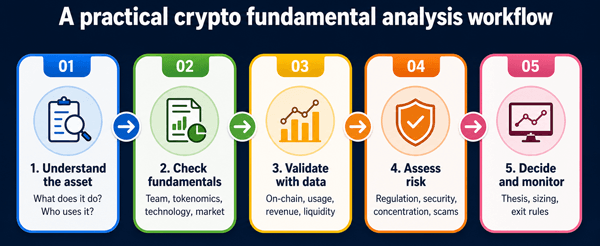
A practical crypto fundamental analysis workflow
2. Why Fundamental Analysis Matters in Crypto
Crypto markets move fast. Prices can rise because of real adoption, but they can also rise because of hype, leverage, influencer promotion, low liquidity, temporary narratives, or coordinated speculation. Fundamental analysis helps beginners slow down and separate a promising project from a risky story.
In traditional investing, analysts study revenue, cash flow, balance sheets, industry position and management quality. Crypto assets are different. Many do not represent ownership in a company. Some are commodities-like network assets, some are governance tokens, some are stablecoins, some are meme coins, and some are securities under certain laws. Because of that, crypto analysis must adapt to the asset type.
The goal is not to predict the exact next price move. The goal is to build a clear investment or research thesis, identify risks before you buy, and avoid decisions based only on fear of missing out.
3. Fundamental Analysis vs Technical Analysis vs Sentiment Analysis
Beginners often confuse different types of analysis. They can be useful together, but they answer different questions.
| Type of analysis | Main question | Common tools | Best use | Main weakness |
|---|---|---|---|---|
| Fundamental analysis | Is this asset valuable or useful? | Tokenomics, on-chain metrics, team, technology, adoption, revenue, security | Longer-term research and risk review | Can be hard to value assets with no cash flow |
| Technical analysis | What is price doing? | Charts, trend lines, support/resistance, volume, moving averages | Timing entries, exits and risk levels | Can fail during news shocks and low-liquidity moves |
| Sentiment analysis | What does the market feel? | Social media, funding rates, Google Trends, news, community activity | Understanding hype, fear and crowd behavior | Very noisy and easy to manipulate |
4. The Main Types of Crypto Assets and How to Analyze Them
Not every crypto asset should be analyzed the same way. A Bitcoin analysis, a DeFi lending-token analysis, and a stablecoin analysis require different questions.
| Asset type | Examples | What to study first | Beginner warning |
|---|---|---|---|
| Layer-1 network asset | Bitcoin, Ethereum, Solana | Network usage, security model, fees, developer ecosystem, decentralization, monetary policy | A high market cap does not remove technology, regulatory or valuation risk. |
| Layer-2 or scaling token | Tokens tied to rollups or scaling networks | User activity, fee generation, relationship to base chain, sequencer model, token utility | Some tokens may have weak value capture even if the network is useful. |
| DeFi protocol token | DEX, lending, derivatives or yield protocol tokens | TVL, fees, revenue, security audits, governance, token incentives, bad debt risk | High yield can hide smart-contract, liquidity or token-inflation risk. |
| Stablecoin | Fiat-backed or crypto-backed stablecoins | Reserve quality, redemption rights, issuer transparency, regulatory status, depeg history | A stable price target does not mean zero risk. |
| Meme coin | Community-driven tokens | Liquidity, holder concentration, community strength, listing venues, contract risk | Often driven more by attention than fundamentals. Many collapse after hype fades. |
| Utility or gaming token | Game, marketplace or app tokens | Actual users, token sinks, emissions, product-market fit, player retention | A fun product does not automatically make the token valuable. |
5. How Crypto Fundamental Analysis Works Step by Step
Step 1: Understand What the Asset Actually Does
Start with the simplest question: what problem does this crypto asset solve? If you cannot explain it in one or two plain-English sentences, do not invest yet. Read the project website, whitepaper, documentation, token page and independent analysis. Avoid vague claims such as “revolutionary,” “AI-powered,” or “next-generation” unless you can identify the real mechanism.
Step 2: Identify the Asset Type and Value Driver
Ask what creates demand for the asset. For Bitcoin, demand may relate to scarcity, settlement, security and monetary narrative. For ETH, demand can relate to transaction fees, staking, applications and collateral use. For a DeFi token, demand may depend on governance rights, fee sharing, staking benefits, liquidity incentives or speculation. If the token is not needed for the product to work, the project can succeed while the token performs poorly.
Step 3: Study Tokenomics
Tokenomics means how the token is created, distributed, used and removed from circulation. Beginners should focus on supply, inflation, unlock schedules, insider allocation, utility and incentives. A project with strong marketing but heavy upcoming unlocks may face selling pressure. A project with useful technology but no clear token demand may struggle to justify a high valuation.
Step 4: Review On-Chain Activity
Blockchains make some activity visible. Depending on the network, you can inspect active addresses, transactions, fees paid, value transferred, staking participation, miner or validator activity, stablecoin flows, exchange inflows and protocol deposits. These metrics are helpful, but they need context. One user can control many addresses, bots can create activity, and airdrop farming can inflate numbers.
Step 5: Analyze Security and Technical Risk
Crypto assets depend on code, cryptography, consensus, bridges, wallets and smart contracts. Review audits, bug bounties, exploit history, validator or miner concentration, admin keys, upgrade control and bridge dependencies. A high yield is not attractive if the protocol can be drained by a contract bug.
Step 6: Compare the Project With Alternatives
A project can be good and still be overvalued if better competitors exist. Compare similar assets by users, revenue, TVL, fees, developer activity, liquidity, decentralization, security record, ecosystem partnerships and valuation ratios.
Step 7: Build a Clear Thesis Before Buying
Write down why you are interested, what would prove you wrong, what risks matter most, how much you are willing to lose, and when you will review the position. This one habit can prevent many emotional decisions.
6. Important Crypto Fundamental Analysis Metrics
No single metric can prove that a crypto asset is undervalued. Use metrics as clues, then combine them with qualitative research.
| Metric | What it means | Why it matters | What can go wrong |
|---|---|---|---|
| Market capitalization | Price multiplied by circulating supply | Gives a rough size comparison | Can be misleading when supply is illiquid or circulating supply is poorly reported. |
| Fully diluted valuation (FDV) | Price multiplied by maximum or total supply | Shows valuation if all tokens existed today | Not all tokens unlock at once, but large FDV can signal future dilution. |
| Circulating supply | Tokens currently available in the market | Needed for market cap | Different data providers may classify locked, vested or bridged tokens differently. |
| Token unlock schedule | When locked tokens become transferable | Helps identify potential sell pressure | Not every unlock causes selling, but it increases available supply. |
| Active addresses | Unique addresses active during a period | Proxy for network activity | One person can use many addresses; bots and airdrop farmers can inflate numbers. |
| Transactions | Number of transfers or smart-contract interactions | Shows network usage | Low-value spam can make usage look stronger than it is. |
| Fees paid | Fees users pay to use the network or protocol | Shows willingness to pay | High fees may reflect demand or poor scalability. |
| Total value locked (TVL) | Dollar value of crypto assets deposited in DeFi protocols | Useful for DeFi adoption and liquidity | TVL can rise only because token prices rise; calculation methods are not always standardized. |
| Protocol revenue | Fees retained by the protocol or token holders | More comparable to business economics | Many tokens do not have a legal or direct claim on protocol revenue. |
| Liquidity and volume | How easily the asset trades without big slippage | Important for entry, exit and risk control | Reported volume can be inflated; order-book depth matters. |
| Holder concentration | Share of supply held by top wallets, insiders or contracts | Shows centralization and sell-pressure risk | Exchange wallets and smart contracts can distort raw holder lists. |
| Developer activity | Code contributions and ecosystem building | Signals ongoing maintenance and innovation | GitHub activity can be gamed; quality matters more than count. |
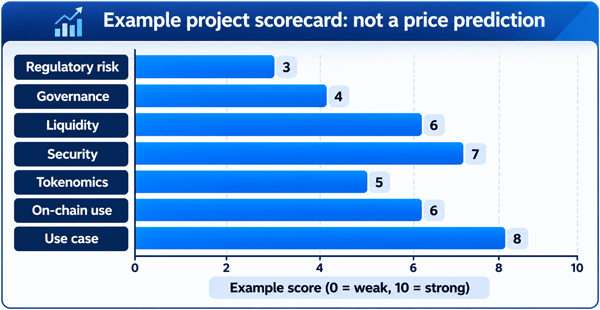
Figure: A scorecard helps organize research. It should not be treated as a mathematical price target.
7. Tokenomics: The Beginner-Friendly Checklist
Tokenomics is one of the biggest reasons beginners get surprised. A project may look cheap because the price per token is low, but price per token means very little without supply. A token priced at $0.05 can be expensive if there are hundreds of billions of tokens.
- Current circulating supply: How many tokens are actually tradeable now?
- Maximum or total supply: How many tokens could exist later?
- Inflation rate: Are new tokens issued to validators, miners, liquidity providers, insiders or users?
- Unlock schedule: When do team, investor and ecosystem tokens become available?
- Token utility: Is the token needed for fees, staking, collateral, governance, access, discounts or security?
- Value capture: Does project success create demand for the token, or only for the app?
- Burns and sinks: Are tokens removed or locked because of real usage, not just marketing?
- Holder distribution: Are a few wallets able to move the market?
7.1 Simple Tokenomics Example
Imagine two tokens trade at $1. Token A has 10 million circulating tokens and 20 million maximum supply. Token B has 10 million circulating tokens but 1 billion maximum supply, with most tokens unlocking over the next two years. Token B may look equally priced, but its future dilution risk is much higher. If demand does not grow as supply unlocks, price can fall even if the project keeps developing.
8. Practical Examples of Crypto Fundamental Analysis
8.1 Example 1: Bitcoin Fundamental Analysis
Bitcoin is usually analyzed as a proof-of-work monetary network rather than a company. Important questions include: Is the network secure? Is hash rate and mining participation healthy? Are transaction fees sufficient over time? Is the supply schedule credible? Is liquidity deep? Is the asset widely recognized and held? What regulatory or custody risks exist?
Useful metrics include market cap, realized cap, active addresses, transaction fees, hash rate, mining difficulty, long-term holder behavior, exchange balances, liquidity and volatility. A beginner should not assume that Bitcoin has no risk because it is the oldest crypto asset. Its risks include price volatility, regulatory changes, custody mistakes, miner economics, fee-market uncertainty and macro sensitivity.
8.2 Example 2: Ethereum Fundamental Analysis
Ethereum can be analyzed as a smart-contract platform. The ETH asset is used for transaction fees, staking, collateral and settlement across a large ecosystem. Important questions include: Are developers and applications still building on it? Are users willing to pay fees? Is staking participation healthy? Are layer-2 networks adding value or pulling value away? How secure and decentralized is the validator set?
Ethereum uses proof of stake, where validators stake ETH and can be penalized for dishonest behavior. For analysis, this means staking economics, validator distribution, slashing risk, issuance, fee burns, application activity and layer-2 growth all matter.
8.3 Example 3: DeFi Lending Token Analysis
For a DeFi lending protocol, the token is not automatically valuable just because the protocol has deposits. Study TVL, borrow demand, net interest margins, bad debt, liquidation performance, oracle risk, smart-contract audits, governance control, treasury runway, token emissions and whether token holders receive any direct or indirect benefit from protocol growth.
A red flag would be a protocol whose TVL is high only because it pays unsustainable token rewards. When rewards fall, liquidity may leave.
8.4 Example 4: Stablecoin Analysis
Stablecoin analysis is mostly risk analysis. Ask what backs the stablecoin, who controls reserves, whether users have direct redemption rights, how often reserves are attested or audited, whether reserves are liquid, what happened during past stress events, and how the issuer is regulated.
A stablecoin can trade at $1 for a long time and still carry reserve, regulatory, operational, smart-contract or depeg risk.
8.5 Example 5: Meme Coin Analysis
Meme coins often have little traditional fundamental value. Analysis should focus on liquidity, holder concentration, contract permissions, community durability, exchange listings, narrative strength and downside risk. Treat them as highly speculative. A large community can create attention, but attention can disappear quickly.
For beginners, the safest assumption is that a meme coin can go down 80-100% even after looking popular online.
9. Real-World Scenario: How a Beginner Might Research a New Token
Suppose a friend tells you about “FastPay Token,” a fictional payment-network token that has doubled in a week. Here is a practical research process:
- Read the official docs and summarize the use case in plain English.
- Check whether the token is required for payments or is only used for governance.
- Look up circulating supply, FDV and unlock schedule.
- Check active wallets, transactions, fees and whether activity looks organic.
- Compare with similar payment or layer-1 projects.
- Review audits, admin keys, bridge dependencies and exploit history.
- Check liquidity on reputable exchanges and estimate slippage for your position size.
- Search for regulatory warnings, lawsuits, team controversies and past failed projects.
- Write a one-paragraph thesis and a one-paragraph bear case.
- Decide whether the risk is acceptable before thinking about price targets.
A beginner mistake would be buying immediately because the price is rising. A better approach is asking: “What would make me still want to own this if the price dropped 40% tomorrow?” If the answer is “nothing,” you probably do not have a fundamental thesis.
10. Crypto Fundamental Analysis Red Flags
- Anonymous or unverifiable team with control over treasury, admin keys or token supply.
- Unclear token utility: the product can work without the token.
- Very high FDV with a small circulating supply.
- Large insider or venture-capital unlocks coming soon.
- No security audit for complex smart contracts handling user funds.
- Promises of guaranteed returns, risk-free yield or fixed profits.
- Heavy influencer marketing with little technical documentation.
- Low liquidity, wide spreads or most volume on obscure exchanges.
- Bridge dependency without clear security assumptions.
- Governance controlled by a small group of wallets.
- TVL or user activity that depends mainly on temporary token rewards.
- Copied code, fake partnerships, fake audit badges or plagiarized whitepapers.
11. Benefits and Limitations of Fundamental Analysis in Crypto
| Benefits | Limitations |
|---|---|
| Helps you avoid obvious scams, weak tokenomics and hype-driven decisions. | Crypto assets can stay overpriced or underpriced for long periods. |
| Forces you to understand what you are buying. | Some metrics are noisy, manipulated or hard to compare across chains. |
| Improves risk management and position sizing. | Many tokens do not have cash flows, so valuation is less precise than equity analysis. |
| Makes it easier to compare similar projects. | Regulatory, technical or market shocks can overwhelm fundamentals. |
| Encourages long-term thinking instead of emotional trading. | A good project can still be a bad investment at the wrong price. |
12. Major Risks Beginners Must Understand
12.1 Market risk
Crypto prices can be extremely volatile. Even fundamentally strong assets can fall sharply during liquidity crises, macro shocks or leverage unwinds.
12.2 Regulatory risk
Crypto rules vary by country and can change. Tokens, exchanges, staking, stablecoins and DeFi products may face restrictions, enforcement actions or new compliance costs.
12.3 Custody risk
If you lose private keys or send funds to the wrong address, recovery may be impossible. Custodial platforms can also fail, freeze withdrawals or be hacked.
12.4 Smart-contract risk
Code bugs, oracle failures, governance attacks and bridge exploits can lead to permanent loss of funds.
12.5 Liquidity risk
A token may show a high market cap but have shallow order books. Selling a meaningful amount can move the price against you.
12.6 Concentration risk
If insiders, whales or treasuries hold large supply, their selling can pressure price.
12.7 Data-quality risk
Crypto data sources disagree. Always check definitions, chains covered and whether metrics include spam, failed transactions or bridged assets.
12.8 Scam and fraud risk
Phishing, fake airdrops, malicious wallet approvals, Ponzi schemes and impersonation scams are common in crypto markets.
13. Best Practices for Crypto Fundamental Analysis
- Begin with asset classification. Do not use the same checklist for Bitcoin, a stablecoin and a governance token.
- Use multiple data sources. Compare official docs, block explorers, analytics dashboards, exchange data and independent research.
- Study FDV and unlocks before market cap. A low circulating market cap can hide heavy dilution.
- Look for real demand, not just token rewards. Organic usage matters more than subsidized activity.
- Separate protocol success from token value. A popular app can have a weak token.
- Check liquidity before you buy. If you cannot exit without major slippage, position size should be smaller.
- Review security assumptions. Know whether funds depend on bridges, multisigs, admin keys or unaudited contracts.
- Write your thesis. Include the bull case, bear case, key metrics to monitor and what would make you change your mind.
- Use risk limits. Never invest money you cannot afford to lose, and avoid borrowing to buy volatile crypto assets.
- Keep learning. Crypto changes quickly; a thesis that was reasonable six months ago may become outdated.
14. Crypto Fundamental Analysis Checklist
| Question | Why it matters | Good signs | Warning signs |
|---|---|---|---|
| What does the asset do? | Clarifies whether there is a real use case. | Simple use case, clear documentation, real users. | Vague buzzwords or no clear need for a token. |
| Who uses it? | Adoption supports long-term demand. | Growing active users, developers, integrations. | Activity mainly from bots, incentives or airdrop farming. |
| How does the token capture value? | Project success must connect to token demand. | Fees, staking, collateral, security or credible governance role. | Token is optional or only used for speculation. |
| What is the supply schedule? | Dilution can pressure price. | Transparent emissions and moderate unlocks. | Large insider unlocks or unclear supply data. |
| Is the technology secure? | Bugs and exploits can destroy value. | Audits, bug bounty, battle-tested code, clear risk docs. | No audit, admin-key opacity, recent exploit. |
| How liquid is it? | Liquidity affects buying and selling safely. | Deep order books and multiple reputable venues. | Thin liquidity or volume mostly on obscure platforms. |
| Who controls governance? | Centralized control can change rules quickly. | Broad participation and transparent proposals. | Small group can upgrade contracts or drain treasury. |
| What could prove the thesis wrong? | Prevents emotional attachment. | Clear risk triggers and monitoring plan. | No exit criteria or denial of risks. |
15. Common Misconceptions About Crypto Fundamentals
15.1 “Low price means cheap.”
False. Price per token means little without supply. A $0.01 token can be expensive if supply is enormous.
15.2 “High TVL always means a strong project.”
Not always. TVL can be mercenary capital chasing rewards, double-counted across protocols, or inflated by rising token prices.
15.3 “More transactions always mean more adoption.”
Not always. Transactions can include bots, spam, failed transactions or low-value activity.
15.4 “Audited means safe.”
No audit eliminates all risk. Audits reduce risk but cannot guarantee safety.
15.5 “A good project is always a good investment.”
Price matters. A strong project can be overvalued, and a weak project can rise temporarily because of speculation.
15.6 “Crypto fundamentals do not matter.”
They may not matter every day, but over longer periods, usage, security, liquidity, incentives and trust strongly influence survival.
16. Useful Tools and Data Sources for Beginners
| Tool type | Examples | What to use it for |
|---|---|---|
| Official documentation | Project docs, whitepaper, governance forum | Understand purpose, architecture, token utility and roadmap. |
| Block explorers | Etherscan, Solscan, Blockchain.com explorer | Verify transactions, holders, contracts, token supply and wallet activity. |
| On-chain analytics | Coin Metrics, Glassnode, Token Terminal, Dune dashboards | Study active addresses, fees, exchange flows, revenue, protocol metrics. |
| DeFi dashboards | DeFiLlama, protocol dashboards | Review TVL, fees, chains, yields and protocol categories. |
| Security resources | Audit reports, bug bounty pages, exploit databases, governance forums | Check smart-contract risk and past incidents. |
| Market data | CoinGecko, CoinMarketCap, exchange order books | Compare market cap, FDV, volume, liquidity and listings. |
| Regulatory and investor education | Investor.gov, CFTC, IOSCO, local regulators | Understand warnings, custody risks, fraud patterns and investor protections. |
17. FAQs About Fundamental Analysis for Crypto
17.1 Is crypto fundamental analysis the same as stock analysis?
No. Stock analysis often focuses on company ownership, profits, cash flow and balance sheets. Crypto analysis may focus on network usage, token supply, decentralization, security, liquidity and whether the token has real utility.
17.2 Can fundamental analysis predict crypto prices?
It can support better decisions, but it cannot reliably predict short-term prices. Crypto markets are affected by sentiment, liquidity, leverage, regulation, macro conditions and speculation.
17.3 What is the most important crypto fundamental metric?
There is no single best metric. For a layer-1 network, fees, security, active users and developer activity may matter. For a DeFi protocol, TVL, revenue, liquidity, security and token incentives may matter. For a stablecoin, reserve quality and redemption risk matter most.
17.4 What does FDV mean in crypto?
FDV means fully diluted valuation. It estimates the value of a project if all tokens existed at the current price. It is important because a project can look small by circulating market cap but expensive by FDV.
17.5 Is high TVL good?
High TVL can show capital deposited in a protocol, but it is not automatically good. You need to ask whether the TVL is sticky, profitable, secure and driven by real demand rather than temporary rewards.
17.6 How do I know if on-chain activity is real?
Look for consistent activity over time, fees paid by users, diversity of wallets, retention, application usage and activity that continues after incentives decline. Be cautious when activity spikes only around airdrop campaigns.
17.7 Should beginners invest in new crypto projects?
New projects can offer opportunity but carry high risk: limited history, thin liquidity, unknown security, insider unlocks and hype cycles. Beginners should usually start by learning with small amounts or paper tracking before risking meaningful capital.
17.8 What is a crypto whitepaper?
A whitepaper is a document that explains a project’s purpose, design, technology and sometimes token economics. It is useful, but it is not proof that the project will succeed.
17.9 How often should I review crypto fundamentals?
For long-term holdings, review at least monthly or quarterly, and immediately after major events such as exploits, governance changes, regulatory news, token unlocks, chain outages or major competitor launches.
17.10 What is the biggest beginner mistake?
Buying because of price hype before understanding supply, token utility, liquidity and downside risk. The second biggest mistake is assuming that a popular project automatically has a valuable token.
18. Final Takeaway
Fundamental analysis for crypto is not about finding a magic formula. It is about asking better questions before taking risk. What does the asset do? Who uses it? Why should the token be valuable? How much supply is coming? Is the network secure? Is liquidity real? What could go wrong?
For beginners, the best approach is simple: understand the asset type, check tokenomics, validate usage with data, review security and regulation, compare competitors, and write down a clear thesis. If you cannot explain why an asset has value without mentioning that its price is going up, you are not doing fundamental analysis yet.
Sources Consulted and Checked
These sources were consulted and checked while preparing this document to support accuracy and clarity.
- Investor.gov - Crypto Asset Custody Basics for Retail Investors
- Investor.gov - Exercise Caution with Crypto Asset Securities
- CFTC - Understand the Risks of Virtual Currency Trading
- Ethereum.org - Proof-of-Stake
- Ethereum.org - Proof-of-Stake Rewards and Penalties
- Coin Metrics Docs - Active Addresses
- Coin Metrics Docs - Transactions
- DeFiLlama - DeFi Analytics and TVL Dashboard
- BIS Working Paper - Towards Verifiability of Total Value Locked in DeFi
- Blockchain.com - Network Difficulty Chart and Explanation
- IOSCO - Investor Education on Crypto-Assets
Reader Advice
This article is provided for educational and informational purposes only. It is not personalized financial, investment, tax, or legal advice, and it is not a recommendation to buy, sell, or hold any crypto asset. Crypto assets are highly volatile and may involve loss of some or all invested funds, as well as liquidity, custody, technology, fraud, and regulatory risks. Rules, policies, laws, market data, and statistics can change over time and may vary by country or region, so please verify important information through current official sources and consider qualified professional advice before making decisions.