Blockchain Finality Explained: Probabilistic vs Instant Finality and Why It Matters
Quick Answer: Blockchain finality is the point at which a transaction is considered settled and extremely difficult, or impossible under normal protocol rules, to reverse. Probabilistic finality, used by Bitcoin-style chains, becomes stronger as more blocks are added after your transaction. Instant or deterministic finality, common in BFT-style proof-of-stake systems, finalizes a block after validators reach the required vote threshold. Finality matters because exchanges, bridges, merchants, wallets, and smart contracts need to know when it is safe to treat a transaction as complete.
1. What Is Blockchain Finality?
Blockchain finality is about settlement certainty. When you send a transaction, the network may first see it, then include it in a block, then build more confidence around that block. Finality answers a practical question: “Can this transaction still be reversed?”
In traditional payments, settlement can also be delayed. A card payment may look approved instantly, but chargebacks and bank settlement can happen later. In a blockchain, the goal is to let users and applications decide when an on-chain transfer is reliable enough to act on.
Finality is not the same thing as speed. A blockchain can show a transaction quickly but still need time before the transaction is safe from reorganization. This distinction is especially important when moving large amounts of money, accepting deposits on an exchange, using bridges, or triggering smart contracts.
2. Why Finality Matters in Real Life
Finality matters because blockchains are used for assets, not just messages. If a payment, trade, or bridge transfer can be reversed after someone has delivered goods or released funds, the receiver can lose money.
For a small coffee purchase, a merchant might accept more risk for speed. For a million-dollar exchange deposit, the same merchant would wait for stronger finality. Good systems match the confirmation policy to the value and risk of the transaction.
| Scenario | Why finality matters | Practical decision |
|---|---|---|
| Exchange deposit | A deposit credited too early could be reversed by a chain reorg or attack. | Wait for the exchange’s required confirmations or finality status. |
| Merchant payment | The seller wants to know whether it is safe to hand over goods. | Use faster acceptance for low-value items and stronger finality for high-value items. |
| Cross-chain bridge | A bridge may mint or release assets on another chain based on a source-chain event. | Wait for robust finality before releasing funds on the destination chain. |
| DeFi liquidation or trade | Smart contracts may act automatically once a transaction is included. | Applications should understand the chain’s reorg risk and finality guarantees. |
3. The Basic Lifecycle of a Blockchain Transaction
A transaction usually passes through several stages before users treat it as final. Different chains use different names, but the basic idea is similar.
- Created: Your wallet signs a transaction and sends it to the network.
- Propagated: Nodes receive the transaction and share it with other nodes.
- Included: A miner or validator includes the transaction in a block.
- Confirmed: The block is accepted by the network, or more blocks are added after it.
- Finalized: The transaction is now safe enough, or formally final under the chain’s consensus rules.
The confusion comes from the words “confirmed” and “final.” On some networks, a confirmation is only a growing signal of confidence. On others, finality is a specific protocol state created by validator votes.
4. Probabilistic Finality Explained
Probabilistic finality means a transaction becomes harder to reverse as more blocks are built on top of it. It is called “probabilistic” because the risk of reversal decreases over time, but the protocol does not usually declare a single instant where reversal becomes mathematically impossible.
Bitcoin is the classic example. A transaction included in a block has one confirmation. When another block is added after it, it has two confirmations, and so on. Each extra confirmation makes it more expensive and less likely for an attacker to rewrite that part of history.
4.1 How Probabilistic Finality Works
- A miner creates a valid block that includes your transaction.
- Other miners choose the valid chain they see as the best chain and build on it.
- Each new block added after yours makes your transaction deeper in the chain.
- An attacker who wants to reverse your transaction must create a competing chain that catches up and becomes accepted by the network.
- The deeper your transaction is, the lower the practical probability of reversal becomes.
This is why Bitcoin users often hear about “waiting for confirmations.” Six confirmations is a common rule of thumb for high-value Bitcoin transactions, but it is not a universal law. The right number depends on transaction value, network conditions, risk tolerance, and the policy of the service receiving the funds.
5. Instant Finality Explained
Instant finality, also called deterministic finality or absolute finality, means that once the protocol finalizes a block, honest nodes will not later replace it with another block at the same height. In practice, “instant” usually means finality happens as part of block commitment or shortly after a voting round, not necessarily in zero seconds.
Many BFT-style proof-of-stake systems work this way. Validators propose a block and vote on it. If the required supermajority agrees, the block is committed and considered final. CometBFT/Tendermint-style systems are often described this way: once a block is committed, applications do not need to wait for a long chain of later confirmations.
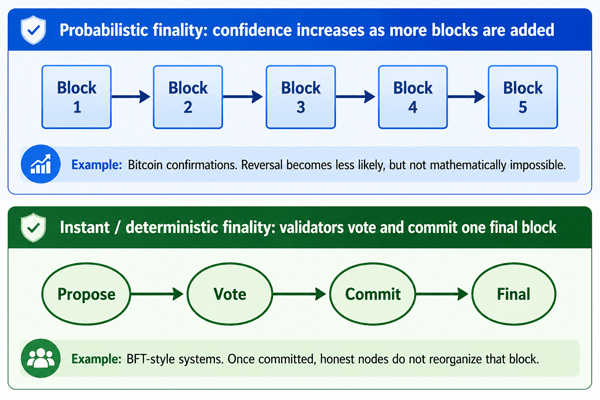
Diagram: Probabilistic finality gains confidence over time; instant/deterministic finality commits a block after consensus voting.
| Feature | Probabilistic finality | Instant / deterministic finality |
|---|---|---|
| Core idea | Reversal becomes less likely as more blocks are added. | A block becomes final after the required consensus vote or commit. |
| Common examples | Bitcoin and many proof-of-work or longest-chain systems. | Tendermint/CometBFT-style chains and many BFT proof-of-stake systems. |
| User experience | Users wait for confirmations based on risk. | Users can often act after the block is finalized. |
| Main strength | Simple, resilient, and proven in open networks such as Bitcoin. | Clear settlement point; useful for payments, exchanges, bridges, and DeFi. |
| Main weakness | No exact moment of absolute finality; reorg risk falls but does not fully disappear. | May rely on a known validator set and assumptions about honest supermajority participation. |
| Best fit | Highly decentralized settlement where waiting is acceptable. | Fast settlement applications where quick certainty matters. |
6. Finality vs Confirmation vs Settlement: What Is the Difference?
A confirmation usually means a transaction is included in a block, or that additional blocks have been added after it. Finality means the transaction has reached the level of certainty required to treat it as settled. Settlement is the business or user decision to act on that certainty.
For example, an exchange may wait for a deposit to be final enough before allowing withdrawals. The blockchain provides technical evidence; the exchange turns that evidence into a risk policy.
7. What Are Chain Reorganizations?
A chain reorganization, or reorg, happens when nodes replace part of the chain they were following with a different valid chain. Small reorgs can happen naturally in longest-chain systems when two blocks are found at nearly the same time. Larger reorgs are more serious because they can remove previously included transactions from the canonical chain.
Reorgs are the reason finality exists as a user concern. If your transaction is in a block that later gets replaced, the transaction may return to the mempool, be included later, or be excluded entirely. A receiver who acted too early may face loss.
8. Benefits of Strong Finality
Strong finality gives users, businesses, and applications clearer settlement rules. It reduces uncertainty, simplifies accounting, improves user experience, and lowers the chance of building on top of a transaction that later disappears.
It is especially valuable for bridges, stablecoin issuers, payment processors, centralized exchanges, high-frequency trading, gaming assets, and any smart contract that triggers irreversible follow-up actions.
9. Limitations and Trade-Offs
No finality model is magic. Probabilistic finality can be slower for high-value use cases, but it works well in highly open systems and has a long security track record. Instant finality can offer faster certainty, but it depends on validator voting, network assumptions, and penalties or governance rules that must work as designed.
Finality also does not protect against every risk. It does not fix sending funds to the wrong address, signing a malicious transaction, smart contract bugs, oracle failures, private key theft, or a centralized service freezing your account.
| Risk or mistake | What beginners often think | What is actually true |
|---|---|---|
| “My transaction appeared in my wallet, so it is final.” | Visibility equals settlement. | Wallets may show pending, processed, or confirmed transactions before strong finality. |
| “Instant finality means no risk at all.” | Finality removes every possible problem. | Finality reduces reorg risk, but bugs, bad signatures, governance failures, and user mistakes can still matter. |
| “Six confirmations is always enough.” | One rule fits every chain and every amount. | Confirmation policies should match transaction value, chain security, and receiver risk. |
| “Fast block time means fast finality.” | Short blocks automatically mean safe settlement. | A chain can produce blocks quickly but still require time or votes before finality. |
10. How Finality Works on Popular Networks
The details vary by network, so always check the current documentation for the chain or service you use. The examples below are simplified for beginners.
| Network / family | Finality style | Beginner takeaway |
|---|---|---|
| Bitcoin | Probabilistic finality through proof-of-work confirmations. | More confirmations generally mean stronger confidence. High-value payments usually wait longer. |
| Ethereum proof of stake | Crypto-economic finality through validator checkpoints. | Finalized checkpoints are extremely costly to revert because validators can be penalized. |
| CometBFT / Tendermint-style chains | BFT-style deterministic finality. | Once a block is committed by the required validator votes, applications usually treat it as final. |
| Solana | Commitment levels such as processed, confirmed, and finalized. | Applications should choose the commitment level that fits their speed and safety needs. |
11. Practical Best Practices for Users, Builders, and Businesses
11.1 For everyday users
- Check whether your wallet says pending, confirmed, finalized, or completed.
- For large transfers, wait for the receiving service to mark the deposit complete before taking further action.
- Do not assume a transaction is safe just because it appears in a block explorer immediately.
- Use the correct chain and address. Finality does not reverse user mistakes.
11.2 For exchanges and merchants
- Set confirmation requirements by asset value, chain security, liquidity, and attack risk.
- Use stricter finality rules for withdrawals, bridge releases, and irreversible deliveries.
- Monitor reorgs, validator health, chain halts, and known network incidents.
- Publish clear deposit policies so customers understand why some deposits take longer.
11.3 For developers
- Know the exact meaning of your RPC provider’s commitment or confirmation levels.
- Use finalized or safe block tags where appropriate for accounting and irreversible actions.
- Design smart contracts and off-chain services to handle reorgs, retries, and duplicate events.
- Never build bridge logic that releases destination-chain funds based only on weak source-chain confirmation.
12. How Long Should You Wait Before Trusting a Transaction?
There is no single answer for every blockchain or every use case. Use this simple risk-based approach:
- Identify the chain’s finality model: probabilistic, deterministic, hybrid, or commitment-level based.
- Estimate the value at risk: a $5 transfer and a $500,000 transfer should not use the same policy.
- Check the receiver’s policy: exchanges and bridges often have their own confirmation requirements.
- Consider current network conditions: congestion, forks, validator issues, or known attacks may justify waiting longer.
- Use stronger finality for irreversible follow-up actions such as releasing goods, crediting withdrawals, or minting bridged assets.
13. Pros and Cons of Probabilistic Finality
| Pros | Cons |
|---|---|
| Battle-tested in Bitcoin-style systems. | Users must wait for enough confirmations. |
| Works well in open networks where anyone can participate in mining or validation. | No exact protocol moment where reversal becomes impossible. |
| Security grows with economic cost and accumulated work. | Short-term reorgs can confuse users and applications. |
14. Pros and Cons of Instant Finality
| Pros | Cons |
|---|---|
| Clear settlement point for users and applications. | Depends on validator participation and honest-supermajority assumptions. |
| Useful for payments, bridges, exchanges, and DeFi workflows. | Network stalls can occur if consensus cannot reach the required vote threshold. |
| Reduces the need for long confirmation waits. | Implementation, governance, or slashing failures can weaken real-world guarantees. |
15. FAQs About Blockchain Finality
15.1 Is blockchain finality the same as confirmation?
No. Confirmation is evidence that a transaction has been included in the chain or buried under later blocks. Finality is the stronger idea that the transaction is safe enough, or formally finalized, so it should not be reversed under normal protocol rules.
15.2 Can a finalized transaction ever be reversed?
In a well-functioning deterministic-finality system, finalized blocks should not be reorganized by honest nodes. However, extreme events such as consensus bugs, social recovery, governance intervention, or catastrophic validator failure can still create real-world exceptions. Finality is very strong, but it is not a cure for every possible failure.
15.3 Why does Bitcoin not have instant finality?
Bitcoin uses Nakamoto-style proof-of-work consensus. Its security comes from accumulated work and the difficulty of building a competing chain. That design gives probabilistic finality: confidence grows as more blocks are added.
15.4 Is instant finality always better?
Not always. Instant finality is excellent for fast settlement, but it comes with its own assumptions, such as validator voting thresholds and network liveness. Probabilistic finality may be slower, but it can be highly robust and decentralized.
15.5 What does “time to finality” mean?
Time to finality is the time it usually takes for a transaction or block to reach the network’s finality standard. On probabilistic chains, people often express this as a number of confirmations. On deterministic-finality chains, it may be measured in seconds, blocks, slots, or epochs.
15.6 What is a safe confirmation count?
It depends on the chain, asset, transaction value, and receiver policy. For low-value transactions, fewer confirmations may be acceptable. For high-value transfers, exchanges and institutions often require stronger confirmation or finalized status.
15.7 Does finality stop double-spending?
Finality helps prevent successful double-spending by making it difficult or impossible to replace a transaction after settlement. Before sufficient finality, double-spend risk is higher, especially if the receiver accepts payment too early.
15.8 Why do bridges care so much about finality?
A bridge may release or mint assets on one chain after seeing an event on another chain. If the source-chain event is later reversed, the bridge can become undercollateralized or lose funds. Strong finality reduces that risk.
16. Key Takeaways
- Blockchain finality is the settlement confidence behind a transaction.
- Probabilistic finality gets stronger with more confirmations but does not provide a single absolute final moment.
- Instant or deterministic finality gives a clearer commit point after validator consensus, but it has its own assumptions.
- The right waiting time depends on the chain, transaction value, current network conditions, and what you plan to do after receiving the funds.
- For high-value or irreversible actions, use the strongest available finality signal, not just the fastest transaction display.
Sources Consulted and Checked
These sources were consulted and checked while preparing this document to support accuracy and clarity.
- Bitcoin whitepaper: Satoshi Nakamoto, “Bitcoin: A Peer-to-Peer Electronic Cash System”
- Ethereum documentation: Proof-of-stake and finality
- Ethereum roadmap: Single-slot finality and crypto-economic security
- CometBFT documentation: Byzantine Fault Tolerant state machine replication
- Tendermint Core overview: fast finality
- Solana / Anza documentation: commitment statuses
- Solana developer guide: transaction confirmation and commitment levels
Reader Advice
This article is provided for educational and informational purposes only. It explains general blockchain concepts and does not constitute personalized legal, financial, investment, tax, cybersecurity, or technical advice or a recommendation to use any particular network, asset, exchange, bridge, wallet, or service. Blockchain rules, confirmation policies, laws, regulations, statistics, network conditions, and protocol features can change over time and may vary by country, region, platform, and transaction type. Before making a decision or transferring value, verify current information through official network and service documentation and, where appropriate, seek advice from a qualified professional. Blockchain transactions can involve loss, fraud, smart-contract failure, reorganization, bridge, custody, liquidity, operational, and regulatory risks, and finalized transactions may be difficult or impossible to reverse.