How Blockchain Transactions Work: From Wallet Signature to Final Confirmation
1. Quick Answer: What Happens in a Blockchain Transaction?
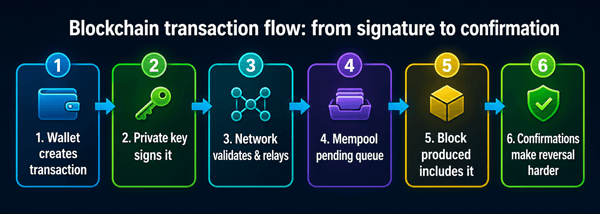
A blockchain transaction is a signed instruction that asks a blockchain network to update its shared record. In simple terms, your wallet prepares a message, your private key signs it, the transaction is broadcast to nodes, nodes check whether it follows the rules, it waits in a pending area, a miner or validator includes it in a block, and later blocks or finality rules make it harder to reverse.
- You enter the recipient address, amount, and fee settings in your wallet.
- Your wallet creates the transaction data.
- Your private key signs the transaction locally. The key should not leave your wallet.
- The signed transaction is broadcast to the peer-to-peer network.
- Nodes validate it and usually place it in their mempool or transaction pool.
- A block producer selects it, includes it in a block, and broadcasts that block.
- Other nodes verify the block. The transaction gets its first confirmation.
- More confirmations or protocol finality make the transaction increasingly settled.
2. What Is a Blockchain Transaction?
A blockchain transaction is not a physical movement of coins. It is a digitally signed instruction recorded by a decentralized network. The network updates its ledger to show who can spend which assets next, or how a smart contract state has changed.
On Bitcoin, a transaction usually spends previous unspent outputs, called UTXOs, and creates new outputs. The Bitcoin developer documentation explains that each transaction has at least one input and one output, and wallet balances are really the sum of spendable UTXOs. On Ethereum, a transaction is a cryptographically signed instruction from an account that changes the state of the Ethereum network, such as transferring ETH or calling a smart contract.
| Everyday analogy | Blockchain version |
|---|---|
| Writing a check | You authorize a payment with a signature. |
| Mailing the check | Your wallet broadcasts the signed transaction. |
| Bank verifies funds and signature | Nodes verify rules, balance, signature, fee, nonce or UTXOs. |
| Payment clears | The transaction is included in a block and receives confirmations or finality. |
3. The Main Parts of a Transaction
Different blockchains use different transaction formats, but most include the same basic ideas: sender authorization, recipient details, value, fees, and replay protection. Understanding these parts makes wallet pop-ups and block explorers much easier to read.
| Part | Plain-English meaning | Why it matters |
|---|---|---|
| Sender | The account or previous coins being spent. | Shows where the value is coming from. |
| Recipient | The address, contract, or output receiving value. | A wrong address usually cannot be reversed. |
| Amount/value | How much asset is being transferred. | This may be native coin, token amount, or zero for some contract calls. |
| Fee | Payment to include and process the transaction. | Higher fees can improve inclusion during congestion. |
| Signature | Proof that the owner authorized the transaction. | Prevents others from spending your assets. |
| Nonce or UTXO reference | Ordering or source reference. | Prevents replay or double spending. |
| Data/input | Optional instructions for a smart contract. | Can trigger swaps, approvals, mints, votes, or other actions. |
4. Step 1: Your Wallet Builds the Transaction
A wallet is not just an app that shows a balance. It is transaction-building software. When you click Send, the wallet gathers the required details and prepares a transaction for the specific blockchain you are using.
4.1 Example: Sending Bitcoin
Suppose Alice wants to send Bob 0.01 BTC. Alice’s wallet looks for enough UTXOs under Alice’s control, creates one output for Bob, often creates a second “change” output back to Alice, and chooses a transaction fee. If Alice has one UTXO worth 0.015 BTC, the transaction might create:
- 0.01 BTC output to Bob.
- 0.0049 BTC change output back to Alice.
- 0.0001 BTC transaction fee.
This is similar to paying for a $10 item with a $20 bill and receiving change. Bitcoin does not spend part of a UTXO; it spends the whole referenced output and creates new outputs.
4.2 Example: Sending ETH
On Ethereum, Bob’s account balance is stored as part of the network state. If Bob sends Alice 1 ETH, the transaction includes fields such as from, to, value, nonce, gas limit, fee settings, and signature. The nonce is a sequential transaction counter for that sender, which helps the network order transactions and avoid replay issues.
5. Step 2: Your Private Key Signs the Transaction
The signature is the authorization layer. Your private key signs the transaction data and proves that the transaction came from the asset owner. The important point for beginners is this: signing is not the same as sending your private key. A well-designed wallet uses your private key locally to produce a cryptographic signature, but the key itself should remain secret.
A valid signature tells the network two things:
- The transaction was authorized by whoever controls the private key.
- The signed parts of the transaction have not been changed after signing.
This is why wallet security matters so much. Anyone who controls your private key or seed phrase can create valid signatures and move your assets. The blockchain will see those signatures as authorized, even if the person using them stole the key.
6. Step 3: The Signed Transaction Is Broadcast to the Network
After signing, your wallet sends the transaction to a node. That node checks the transaction and, if it passes policy and consensus-related checks, relays it to other nodes. The transaction spreads across the peer-to-peer network like a message being passed between many independent computers.
Broadcasting does not mean the transaction is final. It means the network has heard about it. At this stage, the transaction is usually pending.
7. Step 4: Nodes Validate the Transaction Before Relaying It
Nodes do not blindly accept everything they receive. They run validation checks before keeping or forwarding a transaction. The exact checks vary by blockchain, but they commonly include:
- Is the signature valid?
- Does the sender have enough spendable balance or valid UTXOs?
- Is the transaction format correct?
- Is the fee high enough for the node’s policy?
- Is the nonce correct, or are the referenced UTXOs unspent?
- Does the transaction avoid violating consensus rules?
This decentralized validation is one reason blockchains can operate without a central payment processor. Many independent participants check the same rules.
8. Step 5: The Transaction Waits in the Mempool or Transaction Pool
A mempool, short for memory pool, is a node’s local collection of valid transactions that have not yet been included in a block. It is not one single global waiting room. Each node maintains its own view, so mempools can differ slightly across the network.
When the network is quiet, transactions may be included quickly. When demand is high, many transactions compete for limited block space. Block producers usually prefer transactions that pay better fees relative to the resources they consume.
| Status | What it means | What you can do |
|---|---|---|
| Pending | Broadcast but not yet in a block. | Wait, check fee conditions, or use wallet speed-up features if available. |
| Dropped | No longer widely held in mempools. | Rebroadcast or create a replacement if your wallet supports it. |
| Failed | Included but execution failed, common with smart contracts. | Review the reason; fees may still be spent for attempted execution. |
| Confirmed | Included in a block. | Wait for more confirmations if the amount or risk is high. |
9. Step 6: A Miner or Validator Includes the Transaction in a Block
A block producer chooses pending transactions, packages them into a block, and proposes that block to the network. The name of the block producer depends on the consensus mechanism:
- In proof-of-work systems such as Bitcoin, miners compete to create valid blocks.
- In proof-of-stake systems such as Ethereum, validators propose and attest to blocks according to protocol rules.
In both cases, the block is not trusted merely because one participant proposed it. Other nodes verify the block independently. If the block follows the rules, nodes add it to their copy of the blockchain.
10. Step 7: The First Confirmation Happens
A transaction receives its first confirmation when it is included in a valid block. In many wallets and block explorers, “1 confirmation” means the transaction is in the latest accepted block.
However, one confirmation is not the same as absolute finality on every chain. A newly created block can sometimes be replaced by a competing block, a process often called a reorganization or reorg. The risk depends on the blockchain, network conditions, the value being transferred, and the consensus design.
11. Step 8: More Confirmations or Finality Increase Settlement Confidence
Confirmations are like layers of history built on top of your transaction. On Bitcoin, each new block after the block containing your transaction adds another confirmation. Reversing the transaction would require replacing that block and the blocks after it, which generally becomes harder as more blocks are added.
Ethereum uses proof-of-stake finality. A transaction becomes more secure as its block is justified and finalized. Ethereum documentation describes finality as a state where a block cannot be changed without a large amount of ETH being burned through slashing. In normal use, wallets and exchanges may still show simple confirmation counts, but finality has a specific meaning in the protocol.
| Term | Beginner meaning | Important nuance |
|---|---|---|
| Broadcast | The network has received the transaction. | Not confirmed yet. |
| Pending | Valid-looking transaction waiting for block inclusion. | Can be delayed, replaced, or dropped depending on chain and wallet features. |
| Confirmed | Included in a block. | Usually good for small transfers, but risk tolerance matters. |
| Finalized | Protocol-level settlement is extremely hard or economically costly to reverse. | Meaning differs by blockchain. |
12. How Fees Work
Fees are the market price for block space and computation. They are not usually based on the dollar amount being transferred. Sending $10 and sending $10,000 can cost the same if the transaction uses the same amount of block space and computation.
12.1 Bitcoin fees
Bitcoin fees are often discussed as satoshis per virtual byte. A transaction with more inputs is usually larger and may cost more to confirm quickly. Spending many small UTXOs can be more expensive than spending one larger UTXO because the transaction data is bigger.
12.2 Ethereum fees
Ethereum fees are based on gas, which measures computational work. A simple ETH transfer uses far less gas than a complex smart contract interaction. Modern Ethereum transactions commonly include a base fee and a priority fee. The base fee is burned, while the priority fee is the tip that helps incentivize inclusion.
| Fee misconception | Reality |
|---|---|
| “The fee depends only on how much money I send.” | Usually false. Fees depend on data size, computation, congestion, and fee settings. |
| “A high fee guarantees instant confirmation.” | It improves priority but cannot guarantee timing during abnormal network conditions. |
| “If a smart contract transaction fails, I always get all fees back.” | Often false. You may still pay for computation already performed. |
| “Wallet fee estimates are perfect.” | They are estimates. Conditions can change quickly. |
13. What Can Go Wrong?
| Problem | What happens | How to reduce the risk |
|---|---|---|
| Wrong address | Funds may go to an address you do not control. | Copy carefully, use address books, verify hardware wallet screens, send a small test for large transfers. |
| Wrong network | Tokens may arrive on a different chain or be hard to recover. | Confirm the network in wallet and exchange before sending. |
| Low fee | Transaction may remain pending for a long time. | Use recommended fee settings; learn speed-up or replace features. |
| Blind signing | You approve data you do not understand. | Use trusted apps, clear-signing wallets, and read transaction previews carefully. |
| Malicious approval | A token approval may allow a contract to spend your tokens later. | Limit approvals, revoke unused approvals, avoid suspicious dApps. |
| Seed phrase compromise | Attacker can sign transactions as you. | Never type seed phrases into websites; store offline; use hardware wallets for larger amounts. |
14. Blockchain Transaction Pros and Cons
| Benefits | Limitations |
|---|---|
| User-controlled authorization through private keys. | Lost or stolen keys can mean lost assets. |
| Transparent public verification on most public chains. | Privacy can be weaker than beginners expect. |
| No central bank or card processor is required for settlement. | Fees and confirmation times vary with demand. |
| Transactions can interact with programmable smart contracts. | Smart contracts can contain bugs or malicious logic. |
| Final settlement can be strong after confirmations or finality. | Mistakes are often irreversible. |
15. How to Read a Blockchain Explorer
A block explorer is like a public search engine for blockchain data. Paste a transaction hash into an explorer and you can usually see:
- Transaction hash or ID.
- Status: pending, confirmed, failed, or finalized depending on explorer and chain.
- Sender and recipient addresses.
- Amount transferred.
- Fee paid.
- Block number and timestamp.
- Number of confirmations.
- Smart contract logs or token transfers, if applicable.
Be careful: explorers show on-chain facts, but they do not always explain the human meaning of a transaction. A token approval, bridge deposit, NFT transfer, or decentralized exchange swap may require reading logs and contract interactions, not just the visible value field.
16. Best Practices Before You Click Send
- Verify the recipient address on the wallet screen, not only on your computer clipboard.
- Check the network: Ethereum, Bitcoin, BNB Smart Chain, Polygon, Solana, and others are not interchangeable.
- Use a small test transaction for large or unfamiliar transfers.
- Keep enough native coin for fees, such as ETH for Ethereum gas or BTC for Bitcoin fees.
- Do not sign messages or transactions you do not understand.
- Use hardware wallets for meaningful amounts.
- Bookmark official dApp URLs instead of trusting search ads or random links.
- Review token approvals and revoke unlimited approvals you no longer need.
- Do not share your seed phrase, private key, or wallet backup with anyone.
17. Common Misconceptions About Blockchain Transactions
17.1 “My coins travel through the internet like files.”
Not exactly. A blockchain transaction updates who has the right to spend assets according to the ledger. Coins do not move as files from one phone to another.
17.2 “A pending transaction means my money is gone.”
Not necessarily. Pending means the transaction has not yet been included in a block. Depending on the chain, it may confirm, be replaced, expire from mempools, or need action from your wallet.
17.3 “One confirmation always means final forever.”
Not on every chain and not for every risk level. One confirmation is usually enough for low-risk activity on many networks, but larger transfers often require more confirmations or explicit finality.
17.4 “A smart contract approval is harmless because no tokens moved yet.”
False. A token approval can grant future spending permission. Unlimited approvals to malicious contracts are a common source of losses.
18. Beginner Scenario: Buying an NFT or Swapping a Token
Imagine you use a decentralized exchange to swap Token A for Token B. The process may involve more than one transaction:
1. Approval transaction: You allow the exchange contract to spend Token A.
2. Swap transaction: You instruct the contract to trade Token A for Token B.
3. Confirmation: The transaction enters a block and token balances update.
4. Explorer review: You check logs to confirm the token transfer and fee.
This is why smart contract transactions can feel more complicated than a simple transfer. You are not only sending value; you may be giving instructions to code that can move tokens, mint assets, borrow funds, or interact with other contracts.
19. FAQs About Blockchain Transactions
19.1 What is a blockchain transaction in simple words?
It is a signed instruction that tells a blockchain network to update its ledger, such as sending coins, transferring tokens, or interacting with a smart contract.
19.2 Does my wallet send my private key to the blockchain?
No. A proper wallet uses your private key locally to create a signature. The signature is shared, but the private key should remain secret.
19.3 Can a confirmed blockchain transaction be reversed?
Usually not by a customer support team or bank-like authority. However, very recent blocks on some chains can be reorganized. Finality rules and more confirmations reduce this risk.
19.4 Why is my transaction pending?
Common reasons include low fees, network congestion, nonce issues, wallet connection problems, or a transaction that has not propagated well across nodes.
19.5 What is a transaction hash?
A transaction hash, or transaction ID, is a unique identifier created from transaction data. You can use it to search for the transaction in a block explorer.
19.6 What is the difference between confirmation and finality?
A confirmation usually means the transaction is in a block. Finality means the protocol considers that block extremely difficult or economically costly to reverse. The exact meaning differs by chain.
19.7 Do I pay fees if a transaction fails?
On smart contract chains, often yes. If the network executed part of the transaction before it failed, you may still pay for the computational work.
19.8 Can I cancel a blockchain transaction?
Sometimes, if it is still pending and the chain and wallet support replacement or cancellation. Once confirmed or finalized, cancellation is usually not possible.
19.9 Why do exchanges require several confirmations?
They manage risk. More confirmations reduce the chance that a deposit disappears because of a reorg or other chain event.
19.10 Are blockchain transactions anonymous?
Most public blockchains are pseudonymous, not fully anonymous. Addresses do not automatically show real names, but transaction histories are often public and can sometimes be linked to identities.
20. Key Takeaways
- A blockchain transaction is a signed instruction, not a physical movement of digital coins.
- Your wallet builds and signs the transaction; nodes validate it; block producers include it in blocks.
- Pending means broadcast but not yet confirmed.
- Confirmed means included in a block; finality means much stronger settlement assurance, depending on the chain.
- Fees pay for block space and computation, not simply the amount transferred.
- The biggest beginner risks are wrong addresses, wrong networks, malicious approvals, and seed phrase compromise.
Sources Consulted and Checked
These sources were consulted and checked while preparing this document to support accuracy and clarity.
- Bitcoin Developer Guide: Transactions
- Bitcoin Developer Guide: Block Chain
- Ethereum.org: Transactions
- Ethereum.org: Proof-of-Stake
Reader Advice
This article is provided for educational and informational purposes only and is not personalized investment, tax, legal, financial, or technical advice or a recommendation to use any asset, wallet, platform, or blockchain. Blockchain transactions may be irreversible and can involve loss from wrong addresses or networks, fees, delays, software or smart-contract faults, scams, compromised keys, and changing market or protocol conditions. Rules, policies, laws, fees, network behavior, and statistics can change over time and vary by region, platform, and blockchain. Before acting, verify transaction details in your own wallet, consult current official documentation and applicable local requirements, and seek qualified professional advice where appropriate.