On-Chain vs Off-Chain Transactions: Meaning, Differences and Examples
1. Quick Answer
An on-chain transaction is recorded directly on a blockchain, such as Bitcoin or Ethereum. It is validated by the network, included in a block, and becomes part of the public ledger. An off-chain transaction happens outside the main blockchain. It may use a payment channel, an exchange internal ledger, a Layer 2 network, or a private agreement, and only the final result or proof may later be settled on-chain.
| In simple terms | Meaning |
|---|---|
| On-chain transaction | A transaction written directly to the blockchain and visible on the public ledger. |
| Off-chain transaction | A transaction handled outside the base blockchain, often for speed, lower cost, privacy, or scalability. |
2. Why This Topic Matters
When people first learn about crypto, they often assume every transfer is automatically recorded on the blockchain. That is not always true. Some transactions are fully on-chain, while others are processed off-chain and may never appear as an individual blockchain transaction. Understanding the difference helps you estimate fees, avoid delays, choose safer wallets or platforms, and know what kind of proof you actually have.
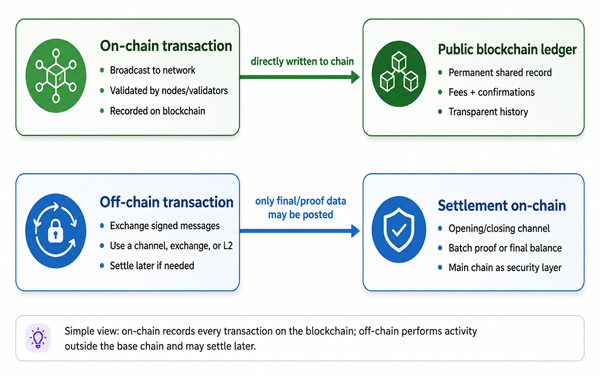
Figure 1: On-chain transactions are recorded directly on the blockchain. Off-chain transactions happen outside the base chain and may later settle final data on-chain.
3. What Is an On-Chain Transaction?
An on-chain transaction is a transaction that is broadcast to a blockchain network and recorded in a block. Once confirmed, it becomes part of the blockchain history. Anyone using a block explorer can usually see the transaction hash, addresses involved, amount, time, fee, and confirmation status, although the real-world identities behind addresses are not automatically visible.
For example, if you send Bitcoin from your self-custody wallet to another Bitcoin address and the transaction appears on a Bitcoin block explorer, that is an on-chain transaction. If you send ETH from one Ethereum wallet to another and it is included in an Ethereum block, that is also on-chain.
3.1 How On-Chain Transactions Work
- You create a transaction in your wallet, such as sending 0.05 BTC or 1 ETH.
- Your wallet signs the transaction with your private key. This proves authorization without revealing the private key.
- The transaction is broadcast to the peer-to-peer network.
- Nodes check whether the transaction follows the rules, such as whether the funds exist and the signature is valid.
- A miner or validator includes the transaction in a block.
- The block is added to the blockchain. As more blocks are added after it, the transaction gains more confirmations.
On Bitcoin, transactions spend previous unspent outputs, often called UTXOs. On Ethereum, transactions are signed instructions from an account that update the network state, such as transferring ETH or interacting with a smart contract. Ethereum transactions also require gas, which pays for computation and network resources.
3.2 Examples of On-Chain Transactions
- Sending BTC from a hardware wallet to a friend’s Bitcoin address.
- Sending ETH from MetaMask to another Ethereum address.
- Minting an NFT directly on Ethereum mainnet.
- Swapping tokens on a decentralized exchange when the swap is executed on the blockchain.
- Depositing crypto from your wallet to an exchange address, if the deposit is visible on-chain.
- Opening or closing a payment channel when the channel action is recorded on the base blockchain.
3.3 Benefits of On-Chain Transactions
- Strong transparency: transactions can usually be verified through public block explorers.
- No need to trust a single company to keep the ledger correctly.
- Good audit trail for deposits, withdrawals, and settlement.
- Useful for high-value transfers where settlement certainty matters more than speed or cost.
- Can interact directly with smart contracts and decentralized applications.
3.4 Limitations and Risks of On-Chain Transactions
- Fees can rise when the network is busy.
- Confirmation can take time, especially if the fee is too low.
- Most public blockchains are transparent, so privacy is limited.
- Mistakes are hard to reverse. Sending funds to the wrong address can be permanent.
- Small payments can become impractical when fees are high.
4. What Is an Off-Chain Transaction?
An off-chain transaction is a transfer or activity that happens outside the base blockchain. It may still be connected to a blockchain system, but the individual transaction is not written directly to the main chain at the moment it happens. Instead, the transaction may be recorded in a payment channel, an exchange database, a Layer 2 network, or another external system.
Off-chain does not automatically mean unsafe or fake. It simply means the transaction is not individually posted to the base blockchain. The safety depends on how the off-chain system is designed, who controls it, and whether users can enforce the result on-chain if something goes wrong.
4.1 How Off-Chain Transactions Work
There are several off-chain models. The details vary, but most use one of these approaches:
- Payment channels: Two or more parties lock funds on-chain, then exchange many signed updates privately. Only the opening and closing transactions may be posted on-chain.
- Layer 2 networks: Transactions happen on a separate network or protocol that uses the main chain for settlement, security, or dispute resolution.
- Exchange internal transfers: A centralized exchange updates balances inside its own database. No blockchain transaction occurs until a user deposits or withdraws.
- Custodial wallet transfers: A provider moves balances between users internally, similar to how a bank or payment app updates account balances.
- Private agreements: Two parties agree that value has changed hands without immediately updating a blockchain. This is more trust-based and less suitable when proof is important.
4.2 Examples of Off-Chain Transactions
- A Bitcoin Lightning Network payment for a coffee, where the payment is routed through payment channels instead of being written as a separate Bitcoin transaction.
- A transfer between two users of the same centralized crypto exchange, where the exchange updates both users’ balances internally.
- A Layer 2 transaction that is processed away from Ethereum mainnet and later settled or proven on Ethereum.
- A gaming app that records many small in-game item transfers off-chain and only settles important results on-chain.
- Two traders using a payment channel to make many rapid transfers, then closing the channel with one final on-chain settlement.
4.3 Benefits of Off-Chain Transactions
- Usually faster because every transaction does not wait for a base-chain block.
- Often cheaper because many actions can be bundled, netted, or kept outside the base chain.
- Better for micropayments, gaming, streaming payments, and high-frequency activity.
- Can improve privacy because not every individual action is publicly visible on the base chain.
- Can reduce congestion on the main blockchain.
4.4 Limitations and Risks of Off-Chain Transactions
- You may need to trust an operator, exchange, wallet provider, or network design.
- The transaction may be harder to verify on a public block explorer.
- Some systems have liquidity limits, routing failures, withdrawal delays, or bridge risks.
- If a centralized platform fails, freezes withdrawals, or is hacked, users may be affected.
- The final settlement may still require on-chain fees and time.
5. On-Chain vs Off-Chain Transactions: Key Differences
| Feature | On-chain transaction | Off-chain transaction |
|---|---|---|
| Where it happens | Directly on the blockchain | Outside the base blockchain |
| Public visibility | Usually visible on a block explorer | May be private, internal, or only partially visible |
| Speed | Depends on block time and confirmations | Often near-instant or faster than base chain |
| Cost | Pays base-chain transaction fees | Often lower per transaction, but may have service, routing, or settlement fees |
| Trust model | Relies mainly on blockchain consensus and wallet security | May rely on channels, operators, contracts, or custodians |
| Finality | Strong after confirmations/finality | Depends on system; may need later on-chain settlement |
| Best for | Large transfers, public settlement, smart contract execution, auditability | Micropayments, frequent transfers, gaming, exchange transfers, scaling |
| Main risk | High fees, delays, public traceability, irreversible mistakes | Counterparty, custody, liquidity, bridge, or operator risk |
6. Simple Real-World Scenarios
6.1 Scenario 1: Sending Bitcoin to a Friend
You send BTC from your own wallet to your friend’s Bitcoin address. The transaction is broadcast, mined into a block, and later shows confirmations. This is on-chain. It is easy to verify, but the fee and waiting time depend on network conditions.
6.2 Scenario 2: Buying Coffee with Bitcoin Lightning
You pay a coffee shop using the Lightning Network. The payment happens through payment channels. The coffee shop receives the payment quickly, and the individual coffee purchase is not recorded as a separate Bitcoin base-layer transaction. This is off-chain, although channel opening and closing can involve on-chain Bitcoin transactions.
6.3 Scenario 3: Moving Funds Inside an Exchange
You send USDT to another user on the same centralized exchange. The exchange may simply debit your account and credit the other user’s account in its internal database. That transfer is off-chain. A real on-chain transaction happens only when funds are deposited to or withdrawn from the exchange.
6.4 Scenario 4: Using Ethereum Mainnet vs a Layer 2
If you swap tokens directly on Ethereum mainnet, the transaction is on-chain on Ethereum. If you swap on a Layer 2 network, the transaction may be processed on the Layer 2 and later settled, posted, or proven to Ethereum in batches. From the user’s perspective it can feel similar, but the technical settlement path is different.
7. Pros and Cons Summary
| Type | Pros | Cons |
|---|---|---|
| On-chain | Transparent, independently verifiable, strong settlement, works directly with blockchain rules and smart contracts. | Can be slower, more expensive during congestion, public, and usually irreversible. |
| Off-chain | Fast, low-cost, scalable, useful for small or frequent transactions, can improve privacy. | May require more trust, may be harder to audit, can introduce liquidity, custody, bridge, or operator risks. |
8. Common Misconceptions
- Misconception: Off-chain means it is not crypto. Reality: Many off-chain systems are built around crypto assets and may use cryptographic signatures, smart contracts, or later on-chain settlement.
- Misconception: On-chain is always safer. Reality: On-chain settlement is powerful, but users can still lose funds through wrong addresses, scams, malicious contracts, or poor wallet security.
- Misconception: Off-chain is always centralized. Reality: Some off-chain systems are custodial, but others, such as payment channels and certain Layer 2 designs, can be non-custodial or trust-minimized.
- Misconception: If a transfer is not on a block explorer, it did not happen. Reality: It may have happened inside an exchange, wallet provider, payment channel, or Layer 2 system. The proof is different.
- Misconception: Lower fees always mean better. Reality: Lower fees are useful, but you should also consider withdrawal rules, security assumptions, liquidity, and whether you can verify or recover funds.
9. How to Decide Which One to Use
| Your goal | Better choice | Why |
|---|---|---|
| Sending a large amount to long-term storage | On-chain | You usually want direct settlement and a clear audit trail. |
| Paying for small everyday purchases | Off-chain | Lower fees and faster payment experience are more practical. |
| Moving money between your own self-custody wallets | On-chain | You control the transaction and can verify it publicly. |
| Trading frequently on one exchange | Off-chain inside the exchange | Internal transfers and trades are faster, but you accept custody risk. |
| Using DeFi directly on mainnet | On-chain | Smart contract interaction is executed on the chain itself. |
| Gaming, social apps, or micro-rewards | Off-chain or Layer 2 | High-frequency small actions are usually too expensive for the base chain. |
10. Best Practices for Beginners
- Check the network before sending. BTC, Ethereum, Tron, Solana, Arbitrum, and other networks are not interchangeable by default.
- For on-chain transactions, confirm the address, network, fee, and amount before signing. A small test transaction can be wise for large transfers.
- Use a block explorer to verify on-chain deposits and withdrawals. Search by transaction hash, not just by address if possible.
- For off-chain transfers, understand who controls the funds. If an exchange or app is holding the assets, you have platform risk.
- Do not assume “instant” means final. Some systems show a fast balance update before final settlement is complete.
- Keep records. Save transaction hashes for on-chain transfers and receipts, order IDs, or internal transfer references for off-chain transfers.
- Be careful with bridges and Layer 2 withdrawals. Read withdrawal times, supported networks, fees, and security model before moving funds.
- Avoid signing unclear transactions. On Ethereum and similar chains, malicious approvals can drain tokens even if the transfer amount looks small.
11. Security and Privacy Considerations
On-chain transactions are transparent by design. This transparency helps verification, but it can reveal patterns. If the same address is reused, observers may connect multiple payments to one wallet. Off-chain systems may expose less public information, but they can expose information to the platform, routing nodes, or service provider depending on the design.
From a security perspective, the key question is not only “on-chain or off-chain?” It is also: Who can block, reverse, delay, censor, or lose this transaction? With on-chain self-custody, your main risks are private key security and transaction mistakes. With custodial off-chain systems, your main risks include platform solvency, account freezes, hacks, and withdrawal restrictions. With non-custodial Layer 2 systems, risks may include smart contract bugs, bridge design, proof systems, sequencer behavior, and withdrawal mechanics.
12. On-Chain and Off-Chain Are Often Used Together
Many blockchain systems combine both methods. A payment channel may open with an on-chain transaction, process hundreds of off-chain payments, and close with one final on-chain settlement. A Layer 2 may process many user transactions off-chain or on a separate execution layer, then post data, proofs, or settlement results to a base chain. A centralized exchange may receive your on-chain deposit, let you trade internally off-chain, and then send an on-chain withdrawal when you move funds out.
This is why the best question is not always “Which is better?” A better question is: “Which method fits this specific use case, amount, risk level, and need for verification?”
13. FAQs About On-Chain and Off-Chain Transactions
13.1 Is an on-chain transaction the same as a blockchain transaction?
Yes. In most everyday crypto discussions, an on-chain transaction means a blockchain transaction that is recorded directly on the chain.
13.2 Can an off-chain transaction be reversed?
It depends on the system. A centralized exchange may reverse or freeze internal transfers under its rules. A payment channel or Layer 2 may have different dispute and settlement rules. Once funds are finally settled on-chain, reversal is usually much harder.
13.3 Why are on-chain transactions sometimes expensive?
Fees rise when many users compete for limited block space. On Ethereum, users pay gas for computation and block inclusion. On Bitcoin, users pay transaction fees to incentivize miners to include their transaction.
13.4 Are off-chain transactions always free?
No. They are often cheaper, but they may still have routing fees, platform fees, spread costs, withdrawal fees, or later settlement fees.
13.5 Can I see an off-chain transaction on a block explorer?
Usually not as an individual base-chain transaction. You may only see related deposits, withdrawals, channel opens or closes, batch settlements, or proofs.
13.6 Which is safer: on-chain or off-chain?
Neither is automatically safer in every situation. On-chain gives direct public settlement, but user mistakes are permanent. Off-chain can be faster and cheaper, but safety depends on custody, protocol design, liquidity, and settlement guarantees.
13.7 What is a transaction hash?
A transaction hash, or txid, is a unique identifier for an on-chain transaction. It lets you look up the transaction on a block explorer.
13.8 Does Layer 2 mean off-chain?
Often, yes in a broad beginner sense, because activity is not processed directly as individual base-chain transactions. However, Layer 2 designs vary. Some post transaction data, proofs, or settlement information to the base chain.
13.9 When should beginners use on-chain transactions?
Use on-chain transactions when you need direct settlement, self-custody, public verification, or long-term storage. Always double-check addresses and networks.
13.10 When should beginners use off-chain transactions?
Use off-chain methods for small, frequent, or speed-sensitive transfers, but only after understanding who controls the funds and how withdrawals or settlement work.
14. Key Takeaways
- On-chain transactions are recorded directly on the blockchain and are usually publicly verifiable.
- Off-chain transactions happen outside the base blockchain and may use channels, exchanges, custodial systems, or Layer 2 networks.
- On-chain is better for settlement, transparency, and auditability; off-chain is often better for speed, cost, and scale.
- The best choice depends on amount, urgency, trust assumptions, privacy needs, and whether you need public proof.
- Beginners should always verify the network, address, fees, custody model, and withdrawal rules before moving funds.
Sources Consulted and Checked
The following sources were consulted and checked while preparing this article and reviewing its accuracy:
- Bitcoin Developer Guide: Transactions - explains Bitcoin transaction inputs, outputs, UTXOs, signatures, and validation.
- Ethereum.org Developer Docs: Transactions - explains Ethereum transactions as signed instructions that update network state.
- Ethereum.org Developer Docs: Gas and Fees - explains gas, gas fees, base fee, priority fee, and gas limits.
- The Bitcoin Lightning Network whitepaper by Joseph Poon and Thaddeus Dryja - explains payment channels and Lightning’s off-chain payment design.
Reader Advice
This article is provided for educational and informational purposes only and is not personalized financial, legal, tax, investment, or security advice or a recommendation to use any particular blockchain, wallet, exchange, Layer 2 network, bridge, or transaction method. Blockchain rules, platform policies, fees, technical features, laws, regulations, and statistics can change over time and may vary by country or region, so readers should verify current details through official sources before making a decision. Crypto transactions may involve irreversible errors, price volatility, custody failures, smart-contract or bridge vulnerabilities, privacy exposure, fraud, network delays, and loss of funds. Consider your circumstances, use appropriate security precautions, and seek qualified professional advice where needed.