Blocks, Hashes and Merkle Trees Explained for Blockchain Beginners
Quick answer: A blockchain block is a package of data, a hash is a fixed-length digital fingerprint of data, and a Merkle tree is a tree-shaped structure that summarizes many transactions into one compact value called the Merkle root. Together, they help blockchains make records difficult to alter, easy to verify, and efficient to share across many computers.
1. Introduction: Why These Three Ideas Matter
Blockchain can sound complicated because it mixes computer science, cryptography, networking, and economics. But three ideas explain a large part of how blockchain data works: blocks, hashes, and Merkle trees. If you understand these, you can understand why people describe blockchains as tamper-evident ledgers.
A normal database can store records and update them whenever an administrator or application has permission. A blockchain is different. It stores records in blocks, links those blocks together with hashes, and usually distributes copies of the ledger across many participants. This does not make blockchain magic or automatically trustworthy, but it does make certain types of changes easy to detect.
2. The Big Picture in One Simple Example
Imagine a shared notebook used by a group of people. Every page records several payments. At the bottom of each page, the group writes a special fingerprint of that page. On the next page, they copy the previous page fingerprint before adding new payments. If someone changes an old payment, the fingerprint on that page changes, which also makes the next page wrong, and then the next one, and so on.
That is the basic idea behind blocks and hashes. Merkle trees add another useful trick: instead of checking every payment on a page one by one, you can use a short proof to show that a specific payment is included in that page.
3. Blocks, Hashes, and Merkle Trees: Beginner Definitions
| Concept | Plain-English meaning | Blockchain role | Simple analogy |
|---|---|---|---|
| Block | A container that groups transactions or records. | Stores data plus metadata such as a timestamp, previous block hash, and Merkle root. | A page in a ledger. |
| Hash | A fixed-length fingerprint created from data. | Links blocks and detects changes in data. | A tamper-evident seal. |
| Merkle tree | A tree of hashes that summarizes many pieces of data into one root hash. | Lets networks verify transaction inclusion efficiently. | A contents summary that can prove one item is inside. |
4. What Is a Block in Blockchain?
A block is a structured bundle of information added to a blockchain. The exact format depends on the blockchain, but a block usually contains two broad parts: the block body and the block header.
4.1 What a block usually contains
- Transactions or records: The actual data being added, such as payments, token transfers, smart contract actions, or supply chain events.
- Previous block hash: A reference to the fingerprint of the block before it.
- Merkle root: One compact hash representing all transactions in that block.
- Timestamp: A time value showing roughly when the block was created or proposed.
- Consensus-related fields: Data used by the network to decide whether the block is valid. In Bitcoin this includes proof-of-work fields such as the nonce and difficulty target.
4.2 How blocks form a chain
Each new block includes the hash of the previous block. This creates a chain of references. If an old block is changed, its hash changes. Because the next block stored the old hash, the link no longer matches. In a well-designed blockchain network, other nodes reject the altered history unless an attacker can also satisfy the network consensus rules.
5. What Is a Hash?
A hash is the output of a hash function. A hash function takes input data of almost any size and turns it into a fixed-length string of characters. For blockchain beginners, the most useful way to think of a hash is as a digital fingerprint.
5.1 Example: the avalanche effect
A tiny change in input should produce a very different hash. For example, these two sentences look almost the same:
- Majid sends 1 coin to Sara.
- Majid sends 2 coins to Sara.
A secure cryptographic hash function should produce completely different outputs for those two inputs. This is called the avalanche effect. It is why hashes are useful for detecting changes.
5.2 Important properties of cryptographic hashes
| Property | What it means | Why beginners should care |
|---|---|---|
| Deterministic | The same input always gives the same hash. | Everyone can independently verify the same data. |
| Fixed length | Outputs have the same length even if inputs are different sizes. | A block can store a compact fingerprint instead of all referenced data. |
| Fast to compute | Computers can calculate the hash quickly. | Nodes can verify data efficiently. |
| One-way | It should be infeasible to reconstruct the input from the hash. | A hash is not encryption and cannot be decrypted. |
| Collision resistant | It should be infeasible to find two different inputs with the same hash. | This protects the integrity of blockchain records. |
| Sensitive to change | A small input change causes a very different output. | Tampering becomes easy to notice. |
5.3 Hashing is not the same as encryption
This is a common beginner mistake. Encryption hides data so it can later be decrypted with a key. Hashing creates a fingerprint that is not meant to be reversed. If someone says a blockchain hash can be decrypted, that is usually a sign they are mixing up two different ideas.
6. What Is a Merkle Tree?
A Merkle tree, also called a hash tree, is a structure that combines many hashes into one final hash called the Merkle root. The leaves at the bottom are hashes of individual transactions or data items. Parent nodes are created by combining child hashes and hashing the result again. This continues until only one hash remains at the top.
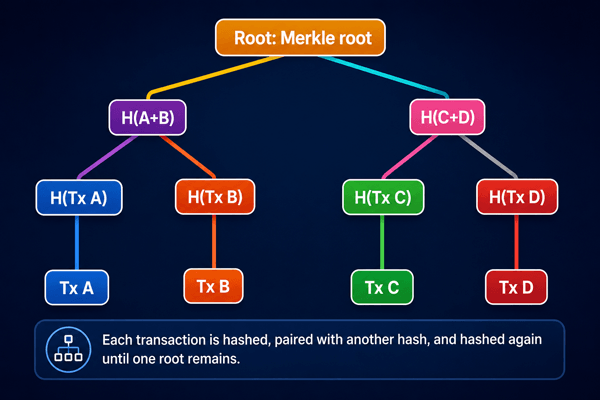
Figure: A simplified Merkle tree for four transactions. Real blockchains may contain many more transactions and may use additional encoding rules.
6.1 Step-by-step Merkle tree example
- Hash each transaction: Tx A becomes H(A), Tx B becomes H(B), and so on.
- Pair neighboring hashes: H(A) is paired with H(B), and H(C) is paired with H(D).
- Hash each pair: H(A+B) and H(C+D) are created.
- Hash the parent hashes together: the result is the Merkle root.
- Store the Merkle root in the block header.
If one transaction changes, its leaf hash changes. That changes its parent hash, then the next parent hash, and finally the Merkle root. Because the Merkle root is stored in the block header, the block no longer matches its original fingerprint.
6.2 Why not just hash all transactions together?
A blockchain could hash all transaction data in one big chunk, but that would be less flexible. A Merkle tree lets a node prove one transaction is included by sharing only a small path of related hashes, often called a Merkle proof or Merkle branch. This is useful for lightweight clients that do not want to download and process every transaction in every block.
7. How Blocks, Hashes, and Merkle Trees Work Together
- Transactions are collected and checked according to the network rules.
- Each transaction is hashed.
- Transaction hashes are combined into a Merkle tree.
- The Merkle root is placed in the block header.
- The block header also includes the previous block hash and other metadata.
- The block hash is calculated from the block header.
- The next block stores that block hash as its previous block hash.
This creates two important commitments: the Merkle root commits to the transactions inside the block, and the previous block hash commits to the history before the current block.
8. Practical Scenario: Verifying a Payment Without Downloading Everything
Suppose Sara wants to check whether a transaction paying her is included in a block. She does not want to download the full block history. A full node can give her a Merkle proof: the transaction hash plus the few neighboring hashes needed to rebuild the Merkle root. Sara calculates the path herself and compares the result with the Merkle root in the block header. If it matches, she has evidence that the transaction is included in that block.
This is powerful, but it is not the same as proving the transaction is final forever. Sara still needs to consider the blockchain’s confirmation rules, network assumptions, and whether the block is part of the accepted chain.
9. Comparison: Blocks vs Hashes vs Merkle Trees
| Question | Block | Hash | Merkle tree | Merkle root |
|---|---|---|---|---|
| What is it? | A container of blockchain data. | A fingerprint of data. | A hierarchy of hashes. | The final top hash. |
| Main job | Group new records. | Detect changes and link data. | Summarize many records efficiently. | Represent all transactions in one compact value. |
| Where it appears | In the blockchain ledger. | In block headers, transaction IDs, addresses, and proofs. | Inside block validation and proof systems. | In the block header. |
| Beginner mistake | Thinking a block is only a transaction. | Thinking a hash is encrypted data. | Thinking it stores transactions directly. | Thinking it proves everything by itself. |
10. Benefits of Using Hashes and Merkle Trees in Blockchain
- Tamper evidence: If old data changes, the related hashes change.
- Efficient verification: A Merkle proof can verify inclusion without sharing every transaction.
- Compact summaries: A Merkle root can represent a large set of transactions in one fixed-size value.
- Distributed checking: Different nodes can independently calculate and compare hashes.
- Better scalability for verification: Lightweight clients can check specific data with less bandwidth than full verification requires.
11. Risks and Limitations Beginners Should Understand
- A hash does not make bad data true. If false information is recorded, hashing only preserves that false information.
- A blockchain is not automatically private. Hashes can hide some details, but transactions may still reveal patterns or metadata.
- Security depends on the whole system. Hash functions are only one part; consensus, node distribution, incentives, software quality, and key management also matter.
- Merkle proofs show inclusion, not necessarily finality. A transaction can be included in a block that later becomes stale or is replaced depending on the chain rules.
- Weak hash functions are dangerous. Modern blockchains use cryptographic hash functions because older or non-cryptographic checksums are not enough for adversarial settings.
- Users can still lose assets. Hashes and blocks do not protect private keys, passwords, seed phrases, or wallets from user error or theft.
12. Common Beginner Misconceptions
12.1 “Blockchain data cannot be changed.”
More accurate: blockchain data is designed to be tamper-evident and difficult to rewrite under the network rules. Whether it is practically changeable depends on the blockchain, validator or miner distribution, consensus model, and economic incentives.
12.2 “A hash stores the original data.”
A hash is a fingerprint, not a compressed copy. You cannot recover the original transaction from the hash alone.
12.3 “Merkle trees are only used in cryptocurrency.”
Merkle-style hash trees are useful in many systems where data integrity and efficient verification matter, including file systems, peer-to-peer networks, version control ideas, transparency logs, and distributed storage.
12.4 “A Merkle root proves a transaction is valid.”
A Merkle root helps prove that a transaction is included in a block. Validity also depends on transaction rules, signatures, balances or state, and consensus acceptance.
13. Best Practices for Beginners Learning or Using Blockchain
- Learn the difference between a transaction hash, block hash, and Merkle root. They are related but not interchangeable.
- When checking a blockchain explorer, look at the block height, block hash, transaction hash, confirmations, and timestamp instead of relying on one value only.
- Do not treat “on-chain” as automatically correct. Verify the source of the data and understand who submitted it.
- For development, use well-reviewed cryptographic libraries. Do not invent your own hash function or Merkle tree rules for production systems.
- When using wallets, focus on private key and seed phrase safety. Blockchain integrity does not protect you from leaking your own keys.
- If building an application, document exactly what your hash commits to: raw data, encoded data, file bytes, transaction fields, or a sorted list of records.
14. Mini Example: Building a Merkle Root by Hand
This simplified example uses short labels instead of real cryptographic hash outputs:
- Transactions: A, B, C, D
- Leaf hashes: H(A), H(B), H(C), H(D)
- Parent hashes: H(H(A) + H(B)) and H(H(C) + H(D))
- Merkle root: H(parent 1 + parent 2)
In real systems, the exact hashing method, byte order, serialization format, and rules for odd numbers of leaves matter. For example, Bitcoin uses double-SHA-256 in parts of its Merkle tree construction and duplicates the last hash at a level if there is an odd number of items.
15. Pros and Cons at a Glance
| Feature | Pros | Cons or cautions |
|---|---|---|
| Block hashes | Create a tamper-evident chain of history. | Do not stop attacks by themselves; consensus rules are needed. |
| Cryptographic hashes | Fast, compact, and excellent for detecting changes. | A hash does not prove the original data was true or legal. |
| Merkle trees | Allow efficient inclusion proofs and compact summaries. | Implementation details matter; proofs can be misunderstood. |
| Distributed verification | Many nodes can independently check the same records. | Full verification can still require storage, bandwidth, and technical knowledge. |
16. FAQs About Blocks, Hashes, and Merkle Trees
16.1 What is a block in blockchain?
A block is a package of transactions or records plus metadata. Blocks are linked together because each block usually includes the hash of the previous block.
16.2 What is a blockchain hash?
A blockchain hash is a fixed-length digital fingerprint of data. It helps identify data and detect whether that data has changed.
16.3 What is a Merkle tree in simple words?
A Merkle tree is a tree of hashes that turns many transaction hashes into one final hash called the Merkle root.
16.4 What is a Merkle root?
The Merkle root is the single top hash of a Merkle tree. It summarizes all transactions or data items included in that tree.
16.5 Why are Merkle trees useful in blockchain?
They make verification more efficient. A user can prove a transaction is included in a block using a small set of hashes instead of downloading every transaction in the block.
16.6 Can a hash be decrypted?
No. Hashing is one-way. Encryption is designed to be decrypted with a key; hashing is designed to create a fingerprint.
16.7 Does a Merkle proof prove a transaction is final?
Not by itself. It helps prove inclusion in a block. Finality depends on the blockchain’s consensus rules and how accepted or confirmed that block is.
16.8 What happens if someone changes a transaction in an old block?
The transaction hash changes, the Merkle root changes, the block hash changes, and the links to later blocks no longer match. A network using proper consensus rules should reject the altered history.
16.9 Do all blockchains use Merkle trees?
No. Many do, but designs vary. Some systems use related structures or different commitment schemes depending on their goals.
16.10 Is blockchain secure only because of hashing?
No. Hashing is important, but blockchain security also depends on consensus design, network participation, cryptographic signatures, software correctness, economics, and user key safety.
17. Final Takeaway
Blocks organize blockchain data. Hashes act as digital fingerprints that link blocks and reveal changes. Merkle trees summarize many transactions into one Merkle root so networks and users can verify inclusion efficiently. These concepts do not make a blockchain perfect, private, or immune to every attack, but they are core building blocks for tamper-evident, distributed ledgers.
Sources Consulted and Checked
These sources were consulted and checked while preparing this article to support clarity and accuracy.
- Bitcoin whitepaper by Satoshi Nakamoto
- Mastering Bitcoin open-source book, blockchain and Merkle tree explanations
- NISTIR 8202: Blockchain Technology Overview
Reader Advice
This article is provided for educational and informational purposes only and is not personalized legal, financial, investment, cybersecurity, or technical advice or a recommendation to use any blockchain, wallet, token, platform, or service. Blockchain rules, network policies, laws, regulations, technical standards, and statistics can change over time and may vary by country or region, so readers should verify important details through current official sources and seek qualified professional advice when appropriate. Blockchain activity can involve technical faults, scams, irreversible transactions, loss of private keys, market volatility, privacy concerns, and loss of funds; carefully assess these risks before making decisions or committing money or sensitive information.