What Is Blockchain? Definition, Examples and How Blockchain Technology Works
Quick definition: A blockchain is a shared digital record book that stores data in blocks, links those blocks together with cryptography, and copies the record across many computers so participants can agree on what happened without relying on one central database owner.
1. What Is Blockchain?
A blockchain is a type of database or ledger that records information in a way that is difficult to secretly change. Instead of keeping one master copy on a single company server, a blockchain usually keeps synchronized copies across many computers called nodes.
The word “blockchain” comes from its basic structure. New records are grouped into blocks. Each block contains data, a timestamp, and a digital fingerprint called a hash. The block also includes the hash of the previous block, which links the blocks together in order. This creates a chain of blocks.
For beginners, the easiest comparison is a shared notebook. Everyone in a group has a copy of the same notebook. When a new page is added, the group checks that the page follows the rules. Once accepted, everyone updates their copy. If one person secretly changes an old page, their notebook no longer matches the others.
2. Blockchain Definition in Simple Terms
Blockchain technology is a system for recording transactions or data across a network of computers, where records are grouped into blocks, secured with cryptography, and confirmed by a shared agreement process called consensus.
In practical terms, blockchain helps answer three important questions: Who owns what? What happened? Can everyone trust the record without trusting one single middleman?
| Term | Simple meaning | Beginner example |
|---|---|---|
| Block | A batch of approved records | A page in a shared notebook |
| Chain | Blocks linked in order | Page 5 points back to page 4 |
| Node | A computer that participates in the network | A person holding a copy of the notebook |
| Hash | A unique digital fingerprint of data | A seal that changes if the page changes |
| Consensus | The method used to agree on valid records | The group checks the rules before adding a page |
| Smart contract | Code that runs when conditions are met | Automatic release of payment after delivery is confirmed |
3. Why Was Blockchain Created?
Blockchain became widely known through Bitcoin, which was introduced in 2008 as a peer-to-peer electronic cash system. The key problem Bitcoin tried to solve was double spending: how can digital money be transferred once, without someone copying and spending the same digital coin again?
Traditionally, banks or payment processors solve that problem by keeping central ledgers. Bitcoin used a public blockchain instead. It allowed many computers to maintain a shared transaction history and agree on which transactions were valid.
Since then, blockchain has expanded beyond cryptocurrency. Some blockchains are used for programmable applications, supply chain tracking, digital identity, tokenized assets, settlement systems, and records shared between organizations.
4. How Blockchain Technology Works Step by Step
Different blockchains use different technical designs, but the basic process is similar.
- A transaction or data entry is created. For example, Alice sends Bob 0.05 BTC, a shipment changes location, or a smart contract records that a condition was met.
- The transaction is broadcast to the network. Participating computers receive the information and check it against the blockchain rules.
- Nodes validate the transaction. They may check digital signatures, account balances, permissions, data format, and whether the same asset has already been spent.
- Valid transactions are grouped into a block. A block usually contains many transactions, a timestamp, the previous block hash, and other technical data.
- The network reaches consensus. The blockchain uses a consensus mechanism, such as proof of work, proof of stake, or a permissioned voting process, to decide which block is accepted.
- The accepted block is added to the chain. Because the new block references the previous block hash, it becomes part of the recorded history.
- Copies of the ledger update across the network. Other nodes store or verify the new block so their version of the ledger stays aligned.
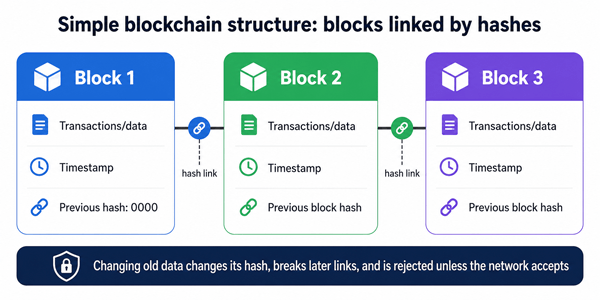
Diagram: A simplified blockchain. Each block contains data and the hash of the previous block, creating a tamper-evident chain.
4.1 What Is a Block?
A block is a container for data. On a cryptocurrency blockchain, a block often contains transactions. On a business blockchain, a block might contain shipment updates, ownership records, or compliance events.
A typical block includes transaction data, a timestamp, the hash of the previous block, and a new hash generated from the current block data. If the data changes, the hash changes too.
4.2 What Is a Hash?
A hash is a fixed-length string created by a cryptographic function. It works like a digital fingerprint. The same input creates the same hash, but even a tiny change in the input creates a very different hash.
Hashes help make blockchain records tamper-evident. If someone changes an older block, its hash changes. Since later blocks store the old hash, the chain breaks unless the attacker also changes later blocks and convinces the network to accept the altered history.
4.3 What Is Consensus?
Consensus is the method a blockchain uses to agree on the valid version of the ledger. Without consensus, different computers could disagree about account balances, ownership, or transaction order.
Public blockchains often use open consensus mechanisms, while private or permissioned systems may use voting or approval among known organizations. Consensus does not make a system perfect, but it helps a distributed network maintain one shared history.
| Consensus method | How it works | Common trade-off |
|---|---|---|
| Proof of work | Miners compete to solve computational puzzles and propose blocks. | Strong security track record for Bitcoin, but energy use can be high. |
| Proof of stake | Validators lock up coins as stake and are selected to propose or confirm blocks. | Lower energy use, but design must manage validator concentration and incentives. |
| Permissioned consensus | Known participants validate blocks using voting or similar rules. | Efficient for organizations, but trust is more centralized than in open public networks. |
5. Public, Private, Permissionless and Permissioned Blockchains
Not all blockchains are open to everyone. A major beginner mistake is assuming every blockchain works like Bitcoin. In reality, blockchains differ in who can read data, who can write data, and who can validate transactions.
| Type | Who can participate? | Best suited for | Example |
|---|---|---|---|
| Public permissionless | Anyone can read, submit transactions, and usually run validating software. | Open networks, cryptocurrency, decentralized apps. | Bitcoin, Ethereum. |
| Public permissioned | Anyone may view some data, but only approved parties validate or write. | Public transparency with controlled governance. | Some government or institutional ledgers. |
| Private permissioned | Only approved users can access and validate. | Business networks, internal records, regulated data sharing. | Enterprise supply chain ledgers. |
| Consortium blockchain | A group of organizations jointly controls access and validation. | Industries where multiple companies need a shared record. | Trade finance or logistics networks. |
6. Blockchain Examples in the Real World
6.1 Cryptocurrency payments
Bitcoin uses blockchain as a public ledger of transactions. Instead of a bank updating a private database, the network verifies and records transfers according to protocol rules.
6.2 Smart contracts and decentralized applications
Ethereum popularized smart contracts: programs stored on a blockchain that execute when conditions are met. A simple example is code that releases funds only after a deadline or a verified event.
6.3 Supply chain tracking
A food company could record when produce was harvested, shipped, inspected, and delivered. If contamination occurs, records can help narrow down where the issue started. This does not guarantee the original data was truthful, but it can improve traceability when combined with audits and sensors.
6.4 Cross-border payments and settlement
Banks and payment companies explore blockchain-based systems to settle transactions faster, reduce reconciliation work, or move tokenized deposits and assets between institutions.
6.5 Digital identity and credentials
Blockchain can support verifiable credentials, where a university, employer, or government issues a credential that others can verify without calling the issuer every time. Privacy design matters because identity data should not be exposed permanently on a public ledger.
6.6 Healthcare records and consent logs
A healthcare blockchain usually should not store medical records directly on-chain. A safer design is to store encrypted references, consent logs, or audit trails while keeping sensitive data in controlled systems.
6.7 NFTs and digital ownership
Non-fungible tokens can represent unique digital items, memberships, tickets, or rights. An NFT proves control of a token, but it does not automatically grant copyright or guarantee the value of the underlying item.
7. Main Benefits of Blockchain Technology
- Tamper-evident records: Old records are difficult to alter secretly because blocks are cryptographically linked.
- Shared source of truth: Participants can work from the same ledger instead of reconciling many separate databases.
- Reduced reliance on intermediaries: Some transactions can be verified by network rules rather than a central administrator.
- Transparency: Public blockchains allow anyone to inspect transaction history, although identities may be pseudonymous.
- Automation: Smart contracts can reduce manual steps when rules are clear and data inputs are reliable.
- Resilience: Distributed networks can be harder to shut down than a single centralized server.
8. Risks and Limitations of Blockchain
- Bad input still creates bad output: Blockchain can prove that data was recorded, but it cannot automatically prove that the real-world data was true.
- Privacy concerns: Public blockchain data can be permanent and traceable. Sensitive personal or business data should usually not be stored directly on-chain.
- Scalability limits: Some blockchains process transactions slower or at higher cost than traditional databases or payment networks.
- Complex user experience: Lost private keys, confusing wallets, and irreversible transactions can be costly for beginners.
- Smart contract bugs: Code can contain vulnerabilities. Once deployed, flawed smart contracts may be difficult to fix.
- Regulatory uncertainty: Laws around crypto assets, tokens, custody, taxes, and compliance vary by country and can change.
- Centralization risks: Mining pools, validator concentration, infrastructure providers, or governance groups can create points of influence.
| Blockchain is useful when... | A normal database is better when... |
|---|---|
| Several parties need to share records but do not fully trust one central owner. | One organization controls the data and users already trust it. |
| You need a tamper-evident audit trail across organizations. | You mainly need fast internal storage and easy editing. |
| Rules can be enforced by code and network agreement. | Records must be frequently changed, deleted, or corrected. |
| Transparency and independent verification are valuable. | Privacy, speed, low cost, and centralized control matter more. |
9. Blockchain vs Traditional Database
| Feature | Traditional database | Blockchain |
|---|---|---|
| Control | Usually controlled by one organization. | Often shared across many nodes or organizations. |
| Editing records | Authorized admins can update or delete records. | Records are append-only or difficult to rewrite. |
| Trust model | Users trust the database owner and access controls. | Users trust protocol rules, cryptography, and consensus. |
| Performance | Often faster and cheaper for simple business apps. | Can be slower or more expensive due to replication and consensus. |
| Best use | Internal apps, customer records, inventory systems. | Shared ledgers, digital assets, multi-party audit trails. |
10. Common Blockchain Misconceptions
Blockchain is not the same thing as Bitcoin. Bitcoin is one application of blockchain. Blockchain is not always anonymous; many public ledgers are pseudonymous and can often be analyzed. Blockchain is not impossible to hack; wallets, exchanges, bridges, smart contracts, and poor key management can all fail. Blockchain is also not needed for every project. Many problems are better solved with a secure database and clear governance.
11. How to Evaluate a Blockchain Project
Before using, investing in, or building on a blockchain project, ask practical questions. What problem does it solve better than a normal database? Who controls validation? What data is public? How are keys protected? Has the smart contract code been audited? What happens if there is a mistake? Are fees, legal obligations, and user risks clearly explained?
12. Best Practices for Beginners
- Learn the basics before buying tokens or connecting a wallet to apps.
- Never share a private key or seed phrase. No legitimate support agent needs it.
- Use official websites and verify URLs carefully to avoid phishing.
- Start with small amounts if experimenting with cryptocurrency or decentralized apps.
- Understand transaction fees and network rules before sending funds.
- Keep long-term holdings in a secure wallet setup, and back up recovery information safely offline.
- Do not assume a project is safe because it uses blockchain, has a token, or uses words like “decentralized” and “AI.”
- For business use, avoid putting sensitive personal data directly on a public blockchain. Use privacy-preserving designs and legal review.
13. When Should a Business Use Blockchain?
A business should consider blockchain only when the technology fits the problem. The best use cases usually involve multiple parties, shared records, limited trust, and a need for auditability.
| Question | Why it matters |
|---|---|
| Do multiple organizations need the same record? | Blockchain is more useful when many parties need shared truth. |
| Is there a trust or reconciliation problem? | If everyone already trusts one database owner, blockchain may add complexity. |
| Does the record need to be tamper-evident? | Append-only history is one of blockchain’s strongest features. |
| Can data be verified before it goes on-chain? | Blockchain cannot fix inaccurate real-world data. |
| Are privacy and compliance requirements manageable? | Permanent public data can create legal and ethical problems. |
| Will the benefits exceed cost and complexity? | Consensus, integration, governance, and security all require investment. |
14. Frequently Asked Questions About Blockchain
14.1 Is blockchain safe?
Blockchain can be secure by design, but safety depends on the network, software, wallet practices, smart contract code, and surrounding services. A strong blockchain does not protect you from phishing, exchange failure, bad investments, or lost keys.
14.2 Can blockchain be changed?
A blockchain is designed to make old records difficult to change secretly. However, changes can happen through agreed protocol upgrades, forks, or attacks if enough control is captured. “Immutable” is best understood as tamper-evident and very hard to rewrite, not magically impossible.
14.3 Is blockchain anonymous?
Not always. Many public blockchains are pseudonymous. Addresses do not show your legal name by default, but transaction patterns can sometimes be traced and connected to real identities.
14.4 What is the difference between blockchain and cryptocurrency?
Blockchain is the recordkeeping technology. Cryptocurrency is a digital asset that often uses a blockchain to record balances and transactions. You can have blockchain applications that are not cryptocurrencies.
14.5 What is a smart contract?
A smart contract is software stored on a blockchain that runs when specific conditions are met. It is not necessarily a legal contract, and it is only as reliable as its code and data inputs.
14.6 Why does blockchain use so much energy?
Some proof-of-work blockchains use high amounts of computing power to secure the network. Other designs, such as proof of stake or permissioned consensus, use far less energy. Energy use depends on the specific blockchain.
14.7 Can blockchain replace banks?
Blockchain can reduce the need for certain intermediaries in some transactions, but it does not replace all banking functions. Banks also provide lending, compliance, fraud support, custody, customer service, and regulated financial infrastructure.
14.8 Is blockchain good for small businesses?
Sometimes, but not always. Small businesses usually benefit from blockchain only when they need shared records with partners, verifiable provenance, tokenized assets, or specialized payment rails. For normal accounting, inventory, and customer management, traditional software is often simpler.
14.9 What is the biggest mistake beginners make?
The biggest mistake is treating blockchain as automatically trustworthy. You still need to evaluate the people, code, incentives, security, legal risks, and real-world usefulness behind any project.
14.10 What is the future of blockchain?
Blockchain is likely to keep developing in areas such as digital assets, settlement, identity, supply chain records, and programmable finance. Adoption will depend on security, regulation, usability, privacy, scalability, and whether projects solve real problems better than existing systems.
15. Conclusion
Blockchain is a shared, cryptographically linked ledger that helps groups record and verify data without relying entirely on one central authority. Its core ideas are simple: group data into blocks, link blocks with hashes, validate new records through consensus, and keep copies across a network.
The technology can be powerful when many parties need a trustworthy shared record, programmable rules, or digital asset ownership. But blockchain is not a cure-all. It can be slower, more complex, less private, and riskier than traditional systems if used for the wrong problem. The most practical approach is to understand the trade-offs, protect private keys, question bold claims, and use blockchain only where its shared, tamper-evident design creates real value.
Sources Consulted and Checked
The following sources were consulted and checked while preparing this article to support clarity and accuracy.
- NIST, Blockchain Technology Overview (NISTIR 8202), for foundational terminology and design concepts.
- IBM Think, “What is blockchain?”, for a business-focused explanation of distributed ledgers, immutable records, and smart contracts.
- Bitcoin white paper, “Bitcoin: A Peer-to-Peer Electronic Cash System,” for the original Bitcoin blockchain design context.
- Ethereum.org documentation, for proof-of-stake and smart contract platform concepts.
- Investopedia and other educational finance references, used only to cross-check beginner explanations and common terminology.
Reader Advice
This article is provided for educational and informational purposes only. It explains blockchain concepts in general terms and is not personalized legal, financial, investment, tax, cybersecurity, or technical advice or a recommendation to buy, sell, use, or build on any digital asset or blockchain service. Rules, policies, laws, fees, technology, and statistics can change over time and may vary by country or region, so please confirm important details through current official sources and seek qualified professional advice when appropriate. Blockchain and cryptocurrency activities may involve volatility, fraud, phishing, coding flaws, privacy concerns, irreversible transactions, loss of private keys, and possible loss of funds; review the risks carefully and make decisions that fit your circumstances.