Blockchain Trilemma Explained: Scalability, Security and Decentralization
1. Quick Answer: What Is the Blockchain Trilemma?
The blockchain trilemma is the idea that a blockchain usually has to make trade-offs between three goals: scalability, security, and decentralization. In simple terms, a blockchain wants to be fast and cheap to use, hard to attack, and controlled by many independent participants instead of one central authority. The challenge is that improving one goal can put pressure on another.
For example, a network can process more transactions by using a smaller group of powerful validators, but that may reduce decentralization. A network can stay highly decentralized by letting ordinary users run nodes, but that can limit how much data each block can safely include. A network can strengthen security by requiring more verification, but that can increase cost and slow things down.
The trilemma is not a law of physics, and it does not mean progress is impossible. It is a useful mental model for understanding why blockchain design is difficult and why different networks make different compromises.
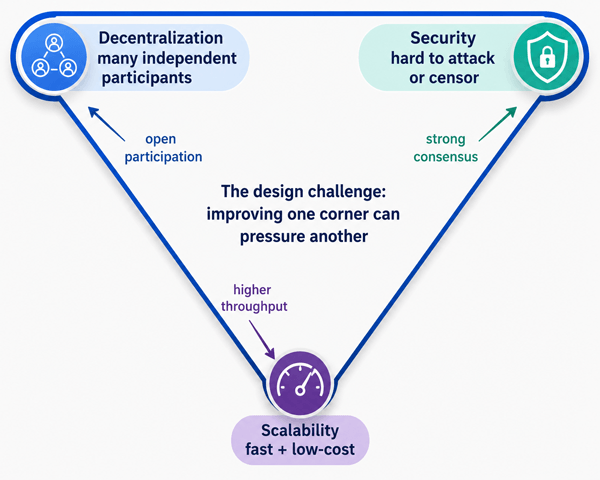
Figure 1: The blockchain trilemma shows the tension between scalability, security, and decentralization.
| Part of the trilemma | Beginner meaning | Simple question to ask |
|---|---|---|
| Scalability | Can the network handle many users and transactions without becoming slow or expensive? | Will it still work well when millions of people use it? |
| Security | Can the network resist attacks, fraud, censorship, and data tampering? | How hard is it to cheat or break the system? |
| Decentralization | Is control spread across many independent participants? | Can ordinary people verify the system instead of trusting a company? |
2. Why the Blockchain Trilemma Matters
The blockchain trilemma matters because it explains many of the practical problems people notice in crypto and Web3: high fees, slow transactions, complex scaling solutions, validator concentration, bridge hacks, and confusing claims about “next-generation” blockchains.
When a project says it is “fast, secure, and decentralized,” the useful question is not whether those words appear in the marketing. The useful question is how the system achieves those goals, what assumptions it makes, and what trade-offs users accept.
- Users care because scalability affects fees and speed.
- Developers care because security affects whether applications can safely hold value.
- Investors and researchers care because decentralization affects censorship resistance, governance risk, and long-term resilience.
- Businesses care because the right blockchain for payments may not be the same as the right blockchain for storing high-value assets or running public infrastructure.
3. A Simple Blockchain Refresher
A blockchain is a shared digital ledger. Instead of one company keeping the official database, many computers, often called nodes, keep copies of the same record. New transactions are grouped into blocks. Each block is linked to previous blocks using cryptographic hashes, which makes old records difficult to change without being noticed.
Public blockchains such as Bitcoin and Ethereum are designed so that strangers can agree on the state of the ledger without needing to trust one central operator. This agreement process is called consensus. Consensus is what lets the network decide which transactions are valid, which block comes next, and which chain is the accepted history.
This design gives blockchains their main strengths, but it also creates the trilemma. When many independent nodes must verify the same data, the network becomes more transparent and resilient, but it may be slower than a centralized database run by one company.
4. The Three Sides of the Blockchain Trilemma
4.1 Scalability: Can the Blockchain Handle More Users?
Scalability means the network can support growing usage without fees rising sharply or transactions taking too long. A scalable blockchain can process more transactions, store and transmit data efficiently, and keep user experience smooth during busy periods.
In blockchain conversations, scalability is often measured through:
- Throughput: how many transactions the system can process in a given time.
- Latency: how quickly a transaction appears or becomes final.
- Cost: how expensive it is to send a transaction or use an application.
- Data capacity: how much information the network can safely publish and verify.
The scalability problem appears when a blockchain becomes popular. More people want to use the same limited block space. If demand exceeds supply, users compete by paying higher fees, and simple actions can become expensive.
4.2 Security: Can the Blockchain Resist Attacks?
Security means the blockchain can protect its history and users from attacks. A secure blockchain makes it difficult to rewrite transactions, double-spend coins, censor users, exploit validators, or trick the network into accepting invalid data.
Security depends on several layers:
- Consensus security: the rules that decide which blocks are valid.
- Economic security: the cost of attacking the network compared with the likely reward.
- Network security: how well nodes communicate and resist disruption.
- Software security: whether node software, wallets, smart contracts, and bridges have bugs.
- User security: whether users protect private keys and avoid scams.
A common beginner mistake is thinking that “blockchain is secure” means every app built on a blockchain is secure. That is not true. The base chain may be strong, while a smart contract, bridge, wallet, or exchange can still fail.
4.3 Decentralization: Who Controls the Network?
Decentralization means control is spread across many independent participants. In a decentralized blockchain, no single company, government, validator, mining pool, or infrastructure provider should be able to easily rewrite history, block users, or change rules alone.
Decentralization is not one number. It includes several practical questions:
- How easy is it for ordinary users to run a node?
- How many independent validators or miners participate?
- Is stake, hash power, or governance power concentrated among a few parties?
- Can users verify the chain themselves without trusting a third party?
- Are key services, such as sequencers, bridges, RPC providers, or development teams, centralized?
A blockchain can have many users but still be weakly decentralized if only a few operators produce blocks or if most users depend on the same infrastructure provider.
| Goal | What improves it | What can get worse |
|---|---|---|
| Scalability | Larger blocks, faster block times, rollups, sharding, optimized execution | Node hardware requirements, complexity, centralization pressure |
| Security | More validators/miners, strong incentives, slashing, audits, conservative design | Speed, cost, flexibility, user convenience |
| Decentralization | Low hardware requirements, open participation, many independent nodes | Raw throughput, coordination speed, sometimes user experience |
5. How the Blockchain Trilemma Works in Practice
The trilemma appears because every blockchain has limited resources: bandwidth, storage, computation, validator attention, and social coordination. A decentralized network cannot simply demand that every participant use expensive data-center hardware, because that would push out ordinary users and reduce decentralization.
Imagine a blockchain that wants to process 100 times more transactions directly on its base layer. It might increase block size or block frequency. That can improve throughput, but nodes must download, verify, and store more data. If running a node becomes too expensive, fewer people will do it. The network may become faster, but also more dependent on professional operators.
Now imagine the opposite approach. A blockchain keeps small blocks so that many people can run nodes on modest hardware. That supports decentralization and independent verification, but block space stays scarce. When demand rises, users may experience congestion and higher fees.
That is the heart of the trilemma: public blockchains are trying to scale without giving up the features that make them valuable in the first place.
6. Real-World Examples of Trilemma Trade-Offs
6.1 Bitcoin: Strong Security and Decentralization, Limited Base-Layer Throughput
Bitcoin is often used as an example of a blockchain that prioritizes security and decentralization over high base-layer throughput. Its design is conservative: blocks are produced at a predictable pace, full nodes can verify the chain, and the proof-of-work system makes rewriting history expensive.
The trade-off is that Bitcoin’s base layer is not designed for high-volume everyday payments at global scale. During busy periods, users may pay higher fees or wait longer. Scaling efforts such as the Lightning Network aim to move many small payments off the base layer while still using Bitcoin as a settlement layer.
6.2 Ethereum: General-Purpose Security with Layer 2 Scaling
Ethereum supports smart contracts, which means developers can build decentralized applications such as exchanges, lending protocols, games, identity systems, and token platforms. That flexibility increases demand for block space. When Ethereum is busy, fees can rise because many applications compete for the same base-layer capacity.
Ethereum’s modern scaling approach relies heavily on Layer 2 networks and rollups. Rollups process transactions outside the Ethereum base layer, bundle them, and publish data or proofs back to Ethereum. This can reduce costs and increase throughput, but it also introduces new considerations: sequencer centralization, bridge risk, data availability, withdrawal delays, and user confusion across networks.
6.3 High-Throughput Chains: Faster User Experience, Different Trust Assumptions
Some blockchains focus on high throughput and low fees by using faster block times, larger blocks, or a smaller set of high-performance validators. This can make applications feel more like normal web apps. The trade-off is that hardware requirements and validator economics may limit who can participate directly in consensus.
That does not automatically mean such chains are “bad.” It means users should understand the design choice. A gaming app, social app, or low-value payment system may prefer speed and low fees. A system securing very large amounts of value may prefer slower, more conservative settlement.
| Example design choice | Likely benefit | Possible trade-off |
|---|---|---|
| Small blocks and easy node operation | More people can verify the chain independently | Lower transaction capacity on the base layer |
| Large blocks or faster blocks | More transactions and lower fees during normal use | Higher hardware and bandwidth requirements |
| Small validator set | Fast finality and simpler coordination | Greater centralization risk |
| Layer 2 rollups | Lower fees and more throughput while using a secure base layer | More complexity and extra assumptions around sequencers, bridges, and data availability |
| Sharding or data availability sampling | More data capacity without every node processing everything | More protocol complexity and newer security assumptions |
7. Common Ways Blockchains Try to Solve the Trilemma
No solution magically removes trade-offs. The best designs try to reduce trade-offs, move them to less harmful places, or make them transparent.
7.1 Layer 2 Networks and Rollups
A Layer 2 is a network built on top of a base blockchain, often called Layer 1. Rollups are a popular Layer 2 design. They execute transactions off-chain, compress or batch the results, and use the base chain for settlement and security.
There are two common rollup categories:
- Optimistic rollups assume transactions are valid unless someone challenges them during a dispute window.
- Zero-knowledge rollups use cryptographic validity proofs to show that a batch of transactions was processed correctly.
Rollups can improve scalability, but users should still evaluate the maturity of the rollup, who controls the sequencer, how withdrawals work, whether the code is audited, and whether emergency upgrade powers exist.
7.2 Sharding and Data Availability Improvements
Sharding means splitting work or data across multiple parts of the network instead of forcing every node to process everything. In blockchain scaling, sharding and newer data availability designs aim to increase capacity while preserving the ability to verify that data was published correctly.
The benefit is higher capacity. The risk is complexity. More moving parts can introduce new failure modes, and security depends on careful design.
7.3 Proof of Stake and Validator Incentives
Proof of stake replaces mining with validators who lock up value as collateral. Validators can earn rewards for honest participation and can lose funds for certain forms of misbehavior. This changes the security model from energy expenditure to economic stake and protocol-enforced penalties.
Proof of stake can reduce energy usage and improve some scaling paths, but it does not automatically solve decentralization. Stake can concentrate, staking services can become dominant, and users must consider validator diversity.
7.4 Modular Blockchain Design
Traditional blockchains often try to do everything in one place: execution, settlement, consensus, and data availability. Modular designs separate these jobs across specialized layers. For example, one layer may handle execution, another may provide data availability, and another may provide settlement.
Modular design can improve scalability, but it can also make the user experience and security assumptions harder to understand. Beginners should be careful with systems that require bridging assets across several layers without understanding the risks.
7.5 Sidechains, Appchains, and Validiums
Sidechains and app-specific chains can offer cheaper and faster transactions by using their own validator sets or security models. Validiums can keep some transaction data off-chain while using validity proofs. These designs may be useful, but they often involve different trust assumptions from rollups that publish data to a highly secure base layer.
8. Benefits of Understanding the Blockchain Trilemma
- You can judge blockchain claims more realistically.
- You can choose networks based on use case instead of hype.
- You can understand why fees rise during congestion.
- You can spot hidden centralization risks.
- You can ask better questions before using bridges, DeFi apps, or new chains.
9. Risks, Limitations, and Misconceptions
9.1 Misconception 1: A Blockchain Can Fully Maximize All Three Goals Today
Many projects claim to solve the trilemma completely. Be cautious. Improvements are real, but every design has assumptions. Look for independent audits, open-source code, public documentation, validator distribution, incident history, and clear explanations of trade-offs.
9.2 Misconception 2: More Transactions Per Second Always Means Better
High throughput is useful, but raw transaction speed can be misleading. A system might count simple transfers but struggle with complex smart contracts. It might be fast because a small group controls block production. It might also rely on powerful hardware that ordinary users cannot afford.
9.3 Misconception 3: Decentralized Means No One Has Power
Decentralization is a spectrum. Even a public blockchain can have concentrated token ownership, dominant staking providers, centralized sequencers, admin keys, or influential development teams. The question is not whether power exists. The question is how visible, limited, distributed, and accountable that power is.
9.4 Misconception 4: Layer 2 Means No Risk
Layer 2 networks can reduce fees and improve speed, but they can add bridge risk, smart contract risk, sequencer risk, and withdrawal complexity. Users should start with small amounts, understand withdrawal rules, and avoid assuming every Layer 2 has the same security model.
10. How to Evaluate a Blockchain Using the Trilemma
Use the following practical checklist before trusting a blockchain or application with meaningful value.
- Check what the chain optimizes for: payments, smart contracts, gaming, DeFi, storage, identity, or settlement.
- Look at fees during congestion, not only during quiet periods.
- Find out how many validators or miners participate and whether a few parties dominate.
- Check whether ordinary users can run a full node with reasonable hardware.
- Understand finality: when is a transaction practically irreversible?
- Review the security model of bridges and Layer 2 networks.
- Look for audits, bug bounties, incident history, and transparent upgrade processes.
- Avoid putting large funds into systems you do not understand.
| Use case | Most important trilemma priority | Why |
|---|---|---|
| Long-term store of value | Security and decentralization | Users need strong censorship resistance and confidence that history cannot be changed. |
| Retail payments | Scalability and user experience | Low fees and fast confirmation matter for everyday transactions. |
| DeFi with large value locked | Security first, then scalability | Smart contract and settlement risk can cause major losses. |
| Games and social apps | Scalability and low cost | Users need frequent low-value interactions. |
| Public infrastructure or identity | Decentralization and security | Long-term neutrality and verifiability are important. |
11. Best Practices for Beginners
- Do not choose a blockchain only because it is cheap or fast. Ask why it is cheap or fast.
- Use trusted wallets and official links. Many losses come from phishing, not from base-chain failure.
- Start with small test transactions when using a new chain, bridge, or Layer 2.
- Read the project’s documentation on validators, finality, upgrades, and security assumptions.
- Be careful with bridges. They are common targets because they connect assets across different security models.
- Separate investment decisions from technical quality. A well-designed chain can still have a volatile token, and a rising token price does not prove strong decentralization.
- Watch for admin keys, emergency powers, and upgrade controls in DeFi applications.
12. Pros and Cons of Different Scaling Approaches
| Approach | Pros | Cons |
|---|---|---|
| Bigger base-layer blocks | Simple idea; more transactions directly on-chain | Can increase node costs and centralization pressure |
| Layer 2 rollups | Lower fees; can inherit base-layer security for settlement | More complex; sequencer, bridge, and withdrawal risks vary |
| Sidechains | Fast and flexible; good for specific apps | Usually rely on separate security assumptions |
| Sharding/data availability scaling | Can increase capacity while preserving verification goals | Technically complex and still evolving |
| Centralized off-chain systems | Very fast and cheap | Requires trust in an operator; less censorship resistance |
13. So, Can the Blockchain Trilemma Be Solved?
The honest answer is: it can be improved, but not ignored. New cryptography, better network design, rollups, data availability sampling, modular architecture, and improved validator incentives can reduce the severity of the trade-offs. But every blockchain still operates under limits: hardware, bandwidth, economics, governance, and human behavior.
A more useful way to think about the trilemma is this: the goal is not to find a perfect blockchain for every use case. The goal is to choose the right trade-offs for a specific use case and make those trade-offs clear to users.
14. Key Takeaways
- The blockchain trilemma explains the trade-off between scalability, security, and decentralization.
- Scalability means the network can handle more users without high fees or slow performance.
- Security means the network can resist attacks, fraud, and invalid changes.
- Decentralization means control and verification are spread across many independent participants.
- Improving one goal can create pressure on another, especially on public blockchains.
- Layer 2 networks, rollups, sharding, and modular designs are attempts to reduce the trade-offs, not magic fixes.
- Beginners should judge blockchains by their real design assumptions, not by marketing claims.
15. FAQs About the Blockchain Trilemma
15.1 What is the blockchain trilemma in simple words?
It is the challenge of building a blockchain that is fast, secure, and decentralized at the same time. Most designs improve one or two of these goals while making trade-offs in the third.
15.2 Who created the blockchain trilemma idea?
The concept is widely associated with Ethereum co-founder Vitalik Buterin, although researchers and builders continue to debate exactly how strict the trilemma is and how much modern designs can improve it.
15.3 Is the blockchain trilemma proven?
Some research attempts to formalize the trilemma, but in everyday use it is best understood as a design framework rather than a simple mathematical rule. It helps users ask better questions about trade-offs.
15.4 Why can’t blockchains just process more transactions?
They can increase capacity, but public blockchains must also let many independent nodes verify the system. More data and faster blocks can increase hardware and bandwidth needs, which can reduce decentralization.
15.5 Do Layer 2 networks solve the blockchain trilemma?
Layer 2 networks can greatly improve scalability, especially for fees and throughput. They do not remove all trade-offs. Users still need to understand sequencers, bridges, withdrawal rules, data availability, and upgrade controls.
15.6 Which is more important: scalability, security, or decentralization?
It depends on the use case. High-value settlement needs strong security and decentralization. Games and small payments may prioritize speed and cost. Serious DeFi applications need both strong security and practical scalability.
15.7 Is a centralized blockchain still a blockchain?
It may use blockchain-style data structures, but if a small group controls validation and users cannot independently verify the system, it loses many benefits that make public blockchains valuable.
15.8 What should beginners look for before using a blockchain?
Look at fees during congestion, validator distribution, node requirements, bridge design, audits, incident history, and whether the project clearly explains its trade-offs.
Sources Consulted and Checked
The following sources were consulted and checked while preparing this article to support its accuracy and clarity.
- Mssassi, S. “The Blockchain Trilemma: A Formal Proof of the Inherent Trade-Offs Between Decentralization, Security, and Scalability.” Applied Sciences, 2024.
- Nakai, T. “The Blockchain Trilemma Described by a Formula.” IEEE, 2023.
- Buterin, Vitalik. Public comments on the scalability trilemma and its interpretation, 2018.
- Ethereum.org and Ethereum community documentation on proof of stake, scaling, rollups, and the Ethereum roadmap.
- Cao, S.-J., and Guo, D. “Security, Latency, and Throughput of Proof-of-Work Nakamoto Consensus.” arXiv, 2023.
- Huang, C., Song, R., Gao, S., Yu, G., and Xiao, B. “Data Availability and Decentralization: New Techniques for zk-Rollups in Layer 2 Blockchain Networks.” arXiv, 2024.
- Sheng, P., Rana, R., Bala, S., Tyagi, H., and Viswanath, P. “Proof of Diligence: Cryptoeconomic Security for Rollups.” arXiv, 2024.
- Investopedia. “Blockchain Facts: What Is It, How It Works, and How It Can Be Used.” Updated guide.
Reader Advice
This article is provided for educational and informational purposes only. It explains general blockchain concepts and does not constitute personalized legal, financial, investment, tax, cybersecurity, or technical advice or a recommendation to use any blockchain, token, platform, bridge, wallet, or application. Blockchain systems and digital assets involve risks, including price volatility, scams, software flaws, smart-contract or bridge failures, loss of private keys, network disruptions, and changing regulatory treatment. Rules, policies, laws, technical standards, project features, and statistics may change over time and vary by region, so readers should verify important information through current official sources and, where appropriate, seek advice from a qualified professional before making decisions or committing funds.