Blockchain Nodes Explained: Full Nodes, Light Nodes, Validators and Miners
1. Quick Answer: What Is a Blockchain Node?
A blockchain node is a computer or device that connects to a blockchain network. Its job is to send, receive, store, check, or help confirm blockchain data. In simple terms, nodes are the computers that keep a blockchain alive.
Not every node does the same job. Some nodes keep a complete copy of the blockchain. Some only check a small part of the data. Some take part in adding new blocks. The main types beginners usually hear about are full nodes, light nodes, validators, and miners.
| Node type | Simple meaning | Common use |
|---|---|---|
| Full node | Stores and verifies the blockchain rules independently | People who want maximum trust and privacy |
| Light node | Uses less storage and relies on full nodes for some information | Mobile wallets and everyday users |
| Validator | Locks stake and helps create/confirm blocks in proof-of-stake networks | Stakers and network operators |
| Miner | Uses computing power to compete for blocks in proof-of-work networks | Mining businesses and hobbyists with suitable hardware |
2. Why Blockchain Nodes Matter
A blockchain is not stored in one company database. It is copied, checked, and shared by many independent computers around the world. Those computers are nodes. Without nodes, there is no peer-to-peer network, no shared transaction history, and no practical way for users to verify what is true.
Nodes matter because they help answer three important questions:
- Is this transaction valid according to the network rules?
- Which version of the blockchain history is the correct one?
- Can users verify the system without trusting a single company, exchange, or website?
This is the key idea behind blockchain networks: trust is reduced because many independent nodes can check the same rules for themselves.
3. How Blockchain Nodes Work in Simple Terms
Imagine a public notebook that many people copy. Every time someone adds a new page, everyone checks whether the page follows the rules. If it does, they add it to their own copy. If it does not, they reject it. A blockchain node works in a similar way, except the notebook is digital and the rules are enforced by software.
3.1 The basic flow
- A user creates a transaction, such as sending Bitcoin or using a smart contract.
- The transaction is broadcast to nearby nodes.
- Nodes check whether the transaction follows the rules, such as valid signatures and no double spending.
- Valid transactions are shared with other nodes.
- A miner or validator proposes a new block containing transactions.
- Other nodes verify the block and accept it only if it follows the network rules.
This process happens constantly. Nodes are always listening, checking, forwarding, and updating their view of the blockchain.
3.2 Simple diagram: how nodes interact
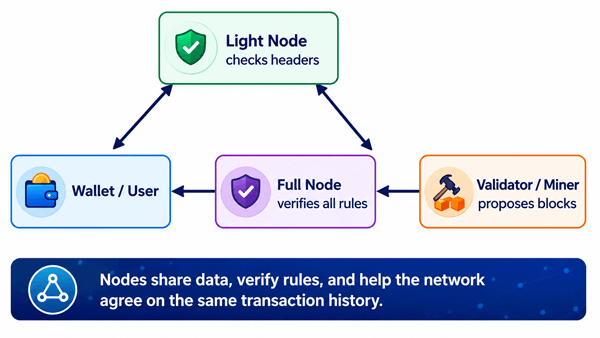
Diagram: A user or wallet connects to nodes, nodes verify data, and validators or miners help propose blocks depending on the blockchain design.
4. Full Nodes Explained
A full node is a node that independently verifies the blockchain. It downloads blockchain data, checks blocks and transactions against the rules, and rejects anything invalid. In many networks, a full node also stores a copy of the blockchain history or enough verified data to enforce the rules.
The most important point is this: a full node does not need to blindly trust someone else. It checks the rules itself.
4.1 What full nodes do
- Verify transactions and blocks according to the network consensus rules.
- Reject invalid blocks, even if another peer sends them.
- Share valid data with other nodes on the network.
- Help wallets and users get accurate blockchain information.
- Improve decentralization by making the network less dependent on a few large providers.
4.2 Example: using a full node for Bitcoin
A Bitcoin user can run Bitcoin Core as a full node. Instead of asking an exchange or block explorer whether a payment happened, the user can verify the Bitcoin blockchain directly. This gives stronger privacy and independence, but it requires disk space, bandwidth, and regular maintenance.
4.3 Pros and cons of full nodes
| Point | What it means |
|---|---|
| High trust minimization | You verify rules yourself instead of relying on a third party. |
| Better privacy | You do not need to reveal all wallet lookups to a public service. |
| Supports decentralization | More independent nodes make the network harder to control. |
| Requires resources | Full nodes need storage, bandwidth, updates, and uptime. |
| Not usually profitable by itself | Running a full node normally does not automatically earn rewards. |
5. Light Nodes Explained
A light node, also called a lightweight node or light client, is designed to use less storage and less computing power than a full node. Instead of downloading and verifying everything, it checks a smaller amount of data and asks full nodes for details when needed.
Light nodes are common in mobile wallets because phones usually cannot store and process an entire blockchain comfortably. A light node can give a user a practical experience while still doing more verification than a fully custodial app.
5.1 How light nodes work
A light node usually downloads block headers or compact proofs rather than every transaction and every block. A block header is like a summary label for a block. It is much smaller than the full block. The light node can use those summaries to check that a transaction is likely included in the blockchain, while relying on full nodes for some underlying data.
5.2 Benefits of light nodes
- Use much less storage than full nodes.
- Can run on phones, browsers, and low-power devices.
- Sync faster than full nodes in many cases.
- Make blockchain access easier for everyday users.
5.3 Limitations of light nodes
- They depend on full nodes for some information.
- They may offer weaker privacy because they often ask other nodes about wallet-related data.
- They may not verify every rule as independently as a full node.
- Security depends on the light client design and the specific blockchain.
6. Validators Explained
A validator is a participant in a proof-of-stake blockchain that helps propose, check, and confirm new blocks. Instead of using large amounts of mining hardware, validators put cryptocurrency at risk as collateral. This collateral is called a stake.
If a validator behaves correctly, it may earn rewards. If it behaves dishonestly or fails important duties, it may lose rewards or, in serious cases, part of its stake. This penalty system is one way proof-of-stake networks encourage honest behavior.
6.1 What validators do
- Run node software for the blockchain network.
- Stay online to participate in consensus.
- Propose new blocks when selected by the protocol.
- Vote on or attest to blocks proposed by other validators.
- Risk penalties if they double-sign, go offline too often, or break protocol rules.
6.2 Example: validators on Ethereum
Ethereum is a well-known proof-of-stake network. A person who wants to run their own Ethereum validator must meet the protocol requirements, which have historically included staking 32 ETH for a standard validator setup. Exact operational choices and validator balance options can change over time, so anyone planning to run a validator should check the current official documentation before depositing funds.
6.3 Validator benefits and risks
| Factor | Explanation |
|---|---|
| Potential rewards | Validators may earn staking rewards for correct participation. |
| Network contribution | Validators help secure proof-of-stake networks. |
| Capital required | You usually need to stake assets or use a staking service. |
| Slashing risk | Dishonest or badly configured validators may lose part of their stake. |
| Uptime matters | Poor internet, power outages, or misconfigured software can reduce rewards. |
| Custody risk | Using third-party staking services can introduce counterparty risk. |
7. Miners Explained
A miner is a participant in a proof-of-work blockchain that uses computing power to compete for the right to add the next block. Mining is best known from Bitcoin. Miners gather valid transactions, build candidate blocks, and repeatedly try to solve a difficult mathematical puzzle. The first miner to find a valid solution can broadcast the block to the network.
Other nodes then check the block. If it follows the rules, they accept it. If it breaks the rules, they reject it, even if the miner spent a lot of energy producing it.
7.1 What miners do
- Collect valid transactions from the network.
- Build candidate blocks.
- Use specialized hardware to perform proof-of-work calculations.
- Broadcast valid blocks when they find them.
- Earn block rewards and transaction fees when their blocks are accepted.
7.2 Mining example
In Bitcoin mining, miners compete globally. A miner cannot simply decide to create coins or rewrite the rules. The block must still be accepted by full nodes. This is why miners are powerful but not all-powerful. They help order transactions and produce blocks, while full nodes enforce the rules.
7.3 Mining benefits and risks
| Factor | Explanation |
|---|---|
| Can earn rewards | Successful miners may earn block subsidies and transaction fees. |
| Strong security model | Proof-of-work makes attacks costly because they require real-world energy and hardware. |
| High operating cost | Mining often requires expensive machines, electricity, cooling, and maintenance. |
| Competitive industry | Mining profits change with coin price, network difficulty, electricity rates, and hardware efficiency. |
| Environmental concerns | Energy use is a major criticism of proof-of-work systems. |
| Regulatory uncertainty | Mining rules and energy policies vary by country and region. |
8. Full Nodes vs Light Nodes vs Validators vs Miners
These terms overlap, but they are not the same. A validator or miner usually runs node software, but a normal full node is not automatically a validator or miner. A light node helps a user access the network but usually does not take part in block production.
| Type | Main role | Creates blocks? | Typical resource need | Example |
|---|---|---|---|---|
| Full node | Verifies blockchain rules independently | Usually no | Medium to high | Bitcoin full node, Ethereum execution node |
| Light node | Provides lightweight access and partial verification | No | Low | Mobile wallet light client |
| Validator | Secures a proof-of-stake network by staking and voting/proposing blocks | Yes, if selected and active | Medium plus staked capital | Ethereum validator, Solana validator |
| Miner | Secures a proof-of-work network through computational work | Yes, if it wins the block race | High hardware and energy needs | Bitcoin miner |
9. Are Validators and Miners Nodes?
Yes, validators and miners are usually nodes or operate alongside nodes. But the word node is broader. A node is any connected participant that communicates with the network. A validator is a node with a consensus role in proof-of-stake. A miner is a node or mining setup with a consensus role in proof-of-work.
A helpful way to remember it is:
- All validators and miners need network participation.
- Many validators and miners run full node software or connect closely to full nodes.
- Not all full nodes are validators or miners.
- Light nodes are nodes, but they usually do not create blocks.
10. Common Real-World Scenarios
10.1 Scenario 1: You use a mobile crypto wallet
Your wallet may behave like a light client or connect to wallet provider servers. This is convenient, but you are often trusting external infrastructure for balances, transaction history, or blockchain queries. For small everyday use, this may be acceptable. For stronger privacy and independence, connecting your wallet to your own node is better.
10.2 Scenario 2: You hold Bitcoin and want stronger self-sovereignty
Running a Bitcoin full node lets you verify your own transactions. You do not need to ask a public block explorer whether you received payment. This is useful for serious long-term holders, merchants, privacy-conscious users, and anyone who wants to reduce reliance on centralized services.
10.3 Scenario 3: You want to earn staking rewards
In a proof-of-stake network, you may run your own validator or use a staking service. Running your own validator gives more control but requires technical care. Using a service is easier but introduces trust, fees, and platform risk. The best choice depends on your technical skill, capital, risk tolerance, and the specific network.
10.4 Scenario 4: You want to mine cryptocurrency
Mining can be a business, but it is not simply “turn on a laptop and get rich.” Modern proof-of-work mining is highly competitive. Before mining, you need to calculate hardware cost, electricity price, cooling, pool fees, taxes, local rules, and expected network difficulty. Many beginners underestimate these costs.
11. Benefits of Running Your Own Node
- Independent verification: You can check the blockchain rules yourself.
- Better privacy: You reduce the need to query public services about your addresses.
- Censorship resistance: More independent nodes make it harder for one party to control access.
- Network health: You help distribute blockchain data across more peers.
- Learning value: Running a node helps you understand how blockchain systems actually work.
12. Risks and Limitations of Running a Node
- Storage and bandwidth: Some blockchains require significant disk space and data transfer.
- Maintenance: Node software needs updates, monitoring, backups, and security care.
- No guaranteed income: A normal full node usually does not earn rewards.
- Security responsibility: Poor setup can expose your machine or funds to risk.
- Complexity: Validator and mining setups are more demanding than basic wallet use.
13. Beginner Mistakes and Misconceptions
13.1 Mistake 1: Thinking every node earns money
Most full nodes do not earn rewards just for existing. Rewards usually go to miners in proof-of-work networks or validators in proof-of-stake networks. Running a full node is mainly about verification, privacy, and supporting the network.
13.2 Mistake 2: Confusing miners with full nodes
Miners create candidate blocks in proof-of-work systems. Full nodes verify whether those blocks follow the rules. Miners cannot force invalid blocks onto honest full nodes.
13.3 Mistake 3: Assuming light wallets are fully trustless
Light wallets are useful, but they usually make tradeoffs. They may depend on full nodes or wallet servers. That does not make them bad, but users should understand the difference between convenience and independent verification.
13.4 Mistake 4: Staking without understanding slashing or custody
Staking rewards are not risk-free income. Validators can be penalized for certain failures, and staking through a third party adds custody, smart contract, or provider risk. Beginners should read the rules of the specific network before staking.
13.5 Mistake 5: Using outdated hardware assumptions
Blockchain requirements change as networks grow. Storage, bandwidth, and software requirements can increase. Always check current official network documentation before buying hardware or committing funds.
14. Best Practices for Running a Node
- Start with the official documentation for the specific blockchain.
- Use reputable node software and download it from official sources.
- Keep your operating system and node software updated.
- Use a dedicated machine if possible, especially for validators.
- Back up important keys, but never expose private keys online.
- Use strong passwords, firewalls, and secure remote access practices.
- Monitor disk space, uptime, and logs.
- For validators, understand slashing, withdrawal, and key-management rules before staking.
- For miners, calculate electricity and hardware costs conservatively before buying equipment.
15. Which Type of Node Should You Use?
The right choice depends on your goal.
| Your goal | Practical starting point |
|---|---|
| I just want to send and receive crypto | Use a reputable wallet; a light client may be enough for small everyday use. |
| I want maximum verification and privacy | Run your own full node and connect your wallet to it. |
| I want to support network decentralization | Run a full node for the blockchain you care about. |
| I want staking rewards | Research validator requirements or carefully compare staking services. |
| I want mining rewards | Study proof-of-work mining economics before buying hardware. |
| I am a developer | Run a local or hosted node depending on whether you need control, speed, or production reliability. |
16. Helpful Glossary
| Term | Beginner-friendly meaning |
|---|---|
| Blockchain | A shared digital ledger made of blocks linked in order. |
| Block | A batch of transactions added to the blockchain. |
| Consensus | The process a network uses to agree on the valid chain history. |
| Proof of work | A consensus method where miners use computing power to secure the network. |
| Proof of stake | A consensus method where validators stake assets to help secure the network. |
| Peer-to-peer network | A network where computers communicate directly with each other. |
| Mempool | A waiting area for valid transactions that have not yet been included in a block. |
| Slashing | A penalty in some proof-of-stake systems where a validator loses stake for serious misbehavior. |
| Block header | A small summary of a block used by nodes and light clients. |
| Pruned node | A node that verifies the chain but discards some old data to save disk space, depending on the network/software. |
17. FAQs About Blockchain Nodes
17.1 What is a blockchain node in one sentence?
A blockchain node is a computer or device that connects to a blockchain network and helps store, verify, send, or confirm blockchain data.
17.2 Do I need to run a node to use crypto?
No. Most people use wallets or exchanges without running their own node. However, running your own node gives stronger verification, better privacy, and more independence.
17.3 Does running a full node make money?
Usually no. A normal full node generally does not earn rewards. Validators and miners may earn rewards, but they also take on costs and risks.
17.4 Is a validator the same as a miner?
No. Validators are used in proof-of-stake networks and usually stake cryptocurrency. Miners are used in proof-of-work networks and use computing power. Both help with block production, but they use different security models.
17.5 Can a light node be safe?
Yes, light nodes can be safe enough for many everyday uses, but they usually provide less independent verification than full nodes. Their safety depends on the design of the light client and the blockchain network.
17.6 What is the difference between a node and a wallet?
A wallet manages keys and helps you create transactions. A node connects to the blockchain network and verifies or retrieves blockchain data. Some wallets connect to your own node, while others connect to third-party nodes or servers.
17.7 Can I run a node on a laptop?
Sometimes. It depends on the blockchain, your laptop, storage, internet connection, and whether the node needs to stay online. A basic full node may be possible on consumer hardware for some networks, while validators and miners often require more careful setups.
17.8 Are more nodes always better?
More independently operated nodes usually improve resilience and decentralization. However, quality also matters. A network benefits most from nodes that are well-maintained, geographically distributed, and run by independent participants.
17.9 What happens if a node goes offline?
A regular full node can usually resync when it comes back online. A validator may miss duties and lose rewards while offline. A miner that goes offline simply stops competing for blocks during that time.
17.10 What is the most beginner-friendly node to run?
For many beginners, a non-mining full node is the best learning project because it teaches verification without requiring staking capital or mining hardware. Choose a blockchain with clear documentation and hardware requirements you can meet.
18. Final Takeaway
Blockchain nodes are the foundation of decentralized networks. Full nodes verify the rules, light nodes make access easier, validators secure proof-of-stake networks, and miners secure proof-of-work networks. Understanding these roles helps you use crypto more safely and make better decisions about wallets, staking, mining, privacy, and self-custody.
For beginners, the most important lesson is simple: a blockchain is only as trustworthy as the network of participants checking it. Nodes are those participants. The more you understand them, the less you have to rely on slogans, hype, or blind trust.
Reader Advice
This article is provided for educational and informational purposes only. It is not personalized legal, financial, tax, investment, technical, or cybersecurity advice, and it should not be treated as a recommendation to buy, sell, stake, mine, or use any digital asset or service. Network requirements, staking rules, hardware needs, rewards, penalties, laws, policies, and statistics can change over time and may vary by blockchain and region. Before running a node, validator, or miner, verify current requirements through official documentation and, where appropriate, consult a qualified professional. Blockchain activity can involve loss of funds, slashing, equipment and electricity costs, software vulnerabilities, custody or counterparty risk, regulatory obligations, and irreversible transactions. Consider your skills, circumstances, and risk tolerance carefully before making a decision.
Sources Consulted and Checked
These source types were consulted for preparing this document and checking its accuracy:
- Official protocol documentation
- Official client documentation
- Official security advisories
- Reputable educational material from the relevant blockchain foundation or development team