Public vs Private Blockchains: Differences, Pros, Cons and Enterprise Use Cases
Public and private blockchains both use distributed ledger technology, but they are designed for different goals. Public blockchains prioritize openness, neutrality, and broad participation. Private blockchains prioritize controlled access, privacy, governance, and operational efficiency.
The simplest way to understand the difference is this: a public blockchain is like a public road that anyone can use, while a private blockchain is like a company-owned road where only approved vehicles can enter. Both roads can move value and information, but the rules, risks, costs, and best use cases are not the same.
Quick answer: Use a public blockchain when you need open participation, public verification, token-based ecosystems, or maximum transparency. Use a private blockchain when a defined group of organizations needs to share data, automate workflows, and keep sensitive information under permissioned access.
1. What Is a Blockchain?
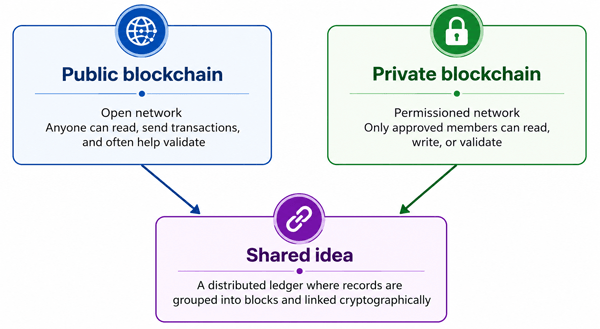
A blockchain is a shared digital record of transactions or events. Instead of storing the record in one central database controlled by one party, copies of the ledger are maintained across multiple computers, often called nodes.
Transactions are grouped into blocks. Each block is linked to the previous block using cryptography. This makes the ledger tamper-evident: if someone changes old data, the change becomes visible because it breaks the chain of cryptographic links.
A blockchain usually includes four basic parts:
- A ledger: the record of transactions or data entries.
- Nodes: computers or organizations that maintain the network.
- Consensus: the method used to agree which transactions are valid.
- Rules or smart contracts: code or policies that define how the system works.
2. Public vs Private Blockchain at a Glance
| Feature | Public blockchain | Private blockchain |
|---|---|---|
| Access | Open to anyone. Anyone can usually read data, submit transactions, and participate within the network rules. | Restricted to approved users, companies, departments, or institutions. |
| Governance | Community, protocol developers, validators/miners, token holders, and ecosystem participants influence changes. | A company, consortium, or governing group sets rules and permissions. |
| Identity | Participants can often use pseudonymous wallet addresses. | Participants are usually known and verified. |
| Transparency | High. Transactions are usually visible publicly, though identities may not be obvious. | Limited. Data visibility can be restricted by role, channel, or permission. |
| Consensus | Designed for trust among unknown participants, often using proof of stake or proof of work. | Designed for known participants, often using faster permissioned consensus. |
| Speed and cost | Can be slower or more expensive during congestion. Fees may vary. | Usually faster and more predictable because participants are controlled. |
| Main strength | Open trust, censorship resistance, public auditability, and network effects. | Privacy, compliance control, predictable performance, and enterprise governance. |
| Best fit | Cryptocurrencies, DeFi, NFTs, public assets, open identity, public notarization. | Supply chains, trade finance, internal settlement, healthcare data sharing, enterprise audit trails. |
3. Simple Diagram: How Access Differs
4. What Is a Public Blockchain?
A public blockchain is an open blockchain network that anyone can join without needing approval from a central owner. People can usually create a wallet, submit transactions, inspect the ledger, and sometimes run a node or validator.
Bitcoin and Ethereum are well-known examples. Ethereum now uses proof-of-stake consensus, where validators stake ETH to help secure the network. Its official consensus specifications describe Ethereum as a proof-of-stake system. Public networks are useful when participants do not already trust each other and need a shared system that is not controlled by one organization.
4.1 How Public Blockchains Work
When you send a transaction on a public blockchain, it is broadcast to the network. Validators or miners check whether the transaction follows the rules. Valid transactions are included in a block. Once enough network consensus forms around that block, it becomes part of the chain.
Because anyone can inspect the chain, public blockchains create strong public auditability. However, openness also means businesses must be careful not to place confidential customer, financial, or operational data directly on-chain.
4.2 Pros of Public Blockchains
- High transparency: anyone can verify transactions and network history.
- Strong decentralization potential: control is spread across many participants rather than one company.
- Censorship resistance: no single administrator can easily block valid activity.
- Open innovation: developers can build wallets, apps, analytics tools, and smart contracts without asking permission.
- Network effects: public networks can attract users, liquidity, developers, and integrations globally.
4.3 Cons of Public Blockchains
- Limited privacy by default: transactions are often visible to everyone.
- Variable transaction fees: costs can rise when the network is busy.
- Performance limits: public consensus is designed for security and openness, not always for enterprise throughput.
- Regulatory uncertainty: tokenized public networks may raise legal, tax, compliance, and custody questions.
- Data permanence: mistakes or sensitive data placed on-chain can be hard or impossible to remove.
5. What Is a Private Blockchain?
A private blockchain is a permissioned blockchain network where participation is controlled. Users, nodes, and organizations must be approved before they can access the network or perform certain actions.
Private blockchains are common in enterprise environments because businesses often need confidentiality, identity checks, role-based access, audit controls, and predictable performance. Hyperledger Fabric, for example, describes itself as an enterprise-grade permissioned distributed ledger framework with a modular design for a wide range of business use cases.
5.1 How Private Blockchains Work
A private blockchain works like a shared database with blockchain-style controls. Approved participants run nodes, submit transactions, and validate records according to rules set by the network owner or consortium.
Instead of allowing everyone on the internet to participate, the network may include a bank and its partners, a manufacturer and suppliers, hospitals in a healthcare network, or departments inside a large company. Access can be restricted so that each participant sees only the data they are allowed to see.
Some permissioned platforms support privacy features such as channels or private data collections, which allow selected members to share sensitive information without exposing it to every participant in the network.
5.2 Pros of Private Blockchains
- Better privacy control: data visibility can be limited to approved parties.
- Known participants: identity and accountability are easier to manage.
- Higher performance potential: permissioned consensus can be faster because validators are known.
- Enterprise governance: rules, upgrades, access, and compliance controls can be defined clearly.
- Lower and more predictable transaction costs: there may be no public gas fees or token price exposure.
5.3 Cons of Private Blockchains
- Less decentralization: control may sit with one company or a small consortium.
- Lower public trust: outsiders cannot always independently verify the full ledger.
- Governance disputes: consortium members may disagree about rules, costs, data access, and responsibilities.
- Integration complexity: connecting legacy systems, identity tools, and business workflows can be difficult.
- Blockchain may be unnecessary: some projects would be simpler and cheaper with a conventional database.
6. Public, Private, Permissioned, and Consortium Blockchains: Key Terms
| Term | Meaning | Example |
|---|---|---|
| Public blockchain | Open network where anyone can usually read, transact, and participate under protocol rules. | Bitcoin or Ethereum mainnet. |
| Private blockchain | Restricted network controlled by one organization or a defined group. | A company blockchain for internal audit records. |
| Permissioned blockchain | A blockchain where participants need approval for certain roles, such as validating blocks or reading data. | A bank-led settlement network. |
| Consortium blockchain | A permissioned blockchain governed by multiple organizations rather than one company. | A supply chain network shared by manufacturers, logistics firms, and retailers. |
| Hybrid blockchain | A design that combines private processes with public verification or anchoring. | A private supply chain ledger that publishes cryptographic proofs to a public chain. |
7. Main Differences Between Public and Private Blockchains
7.1 Access and participation
Public blockchains are open. Private blockchains require permission. This is the core difference that affects everything else: privacy, speed, governance, compliance, and trust assumptions.
7.2 Trust model
Public blockchains assume participants may not know or trust each other. The protocol must defend against dishonest actors. Private blockchains assume participants are known, legally accountable, and approved before joining.
7.3 Transparency and privacy
Public chains are transparent by default. Private chains are selective by design. For enterprises, this matters because invoices, supplier prices, patient information, trade flows, and customer data often cannot be made public.
7.4 Speed and scalability
Private blockchains can often process transactions faster because they use a smaller group of known validators. Public blockchains trade some speed for openness and security across a much larger network.
7.5 Governance
Public networks change through community processes, developer proposals, validator adoption, and market consensus. Private networks can make decisions through contracts, committees, service-level agreements, or internal policies.
7.6 Compliance
Private blockchains usually make it easier to apply know-your-customer checks, data access rules, audit policies, and industry-specific compliance. Public chains can still be used in regulated settings, but they require careful architecture and legal review.
7.7 Cost model
Public chains often use transaction fees paid in a native token. Private chains may have infrastructure, licensing, cloud, support, integration, and governance costs instead of per-transaction public gas fees.
8. Enterprise Use Cases for Private Blockchains
Private blockchains are usually strongest when several organizations need a shared source of truth but do not want one party to control all records. Below are practical enterprise scenarios.
8.1 Supply chain tracking
- Track goods from raw material to retailer.
- Share shipment milestones between manufacturers, logistics firms, customs brokers, and retailers.
- Reduce disputes over delivery status, product origin, and chain-of-custody records.
8.2 Trade finance and banking
- Share letters of credit, invoices, approvals, and settlement status among banks, buyers, sellers, and insurers.
- Reduce paperwork and reconciliation delays.
- Create a tamper-evident audit trail across institutions.
8.3 Healthcare data sharing
- Coordinate patient consent, claims, provider credentials, or clinical trial records.
- Keep sensitive medical data off-chain while recording proofs, permissions, or audit events on-chain.
- Improve accountability without exposing patient records to everyone.
8.4 Manufacturing and quality control
- Record quality inspections, component origins, warranties, maintenance logs, and recalls.
- Help identify affected batches faster during product issues.
- Create a reliable record across suppliers and factories.
8.5 Insurance
- Share claim status, policy events, loss evidence, and fraud signals across insurers, brokers, reinsurers, and service providers.
- Automate parts of claims processing with smart contracts.
- Reduce duplicate data entry and disputes.
8.6 Government and public services
- Manage credentials, permits, public records, notarization, and cross-agency workflows.
- Use permissioned infrastructure when citizen privacy and institutional governance are required.
- Support auditability without making all personal data public.
9. Enterprise Use Cases for Public Blockchains
Public blockchains also have enterprise value, especially when a business needs open verification, digital asset settlement, token-based incentives, or access to public liquidity.
9.1 Digital assets and tokenization
Companies may use public chains to issue or manage tokens, stablecoin payments, NFTs, loyalty assets, or tokenized financial instruments, subject to regulatory requirements.
9.2 Public proof and notarization
A business can publish a hash of a document, certificate, or audit record to a public blockchain. The content stays private, but anyone can later verify that the record existed at a certain time and was not changed.
9.3 Decentralized finance and Web3 applications
Public blockchains support open financial protocols, wallets, decentralized exchanges, and user-owned digital assets. These are usually not possible in the same way on a closed private chain.
9.4 Open identity and credentials
Some identity systems use public chains or public anchoring so credentials can be independently verified without relying fully on one private database.
10. Hybrid Approach: Often the Best Enterprise Design
Many real enterprise blockchain projects do not fit neatly into “public only” or “private only.” A hybrid design can keep sensitive business data in a private system while using a public blockchain for verification, settlement, or proofs.
Example: a pharmaceutical company could keep detailed shipment data in a permissioned network shared with distributors and regulators. Periodically, the network publishes a cryptographic hash to a public blockchain. The public chain does not reveal product data, but it can prove that the private records were not quietly rewritten later.
11. When Should a Business Use a Blockchain at All?
A blockchain is not automatically better than a normal database. Before choosing public or private blockchain, ask whether blockchain is necessary.
| Question | Why it matters |
|---|---|
| Do multiple parties need to share the same records? | If only one company uses the data, a normal database may be enough. |
| Do the parties have limited trust in each other? | Blockchain is useful when no single party should fully control the record. |
| Is an audit trail important? | Blockchains are strong for tamper-evident history. |
| Does the data need privacy or regulatory controls? | This affects whether a private, public, or hybrid design is appropriate. |
| Can the project survive governance disputes? | Consortium blockchains fail when members cannot agree on rules and responsibilities. |
| Will blockchain improve a real workflow? | A blockchain that does not reduce cost, risk, time, or disputes may not justify its complexity. |
12. Common Mistakes and Misconceptions
12.1 “Private blockchain is not real blockchain.”
Private blockchains can use blockchain architecture, cryptographic linking, shared ledgers, and consensus. The better question is whether the design solves a real trust and coordination problem.
12.2 “Public blockchains are anonymous.”
Most public blockchains are pseudonymous, not fully anonymous. Wallet addresses may not show a legal name, but transaction patterns can often be analyzed.
12.3 “Blockchain data is always secure.”
Blockchains can make records tamper-evident, but they do not automatically secure wallets, private keys, smart contracts, APIs, cloud systems, or off-chain data.
12.4 “A private blockchain always beats a database.”
A private blockchain adds governance, infrastructure, and integration complexity. If one organization owns the process and everyone already trusts its database, blockchain may be unnecessary.
12.5 “Put everything on-chain.”
This is risky. Sensitive data, large files, personal information, and legally erasable records should usually stay off-chain, with hashes or references stored on-chain where appropriate.
13. Best Practices for Enterprise Blockchain Projects
- Start with the business problem, not the technology.
- Map participants, incentives, data ownership, and legal responsibilities before building.
- Keep sensitive data off-chain unless there is a clear legal and technical reason to store it on-chain.
- Use permissioned access where privacy, compliance, or contractual accountability matters.
- Consider public-chain anchoring when independent verification is valuable.
- Run a small pilot with measurable outcomes before scaling.
- Plan governance early: who can join, who pays, who upgrades the system, who resolves disputes, and who is liable when something goes wrong.
- Audit smart contracts, key management, APIs, and off-chain systems; blockchain security is more than the chain itself.
- Design for interoperability with existing ERP, CRM, identity, finance, and compliance systems.
14. Public vs Private Blockchain Decision Guide
| Choose public blockchain if... | Choose private blockchain if... | Consider hybrid if... |
|---|---|---|
| You need public verification and open access. | You need controlled participation and privacy. | You need private operations with public proof. |
| You are building a token, DeFi, NFT, or Web3 app. | You are sharing records across known companies or departments. | You want to publish hashes or checkpoints publicly. |
| Users should be able to interact without asking permission. | Participants must be identified and governed by contracts. | Regulators, customers, or partners need independent auditability. |
| Public liquidity or network effects matter. | Performance and predictable costs matter more than openness. | Some data is sensitive, but some verification should be public. |
15. FAQs About Public and Private Blockchains
15.1 What is the biggest difference between public and private blockchains?
The biggest difference is access. Public blockchains are open to anyone. Private blockchains are restricted to approved participants.
15.2 Is Bitcoin public or private?
Bitcoin is a public blockchain. Anyone can download the software, inspect the ledger, and submit transactions according to the network rules.
15.3 Is Ethereum a public blockchain?
Ethereum mainnet is a public blockchain. It is open to users and developers globally and uses proof-of-stake consensus.
15.4 Are private blockchains more secure?
Not automatically. Private blockchains can offer stronger access control and privacy, but security still depends on governance, identity management, key security, code quality, infrastructure, and operational controls.
15.5 Are public blockchains better for transparency?
Yes, public blockchains are generally better for open transparency because anyone can inspect the ledger. However, transparency can be a disadvantage when data is sensitive.
15.6 Can enterprises use public blockchains?
Yes. Enterprises can use public blockchains for tokenization, payments, public proofs, digital assets, and open ecosystems. They must handle privacy, compliance, custody, and regulatory issues carefully.
15.7 Can a private blockchain be decentralized?
It can be decentralized among approved participants, especially in a consortium model. But it is usually less decentralized than a large public blockchain because membership is restricted.
15.8 Which is faster: public or private blockchain?
Private blockchains are often faster because they use known validators and permissioned consensus. Public blockchains may be slower or more expensive during congestion because they prioritize open participation and network security.
15.9 What is a consortium blockchain?
A consortium blockchain is a permissioned blockchain governed by multiple organizations. It is common in industries where competitors or partners need shared records without giving one company full control.
15.10 Should my company use a private blockchain or a database?
Use a private blockchain only if multiple parties need a shared, tamper-evident record and no single party should fully control it. If one company owns the process and trust is not an issue, a traditional database may be simpler and cheaper.
16. Conclusion: Which Blockchain Type Is Better?
Neither public nor private blockchains are universally better. They solve different problems.
Public blockchains are best when openness, public verification, censorship resistance, and broad network participation matter. Private blockchains are best when businesses need controlled access, privacy, known participants, and predictable governance. Many enterprise projects benefit from a hybrid model: private data and workflows, with selective public proof where independent verification adds value.
The most practical advice is simple: do not choose a blockchain because it sounds innovative. Choose it only when it improves trust, coordination, auditability, or automation between parties that need to share records.
Sources Consulted and Checked
These sources were consulted and checked while preparing this article and supporting its accuracy.
- Hyperledger Fabric GitHub repository: describes Fabric as an enterprise-grade permissioned distributed ledger framework with modular design for broad industry use cases.
- IBM Think, “What Is Hyperledger Fabric?”: explains Hyperledger Fabric as an open-source blockchain framework for business and enterprise use cases.
- Ethereum proof-of-stake consensus specifications: official technical specifications for Ethereum consensus.
- Investopedia, “Ethereum Completes The Merge”: summarizes Ethereum’s move from proof of work to proof of stake on September 15, 2022.
- European Blockchain Partnership / EBSI references: examples of permissioned blockchain infrastructure for public services and cross-border digital trust.
Reader Advice
This article is provided for educational and informational purposes only and is not legal, financial, tax, cybersecurity, compliance, investment, or other personalized professional advice. Blockchain rules, platform features, policies, laws, regulations, costs, and statistics can change over time and may vary by country, industry, and use case. Before choosing, investing in, or deploying a public, private, permissioned, consortium, or hybrid blockchain, verify current information through official sources and consult suitably qualified professionals. Carefully assess privacy, data permanence, smart-contract, custody, operational, governance, regulatory, integration, and financial risks, and use appropriate testing, security reviews, and due diligence before making decisions.