Blockchain vs Cryptocurrency: Key Differences, Examples and Use Cases
1. Quick answer: blockchain is the technology; cryptocurrency is one use of it
Blockchain and cryptocurrency are closely related, but they are not the same thing. A blockchain is a type of shared digital record-keeping system. Cryptocurrency is a digital asset, such as Bitcoin or Ether, that usually uses a blockchain to record ownership and transactions.
A simple way to remember the difference: blockchain is like the rail network, while cryptocurrency is one type of train that can run on it. The same rail network could also carry freight, passengers, or maintenance vehicles. In the same way, blockchain can support payments, supply chain tracking, digital identity, smart contracts, tokenized assets, and many other uses beyond crypto coins.
| Term | Simple definition | Beginner example |
|---|---|---|
| Blockchain | A shared digital ledger where records are grouped into blocks and linked in order. | A food company uses a blockchain to track mangoes from farm to store. |
| Cryptocurrency | A digital asset that can be transferred, stored, or used within a blockchain network. | A person sends Bitcoin to another person without using a bank transfer. |
2. What is blockchain?
A blockchain is a digital ledger shared across a network of computers. Instead of one company keeping the only copy of the database, many computers, often called nodes, keep and verify copies of the ledger. New records are grouped into blocks. Each block is connected to the previous block using cryptography, which makes the chain difficult to alter without network agreement.
This structure is useful when several parties need a trusted shared record but do not fully trust one central party to control it. Public blockchains such as Bitcoin and Ethereum are open to anyone. Private or permissioned blockchains are controlled by selected organizations and are common in enterprise projects.
2.1 How blockchain works in simple steps
- A user or system creates a transaction or record, such as a payment, shipment update, vote, certificate, or smart contract action.
- The transaction is broadcast to the network or submitted to approved validators.
- Network participants check whether the transaction follows the rules.
- Valid transactions are grouped into a block.
- The block is added to the chain after the network reaches consensus.
- The updated ledger is shared across participating computers.
The exact process depends on the blockchain. Bitcoin uses proof of work mining. Ethereum now uses proof of stake. Enterprise blockchains may use faster permissioned consensus methods because participants are known.
2.2 Core blockchain features
- Distributed ledger: more than one participant can hold and verify the record.
- Immutability: records are hard to change after they are confirmed; errors are usually corrected by adding a new record rather than deleting the old one.
- Consensus: participants use agreed rules to decide which records are valid.
- Cryptography: digital signatures and hashes help protect ownership, identity, and data integrity.
- Transparency or controlled visibility: public blockchains are broadly visible, while private blockchains can limit access.
- Programmability: some blockchains support smart contracts, which are pieces of code that run when conditions are met.
3. What is cryptocurrency?
Cryptocurrency is a digital asset that exists electronically and is typically recorded on a blockchain. The most famous example is Bitcoin, which was introduced as a peer-to-peer electronic cash system. Other cryptocurrencies serve different purposes. Ether is used to pay transaction fees and run applications on Ethereum. Stablecoins aim to track the value of traditional assets such as the U.S. dollar. Utility tokens may provide access to a service. Governance tokens may give holders voting rights in a decentralized project.
Cryptocurrency can behave like digital money, a network access token, a speculative investment, or a tool inside an application. The important point is that a cryptocurrency is not the blockchain itself. It is an asset that uses a blockchain as the record of who owns what.
3.1 How cryptocurrency works in simple terms
- You create or use a digital wallet. The wallet controls cryptographic keys.
- Your public address can receive funds. Your private key or seed phrase proves control and must be kept secret.
- When you send crypto, your wallet signs a transaction.
- The blockchain network verifies the transaction according to its rules.
- After confirmation, the ledger updates balances or ownership records.
Crypto transactions are often irreversible. If you send assets to the wrong address, lose your seed phrase, or approve a malicious transaction, there may be no bank, platform, or support desk that can recover the funds.
4. Blockchain vs cryptocurrency: key differences
| Comparison point | Blockchain | Cryptocurrency |
|---|---|---|
| Main meaning | Underlying ledger technology for recording and verifying data. | A digital asset or token recorded on a blockchain. |
| Purpose | Create a trusted shared record, automate processes, or coordinate data across parties. | Transfer value, pay fees, access a network, govern a protocol, or represent a digital asset. |
| Examples | Bitcoin blockchain, Ethereum, Hyperledger Fabric, Polygon, private supply-chain ledgers. | Bitcoin (BTC), Ether (ETH), USDC, tokenized rewards, governance tokens. |
| Can exist without the other? | Blockchain can exist without a public cryptocurrency, especially in private enterprise networks. | Most cryptocurrencies need a blockchain or similar distributed ledger to prove ownership and prevent double spending. |
| Who uses it? | Developers, businesses, governments, banks, supply chains, healthcare systems, identity providers. | Consumers, investors, traders, app users, developers, remittance users, decentralized finance participants. |
| Risk profile | Technical complexity, privacy issues, governance problems, integration costs, scalability limits. | Price volatility, scams, wallet loss, regulatory uncertainty, transaction mistakes, exchange risk. |
| Best beginner analogy | A shared notebook everyone can check. | A digital item recorded in that notebook. |
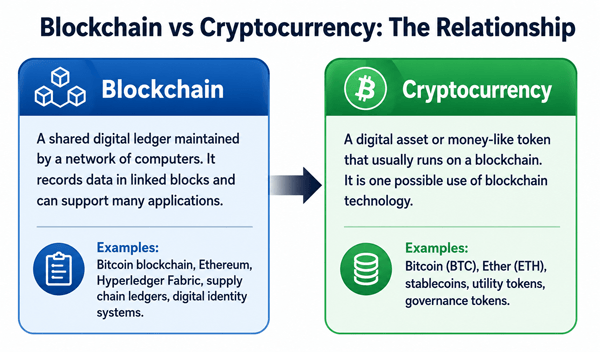
5. Visual diagram: how they connect
The diagram below shows the relationship in one glance: blockchain is the infrastructure; cryptocurrency is one possible asset or application that can run on top of it.
6. Examples of blockchain without cryptocurrency
Many people first hear about blockchain through Bitcoin, but blockchain is broader than crypto trading. Some blockchain systems do not need a public token at all, especially when they are used by known organizations.
| Use case | How blockchain helps | Practical scenario |
|---|---|---|
| Supply chain tracking | Creates a shared audit trail of product movement. | A retailer tracks coffee beans from farm to warehouse to store to verify origin. |
| Digital identity | Lets credentials be verified without repeatedly exposing personal data. | A university issues a tamper-resistant digital diploma that employers can verify. |
| Healthcare records | Can improve auditability and controlled data sharing. | A hospital network records consent and data access events. |
| Trade finance | Reduces duplicated paperwork and reconciliation among banks, exporters, and importers. | A shipment, invoice, and payment milestone are recorded in one shared workflow. |
| Real estate records | Creates a clearer history of ownership, liens, or title events. | A county experiments with land registry records on a permissioned ledger. |
These examples work best when multiple parties need the same trusted record and when ordinary databases are not enough because no single party should fully control the information.
7. Examples of cryptocurrency use cases
Cryptocurrencies vary widely. Some are designed mainly as money-like digital assets, while others support blockchain applications.
| Use case | Crypto example | How it works in practice |
|---|---|---|
| Peer-to-peer payments | Bitcoin, Litecoin | A sender transfers value to a recipient without a traditional bank rail. |
| Network fees | Ether on Ethereum | Users pay fees to run transactions and smart contracts. |
| Stable digital payments | Stablecoins such as USDC or USDT | A token aims to maintain a stable value relative to a traditional currency, though it still carries issuer, reserve, regulatory, and platform risks. |
| Decentralized finance | ETH and DeFi tokens | Users borrow, lend, swap, or provide liquidity through smart contracts. |
| NFTs and digital ownership | NFT-related tokens | A blockchain records ownership of unique digital items, tickets, game assets, or collectibles. |
| Governance | DAO governance tokens | Token holders vote on protocol changes, treasury spending, or project decisions. |
8. Benefits of blockchain
- Shared trust: participants can rely on one synchronized record instead of reconciling separate databases.
- Traceability: records can show the history of an asset or transaction across many steps.
- Tamper resistance: confirmed records are hard to change secretly.
- Automation: smart contracts can trigger actions when predefined conditions are met.
- Reduced intermediaries in some cases: blockchain can lower dependence on central record-keepers, although it does not remove every intermediary.
9. Benefits of cryptocurrency
- Fast global transfer: some networks allow value to move across borders without traditional banking hours.
- User control: self-custody lets users hold assets directly, provided they protect their keys.
- Programmable money: crypto can interact with smart contracts and decentralized applications.
- Financial access: crypto wallets may be easier to create than bank accounts in some regions, although internet access, fees, education, and regulation still matter.
- Open innovation: developers can build apps that use tokens for payments, incentives, governance, or access.
10. Risks and limitations beginners should understand
10.1 Blockchain risks
- A blockchain is not automatically better than a normal database. If one trusted organization controls all users and records, a traditional database may be cheaper and simpler.
- Public blockchains can be slow or expensive during congestion.
- Private blockchains may lose some decentralization benefits because access is controlled.
- Smart contract bugs can cause permanent losses or unexpected behavior.
- Privacy is difficult. Public ledgers may reveal transaction patterns even when real names are not shown.
- Governance can be messy. Communities must decide how to upgrade software, fix problems, and handle disputes.
10.2 Cryptocurrency risks
- Prices can be extremely volatile. A token can lose significant value quickly.
- Scams are common, including fake investment platforms, phishing links, impersonators, giveaway scams, romance scams, and fraudulent wallet apps.
- Transactions are usually irreversible. Mistakes can be permanent.
- Wallet security is the user’s responsibility in self-custody.
- Exchanges and custodians can fail, freeze withdrawals, get hacked, or face regulatory action.
- Legal and tax treatment varies by country and may change over time.
11. Common misconceptions
| Misconception | Reality |
|---|---|
| Blockchain and Bitcoin are the same thing. | Bitcoin is one cryptocurrency and one blockchain network. Blockchain is the broader technology. |
| All blockchains are anonymous. | Many are pseudonymous, not anonymous. Transactions can often be traced to wallet addresses. |
| Blockchain data can never be wrong. | A blockchain can preserve bad data if bad data is entered. This is sometimes called the “garbage in, garbage out” problem. |
| Crypto is always decentralized. | Some tokens, exchanges, wallets, bridges, and stablecoins rely on centralized companies or administrators. |
| Smart contracts are legal contracts. | A smart contract is code. It may support a legal agreement, but code and law are not automatically the same thing. |
| Private keys can be reset like passwords. | In self-custody, losing a seed phrase can mean losing access permanently. |
12. When should a business use blockchain?
Blockchain is most useful when several independent parties need a common record, when trust is limited, when auditability matters, and when shared workflows create costly reconciliation. It is less useful when one organization controls everything, when data must be frequently changed or deleted, or when performance and privacy requirements are better served by a traditional database.
12.1 Good signs blockchain may fit
- Multiple organizations need to write to or verify the same record.
- Participants do not fully trust one central database owner.
- A clear audit trail is important.
- Records need to be tamper-resistant.
- Rules can be automated safely with smart contracts.
- The value of shared trust is greater than the cost and complexity.
12.2 Good signs blockchain may not fit
- Only one organization uses the database.
- Data must be edited or deleted often for business or privacy reasons.
- The system needs very high speed and low cost per transaction.
- There is no clear reason to decentralize control.
- Users cannot manage keys or understand irreversible transactions.
- The project uses “blockchain” mainly for marketing.
13. Best practices for beginners using cryptocurrency
- Learn before buying. Understand the asset, network, wallet, fees, and risks.
- Use reputable platforms and verify URLs manually. Avoid links sent by strangers or social media accounts.
- Never share your seed phrase or private key. No legitimate support agent needs it.
- Start with a small test transaction before sending a large amount.
- Use hardware wallets or strong custody practices for significant holdings.
- Turn on multi-factor authentication for exchange accounts.
- Be skeptical of guaranteed returns, secret trading systems, urgent offers, and “too good to be true” yields.
- Keep records for taxes and compliance. Crypto activity may be taxable even when you do not convert to cash.
- Diversify risk. Do not put money into crypto that you cannot afford to lose.
- Understand the difference between holding a token and owning part of a company. Most tokens are not shares.
14. Blockchain vs cryptocurrency in real-world scenarios
| Scenario | Is it blockchain, cryptocurrency, or both? | Why |
|---|---|---|
| A shipping company tracks temperature logs for medicine shipments. | Blockchain, possibly without cryptocurrency. | The main need is a shared tamper-resistant record, not a tradable token. |
| A person sends Bitcoin to family overseas. | Both. | Bitcoin is the cryptocurrency; the Bitcoin blockchain records the transaction. |
| A game issues a token players can trade. | Both. | The token is cryptocurrency-like, and the blockchain records ownership and transfers. |
| A bank group shares trade finance documents on a permissioned ledger. | Blockchain. | Known institutions may not need a public token. |
| A user swaps tokens on a decentralized exchange. | Both. | Cryptocurrencies move through smart contracts on a blockchain. |
| A university issues verifiable digital certificates. | Blockchain, usually no cryptocurrency needed. | The goal is credential verification, not payment. |
15. Pros and cons summary
| Topic | Pros | Cons |
|---|---|---|
| Blockchain | Shared trust, auditability, tamper resistance, traceability, automation. | Complexity, scalability issues, privacy challenges, governance questions, not always better than databases. |
| Cryptocurrency | Global transfer, user control, programmability, open access, new financial applications. | Volatility, scams, irreversible mistakes, custody risks, regulatory uncertainty. |
16. Final takeaway
Blockchain is the foundation: a shared, tamper-resistant digital ledger. Cryptocurrency is one important application: a digital asset that usually uses a blockchain to record ownership and transfers. Bitcoin made blockchain famous, but blockchain can be used without cryptocurrency in areas such as supply chains, identity, trade finance, and records management. At the same time, cryptocurrency depends heavily on blockchain-style ledgers to prevent double spending, verify ownership, and allow peer-to-peer transfers.
For beginners, the most useful question is not “Which is better?” but “What problem are we trying to solve?” If the problem is shared record-keeping among parties that do not fully trust one another, blockchain may help. If the problem is transferring or using digital value inside an open network, cryptocurrency may be relevant. In both cases, the benefits are real, but so are the risks, costs, and learning curve.
17. FAQs
17.1 Is blockchain the same as cryptocurrency?
No. Blockchain is the underlying record-keeping technology. Cryptocurrency is a digital asset that usually runs on a blockchain.
17.2 Can blockchain exist without cryptocurrency?
Yes. Private and permissioned blockchains can be used for supply chain tracking, identity, records, and business workflows without a public tradable token.
17.3 Can cryptocurrency exist without blockchain?
Most cryptocurrencies rely on a blockchain or similar distributed ledger to record ownership and prevent double spending. Without that ledger, it is difficult to prove who owns what in a decentralized digital system.
17.4 Is Bitcoin a blockchain or a cryptocurrency?
Bitcoin refers to both a cryptocurrency, BTC, and the Bitcoin network/blockchain that records BTC transactions. Context matters.
17.5 What is Ethereum?
Ethereum is a blockchain platform that supports Ether, smart contracts, and decentralized applications. Ether is the native cryptocurrency used for fees and network activity.
17.6 Are blockchains secure?
They can be highly tamper-resistant, but security depends on the network design, code quality, validator incentives, wallet practices, and user behavior.
17.7 Is cryptocurrency safe for beginners?
Crypto can be risky for beginners because prices are volatile, scams are common, and mistakes may be irreversible. Start with education, small amounts, and strong security practices.
17.8 What is the biggest difference in one sentence?
Blockchain is the system that records and verifies data; cryptocurrency is a digital asset recorded and transferred using that system.
Sources Consulted and Checked
The following sources were consulted and checked while preparing this document to support accuracy and clarity.
- IBM Think: “What is blockchain?”
- Bitcoin whitepaper: “Bitcoin: A Peer-to-Peer Electronic Cash System”
- Ethereum.org developer documentation: “Introduction to smart contracts”
- U.S. Federal Trade Commission: “What To Know About Cryptocurrency and Scams”
Reader Advice
This article is provided for educational and informational purposes only. It is not personalized financial, investment, tax, legal, or regulatory advice, and it is not a recommendation to buy, sell, hold, or use any cryptocurrency, token, platform, wallet, or blockchain service. Cryptocurrency and blockchain activities can involve substantial risks, including price volatility, fraud, cybersecurity incidents, irreversible transactions, loss of access credentials, platform failure, and possible loss of funds. Rules, policies, laws, tax treatment, technical standards, and statistics may change over time and vary by country or region. Before making a decision, verify current information through relevant official sources and consider obtaining advice from a suitably qualified professional based on your circumstances.